I’m aware that it’s been a little quiet on here in recent weeks.
The main reason for this is that I’ve been pulling together a 3,000-word journal article due for publication in the Spring (details to follow).
As a result, there hasn’t been much time left to write blogposts of the kind that have featured here since the turn of the year.
As you might imagine, both ‘The Hartley Catastrophe’ (16th January 2023) and ‘Excelsior Stereoscopic Tours’ (25th January 2023, updated 6th February 2023) involved a lot of research and writing up.
However, I’m pleased to report that they have prompted others interested in photo history to contact me with comments and additional information, which is the whole point of ‘pressphotoman.’
In the meantime, during a walk earlier today, my eye was caught by this old post box down by the pier at Berwick-upon-Tweed.
Wall post box, Berwick upon Tweed.
Strangely, it offered a visual clue to the subject of my forthcoming journal article.
More to the point, it also injected a welcome burst of colour into a cold and windy winter’s day.
All over the world, Scots and those of Scottish heritage are today celebrating the birth of Robert Burns, the man widely regarded as their national Bard.
The cottage in Alloway, near Ayr where Burns was born on 25th January 1759 has long been a place of pilgrimage and is still popular today.
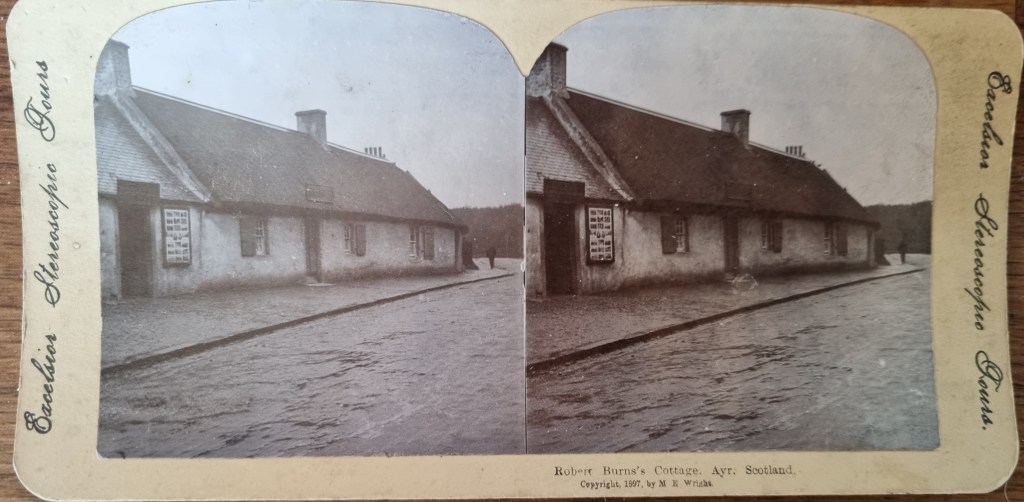
The cottage features in this stereoscopic view from 1897, part of my own collection of 3D stereocards that were popular with Victorian and Edwardian audiences.
Its publisher, Excelsior Stereoscopic Tours, was the brainchild of ‘M.E. Wright,’ who is credited as the image’s copyrightholder.
But who was ‘M.E. Wright,’ and how did Excelsior’s stereoviews become so popular that they feature today in museum and photography collections all over the world?
Milford Elsworth Wright was American, born in 1861 in Perry, Ohio, on the shores of Lake Erie. One of nine children, the 1880 US Census recorded him living in Perry with family members, including his twin Mildred, and working as a ‘farm labourer.’
Stereocard featuring the Wright family at their homestead in Perry, Ohio. Date unknown.
The story of how Milford became involved in stereo photography and developed a successful career in the ‘views’ business is one that I researched further after coming across him during work for my PhD.
During the 1880s, the firm of Underwood & Underwood (U&U) launched a successful business in Ottawa, Kansas, selling 3D stereocards and hand-held viewers door-to-door, state-to-state.
By the end of the decade, the Underwood brothers, Elmer and Bert, had developed plans to grow their stereo business beyond the United States.
It was a plan that led in time to U&U becoming one of the world’s most successful and influential photography firms.
The plan took a major step forward in 1890 when the company put together a team of salesmen to expand its operations into Europe and beyond.
One of those chosen to make the trip from New York across the Atlantic was Milford E. Wright.
Travelling with Bert Underwood and his wife Susie, the party’s destination was the bustling port city of Liverpool where an office was established in a house (since demolished) in Oxford Street in the Mount Pleasant district.
A flavour of the life of a U&U sales agent following that pioneering Liverpool trip is provided by one of Milford’s colleagues.
Writing later in a U&U company brochure, one JLD Chandler described earning upwards of $50 a month in sales commission, travelling through Belgium, Switzerland, Germany, Italy and France as well as to Palestine and Egypt.
Initially, Milford seems to have concentrated on selling stereocards to the UK market.
A few months after arriving in Britain, he was in Wales lodging with a family in Cardiff. The 1891 Census recorded his ‘profession or occupation’ as ‘sailor,’ though this may well have been a mishearing of the term ‘salesman.’
Like other U&U salesmen, Milford became an accomplished stereoscopic photographer himself. ‘Excelsior Stereoscopic Tours’ was the brand he used to market his 3D photographs such as that of Robert Burns’s Cottage.
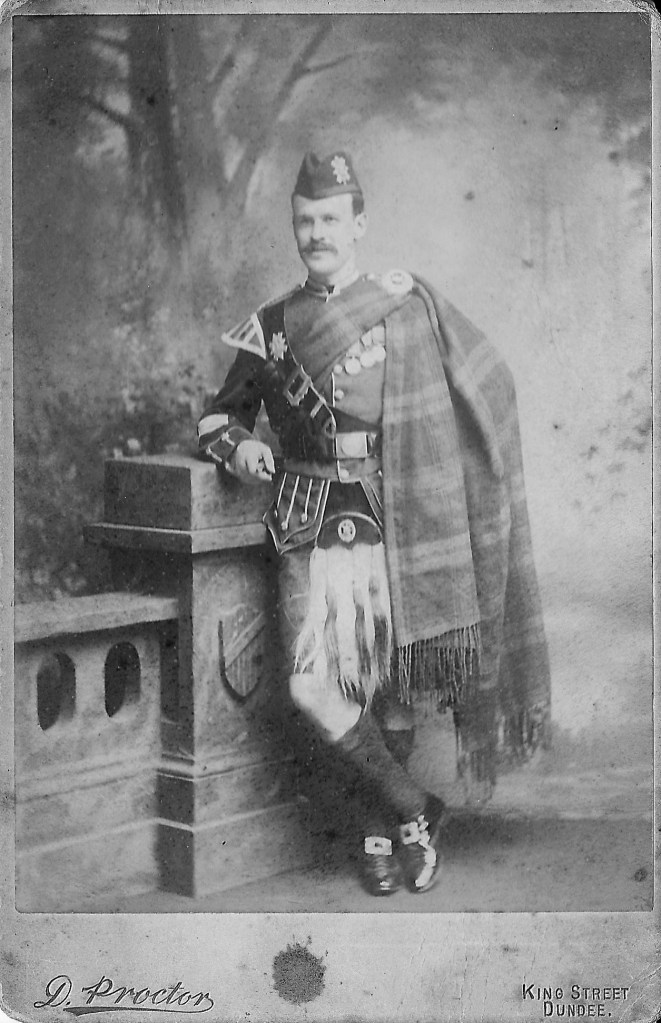
His exact movements during the 1890s are sketchy, but he made at least one return trip to the United States and a family photograph of him taken during this period suggests that he spent time in Scotland.
Milford E. Wright wearing a Highland outfit c. 1890s. By David Proctor of King Street, Dundee.
By the end of the decade, he had settled in the Lancashire mill town of Burnley where he had a photographic studio, and recorded his ‘profession or occupation’ as ‘publisher of stereo views’ in the 1901 Census.
The same year, he married Isabella Davidson from Alloa in Scotland and their growing family soon featured three sons and a daughter.
In contrast to international stereo companies like U&U, whose cards featured cities such as New York and London where they had offices, ‘Excelsior’ stereos featured the Wright family’s home address in Burnley.
With a growing family to provide for, Milford went on the road, selling his ‘Excelsior’ cards with stereoscopes manufactured by H.S. Walbridge & Co. of Bennington, Vermont.
Perhaps the highpoint of Milford’s stereo photography career came in May 1906 in Madrid when he captured the aftermath of an assassination attempt on King Alfonso XIII and Queen Victoria of Spain on their wedding day.
A bomb concealed in a bouquet of flowers was thrown at the couple’s carriage by an anarchist positioned at an upper-storey window.
Exploding in mid-air, it caused the deaths of more than 25 by-standers as well as horses taking part in the wedding procession.
In the immediate aftermath of the explosion, Milford took a sequence of images at the scene using his stereo camera and later produced as Excelsior cards.
These included the body of one of the horses lying in a pool of blood that was so graphic, I decided not to re-publish it here.
Instead, I’ve used another shot from the same sequence in which the horse’s body is visible through the legs of the mules in the foreground.
Despite its explicit nature, the dead horse image was reproduced in The Graphic (9th June 1906) by one of its special artists. The full-page illustration was accompanied by the credit ‘photographed by the Excelsior Stereoscopic Tours Company, Burnley.’
Another image from the wedding parade prior to the bomb going off also appeared, again reproduced by a Graphic artist, but was incorrectly credited to another company. A correction duly appeared in the following week’s edition.
While stereoscopy’s popularity began to wane in the years before the First World War, it seems Milford continued to be as photographically active as ever.
In February 1915 when he applied for a new passport at the US Embassy in London, he recorded his occupation as ‘photographer.’
An official noted on his form: ‘Applicant has identified himself many times at this embassy and has received several passports issued to him here.’
Milford E. Wright’s 1915 US passport photo.
When Milford died from the effects of flu and acute bronchitis in December 1918, aged 57, the Burnley Express headlined its report ‘Expert Photographer.’
It stated that ‘he had travelled to many remote places in the world, and his collection of stereoscopic views and lantern slides is a very remarkable one.’
If you have any more information about Milford E. Wright or have Excelsior Stereoscopic Tours cards in your photo collection, I’d be interested to hear from you via the comment box below.
* Thanks to Milford E. Wright’s family, notably his grandson John Milford Wright and great-grandson Edward Wright, for additional information and photographs.
* Update Monday 6th February 2023.
Readers will find responses to this blogpost via the British Photographic History website.
On this day in 1862, an accident at the Hartley Pit in Northumberland led to the deaths of 204 men and boys.
Around 11 o’clock in the morning, a wooden engine beam snapped sending more than 20 tons of winding gear and equipment down the shaft at the colliery about ten miles north-east of Newcastle-upon-Tyne.
Those working the coal seams below were effectively trapped and, despite heroic rescue efforts, died in the aftermath of the accident from a build-up of gas.
Following the tragedy, an Act of Parliament was passed requiring that, in future, no pit would rely on a single shaft as its only means of access.
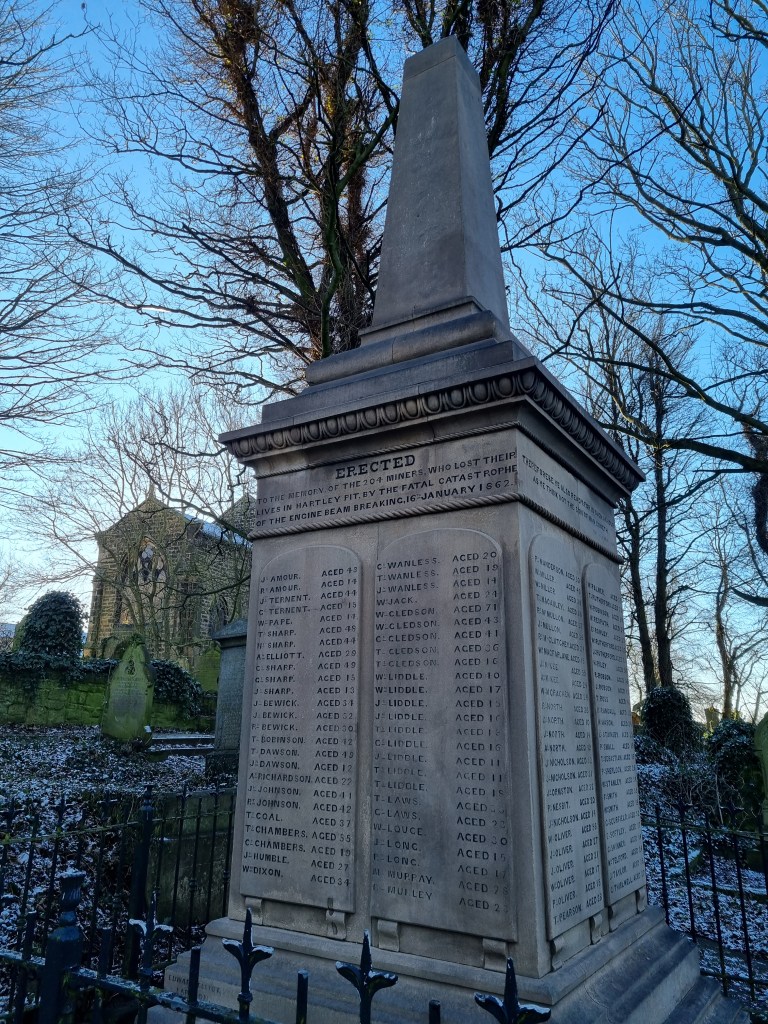
Hartley Pit Disaster Memorial, St. Alban’s churchyard, Earsdon. Photo taken by author 16th January 2023.
In terms of photographic history, the disaster was also significant.
This is graphically described and illustrated in Roger Taylor’s essay ‘The Hartley pit disaster, January 1862’ in Crown & Camera: The Royal Family and Photography 1842-1910 (London, Penguin Books, 1987), 60-63.
The article showcased a series of location photographs taken following the disaster by the firm of W. & D. Downey of Newcastle-upon-Tyne.
The photographs’ inclusion in the Royal Collection came about because the images were sent to Queen Victoria by the company.
The monarch was grieving following the death of her own husband Prince Albert a few weeks earlier, and she wrote to the pit owner, Charles Carr, expressing concern for the fate of the miners and their families.
Once the bodies of those involved were discovered, the Queen headed the list of subscribers to a public relief fund set up to support the women and orphans made destitute.
Today, Downey’s ‘Hartley Colliery’ photographs can be viewed on the Royal Collection website in an online version of its 1987 ‘Crown & Camera’ exhibition.
However, research for this blog raises a key question about the photographs: were they taken on 30th January 1862 as stated in the article and on the website?
The first photograph, measuring 8 inches by 6 inches, is a group shot (RCIN 2935021) featuring Charles Carr, the pit’s owner, its manager Joseph Humble, and master sinker William Coulson alongside other members of the rescue team.
Two further photographs, again 8″ x 6″, were taken of the pit-head ‘after the accident.’ The first (RCIN 2935024) features the letter ‘A’ visible above ‘the Engine House’ and figures arranged along a walkway.
The second pit-head view (RCIN 2935022) is accompanied by a handwritten note that uses the letters A-E to identify all the significant buildings and features of the landscape.
The note also states ‘photographed January 30th 1862 and most respectfully forwarded by W. & D. Downey.’
The dating of 30th January is one that I researched recently for a talk presented to the Royal Photographic Society Historical Group about the Downey company’s early years on Tyneside.
What I discovered from reading contemporary newspapers is that there is evidence that calls into question its accuracy.
Before looking at this evidence, how did Downey’s ‘Hartley pit disaster’ photographs come to be in the Royal Collection in the first place?
By way of background, W. & D. Downey, led by brothers William and Daniel, established its photographic business in and around the port of South Shields in the mid-1850s.
The company thrived and quickly established a reputation for high quality photographic portraits and as a supplier of news images to the illustrated press which appeared as engravings.
In October 1861, according to press reports, it opened its first ‘photographic rooms’ in Northumberland Street, Newcastle, several miles west from South Shields along the River Tyne.
It was a town-centre location that proved popular with ‘nobility, clergy and gentry.’
In January 1862, the firm began placing regular adverts in the Newcastle Daily Journal in a prized position on the front page at the top of the left-hand column.
This strategy made readers aware of its latest carte-de-visites portraits including ‘most of the public men of the north.’
It was a regular pattern that continued until Tuesday 28th January, twelve days after the disaster, when a marked change occurred in the advert’s wording.
Headed ‘The Hartley Colliery Calamity,’ it offered for sale ‘A Photographic View of the Engine-House, Machinery and Pit-Heap sent to any address, album size, for 13 Postage Stamps.’
The ad continued: ‘Those on a larger scale sent on receipt of 30 postage stamps by W. and D. Downey, 111 Northumberland Street, Newcastle-upon-Tyne. The above may also be obtained from Mr. John Mawson, 13 Mosley Street.’
Mawson was a successful chemist at the heart of Newcastle’s contribution to early photography and someone with whom Downey regularly collaborated.
Further down the same column, Mawson used one of his own regular ads in the paper to advertise a ‘photographic view of the engine-house and machinery.’ Indeed, it was one he had first placed there in the previous day’s paper.
The photographs on sale, as described by both Downey and Mawson, suggest they were the ‘after the accident’ images in the Royal Collection highlighted above.
The next day, Wednesday 29th January, the same Downey and Mawson ads re-appeared alongside one placed by another leading Newcastle photographer, ‘Mr. R. Turner of the Fine Arts Repository, Grey Street.’
His advert headed ‘The Heroes of Hartley! Preparing For Immediate Publication’ referenced the human-interest story at the heart of the disaster.
For 7 shillings and 6 pence, it promised ‘a large, beautiful photographic picture of Mr. William Coulson, Master Sinker, and his brave workmen, who so nobly risked their Lives in the perilous Shaft for Ten Successive Days and Nights, endeavouring to save the Two Hundred and Four poor Colliers buried alive in the New Hartley Pit, Jan. 16th, 1862.’
Unlike the group photo in the Royal Collection credited to Downey, there is no mention of Mr. Carr, the mine owner, and Mr. Humble, the pit manager.
Taken together, these adverts suggest that all the photographs being offered for sale were more likely to have been taken, not on Thursday 30th January, but earlier that week.
By that point, the bodies of those who died in the disaster had been successfully brought to the surface and funeral services for its 204 victims had taken place.
So by Monday 27th, for example, a photo-call involving the key participants with access to the pit-head would have been viable.
Such a revised timeline is supported by a brief report that appeared in the Newcastle Daily Journal on Friday 31st January.
On page 2, the paper reported in its news columns:
‘Messrs. W. and D. Downey, the justly celebrated photographers of 111, Northumberland Street, in this town, last night [my italics] received a letter from Sir Charles Phipps, Osborne, thanking them for forwarding to Her Majesty the photographic views of Hartley New Colliery, the scene of the late terrible catastrophe.’
Phipps, Queen Victoria’s private secretary, was writing from the Queen’s residence on the Isle of Wight where she had retreated following the death of Prince Albert.
If the report in the Newcastle Daily Journal is accurate and to fulfill the statement ‘photographed January 30th,’ the following sequence of events happened in the course of a single day.
* First, photographs were taken on location at the Hartley Colliery.
* Prints, made by Downey from its negatives, were then dispatched to the Isle of Wight more than 400 miles away.
* And Sir Charles Phipps’ letter of thanks not only reached Downey back in Newcastle, but its contents were communicated to the Newcastle Daily Journal before its presses rolled.
Even allowing for the speed and reliability of the Victorian postal service, this seems unlikely.
What then might explain the ‘photographed Jan 30th, 1862’ inscription attached to Downey’s photographs in the Royal Collection?
That is a question that you may wish to speculate upon in the ‘comment’ box below this post.
Certainly, by the following Monday, 3rd February, Downey’s regular advert in the Newcastle Daily Journal offered a new and more detailed sales pitch.
‘The Hartley Catastrophe. Now Ready. A Series of Photographs, illustrative of the above Sad Calamity, taken upon the Spot, by W. and D. Downey, Photographers, No. 111, Northumberland Street, Newcastle-upon-Tyne.’
The ad then listed a number of images.
‘No. 1. Photographic portraits of Mr. Coulson and his Heroic Band of Sinkers, preparing to descend the shaft.’
‘No. 2. Mr. Coulson.’
‘No. 3. Johnny, the Tally Boy.’ This may refer to a portrait of a 12 year-old boy named as ‘Mark Bell’ by the Newcastle Courant (news report, 31st January 1862). He helped identify the bodies as his job entailed handing a tally to each miner who descended the shaft and collecting it again at the end of the shift.
‘No. 4. A general view of the Pit, Machinery, &c.’
‘No. 5. The Broken Beam.’
Each photograph was priced at one shilling, 1s 6d, or five shillings for a larger size print that could be bought from either Downey or John Mawson as before.
Accounts of this episode elsewhere state that W. & D. Downey were commissioned by Queen Victoria to take the photographs they did.
I have found no evidence to support this idea.
Rather, the use of the wording ‘most respectfully forwarded by W. & D. Downey’ in the Royal Collection archive suggests that the firm followed its own instincts in response to the Queen’s evident interest in the tragedy.
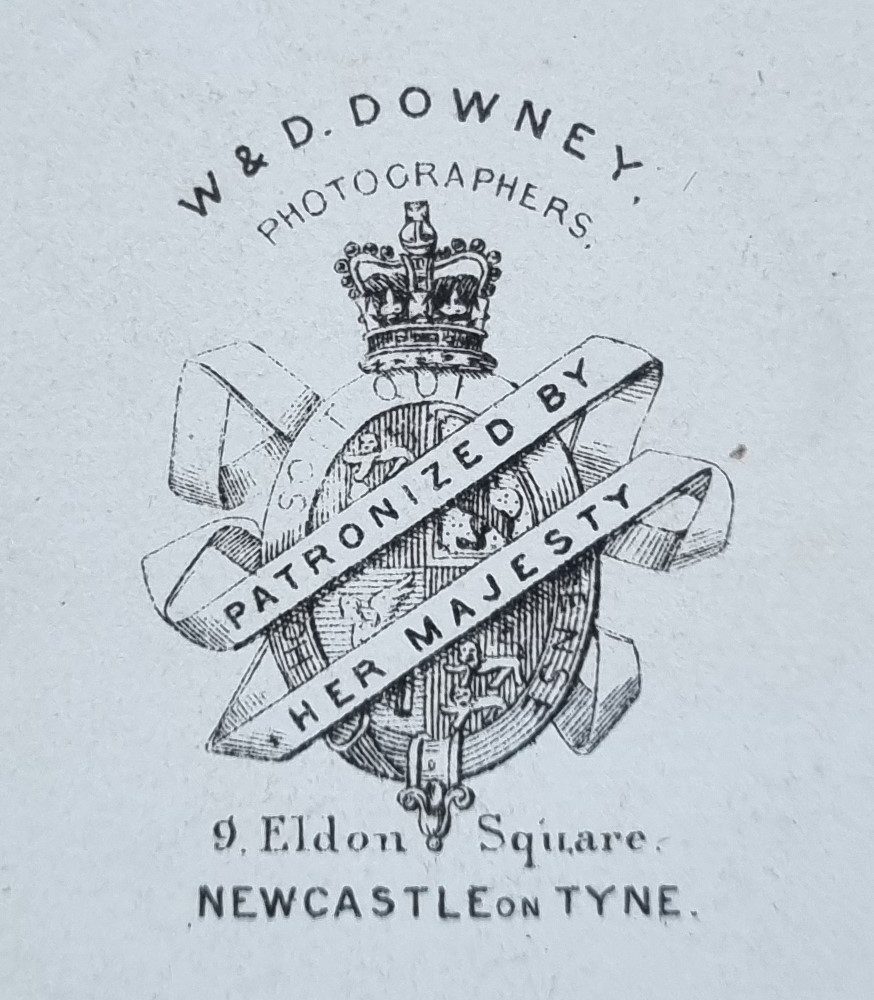
From a commercial viewpoint, it was soon able to use the slogan ‘Patronized By Her Majesty’ on the verso of its carte-de-visites whilst also promoting its new portrait rooms in Newcastle at 9 Eldon Square which opened in early March.
Given the wider public interest in the Hartley Pit disaster and the business opportunity foreseen by W. & D. Downey, it is intriguing to note that these celebrated photographs and larger size print versions referred to in this blogpost rarely appear for auction.
Perhaps they remain treasured momentos of those in the wider community of the North-East of England whose lives were so cruelly affected by events on that January day 161 years ago.
New Hartley Memorial Garden. Photo taken by author 16th January 2023.
The Christmas/New Year holiday offers an opportunity to enjoy another treasure from my recent visit to ‘Slightly Foxed,’ a second-hand bookshop in Berwick.
‘The Pickwick Papers’ is a Charles Dickens that I haven’t read before.
Apart from the brilliance of the writing and story-telling, the copy I bought (along with ‘The Picture Post Album’ – see December 15th, 2022 post) came with an instantly recognisable Quentin Blake cover.
‘The Pickwick Papers’ by Charles Dickens (Nelson Classics). Cover illustration by Quentin Blake c. 1971.
It dates from about 1971, the year Britain went decimal, as the price sticker has both 13 shillings and 65 pence.
Blake, now 90 and still active as an artist and illustrator, has an informative website that is well worth a visit.
A few years back, when I bought my first vintage stereocard 3D viewer, it came with a surprise.
Enclosed within the carefully-wrapped package from Germany was a set of 24 cards portraying ‘The Life of Christ.’
As a series of dramatised scenes from the Nativity to the Ascension, the set was published in the early 1900s by the stereoscopic photography company Underwood & Underwood of New York.
My subsequent interest in Underwood’s activities as a supplier of press photographs ‘taken from stereographs’ led to my doctoral thesis (due to be published in May 2023).
Each card comes with a text taken from The Bible, in this case the Gospel according to Luke, chapter 2 verse 16 – ‘And they went with haste, and found Mary and Joseph, and the babe lying in a manger’ (Revised Standard Version).
On the verso, there follows a brief description of the scene followed by the card’s title in English, French, German, Spanish, Swedish and Russian.
This gives an indication of the scope of the international market at which such stereocards were aimed.
It seems Underwood were not the only stereoscopic company marketing this 3D ‘Life of Christ’ at the turn of the 20th century, presumably because of its commercial appeal.
I’ve seen other examples of the same set including colourised versions and one marketed by Sears, Roebuck & Company, the American mail order giant.
Close inspection of the nativity scene in its half-stereo version adds to the mystery of what we are being invited to witness.
Is it a painted scene? Or were individually figures placed against a painted backdrop? Or is the tableau the result of a stereographer working with a cast of actors?
It was timely that ‘The Mystery of the Nativity’ (Sky Arts, 20th December 2022), presented by the art historian Waldemar Januszczak, helped shed light on the tradition of scenes depicting the birth of Jesus Christ.
What he ably demonstrated was how little the Bible has to say about events at Bethlehem and how much artists down the centuries have used their imagination to portray the Nativity.
That would help explain the presence in the Underwood stereo of the ‘girl, carrying a basket upon her head’ who, the verso text explains, is ‘an attendant bringing refreshments from the inn.’
If you know any more about the ‘Life of Christ’ stereocard set and its history, I for one would be very interested to learn more about it.
Amid the avalanche of news stories from the past week, there was one in particular that stood out for our family.
It involved Cambridge University PhD student Rishi Rajpopat, who attracted headlines worldwide for solving a grammatical puzzle that has long perplexed scholars of the ancient language of Sanskrit.
Earlier this year, it was Sanskrit that made an unexpected appearance while I was researching a film, commissioned by the Royal Photographic Society, marking the 150th birthday of Percy R. Salmon, FRPS.
As a teenager in the 1880s, Salmon served for several years on the domestic staff of Professor E.B. (Edward Byles) Cowell, Cambridge University’s first Professor of Sanskrit.
The 1891 UK Census records that Salmon, my wife’s great-great-uncle, had risen to the rank of ‘footman.’
He left the city soon afterwards and embarked on a long and successful career as a photographer, journalist and author.
Sadly, our research failed to shed any further light on the working relationship between Messrs. Salmon and Cowell.
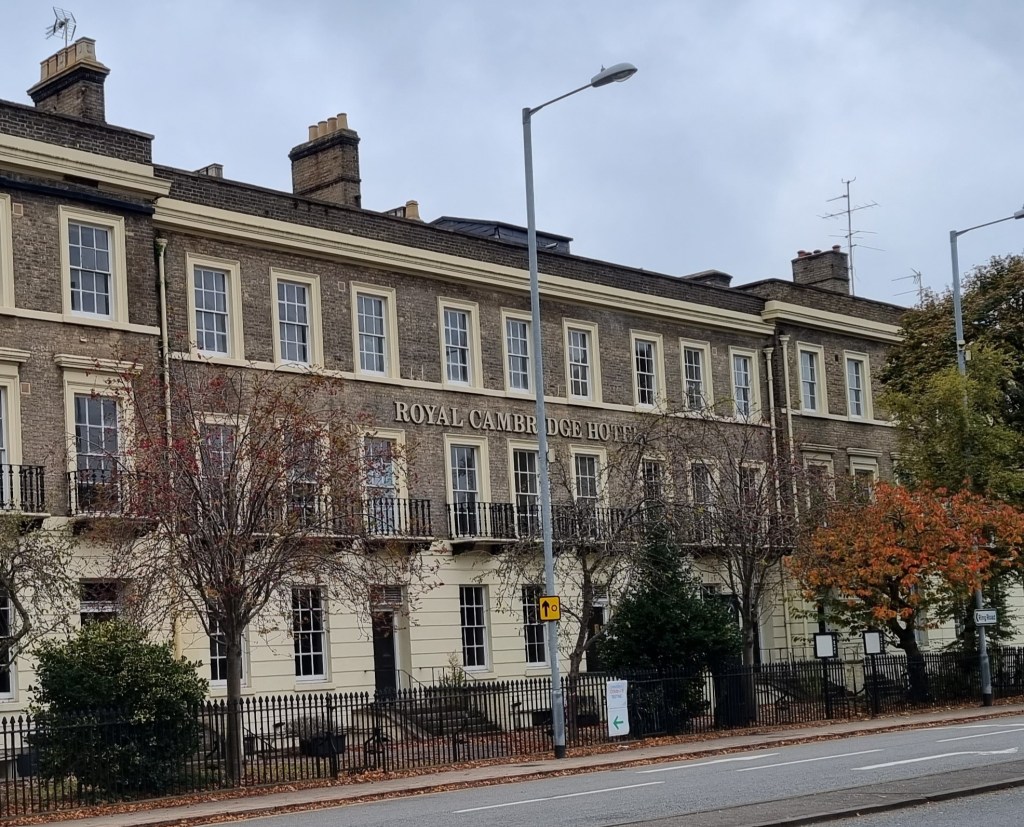
However, we did make a pilgrimage to Scroope Terrace, a grade 2 listed terrace of Cambridge townhouses, where Cowell lived as a Fellow of Corpus Christi College.
Scroope Terrace, Cambridge (formerly the Royal Cambridge Hotel). Photograph by author November 2021.
Though the house numbering system may have changed in the years since Prof. Cowell lived at number 10, counting the surviving doors along the terrace brings you to this section of the terrace.
(Possibly) 10 Scroope Terrace, Cambridge. Photograph by author November 2021.
It gives an idea of the elegant and grand circumstances in which Prof. Cowell lived as a Cambridge don and the location of Percy R. Salmon’s working life as a young man.
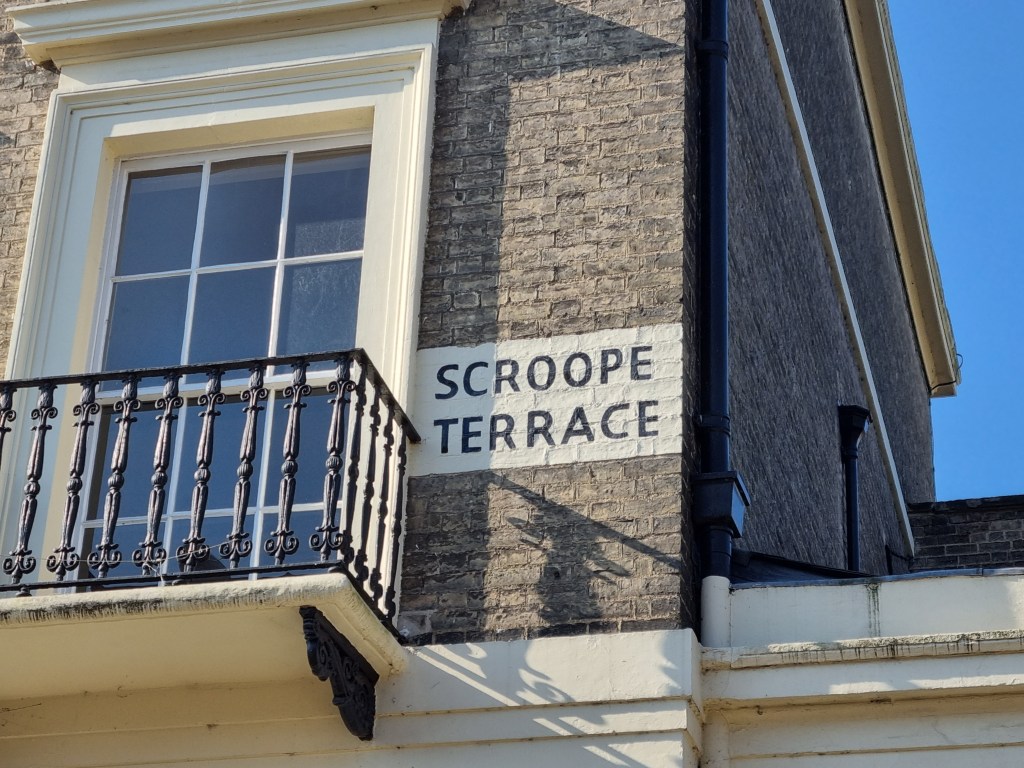
Street sign for Scroope Terrace, Cambridge. Photograph by author March 2022.
The RPS film about Percy R. Salmon’s life contains a section covering his time in Cambridge (beginning at 2.38).
A Royal Photographic Society film to mark the 150th birthday of Percy R. Salmon, FRPS (1872-1959).
The ‘Photography’ sections of second-hand bookshops are usually confined to just a couple of shelves.
But it never ceases to amaze me what can be purchased for just a few pounds.
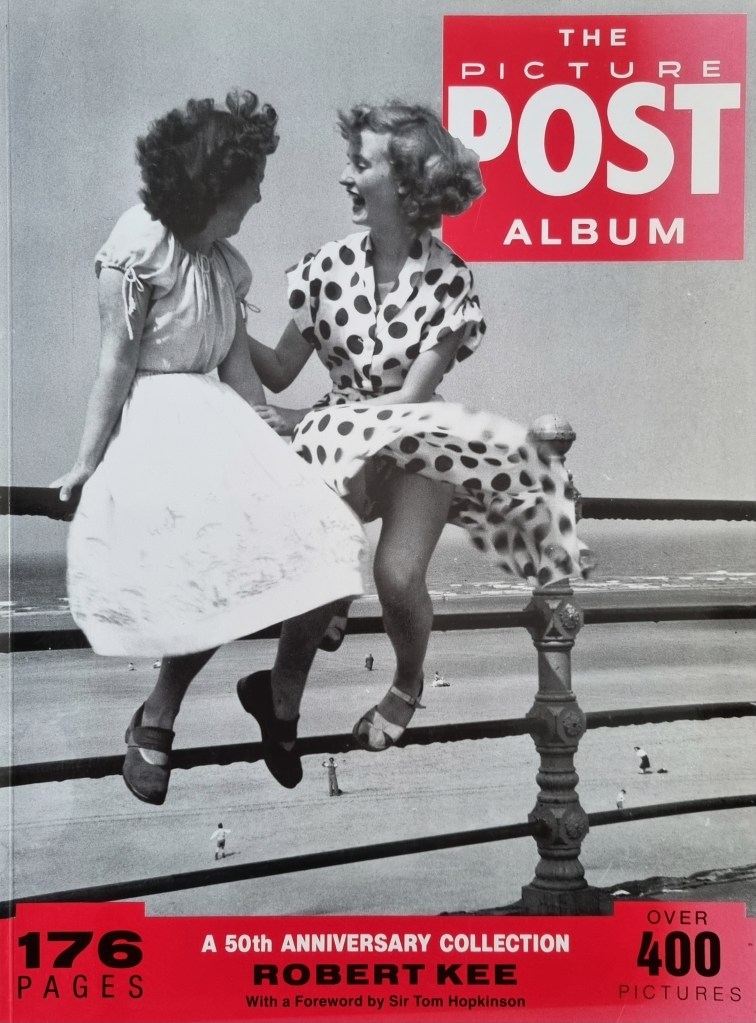
So you can imagine my excitement when a pre-Christmas explore of the wonderfully-named (and wonderful) ‘Slightly Foxed’ in Berwick upon Tweed yielded this title.
The Picture Post Album: A 50th Anniversary Collection by Robert Kee first published in 1989.
Not only that, but there was a choice of copies as two had found their way to the shop.
As a former newspaper journalist and someone interested in the history of press photography, I’m looking forward to curling up with my newly-acquired purchase.
An illustrated talk that I presented recently for the Royal Photographic Society’s Historical Group set me thinking about one image in particular.
The subject of the talk was the photography firm of W. & D. Downey and its first decade in the North-East of England in the 1850s and 1860s.
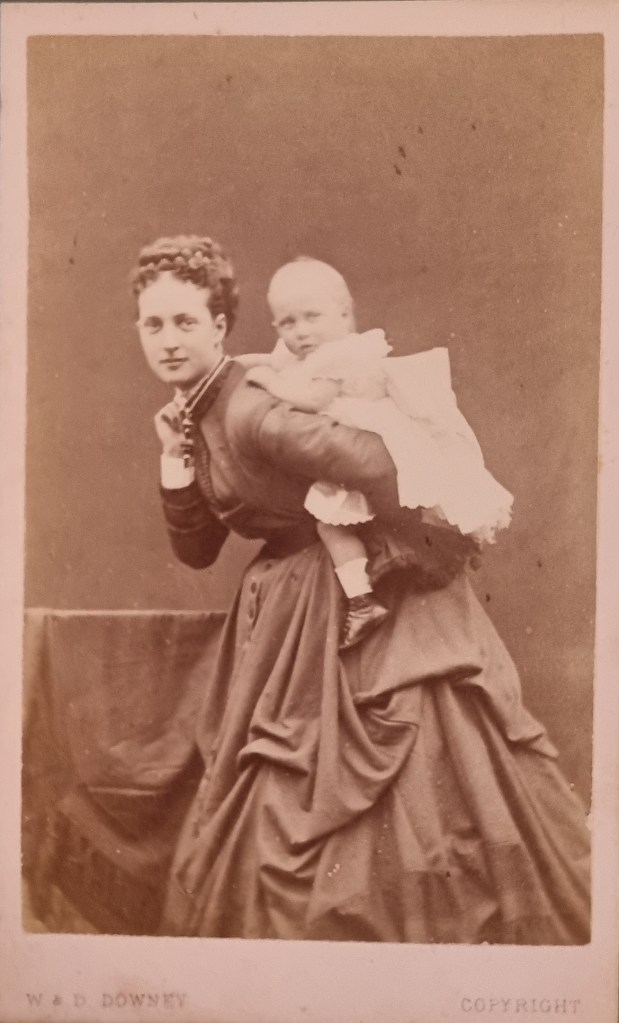
Downey’s celebrated image of Alexandra as Princess of Wales carrying her daughter Louise on her back featured in an earlier post (2nd December 2022).
In the past year, I’ve started collecting Downey carte-de-visites. Such was their ubiquity that many thousands are still in circulation.
The carte-de-visite format appeared in the late-1850s and immediately proved popular with the public.
Aside from its affordability, a carte-de-visite by design nestles conveniently in the palm of your hand
As the talk took place at Newcastle Cathedral, I was pleased to track down a card that featured the building’s distinctive ‘lantern tower’ and then included it in my presentation.
Confusingly though, at some point in its life, an unknown hand has written ‘St Peters’ in pencil on the front of the card, a point that members of my North-East audience were quick to point out.
In fact, the cathedral’s patron saint is St. Nicholas and not St. Peter.
However, that’s not the only aspect of the photograph that prompted a little head scratching.
When you turn the card over (to its ‘verso’), it lists ‘W. & D. Downey. Photographers’ as being based at ‘4 Eldon Square, Newcastle on Tyne.’
As proclaimed in regular adverts for its wares in the local press, the company’s studio in the city from 1862 to the late 1880s was at 9 Eldon Square rather than at number 4.
What then might be the explanation for this apparent anomaly?
Eldon Square, a group of impressive townhouses created by the eminent architect John Dobson between 1825 and 1831, became one of the most fashionable addresses in Newcastle by the mid-19th century.
Public records reveal that 4 Eldon Square was home to one ‘Thomas Humble MD,’ a physician who features in both the 1861 and 1871 censuses for that address.
According to a notice he placed in the Newcastle Courant (1st March 1867), Dr. Humble served the Newcastle Dispensary, a medical charity treating the city’s poor and destitute, for nearly 38 years. He was resigning the position, he said, due to his ‘increasing engagements.’
Given this background, is it possible that he needed to let out rooms to his photographer neighbour to earn additional income?
Downey’s photographic business was certainly booming and extra capacity to accommodate its growing clientele may well have been welcome, if only on a temporary basis.
This scenario is partly supported by other information on the card’s verso.
It lists ‘illustrious and eminent persons’ the firm had photographed including Her Majesty Queen Victoria.
This dates the card’s likely production to late 1866/early 1867 by which point Downey had recently photographed the Queen at Balmoral for the first time.
On the other hand, human error might have been responsible.
Simply put, a batch of carte-de-visite produced for Downey were printed with the wrong address featuring number 4 rather than number 9 Eldon Square.
Despite this error, they were used anyway and sold to a public whose main interest lay in a carte-de-visite photograph rather than its ‘advert’ verso.
There is one remaining possibility though and one that needs to be considered by collectors of all kinds of objects.
That the card is a fake.
If so, it’s a very convincing one.
The faker has even gone to the trouble of attaching a sales sticker for Allan, a bookseller, stationer and news agent in 1860s Newcastle, known to have been one of Downey’s sales outlets.
Alexandra – Britain’s Queen of Hearts, a 70-minute documentary broadcast this week in the UK on Channel 5, was a veritable feast for photohistorians.
The programme featured photo after photo of the woman who was Princess of Wales from 1863 to 1901 and then Queen Consort to her husband as King Edward VII during his 9-year reign.
Various eminent royal historians made a persuasive case for Alexandra, now a largely forgotten figure, creating the template for the royal women who followed in her footsteps.
They included subsequent Princesses of Wales such as Diana and Kate as well as Sophie, Countess of Wessex.
As the documentary’s photographic riches revealed, photographers clearly adored Alexandra as a subject and the camera loved her in return.
But given its role in both her story and that of photographic history, it is surprising that one photograph in particular did not feature.
In September 1868, the firm of W. & D. Downey of Newcastle-on-Tyne photographed Alexandra carrying her baby daughter, Princess Louise, on her back.
According to Frances Dimond’s Developing the Picture: Queen Alexandra and the Art of Photography (Royal Collection Publications, 2004), the informal pose was unusual, especially for a member of the royal family.
Dimond argues it was designed to show that the then Princess of Wales had made a good recovery from a long illness caused by a severe attack of rheumatic fever.
When made available to the public, the ‘mother and baby’ photo proved a popular seller, clocking up reported sales of around 300,000 making it among the best-selling carte-de-visite of the era.
Given its widespread circulation, the card features occasionally on Ebay.
Recently, I was able to purchase one for just a few pounds (rather than the tens or hundreds as is sometimes requested by sellers around the world).
This was largely because the seller had described the item as ‘woman with baby on her back.’
It was a transaction that rather underlined the fact that Alexandra, once one of the most famous women in the world thanks to photography, is less recognised in the 21st century.
Documentaries such as Channel 5’s may help rectify that situation.
It’s curious though that the ‘screen grab’ advertising the programme on the channel’s My5 site features what appears to be a shot of Princess Alexandra of Kent, a cousin of the late Queen Elizabeth II.













Leave a Reply