Photohistory research often resembles a large jigsaw puzzle in which the pieces are randomly scattered around the world
It’s then the researcher’s job to try and locate pieces that have survived the passage of time and reassemble what remains of the puzzle until some sort of understandable picture emerges.
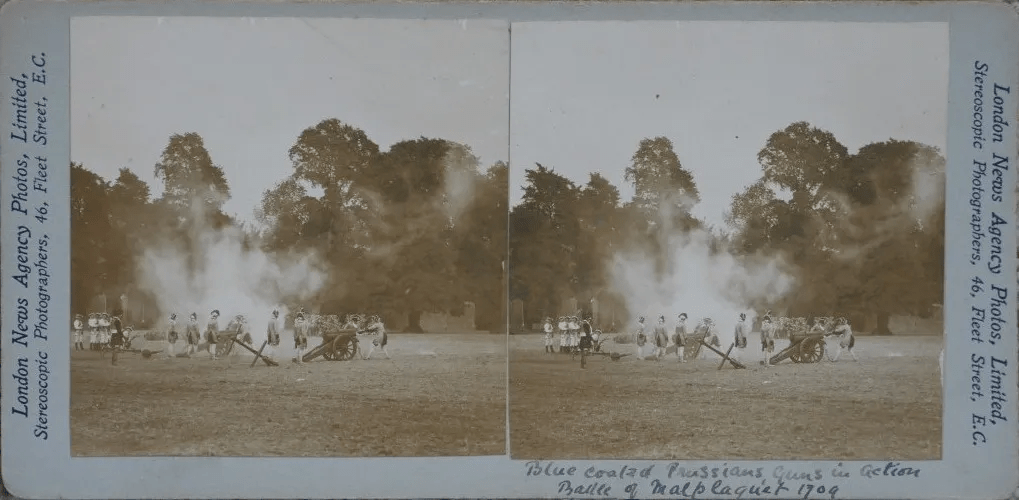
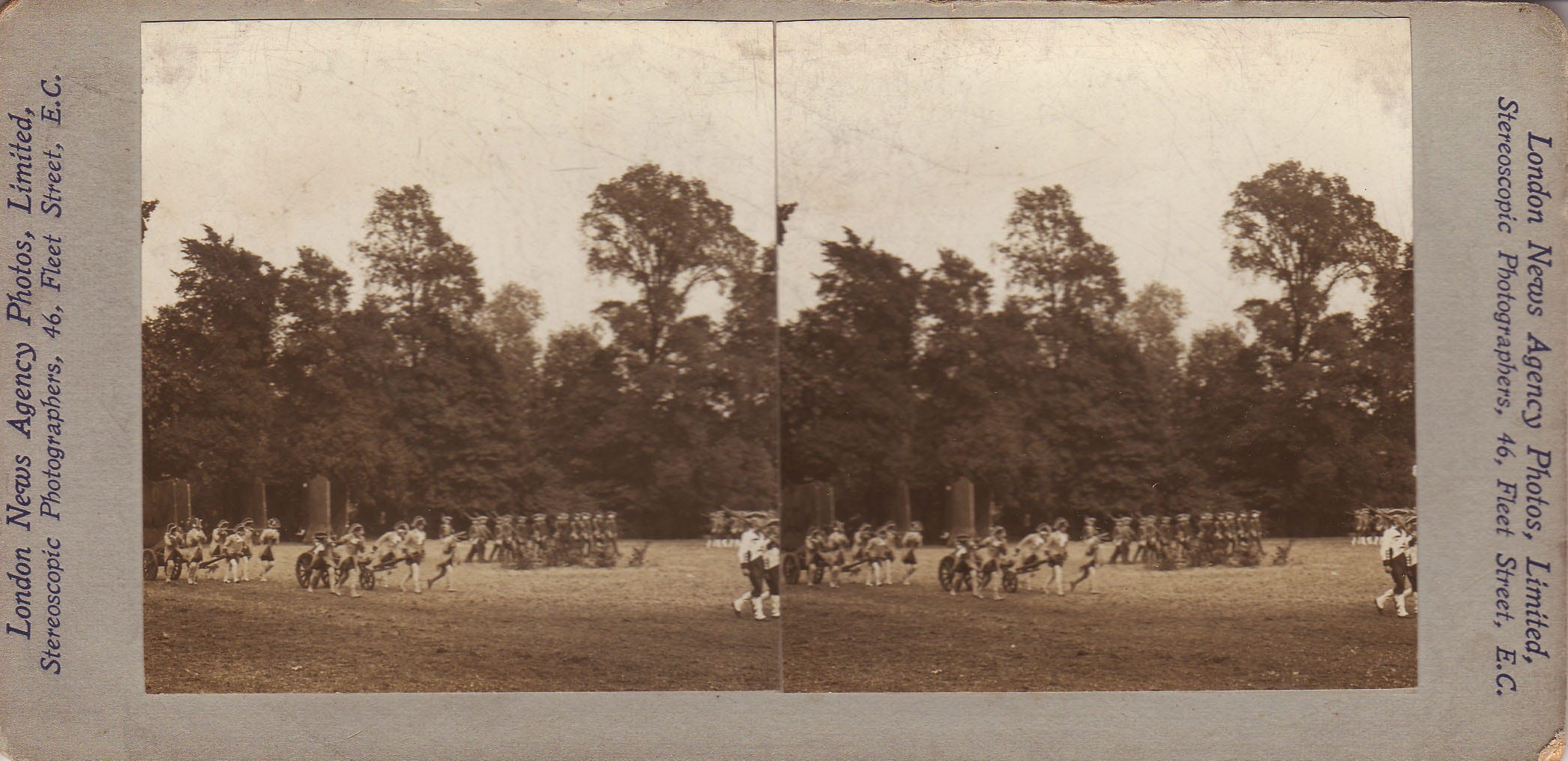
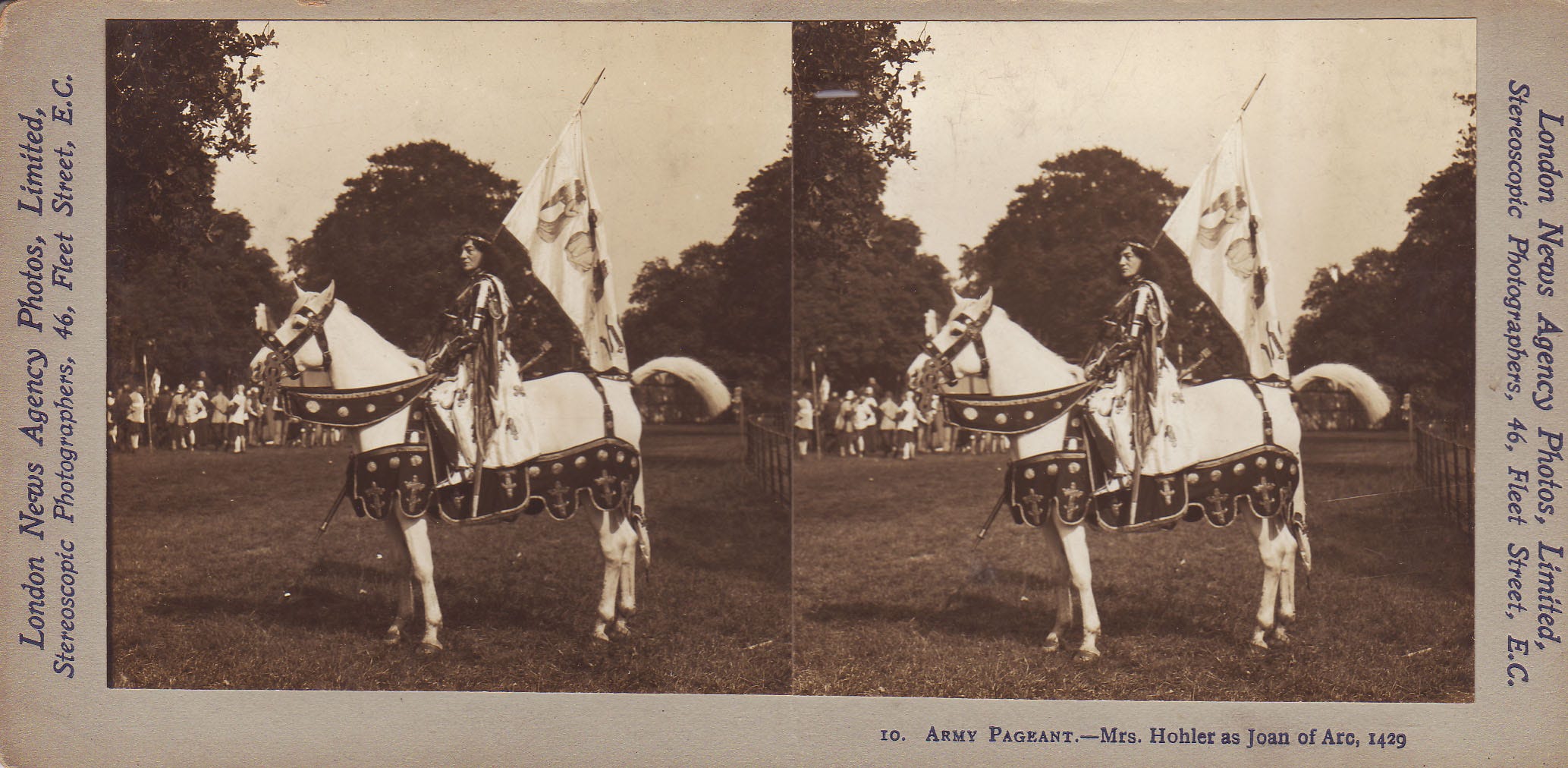
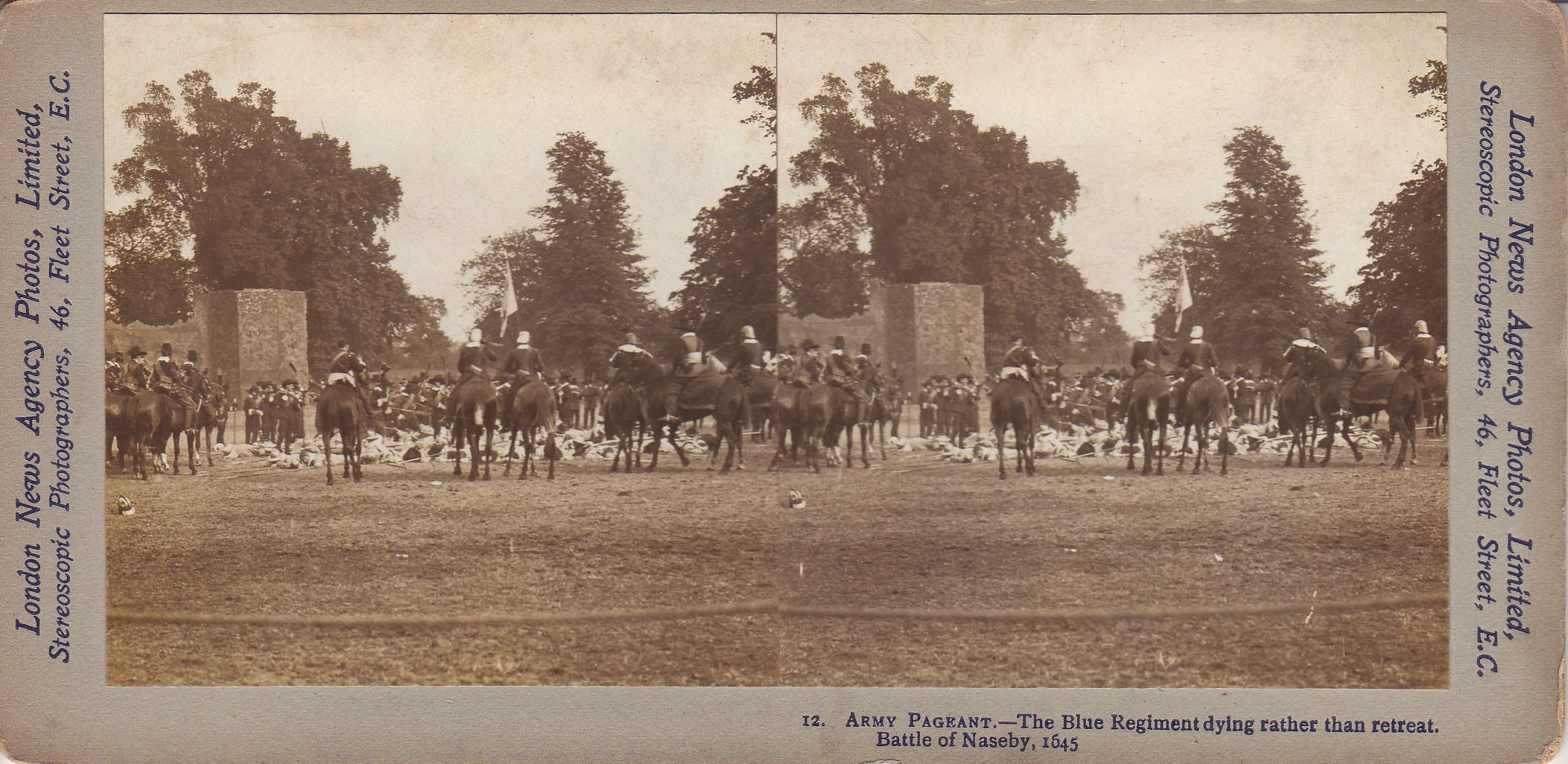
Nearly two years have passed since a couple of 3D stereoscopic images produced by London News Agency Photos (LNA) of 46 Fleet Street came to my attention on a well-known online auction site.
At the time, I made a case for the stereos taken at the 1910 Army Pageant at Fulham Palace being the work of early press photographer James Edward Ellam (1857-1920) whose career I continue to explore.
Then out of the blue, a recent email exchange with Julie Gibb from National Museums Scotland yielded yet more pieces of this particular jigsaw.
She curates the Bernard Howarth-Loomes Collection of around 11,000 stereos.
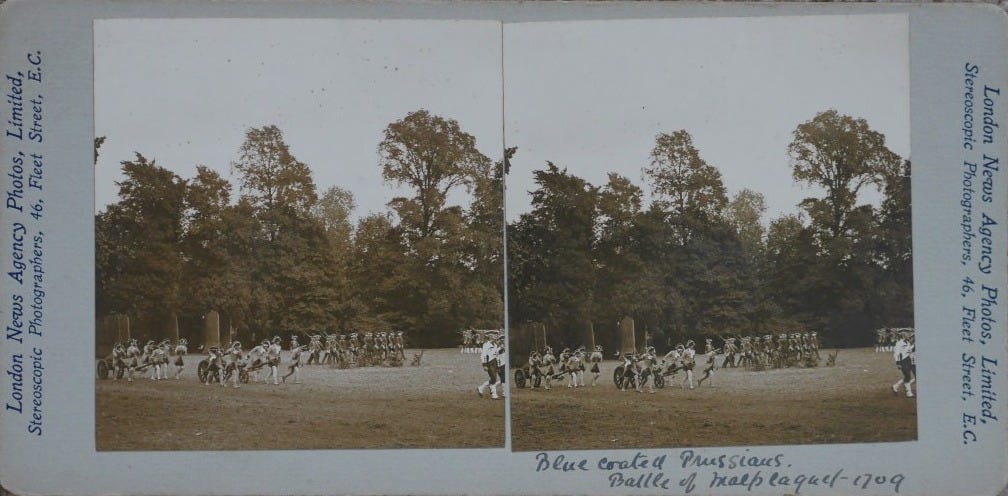
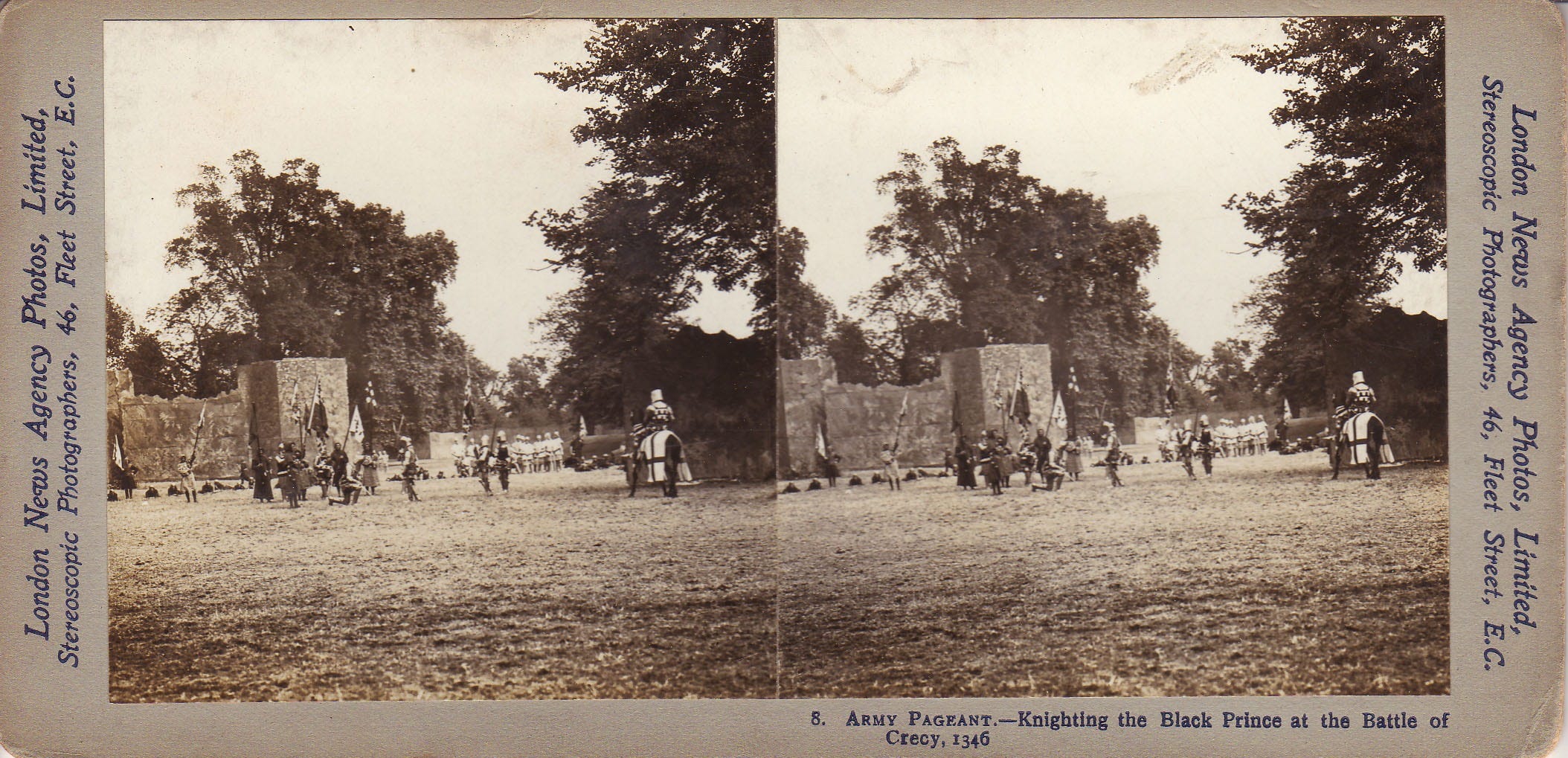
Unbeknownst to me, it included a set of five featuring the self-same 1910 Army Pageant and also published by London News Agency Photos
What was more exciting was that one of the Bernard Howarth-Loomes images matched the second one that that I obtained from Ebay in 2024 minus its handwritten caption as supplied by JE Ellam.
What is apparent from the further four LNA stereos in the Bernard Howarth-Loomes Collection is that they were published as a commercial set complete with printed captions.
This echoes the approach taken during the same era by Underwood & Underwood, a fellow stereoscopic photography company with a London office near Fleet Street.
Like LNA, they too published sets of stereocards featuring news events and supplied the images from the same assignment to newspapers and magazines.
To complete the picture, James Edward Ellam worked for the Underwood company for a decade from 1897 before joining London News Agency Photos after it began life in 1908.
These new LNA stereos featuring the 1910 Army Pageant add further weight to the case for them being Ellam’s work.
My thanks to Julie Gibb for permission to reproduce the following LNA stereos from the Bernard Howarth-Loomes Collection in this blogpost.
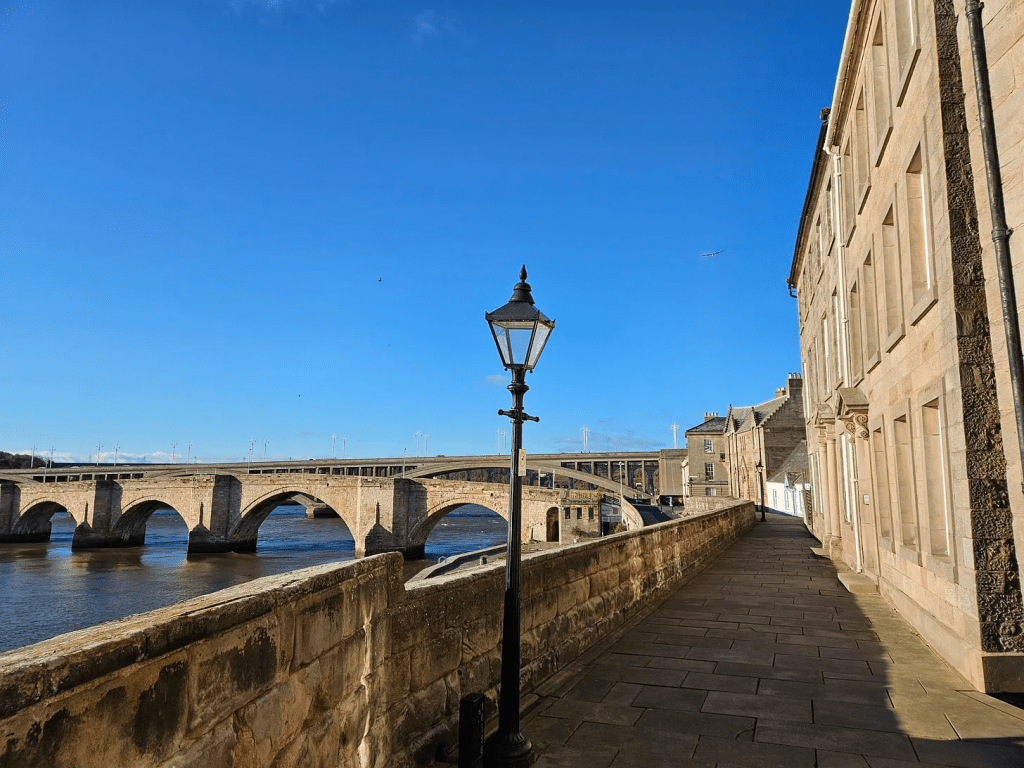
The Border town of Berwick-upon-Tweed in Northumberland has a number of claims to fame including its location as the most northerly in England.
On the banks of the River Tweed within sight of the border with Scotland, Berwick has an historic atmosphere and features an array of wonderful old buildings and structures.
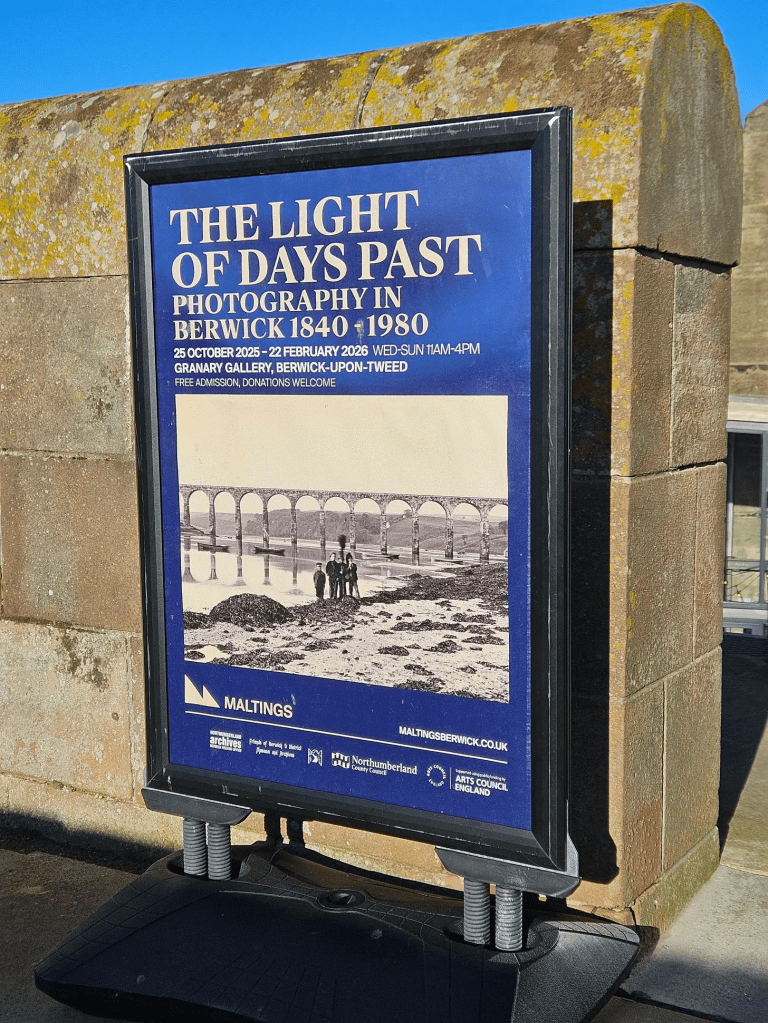
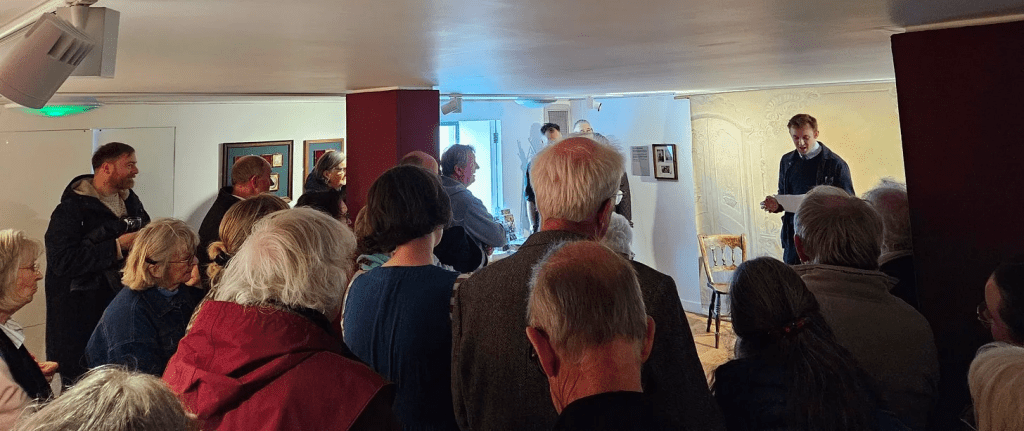
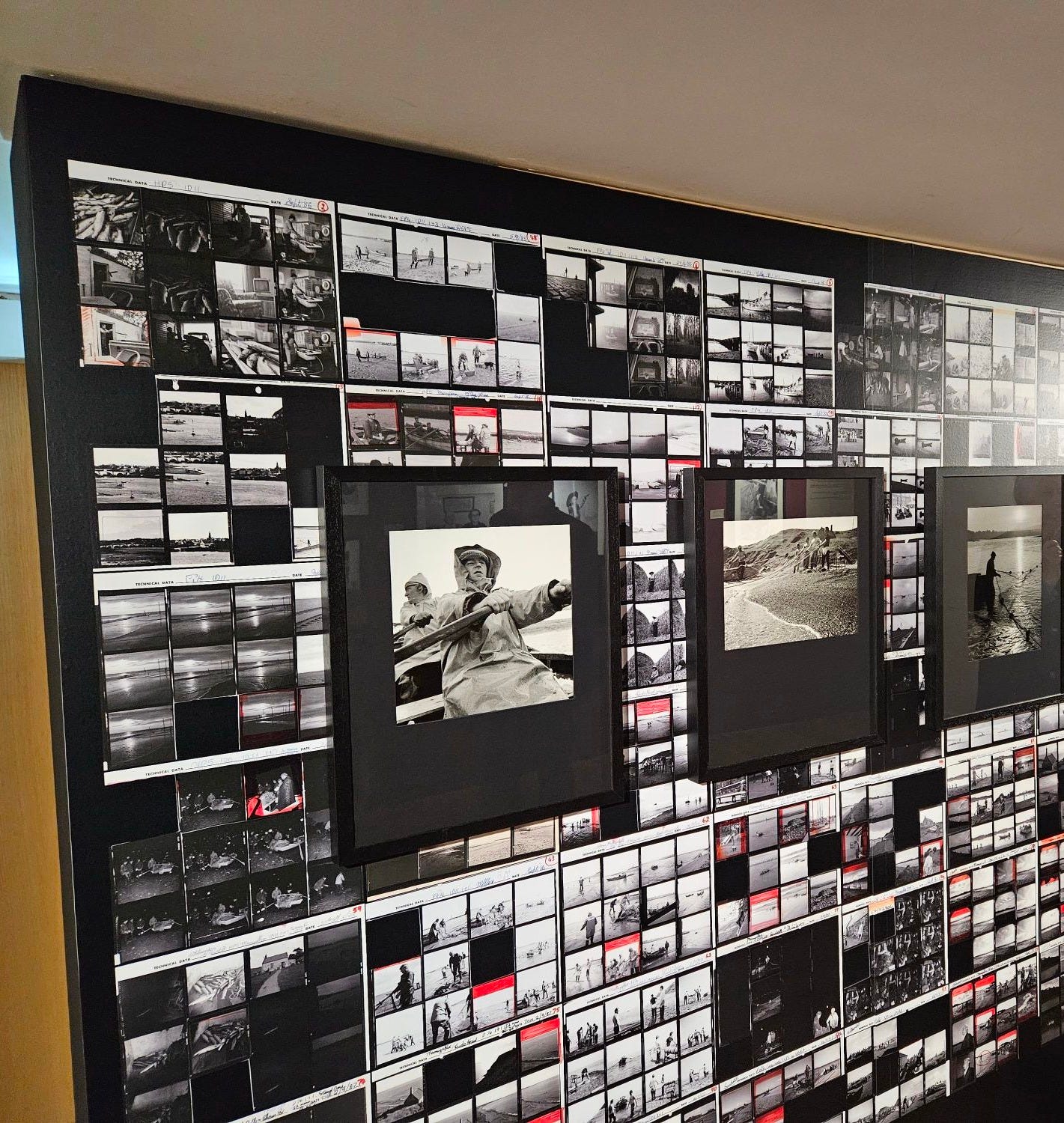
Curated by Cameron Robertson of the Berwick Record Office, the gallery was packed for an exhibition preview I was delighted to attend.
Cameron Robertson (right) at The Days of Light Past exhibition preview. 25th October 2025.
Among its many highlights, the exhibition uses an impressive range of visuals to explore nearly a century and a half of photohistory.
The story starts in August 1839 with the town’s specific inclusion in the first England and Wales patent licence for Louis Daguerre’s new daguerreotype process.
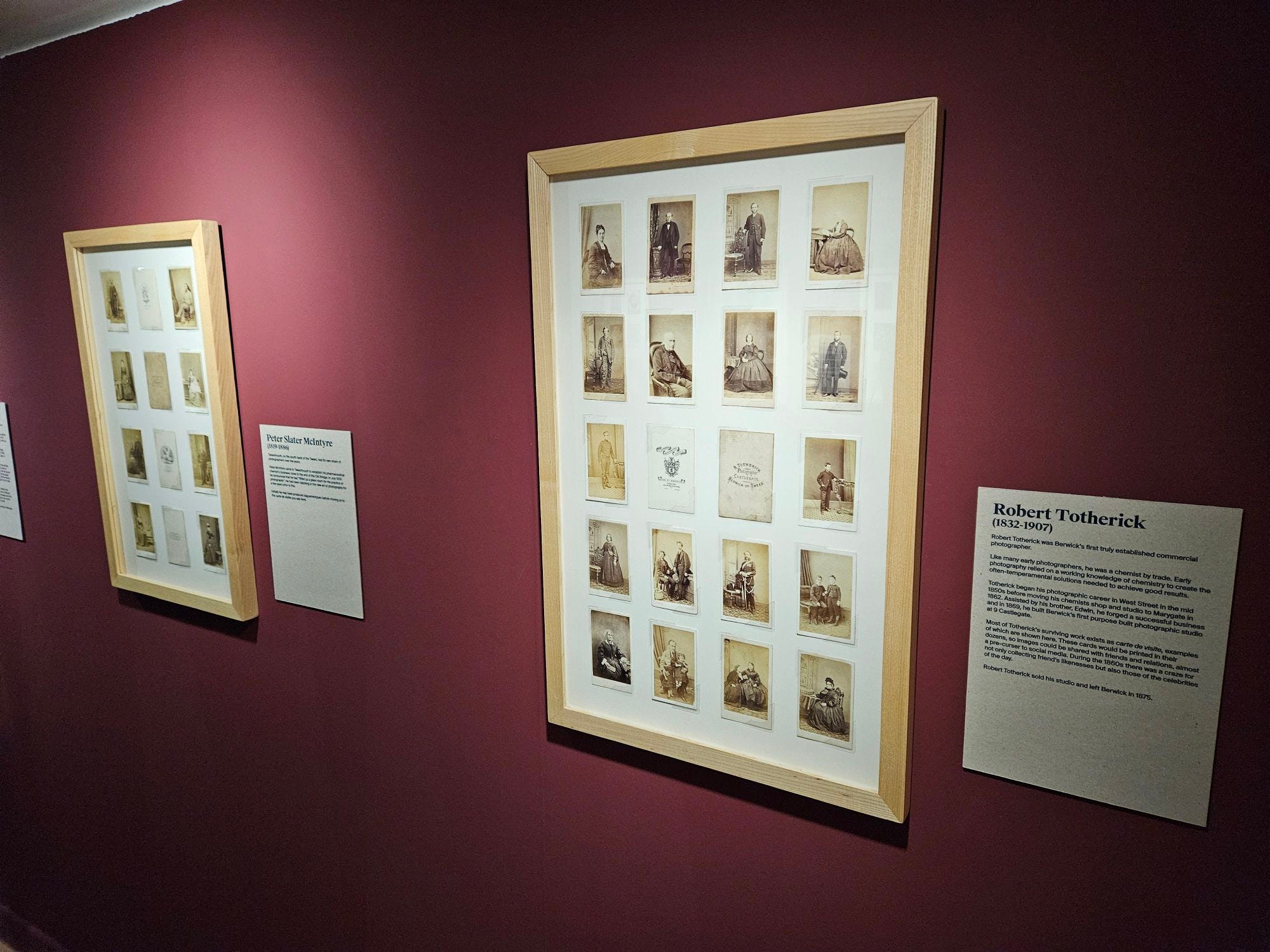
Berwick’s first commercial photography studio followed a decade later and the stories of various pioneers are celebrated in display cases of the carte-de-visites they sold by the thousand.
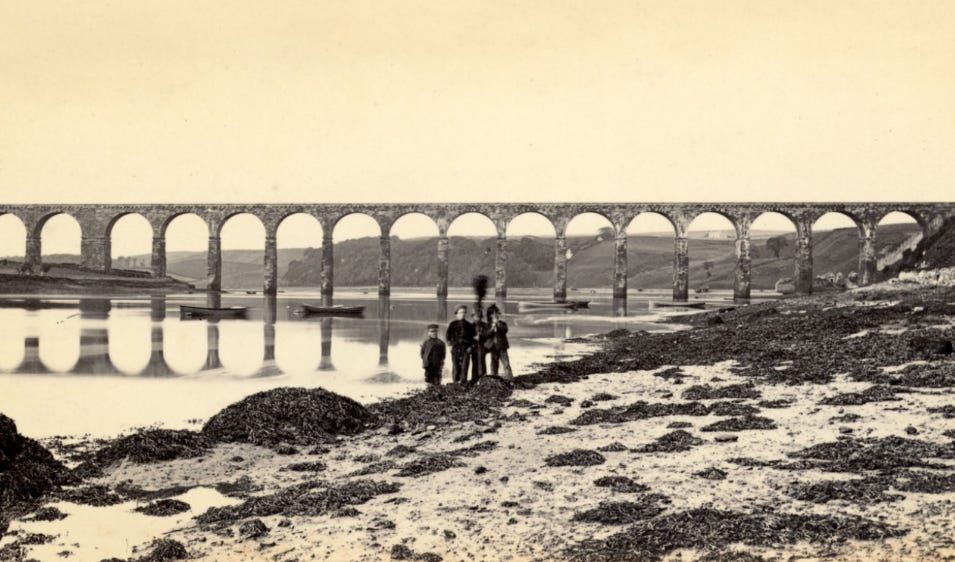
Among the most eye-catching photographs are a selection taken during the mid-late 19th century and blown up in size so their details can be fully enjoyed.
These include a striking image used in the exhibition poster of a group of boys pictured in front of the Royal Border Bridge that carries the East Coast railway line across the River Tweed.
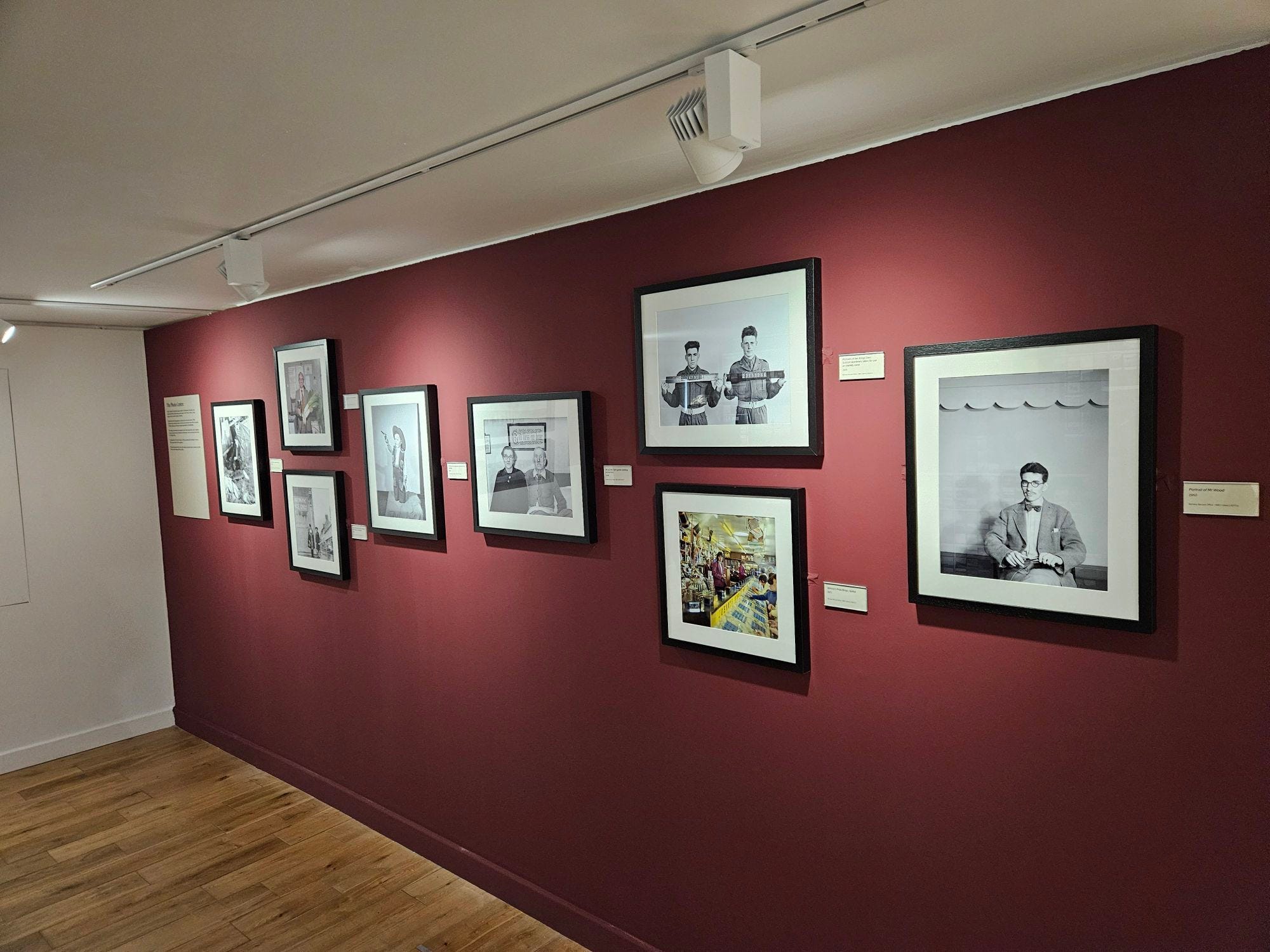
Like many towns across Britain, Berwick and its day-to-day life was later captured photographically by both press photographers and photo agencies.
A selection of these mid-20th century portraits transcend their origins and testify to the skill and artistry of the photographers involved.
It was also a treat to see a display of photographs and contact sheets by the late Jim Walker FRPS, who portrayed the salmon fishing industry on the Tweed.
If you’re in the vicinity, a visit to The Light of Days Past comes highly recommended (Wednesday – Sunday, 11am – 4pm until 22nd February 2026). Admission is free though donations are welcome.
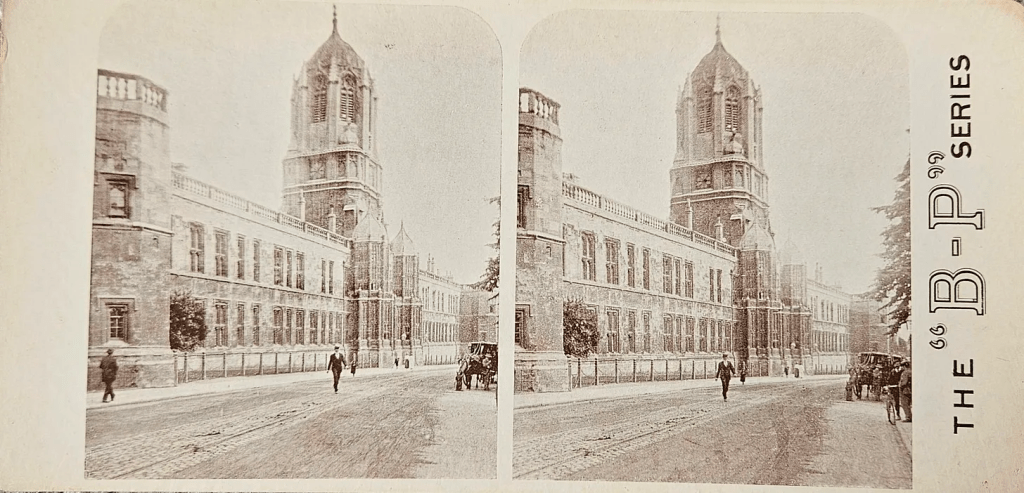
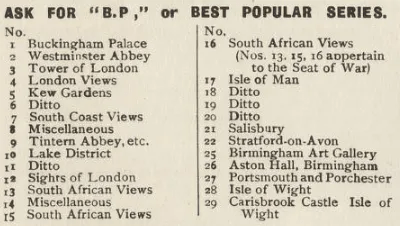
Who, it asked, was behind this ambitious photographic enterprise; one that offered 3D views in sets of 12 taken around England and the Isle of Man complete with pocket viewer?
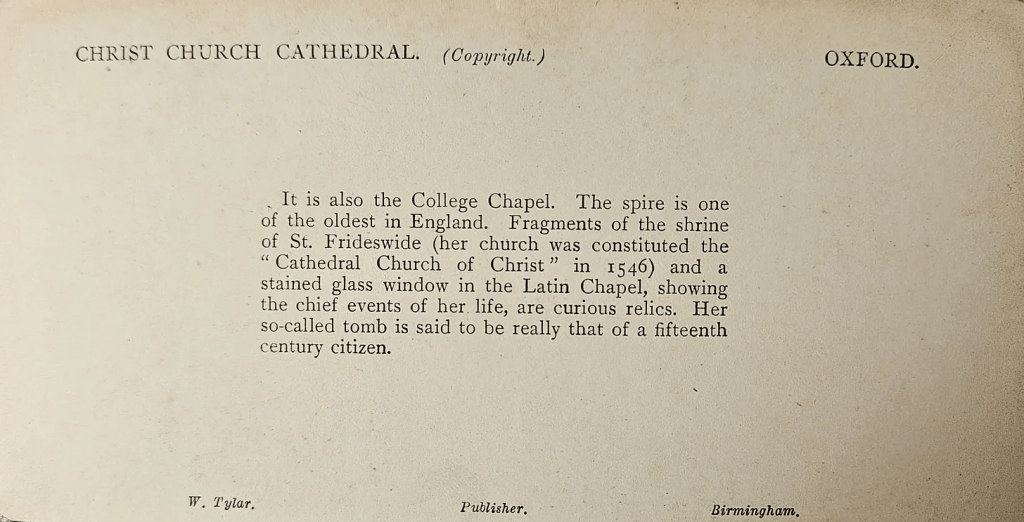
The answer was revealed at the bottom of the verso of the featured cards: ‘W. Tylar, Publisher, Birmingham.’
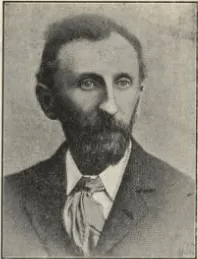
William Tylar (1859-1929) was born in Lincolnshire and by his early twenties was working as a photographer in Birmingham.
William Tylar (1859-1929). Courtesy of the British Library.
By the 1890s, he had established a thriving business in the Aston district of the city that specialised in inventing and supplying photographic equipment.
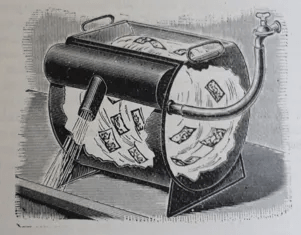
A typical example was Tylar’s P.O.P Washer described in 1896 by the British Journal of Photography as “a thoroughly useful and efficacious addition to the amateur’s outfit.”
From British Journal of Photography (3rd April 1896). Courtesy of the British Library.
The following year, Tylar copyrighted several photographs taken in and around Oxford and the River Thames.
This suggests that his “B-P” stereo series may have been just one of his commercial photography spin-offs.
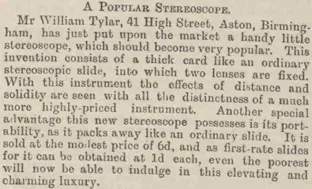
Tylar also had an entrepreneur’s instinct for publicity and “a popular stereoscope” he invented attracted attention from the national press.
The People’s Friend (8th January 1900). From British Newspaper Archive.
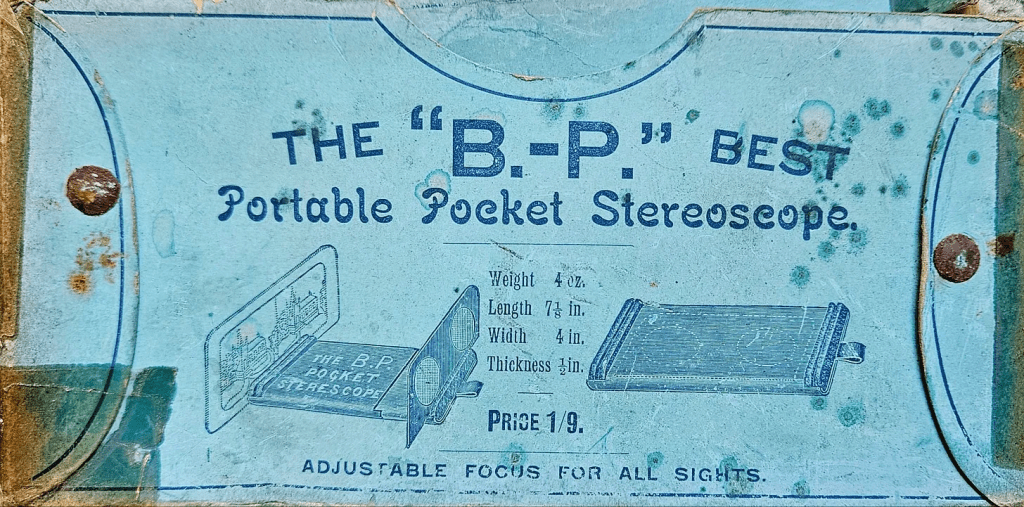
This would appear to be the forerunner of a more sophisticated and expensive version of his invention that later accompanied his “B-P” Series of stereo views.
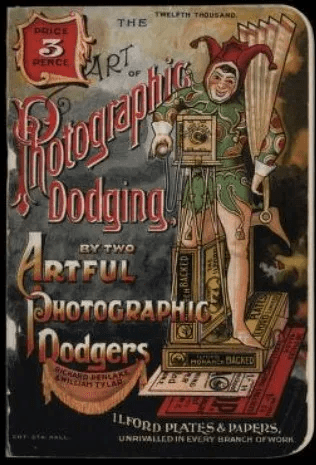
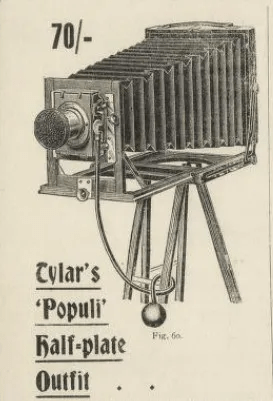
Early in the 20th century, a showcase for William Tylar’s business was published as The Art of Photographic Dodging with its eye-catching front cover advertising Ilford Plates and Papers.
Courtesy of the Bodleian Library, Oxford.
Co-author Richard Penlake will be known to regular readers of this blog as the pen-name of Percy R. Salmon FRPS (1872-1959).
A respected author of several books aimed at amateurs photographers, Salmon was editor of the weekly paper Photographic News between 1901 and 1905.
Rather wonderfully, The Art of Photographic Dodging has been digitised by the Getty Research Institute.
A glimpse inside reveals “Tylar’s tit-bits to tyros turning their troubles to triumphs : tested tips tersely told” alongside nearly 70 pages of advertisements extolling the virtues of his many and varied products.
One of the ads also reveals that sets of 12 “B-P” stereoscopic views cost one shilling and sixpence and that “B-P” stood for ‘Best Popular.’
However, as is sometimes the case with photographers and photographic businesses highlighted by Pressphotoman, Tylar’s fortunes took a downward path.
In 1907, failing health led him to convert his business into a private limited company.
This offered an opportunity to his employees as well as friends and customers to purchase shares in it.
Sadly for him, this idea failed to take flight.
Instead, in June 1908, his company secretary, a Mr. J. T. Roberts, was arrested by police after forging a series of cheques signed by Tylar as the company’s managing director.
Over a six month period, Roberts, a previously trusted employee, drew around £80 (over £8,000 in today’s money) from the company’s bank account. He was jailed for six months with hard labour.
Birmingham Daily Mail (2nd June 1909). From British Newspaper Archive.
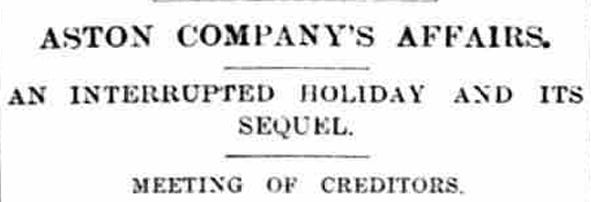
In August 1909, a few months after Roberts was imprisoned, a creditors meeting of William Tylar Limited, “photographic equipment manufacturers and dealers,” was held.
Birmingham Daily Mail (October 1909). From British Newspaper Archive.
The meeting heard that Tylar learned of his company secretary’s dishonesty whilst enjoying “a change of air” in Bournemouth suggested by his doctor.
As reported by the Birmingham Daily Mail, the business had failed due to “bad trade, keen competition, and the cost of getting orders” and a liquidator was appointed.
In the face of this set back, Tylar still recorded his occupation in the 1911 Census as a “Factor of Photographic Goods.”
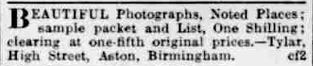
However, a newspaper small ad placedin the same year was perhaps a truer reflection of his position.
Stowmarket Weekly Post (19th January 1911). From British Newspaper Archive.
In 1929, William Tylar, who had settled in Bournemouth, died in hospital in Christchurch, Hampshire aged 71.
A recent online talk by contemporary wet plate photographer Tony Richards for the Royal Photographic Society’s Historical Group happened at a timely moment.
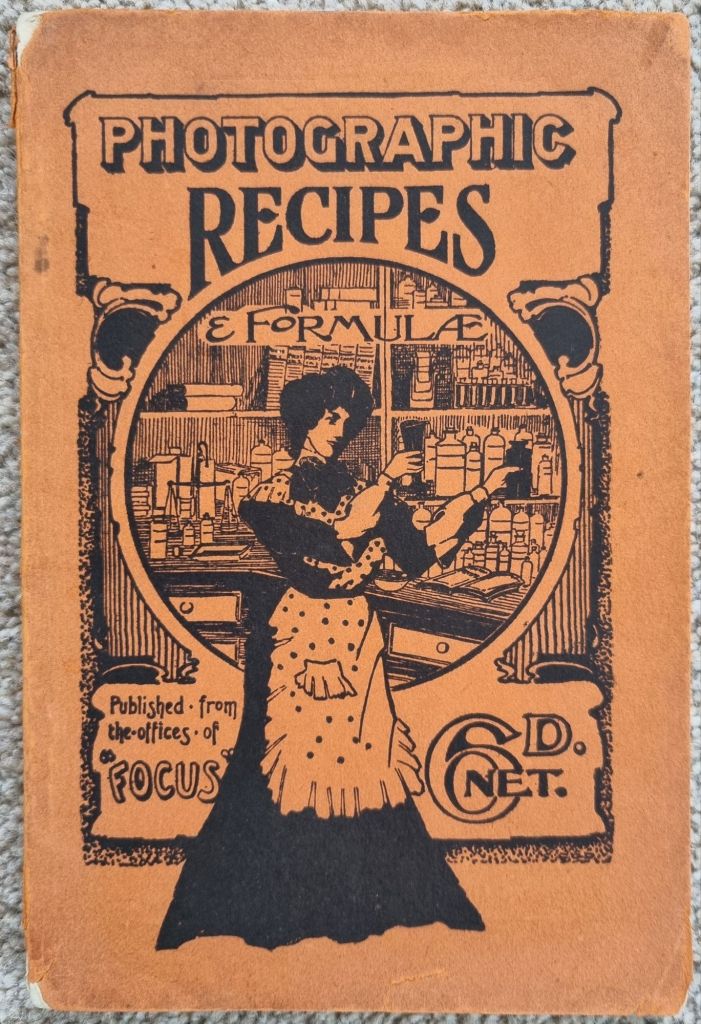
His presentation (‘Contemporary Wet Plate Collodion Photography’ / 2nd April 2024) coincided with the arrival in my collection of a second-hand book titled Photographic Recipes and Formulae.
Photographic Recipes and Formulae published in 1907.
As its title suggests, the book published in 1907 informs photographers about the basic principles of chemistry integral to taking photographs from the medium’s earliest days.
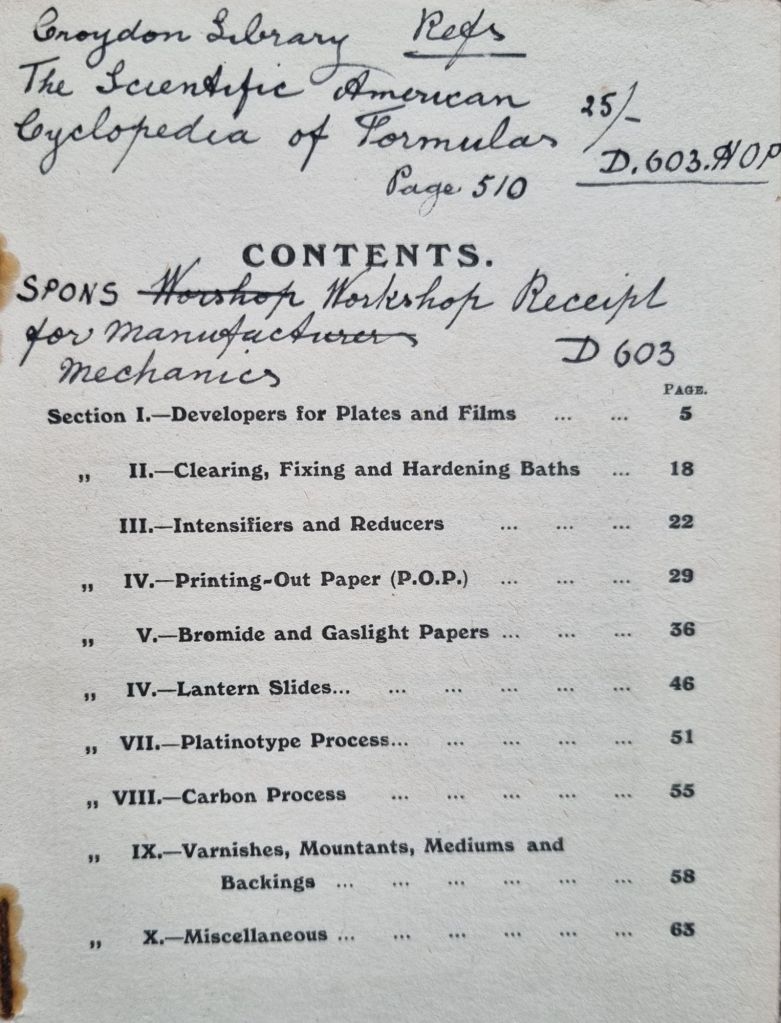
Its contents page (annotated ‘Croydon Library’ in an unknown hand) lists a total of ten sections starting with “Developers for Plates and Films” and working its way through various photographic processes.
Contents page of Photographic Recipes and Formulae (1907).
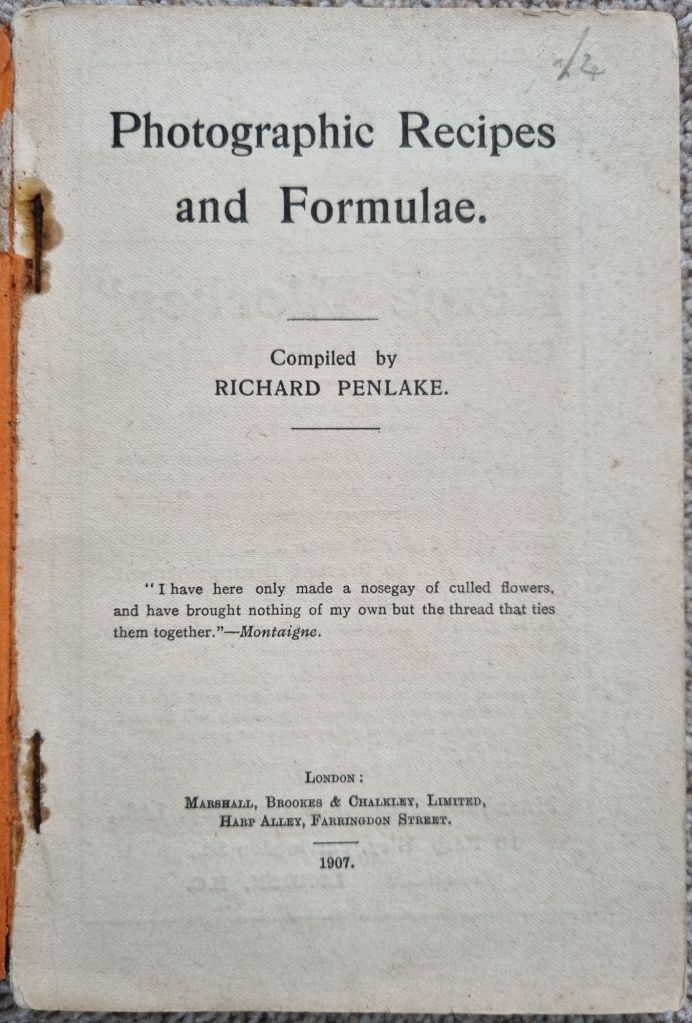
Though traditional methods are an area of interest to photohistorians, mine in this particular book was prompted by a detail on its frontispiece: that of the credit ‘Compiled by Richard Penlake.’
Frontispiece of Photographic Receipes and Formulae (1907).
As regular readers of the Pressphotoman blog will be aware, ‘Richard Penlake’ was a pen-name used by the photographer and author Percy R. Salmon FRPS (1872-1959).
In its catalogue, the British Library lists six titles credited to Richard Penlake, but this particular one seems to have escaped the Deposit Library system and has now been added to our growing family collection of his publications.
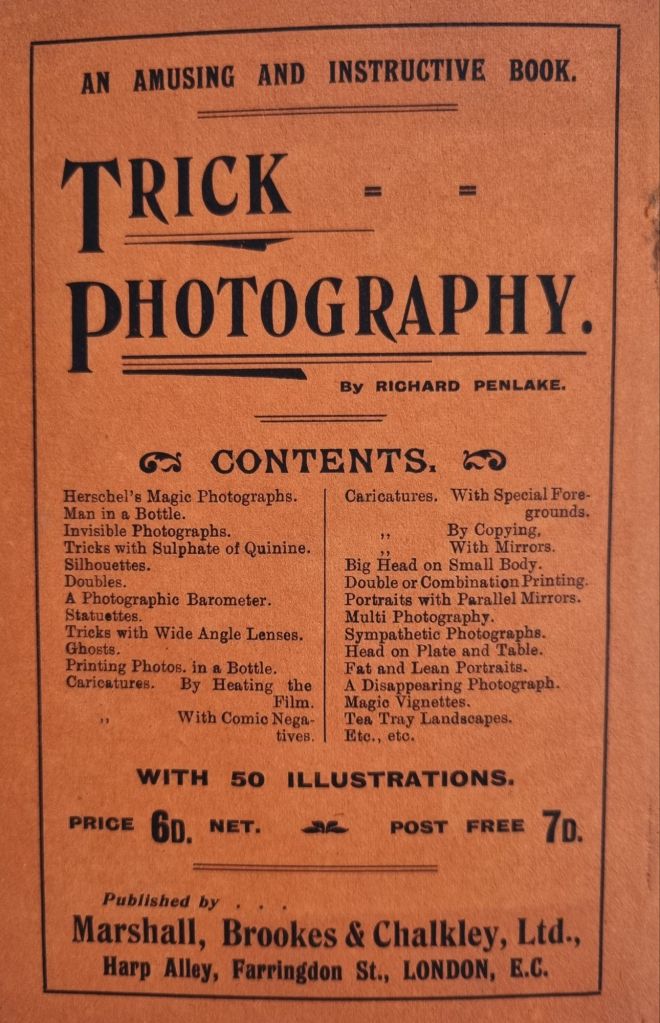
This is slightly surprising as the BL catalogue does include a Richard Penlake title, Trick Photography, by the same publisher, Marshall, Brookes & Chalkley, Ltd., of Harp Alley, Farringdon Street, London, EC, that appeared the previous year (1906).
Indeed, an advertisement for Trick Photography billed as “an amusing and instructive book” appears on the flyleaf of Photographic Recipes & Formulae.
Advertisement for Trick Photography from flyleaf of Photographic Recipes & Formulae (1907).
This flurry of activity occurred at a point in Percy R. Salmon’s career when he had recently stepped down after five years as Editor of Photographic News, a weekly trade paper.
Instead, he was working as a freelance author producing articles and mass market handbooks aimed at amateur photographers.
It was a change that culminated in several popular titles including All About Photography (1925) published in multiple editions by Ward, Lock & Co., into the 1950s.
Over the weekend, a trip to the Glasshouse International Centre for Music (formerly Sage Gateshead) had a welcome photographic spin-off.
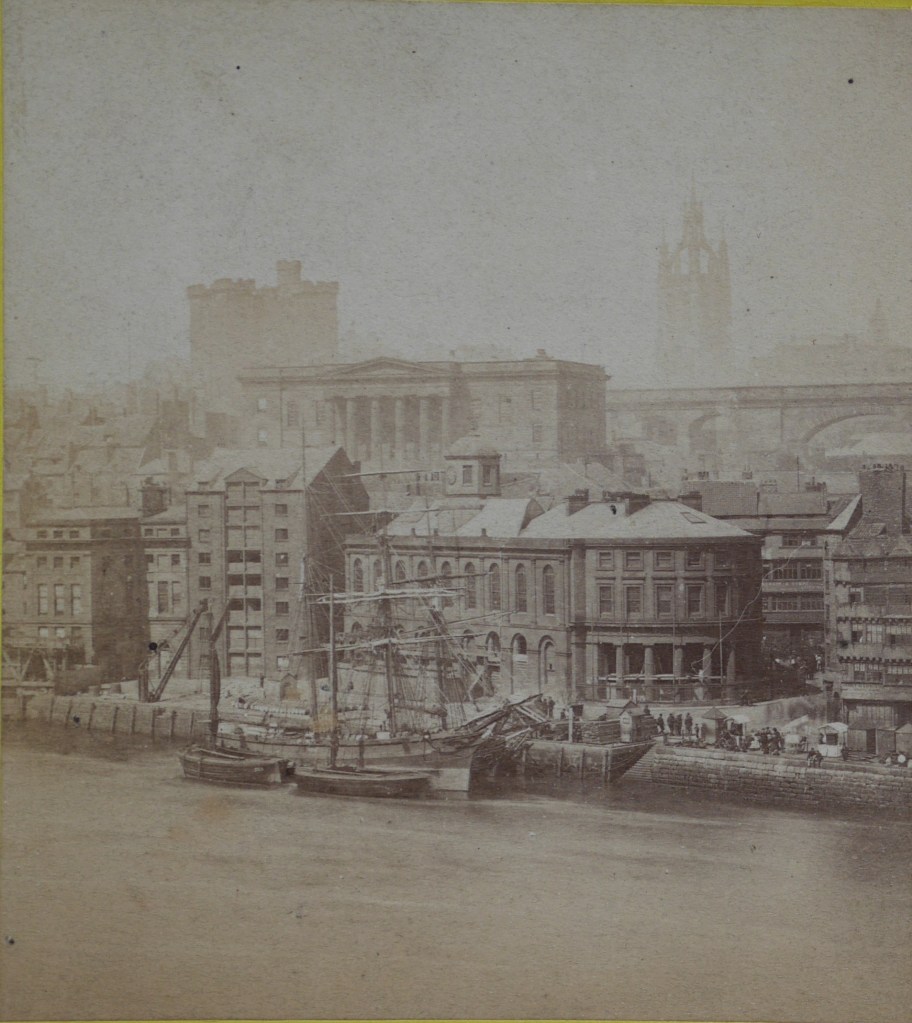
It offered an opportunity to look at Newcastle from across the River Tyne and see how much has changed since a stereographer captured the same scene in the 1860s.
Here’s that stereo from my collection. There is no identifying photographer or company credit on either front or verso.
From left to right, they are the Castle Keep with its crenellated battlements, the Greek Doric order Moot Hall opened as a courthouse in 1812 and St. Nicholas’ Church with its distinctive lantern tower.
On the quayside, a masted sailing ship is tied up alongside various smaller craft.
A dock crane is visible to the left and groups of people are huddled together amid wooden huts and stalls to the right.
The stereo, though difficult to date precisely, is similar in style and presentation to that of the Stephenson Memorial (unveiled in 1862) featured in a recent Pressphotoman blogpost (5th February 2024).
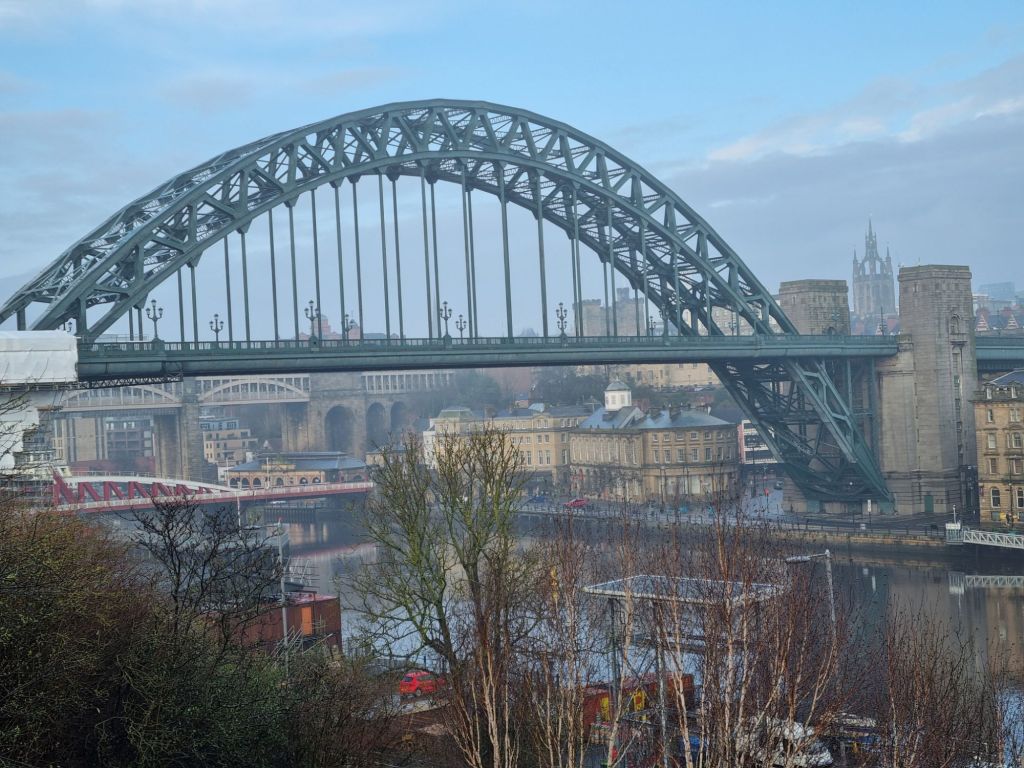
By way of comparison, here is a location photograph taken over the weekend from roughly the same position using a Samsung Galaxy phone.
View of Newcastle-upon-Tyne from the Glasshouse, Gateshead. Author’s photo. 2nd March 2024.
Still visible between the towers of the Tyne Bridge (opened in 1928) is St. Nicholas Church (now Cathedral), whilst the Castle Keep can also be glimpsed between the road and the curve of the metal girders above.
The Moot Hall, now a grade 1 listed building, is obscured by the bridge structure.
Down on the quayside, the sailing ships may have gone, but the buildings with their curved architectural sweep and topped by a white roof rotunda remain intact from the 1860s.
Much of the quayside area was devastated by a huge fire in 1854, so it is interesting to see buildings that survived, captured photographically around 160 years apart.
The world of newspapers and magazines has long relied upon ‘Special Offers’ to attract new customers and retain the loyalty of existing readers.
As Christmas approaches, those publications featuring a ‘free’ gift or money off with your first year’s subscription are everywhere.
Nearly 30 years ago, I took up a newspaper promotion that most definitely fell into the ‘value for money’ category.
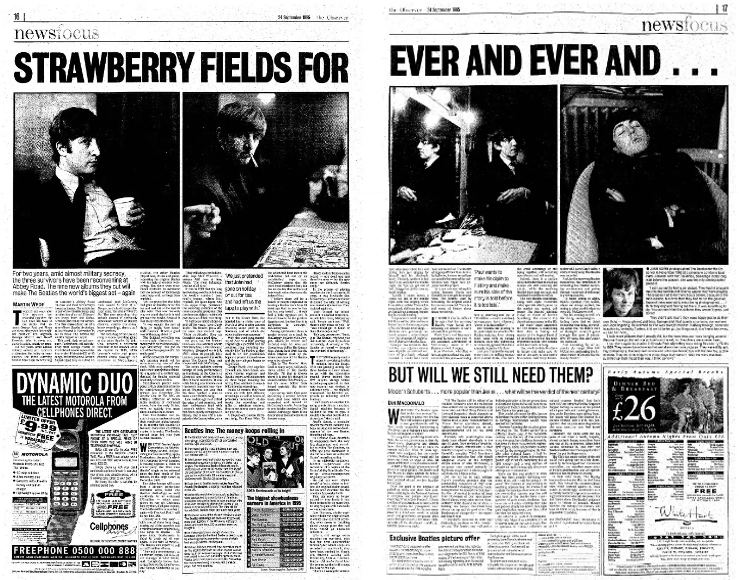
One Sunday in September 1995 whilst reading The Observer, my attention was drawn to a feature article about The Beatles prompted by the band’s then about-to-be-released Anthology project.
The Observer, 24th September 1995. From Newspapers.com
Under the sub-heading But Will We Still Need Them?, the music writer and critic Ian MacDonald (1948-2003) pondered what the next century would make of the Fab Four.
Today, following the recent re-release of the Red and Blue ‘hits’ albums along with what was billed as the final Beatles track ‘Now and Then,’ we perhaps have a better idea.
Photographically, the 1995 Observer double-page spread was lavishly illustrated by four photographs, each featuring a member of the band.
They were taken in November 1963 at a cinema in London’s East Ham by the paper’s celebrated photographer Jane Bown (1925-2014).
Beatlemania was at its height and, for the article, she recalled being smuggled into the venue, which was beseiged by fans.
Using a Rolleiflex camera, she took more photographs than usual while the band counted down the hours backstage before their concert.
Apart from the intimate portraits of John, Paul, George and Ringo, what particularly caught my eye was tucked away at the bottom of the article.
Under the sub-heading “Exclusive Beatles picture offer,” readers were given the opportunity to own an original print from Jane Bown’s 1963 Beatles pictures.
Taken from The Observer, 24th September 1995. From Newspapers.com
Available as a set of 6 for £49 “including postage and packing,” the 12″ x 9.5″ black and white glosy [sic] prints were to be handprinted by the photographer’s printers.
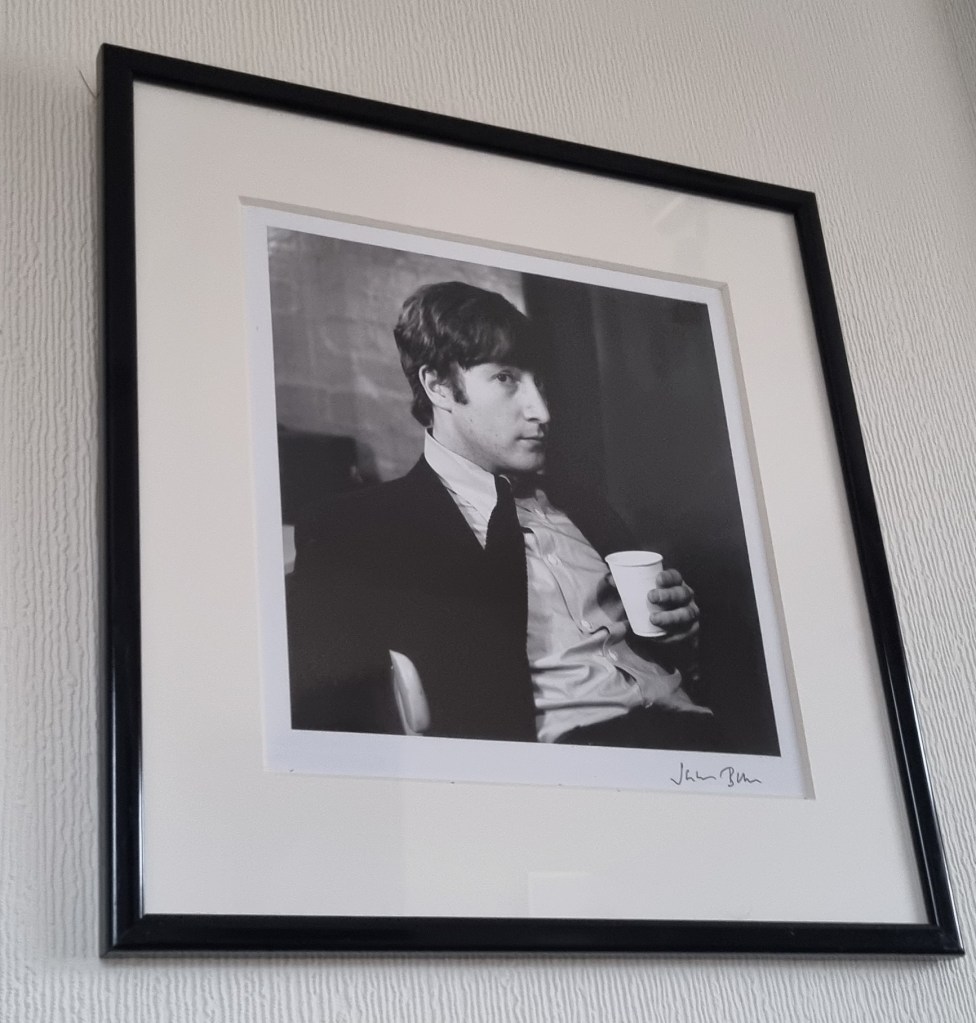
Whether it was the price tag or a lack of information about the two unpublished photos in the set, I decided to send for a single print of John Lennon for £15.
I was also half-hoping that I would be lucky enough to get one of the first 1000 copies “individually signed by Jane Bown and issued on a first-come, first-served basis.”
With fingers crossed, I filled out the accompanying cut-out coupon and sent it along with a £15 cheque to a postal address for The Observer in Bushey, Hertfordshire.
At this point, I am able to look up from my laptop and see that I was successful in obtaining a print of John Lennon signed by Jane Bown.
Unfortunately, the “letter of authentication and introduction from The Observer” that accompanied the photo had vanished by the time the print returned from being framed.
But it’s a photograph that continues to give pleasure and initiated an interest in Jane Bown’s work as a photographer.
Researching this post, I came across a portrait of Jane Bown I had not seen before.
It was taken in 1967 by Yevonde, another pioneering figure in the history of the medium and the subject of a recent Pressphotoman post (27th November 2023).
Twelve months ago, I presented new research on the early years of the celebrated photography firm W. &. D. Downey of South Shields, Newcastle-upon-Tyne and later London.
For its trip to Newcastle in November 2022, the Historical Group of the Royal Photographic Society visited locations with strong links to the early decades of photography in the North-East of England.
In the morning, the Literary and Philosophical Society (known as the Lit & Phil) hosted a talk about Sir Joseph Swan by fellow group member Paul Cordes in its Westgate Road headquarters.
Then in the afternoon, we moved to the Anglican Cathedral of St. Nicholas with its distinctive lantern tower where I presented an illustrated talk on Downey’s activities in the 1850s and 1860s.
St. Nicholas Church, Newcastle c. mid-1860s. From carte-de-visite by W. & D. Downey. Author’s collection.
This was repeated as a livestream event in March 2023 that can be viewed in the “Video Talks” section of this website.
As my Downey research is ongoing, this anniversary seemed a timely opportunity to share new findings from recent months about the company’s first decade.
One discovery in particular has added further detail to how and when the Downey brothers, William (1829-1915) and Daniel (1831-1881), began taking photographic portraits in the Northumberland port of Blyth.
The first mention in the press of their activities that I had previously found came in the North and South Shields Gazette (5th June 1856).
A brief article credited to “Correspondent” described Downey’s Crystal Palace Portrait Gallery as “a handsome, commodious, and substantial wood building” in the yard of the Star and Garter Inn, Blyth.
North & South Shields Gazette, 5th June 1856. From British Newspaper Archive.
However, a recent newspaper archive search has now revealed an earlier report in the Newcastle Guardian published on 10th May 1856.
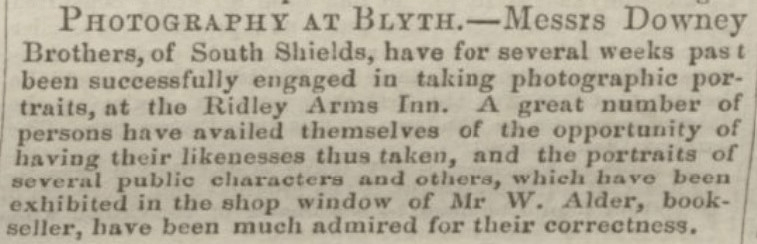
It described how “Messrs. Downey Brothers of South Shields” had been taking photographic portraits “for several weeks past” at another pub in Blyth, the Ridley Arms Inn.
In addition, “Mr. W. Alder, bookseller” was named as providing a shop window where Downey’s “portraits of several public characters and others” could be seen.
The Newcastle Guardian, 10th May 1856. From British Newspaper Archive.
The revelation that Downey’s residency at the Ridley Arms pre-dated its time at the Star and Garter adds further detail to its beginnings as a photography enterprise.
Records held at Blyth Library reveal that the Ridley Arms started life in the 1770s as a private house and was one of the town’s original public houses.
By 1846, a “Mr. Grimson” was its landlord and “ran the daily post coaches to North Shields,” a service gradually replaced by the railways in most provincial towns in Britain during the 1850s.
In Northumberland, the Blyth and Tyne Railway (B&TR) began life in 1853, largely transporting coal from the area’s collieries.
These details about the evolution of mid-19th century transport links in the region shed further light on how the Downey’s maintained communication with their native South Shields fifteen miles to the south.
What is less clear is how the brothers processed their wet plate negatives and then produced prints for sale to the general public.
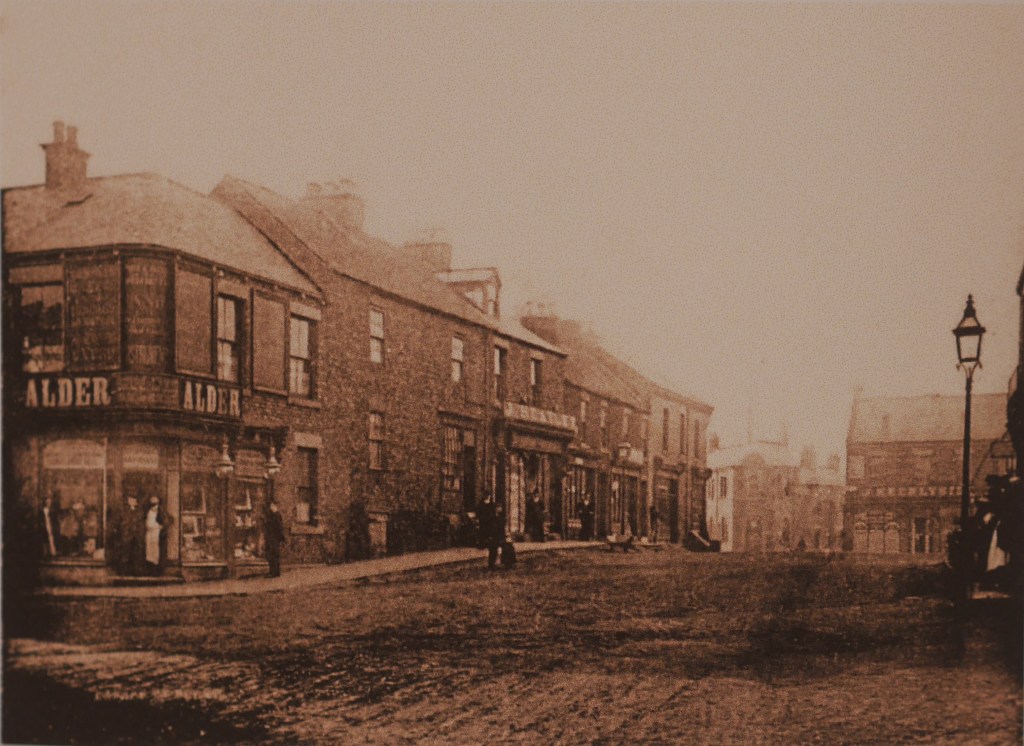
The mention of “Mr. W. Alder, bookseller” in the Newcastle Guardian article provides a clue.
The 1858 Post Office Directory for Blyth lists William Alder as “printer, bookseller, bookbinder, stationer and news agent.”
William Alder’s shop premises (left) from Blyth Through Time by Gordon Smith (2012).
Access to printing facilities in Blyth would have been helpful to producing Downey’s “life-like portraits” that were “much admired for their correctness.”
In identifying William Alder (1829-1883) as a suitable collaborator in their fledgling business, the Downey brothers chose well.
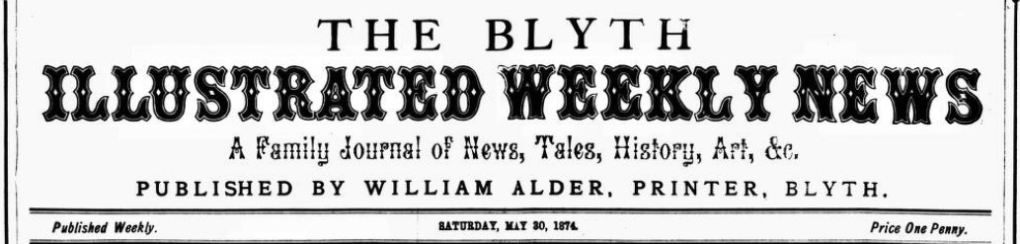
He went on to become a significant figure in Blyth, notably in publishing and printing The Blyth Illustrated Weekly News from 1874.
Masthead from an early issue of The Blyth Illustrated Weekly News published by William Alder.
The ultimate for Downey collectors is to find examples of the brothers’ early portraits produced in Blyth or from their photographic van during its tour of country towns and villages in Northumberland during the summer of 1856.
In December 1860, the Newcastle Journal devoted a short article to what it called “the beautiful art of photography.”
It described how photography was making rapid strides, not only in Newcastle-upon-Tyne, but in neighbouring Sunderland, Durham, North and South Shields.
It continued: “… in all of which towns, portraits of friends and relatives may be had at prices ranging from sixpence to as many guineas.”
I came across the article whilst researching the early years of the celebrated photographic company W. & D. Downey.
Downey began life as a travelling “portrait gallery” in Northumberland and established its first studio in South Shields in 1856.
In drawing attention to Downey’s accomplishments, the Journal article went on to list four Newcastle photographers that it was “unnecessary to call attention to the productions of … as their achievements are well known.”
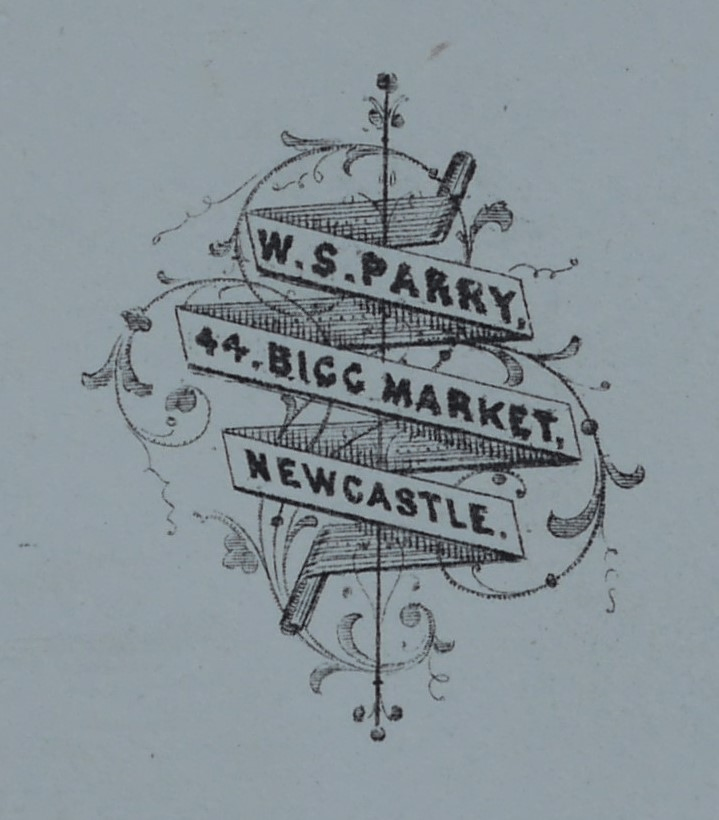
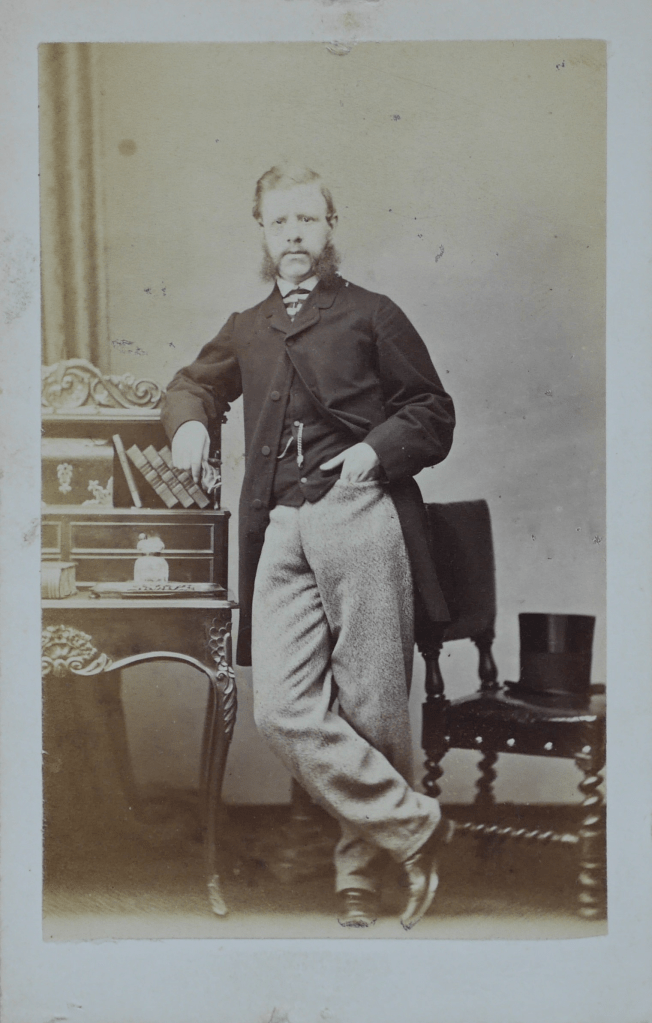
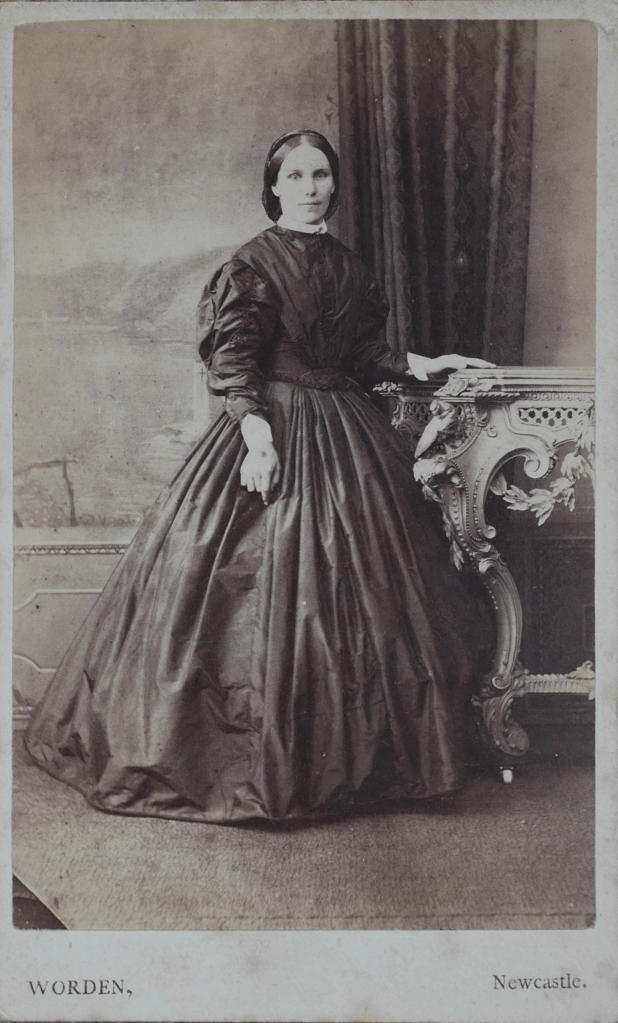
The four were named as “Turner, Warren, Worden or [sic] Parry.”
For the past few years, I’ve kept an eye out for examples of their carte-de-visite or cdv portraits from the late 1850s when the format was first popularised.
But it’s only in the past few days that, thanks to a well-known auction site, I’ve managed to complete my set.
It was the first-named “Turner” that proved the most difficult to track down.
“Warren,” namely George Christopher Warren (1829-1918), featured in my talk about W. & D. Downey for the Royal Photographic Society Historical Group (see this blog’s Video Talks, 15th March 2023).
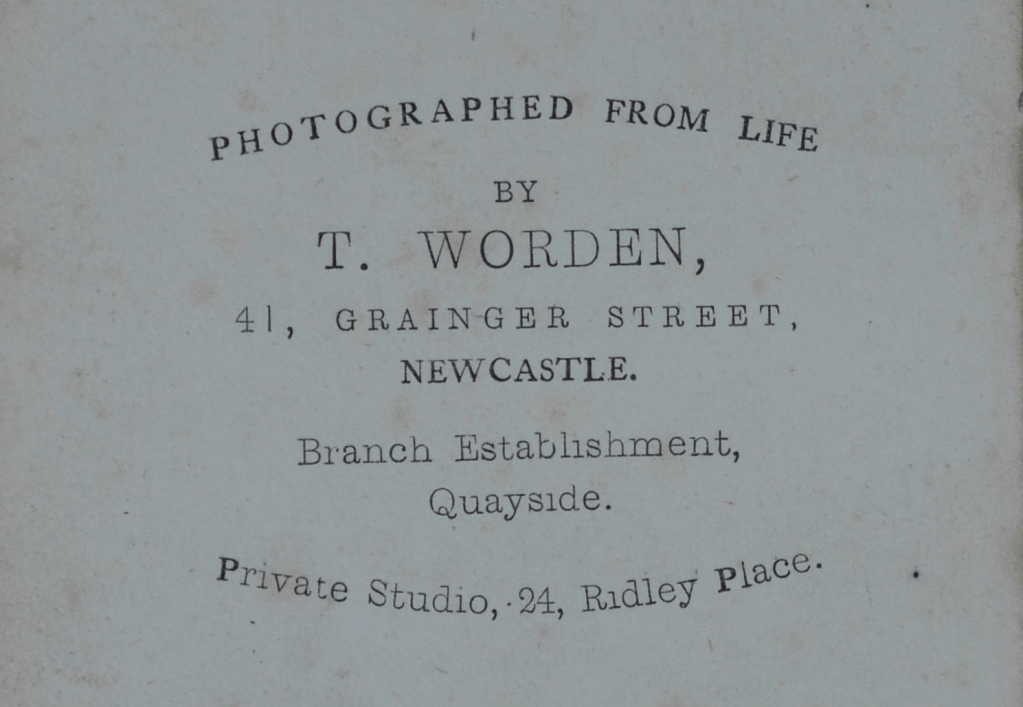
“Worden,” namely Thomas Worden, first established a photographic business in Newcastle in 1854. By the close of the decade, he advertised three city centre locations including a “private studio.”
Finally, “Parry,” namely William Softley Parry (1826-1915), who like the other studios was integral to the development of commercial photography in Newcastle and the North-East of England.
Now the set is complete, it has prompted an idea for future research projects about their activities.
And here to conclude this post are carte-de-visite portraits produced by the studios of Turner, Warren, Worden and Parry featuring subjects that still meet our eye 160 years later.
This Thursday sees the start of The Open Championship, an event so sure of its status that its name makes no reference to what its openness might refer.
The oldest golf tournament in the world is being staged for the 151st time, on this occasion at the Royal Liverpool course at Hoylake.
As someone whose formative years were spent not far from Hoylake, it seems curious that this links course is not actually in Liverpool.
Rather, it’s a short ferry ride across the River Mersey on the Wirral peninsula.
For the past few weeks, this blog has had to take a back seat as a combination of a holiday break and work on a new research paper have taken precedence.
So it’s pleasing that The Open offers a link to that research paper and to this stereoscopic photograph titled “Golf” that I have recently added to my collection.
It was taken by J.E. (James Edward) Ellam, one of the stereographers involved in the development of early press photography either side of 1900.
I wrote a blog about Mr. Ellam (Press Photo Pioneer – April 28, 2023), but since then I have become the owner of 30 stereos that can be attributed to him.
“Golf” with its “J.E. Ellam” credit stamp on the verso is one these stereos.
In future weeks, I’ll be blogging about these Ellam stereos and how they further inform understanding of how an amateur stereographer from Yorkshire became a Fleet Street press professional.
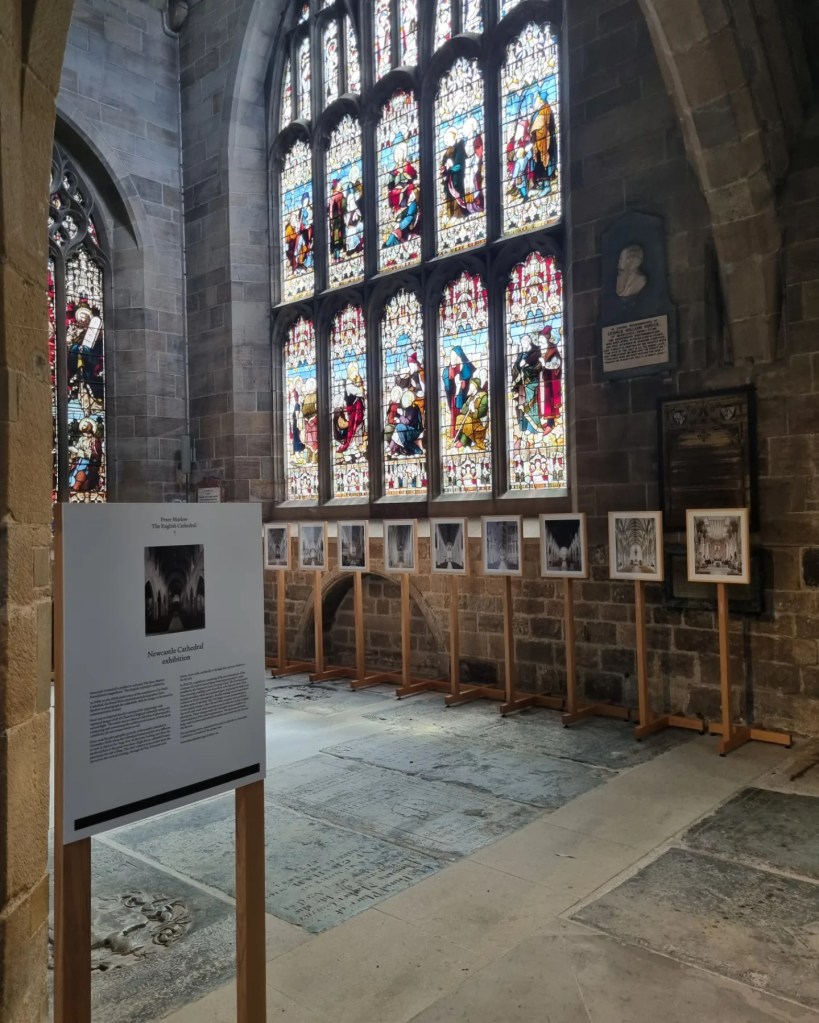
The current touring exhibition The English Cathedral features photographs taken at each of the country’s 42 Anglican cathedrals.
A few weeks ago, I visited the exhibition during its stay in Newcastle (until Thursday 24th May 2023), stop number 13 in its pilgrimage to each of the featured locations.
Entrance to The English Cathedral exhibition. Newcastle Cathedral, 9th May 2023. Author’s photo.
It features the work of Peter Marlow (1952-2016) who was originally commissioned by the Post Office in 2008 to photograph six English cathedrals to feature in a set of commemorative stamps.
He was so inspired by the project that he determined to visit the remaining 36 and this touring exhibition is the result.
Part of The English Cathedral exhibition. Newcastle Cathedral, 9th May 2023. Author’s photo.
Each of the photographs takes the same viewpoint, looking down the nave from west to east.
The result is a wonderfully rich and varied record of the architecture of buildings whose histories span hundreds of years.
If you get the opportunity to visit the exhibition during its tour, I would highly recommended that you do so. Dates for the rest of 2023 are on the link below.
In the past, England’s cathedrals have been photographed many times by both professionals and amateurs.
Among the professionals was my wife’s great great uncle Percy R. Salmon FRPS (1872-1959) whose life and career feature elsewhere on this blog.
From around 1897 to 1899, he worked as a travelling photographer for the stereoscopic 3-D photography company of Lévy et Ses Fils of Paris (or Lévy Fils et Cie as it is also known).
According to the Leeds Mercury (3rd June 1899), one of his commissions involved stereographing “all the English cathedrals.”
Inspired by visiting The English Cathedral and seeing Peter Marlow’s work, I wondered if it might be possible to identify any of Mr. Salmon’s cathedral stereos.
My first port of call was the website of the Roger-Viollet Collection in Paris whose archive features stereos he took for Lévy during an 1898 expedition to Egypt, Palestine, Turkey and Greece.
A “cathedrals” search yielded a sequence of six (3448-10 to 3448-15) that, like those from his 1898 trip, were colourised at some point by Lévy using gouache, a water-soluble paint.
Dated by Roger-Viollet to between 1895 and 1900, the circumstantial evidence suggests that they could be the work of Percy R. Salmon.
Three feature Westminster Abbey, scene of the recent Coronation of King Charles III but, as I learned from visiting The English Cathedral exhibition, not in fact a cathedral and so not photographed by Peter Marlow.
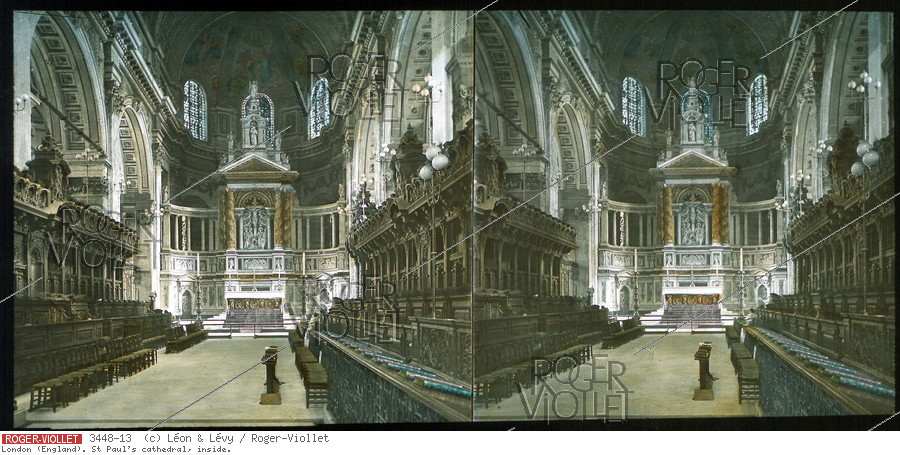
Another shows the interior of St. Paul’s Cathedral whilst the remaining two in the sequence feature Buckingham Palace (taken from an unusual side-on angle) and St. James’s Palace, both in London.
On this occasion, the cost of obtaining high-resolution versions of these stereos for publication is beyond my budget, but I hope you will enjoy viewing this watermarked version of the interior of
St. Paul’s, possibly by Percy R. Salmon.
London (England). St Paul’s Cathedral, inside. Possibly by Percy R. Salmon FRPS.
You can view the other stereos identified in this blogpost by inputting the reference numbers (eg. 3448-10 3448-11, etc) in sequence into the Roger- Viollet website’s search engine.
Encouraged by the existence of these stereos and armed with the knowledge that Lévy also produced postcard versions, I spent time on Ebay to see if I could find any of them.
That search continues, but I have been able to purchase this black-and-white stereo postcard of the interior of Canterbury Cathedral produced by “Lévy Fils et Cie, Paris” and bearing its signature “L.L.” branding.
Stereoscopic postcard of the interior of Canterbury Cathedral. Possibly by Percy R. Salmon FRPS.Company credit from verso of stereoscopic postcard above.
Is this the work of Percy R. Salmon FRPS? If he was commissioned by the company to stereograph “all the English cathedrals” during 1897, it is certainly a possibility worth considering.
Meanwhile, our Percy R. Salmon research project continues.
If you are a postcard collector or have examples of Lévy stereos or lantern slides, please use the comments box below to contact me.
On the eve of the 1902 Coronation of Edward VII and Alexandra, a photo call took place at Lambeth Palace in London.
Present were key players in the following day’s ceremony at Westminster Abbey, notably the Archbishops of Canterbury and York who were to crown the King and Queen respectively.
As the first coronation in Britain for 65 years, this 1902 timeline has echoes of 2023, but there is another significant fact. The 1902 Coronation was the first such occasion since the arrival of photography.
As a result, still and moving cameras were out in force during that coronation summer to record every official function and its participants.
Among the companies involved was Underwood & Underwood of New York, one of the era’s leading stereoscopic ‘3D’ photographers.
This U&U stereo, featuring Frederick Temple (1821-1902), Archbishop of Canterbury, and William Dalrymple Maclagan (1826-1910), Archbishop of York, was issued as part of a coronation-themed set.
‘Archbishops of Canterbury (to left) and York (to right) in Coronation Robes – ready to crown Edward VII, King – London, England.’ Copyright 1902 by Underwood & Underwood. Author’s collection.
The stereo also featured in the company’s short-lived magazine The Stereoscopic Photograph (September 1902) as part of an article promoting its products titled “The Crowning of the King.”
There, it was given an alternative title of “The Archbishops of Canterbury and York in Coronation Robes, with their Sons, London.”
Of course, this additional piece of information, “with their Sons,” provides both context and pointers as to the identity of the other figures portrayed in the stereo.
Here were the two most senior clergy in the Church of England being photographed with members of their families ahead of perhaps the biggest moment of their clerical lives.
Further research has revealed that the U&U stereo featured both a future Archbishop of Canterbury and an influential Director of the Victoria and Albert Museum in London.
Frederick Temple’s son William (back left) pursued a career in the church and followed in his father’s footsteps during the years 1942 to 1944. William Maclagan’s son Eric (back right, later Sir Eric) was an art historian who led the V & A from 1924 to 1945.
Another photograph taken on this occasion is part of the Royal Collection.
As well as the Archbishops of Canterbury and York, it features another participant in the 1902 Coronation service.
At this point, Randall Davidson (1848-1930) was Bishop of Winchester, succeeding Frederick Temple as Archbishop of Canterbury when he died a few months after the ceremony.
On the Royal Collection Trust website, the photographer of this portrait is credited as “unknown person.” (Update 18th May 2023: the Royal Collection Trust has amended its website and attributed the photograph to James Russell & Sons to reflect the research outlined below).
However, evidence identified by this blog points towards that person being John Lemmon Russell (1846-1915), head of the firm of J. Russell & Sons who held a royal warrant as photographers to Queen Victoria.
In an interview published by the weekly illustrated paper Black & White (27th December 1902), Russell described the photo call in some detail.
“The day before the Coronation, I had the pleasure of photographing the Archbishops of Canterbury and York and the Bishop of Winchester in their coronation robes at Lambeth Palace.”
He continued: “An American photographer, a representative of Messrs. Underwood and Underwood, was very anxious to accompany me, and I mentioned to the Archbishop of Canterbury the fact that he was present.
“‘I should very much like to speak to the American gentleman,’ said the Archbishop. On being introduced, Dr. Temple proceeded to say what a keen sympathy he had for the American nation. He delivered quite a little speech to my friend, who was exceedingly gratified by this honour.”
The American gentleman was U&U’s co-founder Bert Underwood, and this account helps explain how the company produced its “Archbishops and their sons” stereo.
The collaborative photographic relationship between U&U and Russell during the Coronation summer of 1902 is one that I explore in the current issue of The PhotoHistorian, the journal of the Royal Photographic Society Historical Group.
A free download of that article is available below with the usual credit protocols.
Annual subscriptions for The PhotoHistorian are available for £60 (UK based) or £75 (overseas) to museums, galleries and academic institutions. Contact the editor at PhotoHistorian@rps.org
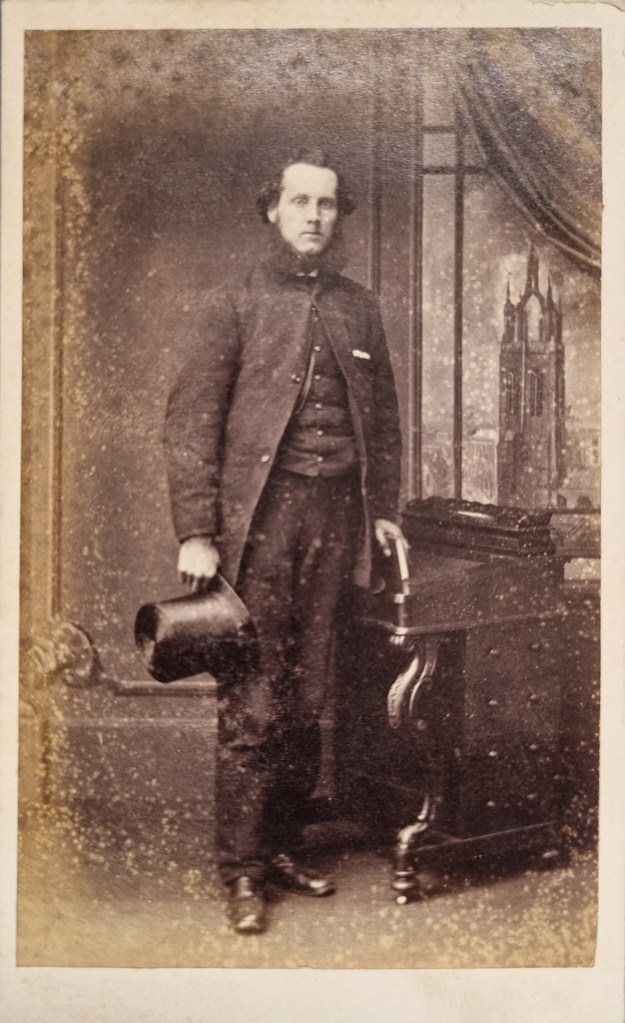
My latest carte-de-visite purchase via a well-known auction site caught my eye for a number of reasons.
The gentleman featured in this full-length portrait has a magnificent beard, is wearing a smart suit and waistcoat complete with watch chain and is carrying a silk top hat which has caught the light.
But it was actually the painted background in front of which the gentleman is standing that particularly attracted my attention.
Detail from carte-de-visite.
Those familiar with Newcastle and the north east of England will recognise it as the lantern tower of the anglican Newcastle Cathedral, England’s most northerly.
Until 1882, it was known as St. Nicholas’ parish church, but the building’s distinctive lantern tower has been part of the city’s skyline since the 15th century.
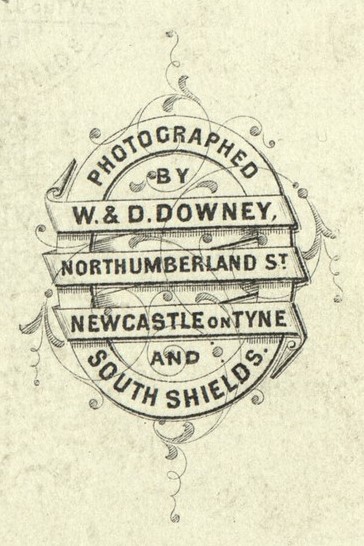
The verso of the cdv confirms it to be by “W. & D. Downey of 9 Eldon Square, Newcastle upon Tyne” and states the firm is “Patronized By Her Majesty.”
This locates it to a period between March 1862 when Downey opened its studio in Eldon Square, and September 1866 when the firm took its first portrait of Queen Victoria.
After this point, it used the slogan “Photographers to Her Majesty” on its products even though its first Royal Warrant was not granted until 1879.
What I hadn’t realised until looking at the cathedral’s website is that in 1865, the celebrated architect Sir George Gilbert Scott was commissioned to underpin and rebuild the lantern tower after it started to lean as a result of nearby building work.
This dating suggests that Downey’s use of the landmark in its branding was not merely a sign of its arrival in Newcastle from nearby South Shields where it started in 1856.
Work to correct the leaning lantern tower would have meant St. Nicholas Church was a talking-point and customers having their portrait taken may have wished to mark their connection with Newcastle and its revitalised skyline accordingly.
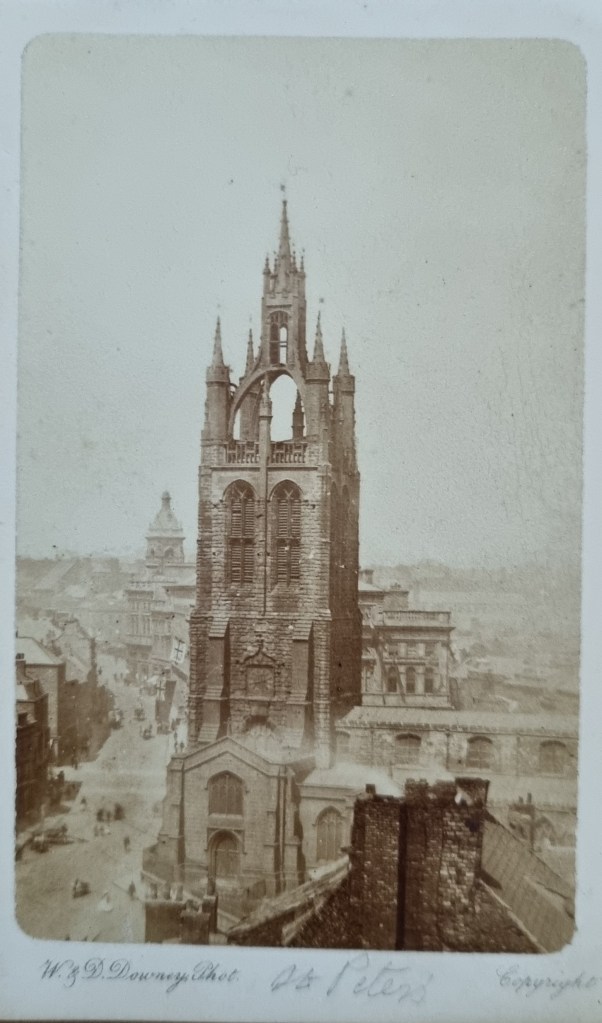
It also might inform the dating in the mid-1860s of another Downey cdv in my collection (erroneously titled by an unknown hand in pencil as “St. Peter’s”) in which the then St. Nicholas’ Church takes centre stage.
Cdv of St. Nicholas’ Church, Newcastle by W. & D. Downey.
My recent talk on W. & D. Downey for the Royal Photographic Society Historical Group prompted responses both to the ‘live’ event and to the recording via social media (see blogpost, 16th March 2023).
The company’s successful activities over several decades are reflected in the extensive photo collections held by museums and galleries around the world.
Thanks to digitisation, these portraits are now viewable online, often with supporting text and information.
So it has been pleasing to be able to share my research findings about Downey’s early years with the National Portrait Gallery in London (due to re-open in June 2023), which has nearly 1,000 portraits credited to the company.
My thanks to Clare Freestone, Curator of Photography, and her NPG colleagues for amending the online company entry for W. & D. Downey.
Last night, I was delighted to accept an invitation from the Royal Photographic Society Historical Group to present new research on royal photographers W. & D. Downey of South Shields and Newcastle.
The talk is now available to view on the RPS YouTube channel and starts at 3′ 42″ into the recording.
Today marks the 151st birthday of the photographer and writer Percy R. Salmon, FRPS (1872-1959).
A year ago, his life and career were celebrated in a short film commissioned by the Royal Photographic Society.
The RPS is an organisation with which he was connected for more than 60 years as a member, fellow and finally as an honorary member.
RPS film about Percy R. Salmon, FRPS: Photographer, photography journalist and writer (2022).
In the past 12 months, members of our family (Mr. Salmon’s great nephew Stephen Martin and my wife Helen Barber, his great great niece) have been following up various research threads.
Some were prompted by responses to the film. Others were previously unexplored.
One was a letter dated 26th April 1950 written by Mr. Salmon to the RPS donating five photographic objects to what was then its museum.
That collection is now part of the Victoria & Albert Museum in London alongside some 800,000 other photographic items.
Unsurprisingly given its size and scope, much of this material has yet to be researched and catalogued.
However, as we discovered on a recent family visit to the V&A, one of the donated photographs has been given a catalogue number.
The photograph featuring two women is framed within an arched shaped mount, edged in gold and black. The object is approximately 4 inches wide by 6 inches long.
One of the women is seated holding a wide-brimmed hat. The second is standing next to her, a hand resting on the other woman’s shoulder. They are posed against a painted landscape backdrop featuring buildings, a woodland, and distant hills.
A caption in Mr. Salmon’s hand attached to the verso provides more information about the photograph and its provenance.
It reads: ‘Photo Taken At A Village Feast (Little Abington, Cambs.) About 1860.’ Another hand has added ‘Glass Positive. Tinted.’
Verso of a framed portrait photograph donated to the RPS by Percy R. Salmon, FRPS in 1950.
The photograph is intriguing on several levels.
Firstly, what was it about this object that Mr. Salmon, an expert in early photographic processes, deemed significant enough to donate it to the RPS?
In the letter that accompanied the donation, he described it as ‘a collodion portrait of two ladies’ and highlighted what he described as ‘a trace of colouring.’
The colouring can be seen in the dress worn by the woman on the right of frame which has a blue-ish tinge whilst the trees in the background have a green-ish hue.
Secondly, his donation letter added the telling phrase ‘Particulars Not Known,’ but was there anything about the portrait that gave it particular meaning to Mr. Salmon?
The reference in the verso label to ‘Little Abington, Cambs.’ relates to a village 8 miles south-east of Cambridge and provides a direct family connection.
His wife Eliza Salmon (née Dickerson) was born at Little Abington in 1863. Her father James, a thatcher, and his wife Lydia had four other young children at that point.
How Eliza, the couple’s youngest daughter and known within the family as ‘Tottie,’ met her future husband is uncertain, but Cambridge University seems to have played a part.
New family research has revealed that Alma Dickerson, Eliza’s elder sister, was a member of the domestic staff of Edward Byles Cowell (1826-1903), the university’s first Professor of Sanskrit.
Census records and newspaper reports confirm that Eliza was Cowell’s cook at the same time as Mr. Salmon was his footman at 10 Scroope Terrace, Cambridge from the mid-1880s to the early 1890s.
In due course, the relationship between Percy R. Salmon and Eliza Dickerson flourished and in July 1901, the couple were married in the parish church at Little Abington.
Given this information, does it yield any clues that might help identify the ‘two ladies’ featured in the photographic portrait donated to the RPS by Mr. Salmon?
His dating of the portrait to ‘around 1860’ would place his wife Eliza’s mother Lydia Dickerson in her late-20s, so perhaps she is a candidate. Or perhaps there is no direct family connection at all.
As to where the portrait was taken, ‘Feasts’ were celebrated throughout the 19th century in many English villages.
During this period, itinerant photographers proliferated, so it is possible that one or more were among the attractions on offer at the Little Abington Feast.
A mobile studio, complete with painted backdrop and offering a selection of suitable clothes to wear with ‘assistance for ladies,’ would have provided an opportunity to have a portrait photograph captured for posterity.
Fashion historians might also be able to shed light on the dresses being worn and the hairstyles on view.
The ‘comments box’ below welcomes your thoughts.
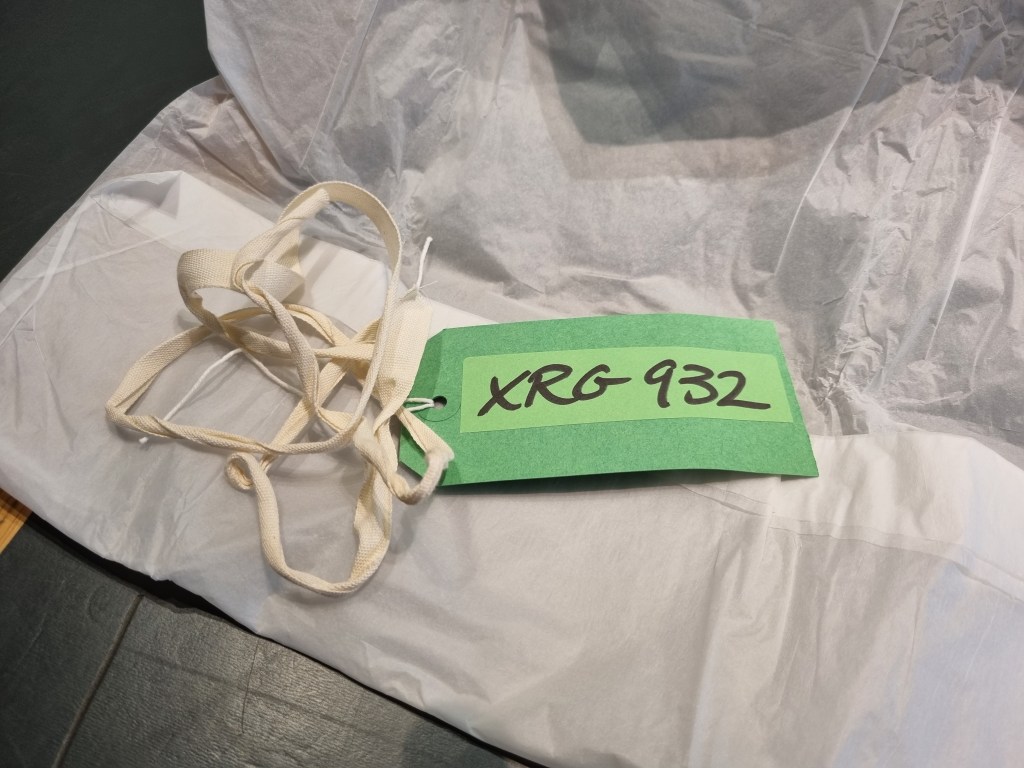
Catalogue label for V&A portrait photograph XRG 932.
I’m aware that it’s been a little quiet on here in recent weeks.
The main reason for this is that I’ve been pulling together a 3,000-word journal article due for publication in the Spring (details to follow).
As a result, there hasn’t been much time left to write blogposts of the kind that have featured here since the turn of the year.
As you might imagine, both ‘The Hartley Catastrophe’ (16th January 2023) and ‘Excelsior Stereoscopic Tours’ (25th January 2023, updated 6th February 2023) involved a lot of research and writing up.
However, I’m pleased to report that they have prompted others interested in photo history to contact me with comments and additional information, which is the whole point of ‘pressphotoman.’
In the meantime, during a walk earlier today, my eye was caught by this old post box down by the pier at Berwick-upon-Tweed.
Wall post box, Berwick upon Tweed.
Strangely, it offered a visual clue to the subject of my forthcoming journal article.
More to the point, it also injected a welcome burst of colour into a cold and windy winter’s day.
All over the world, Scots and those of Scottish heritage are today celebrating the birth of Robert Burns, the man widely regarded as their national Bard.
The cottage in Alloway, near Ayr where Burns was born on 25th January 1759 has long been a place of pilgrimage and is still popular today.
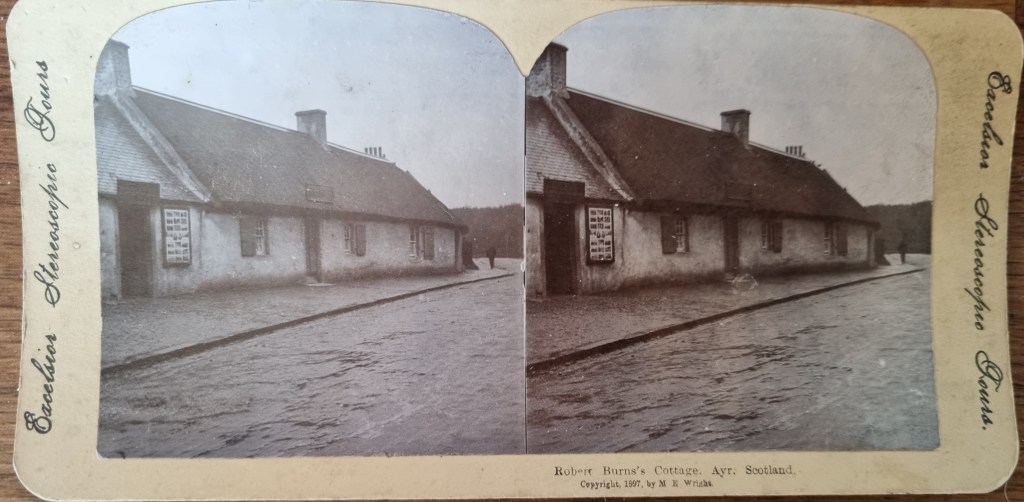
The cottage features in this stereoscopic view from 1897, part of my own collection of 3D stereocards that were popular with Victorian and Edwardian audiences.
Its publisher, Excelsior Stereoscopic Tours, was the brainchild of ‘M.E. Wright,’ who is credited as the image’s copyrightholder.
But who was ‘M.E. Wright,’ and how did Excelsior’s stereoviews become so popular that they feature today in museum and photography collections all over the world?
Milford Elsworth Wright was American, born in 1861 in Perry, Ohio, on the shores of Lake Erie. One of nine children, the 1880 US Census recorded him living in Perry with family members, including his twin Mildred, and working as a ‘farm labourer.’
Stereocard featuring the Wright family at their homestead in Perry, Ohio. Date unknown.
The story of how Milford became involved in stereo photography and developed a successful career in the ‘views’ business is one that I researched further after coming across him during work for my PhD.
During the 1880s, the firm of Underwood & Underwood (U&U) launched a successful business in Ottawa, Kansas, selling 3D stereocards and hand-held viewers door-to-door, state-to-state.
By the end of the decade, the Underwood brothers, Elmer and Bert, had developed plans to grow their stereo business beyond the United States.
It was a plan that led in time to U&U becoming one of the world’s most successful and influential photography firms.
The plan took a major step forward in 1890 when the company put together a team of salesmen to expand its operations into Europe and beyond.
One of those chosen to make the trip from New York across the Atlantic was Milford E. Wright.
Travelling with Bert Underwood and his wife Susie, the party’s destination was the bustling port city of Liverpool where an office was established in a house (since demolished) in Oxford Street in the Mount Pleasant district.
A flavour of the life of a U&U sales agent following that pioneering Liverpool trip is provided by one of Milford’s colleagues.
Writing later in a U&U company brochure, one JLD Chandler described earning upwards of $50 a month in sales commission, travelling through Belgium, Switzerland, Germany, Italy and France as well as to Palestine and Egypt.
Initially, Milford seems to have concentrated on selling stereocards to the UK market.
A few months after arriving in Britain, he was in Wales lodging with a family in Cardiff. The 1891 Census recorded his ‘profession or occupation’ as ‘sailor,’ though this may well have been a mishearing of the term ‘salesman.’
Like other U&U salesmen, Milford became an accomplished stereoscopic photographer himself. ‘Excelsior Stereoscopic Tours’ was the brand he used to market his 3D photographs such as that of Robert Burns’s Cottage.
His exact movements during the 1890s are sketchy, but he made at least one return trip to the United States and a family photograph of him taken during this period suggests that he spent time in Scotland.
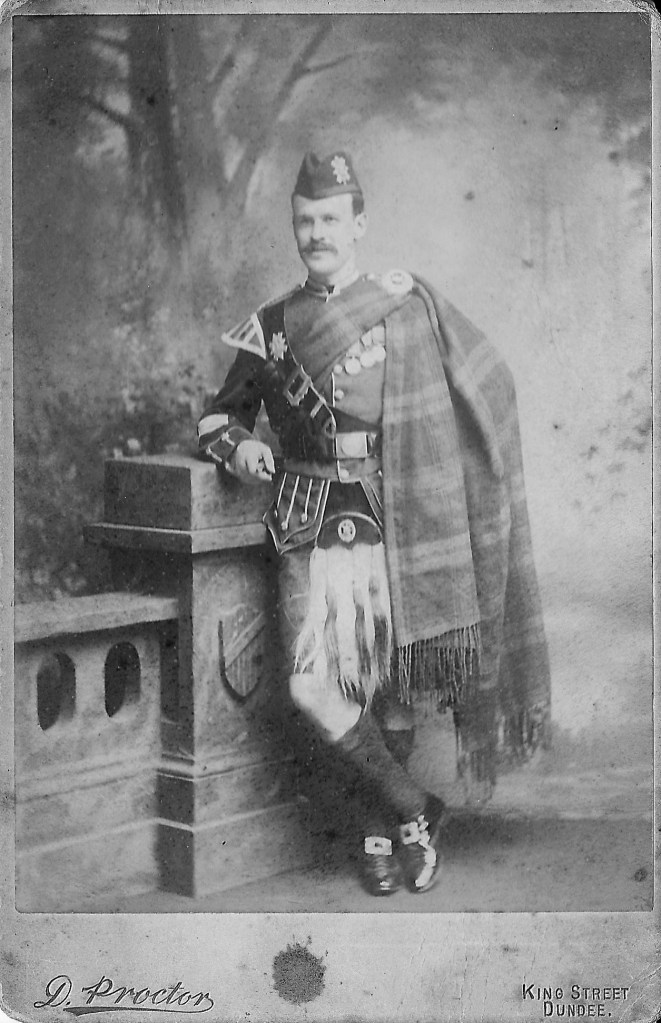
Milford E. Wright wearing a Highland outfit c. 1890s. By David Proctor of King Street, Dundee.
By the end of the decade, he had settled in the Lancashire mill town of Burnley where he had a photographic studio, and recorded his ‘profession or occupation’ as ‘publisher of stereo views’ in the 1901 Census.
The same year, he married Isabella Davidson from Alloa in Scotland and their growing family soon featured three sons and a daughter.
In contrast to international stereo companies like U&U, whose cards featured cities such as New York and London where they had offices, ‘Excelsior’ stereos featured the Wright family’s home address in Burnley.
With a growing family to provide for, Milford went on the road, selling his ‘Excelsior’ cards with stereoscopes manufactured by H.S. Walbridge & Co. of Bennington, Vermont.
Perhaps the highpoint of Milford’s stereo photography career came in May 1906 in Madrid when he captured the aftermath of an assassination attempt on King Alfonso XIII and Queen Victoria of Spain on their wedding day.
A bomb concealed in a bouquet of flowers was thrown at the couple’s carriage by an anarchist positioned at an upper-storey window.
Exploding in mid-air, it caused the deaths of more than 25 by-standers as well as horses taking part in the wedding procession.
In the immediate aftermath of the explosion, Milford took a sequence of images at the scene using his stereo camera and later produced as Excelsior cards.
These included the body of one of the horses lying in a pool of blood that was so graphic, I decided not to re-publish it here.
Instead, I’ve used another shot from the same sequence in which the horse’s body is visible through the legs of the mules in the foreground.
Despite its explicit nature, the dead horse image was reproduced in The Graphic (9th June 1906) by one of its special artists. The full-page illustration was accompanied by the credit ‘photographed by the Excelsior Stereoscopic Tours Company, Burnley.’
Another image from the wedding parade prior to the bomb going off also appeared, again reproduced by a Graphic artist, but was incorrectly credited to another company. A correction duly appeared in the following week’s edition.
While stereoscopy’s popularity began to wane in the years before the First World War, it seems Milford continued to be as photographically active as ever.
In February 1915 when he applied for a new passport at the US Embassy in London, he recorded his occupation as ‘photographer.’
An official noted on his form: ‘Applicant has identified himself many times at this embassy and has received several passports issued to him here.’
Milford E. Wright’s 1915 US passport photo.
When Milford died from the effects of flu and acute bronchitis in December 1918, aged 57, the Burnley Express headlined its report ‘Expert Photographer.’
It stated that ‘he had travelled to many remote places in the world, and his collection of stereoscopic views and lantern slides is a very remarkable one.’
If you have any more information about Milford E. Wright or have Excelsior Stereoscopic Tours cards in your photo collection, I’d be interested to hear from you via the comment box below.
* Thanks to Milford E. Wright’s family, notably his grandson John Milford Wright and great-grandson Edward Wright, for additional information and photographs.
* Update Monday 6th February 2023.
Readers will find responses to this blogpost via the British Photographic History website.
Alexandra – Britain’s Queen of Hearts, a 70-minute documentary broadcast this week in the UK on Channel 5, was a veritable feast for photohistorians.
The programme featured photo after photo of the woman who was Princess of Wales from 1863 to 1901 and then Queen Consort to her husband as King Edward VII during his 9-year reign.
Various eminent royal historians made a persuasive case for Alexandra, now a largely forgotten figure, creating the template for the royal women who followed in her footsteps.
They included subsequent Princesses of Wales such as Diana and Kate as well as Sophie, Countess of Wessex.
As the documentary’s photographic riches revealed, photographers clearly adored Alexandra as a subject and the camera loved her in return.
But given its role in both her story and that of photographic history, it is surprising that one photograph in particular did not feature.
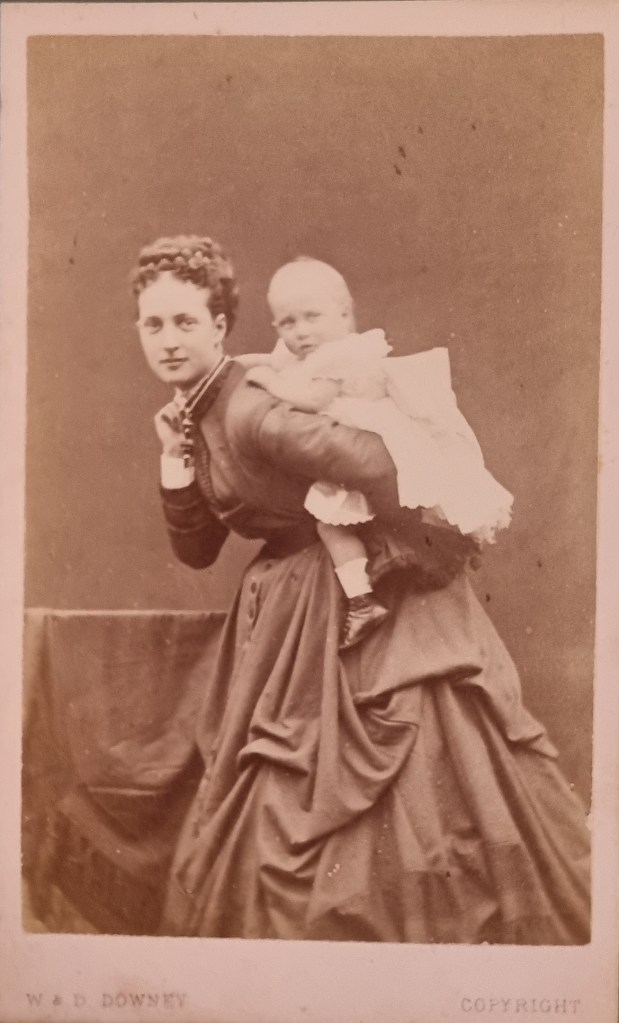
In September 1868, the firm of W. & D. Downey of Newcastle-on-Tyne photographed Alexandra carrying her baby daughter, Princess Louise, on her back.
According to Frances Dimond’s Developing the Picture: Queen Alexandra and the Art of Photography (Royal Collection Publications, 2004), the informal pose was unusual, especially for a member of the royal family.
Dimond argues it was designed to show that the then Princess of Wales had made a good recovery from a long illness caused by a severe attack of rheumatic fever.
When made available to the public, the ‘mother and baby’ photo proved a popular seller, clocking up reported sales of around 300,000 making it among the best-selling carte-de-visite of the era.
Given its widespread circulation, the card features occasionally on Ebay.
Recently, I was able to purchase one for just a few pounds (rather than the tens or hundreds as is sometimes requested by sellers around the world).
This was largely because the seller had described the item as ‘woman with baby on her back.’
It was a transaction that rather underlined the fact that Alexandra, once one of the most famous women in the world thanks to photography, is less recognised in the 21st century.
Documentaries such as Channel 5’s may help rectify that situation.
It’s curious though that the ‘screen grab’ advertising the programme on the channel’s My5 site features what appears to be a shot of Princess Alexandra of Kent, a cousin of the late Queen Elizabeth II.























 Pressphotoman
Leave a comment