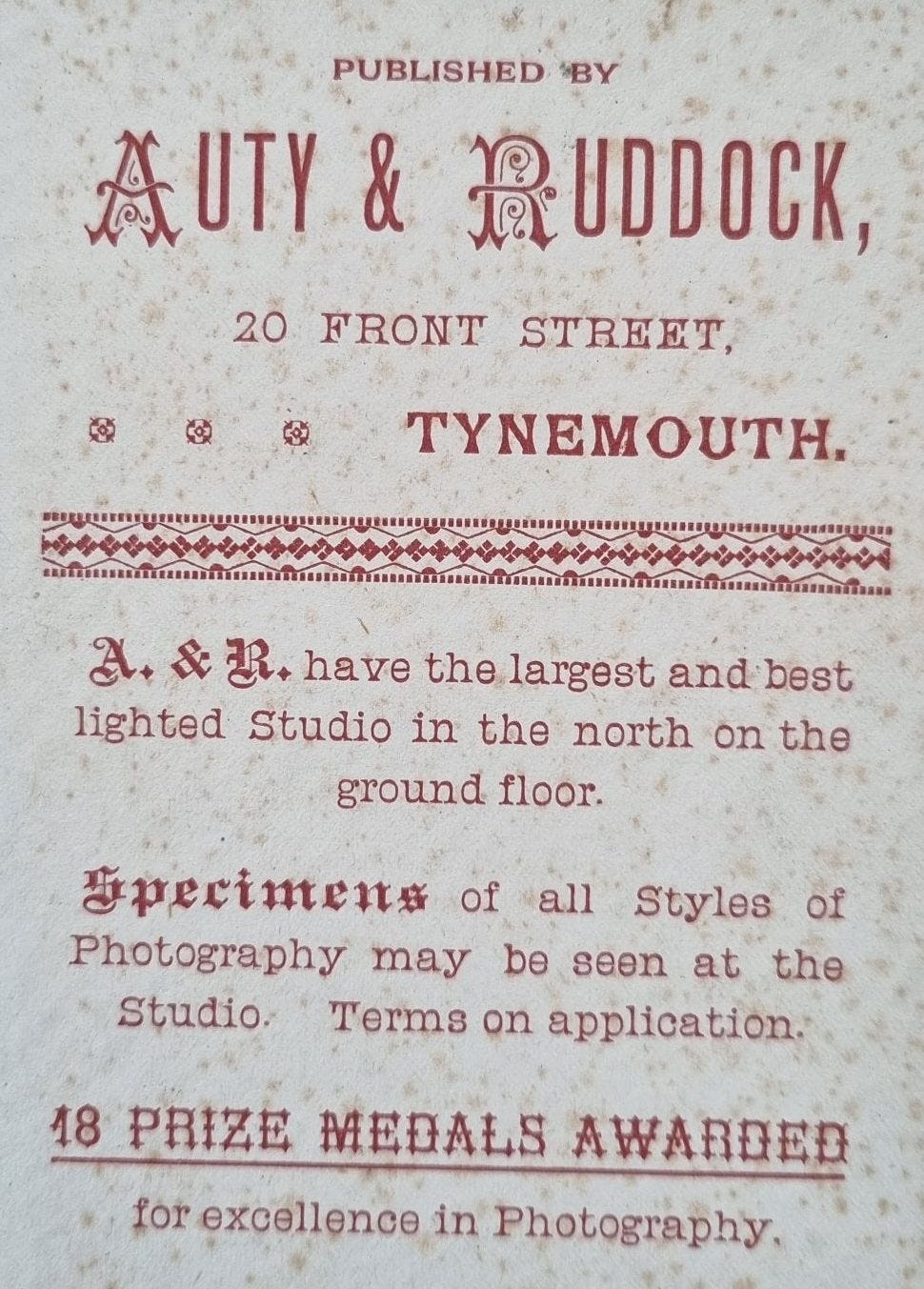
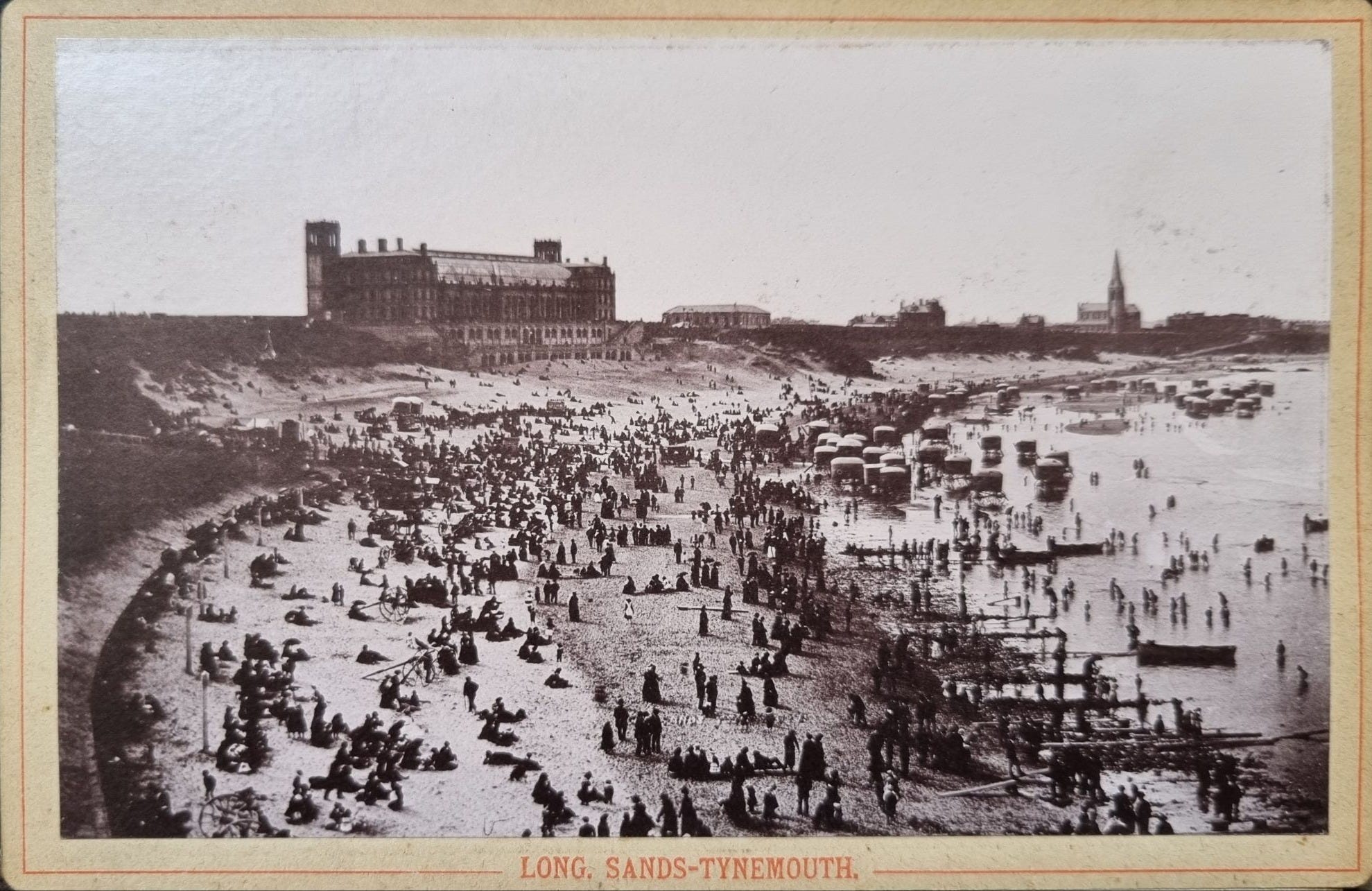
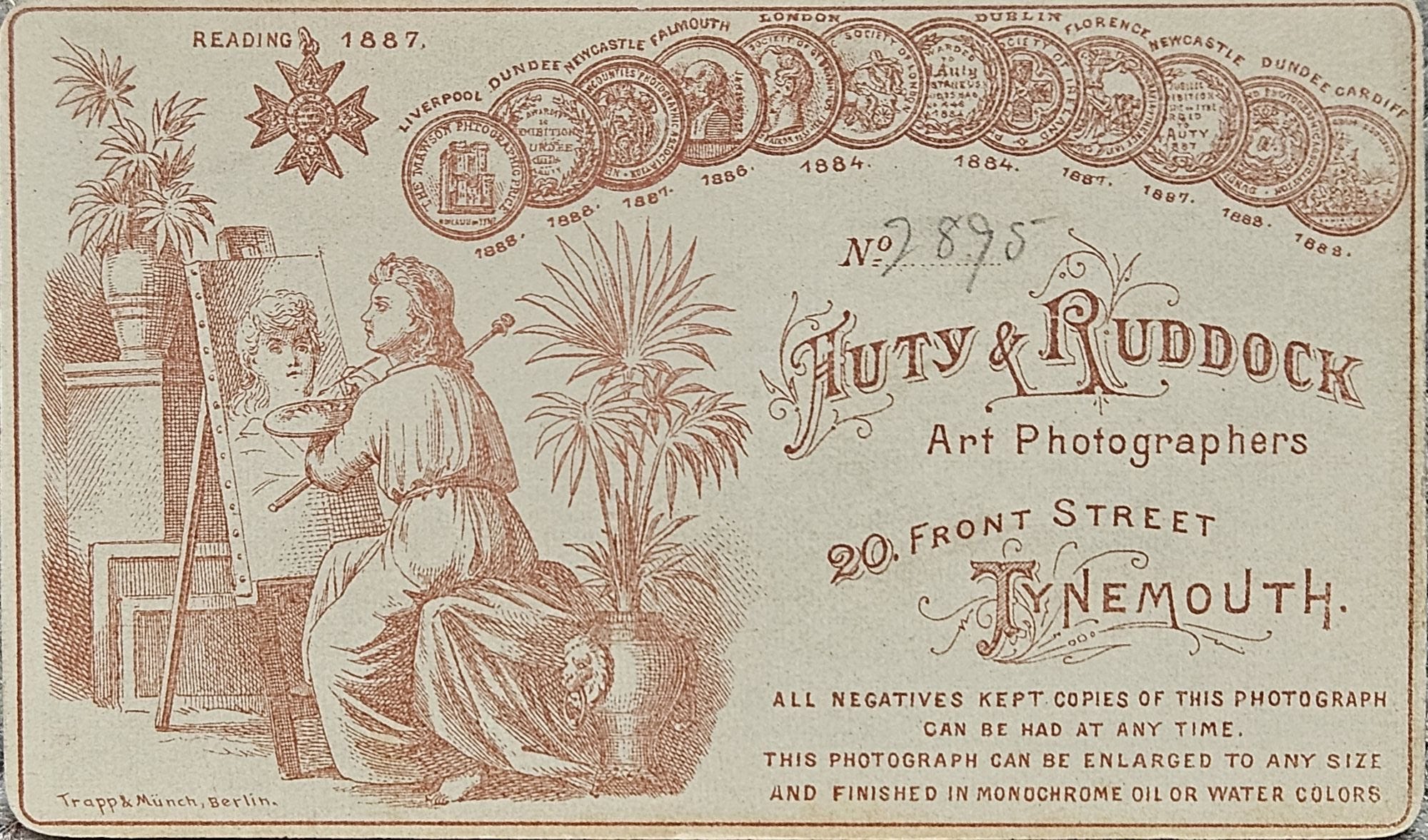
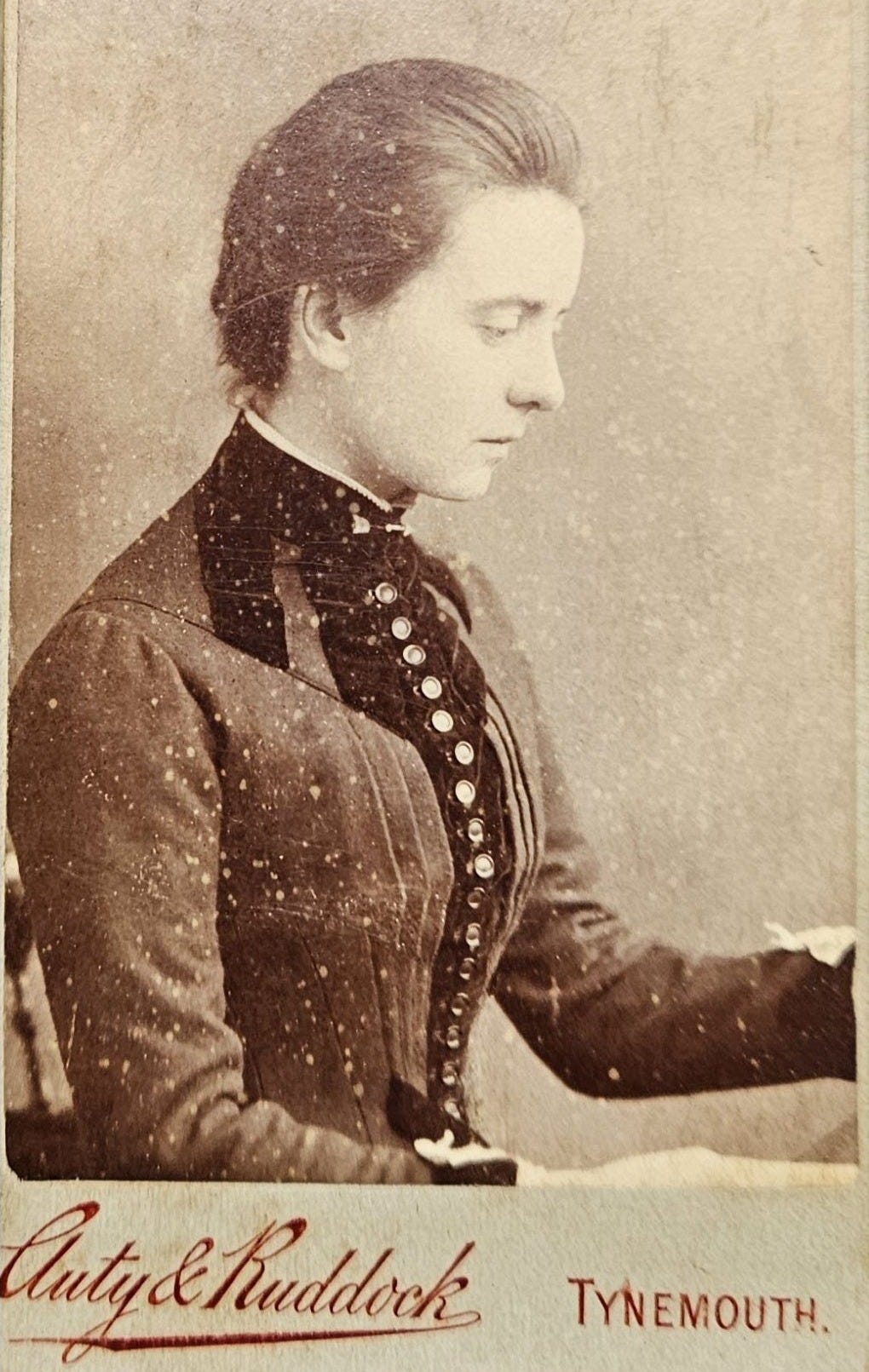
Their short-lived photographic partnership from the late 1880s to 1892 was founded on producing high-quality merchandise.
As an example, a previous Pressphotoman post highlighted a 12-postcard booklet featuring the beaches and cliffs of North East England as they were being transformed by visiting holidaymakers.
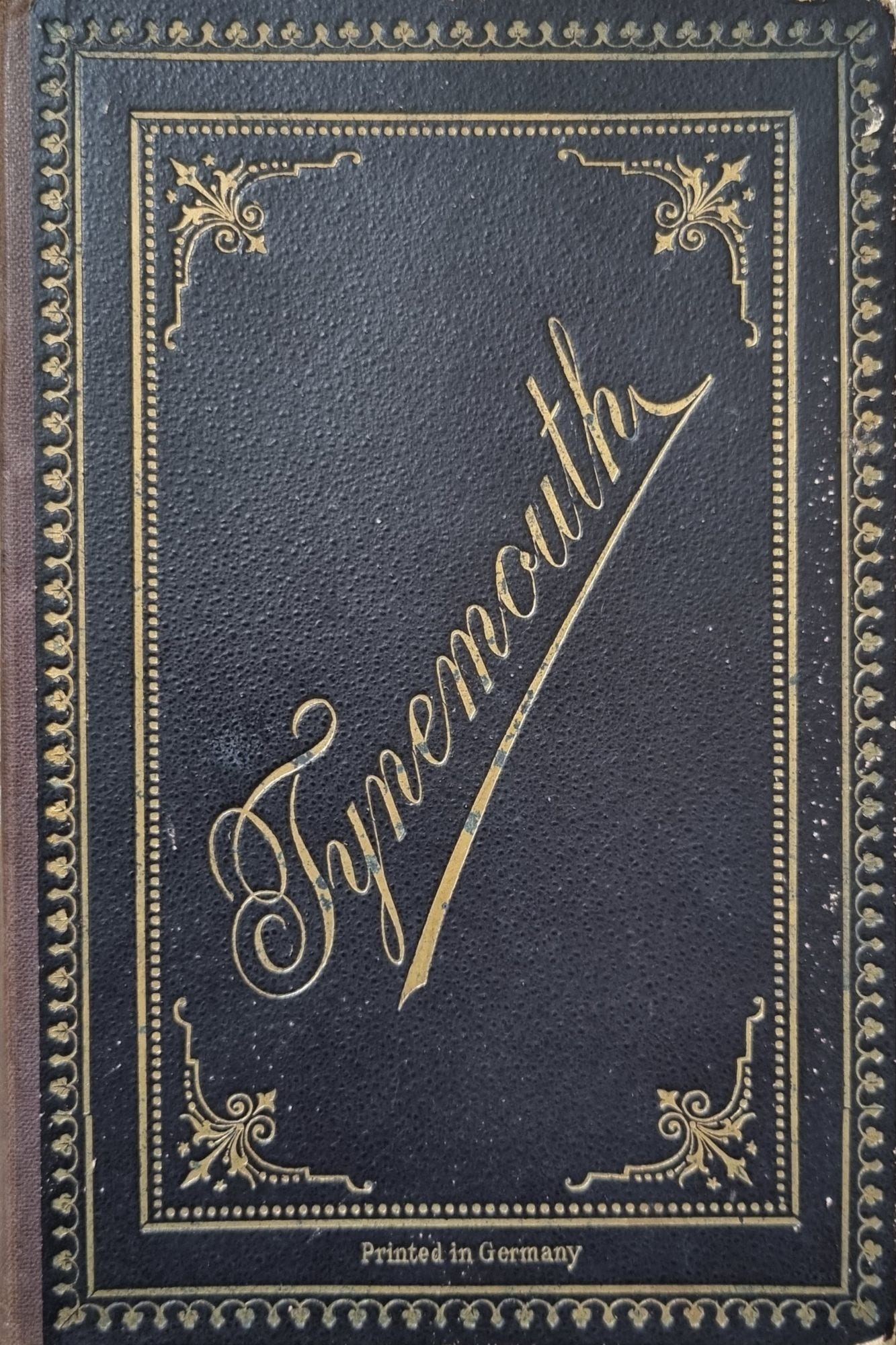
The embossed front cover of the ‘Tynemouth’ booklet proclaimed that it had been ‘printed in Germany,’ which discerning patrons would have known was a mark of its distinction.
German printing firms were widely acknowledged as being world leaders in the production of photographic and colourised postcards whose heyday continued until around 1914.
As to Auty & Ruddock’s trading relationship with Germany, it would also have been informed by the River Tyne’s role in the movement of goods in and out of London as well as to ports in Europe.
This relationship is further borne out by a new addition to the Pressphotoman collection.
A rare Auty & Ruddock carte de visite credits ‘Trapp & Münch, Berlin’ in the bottom left-hand corner.
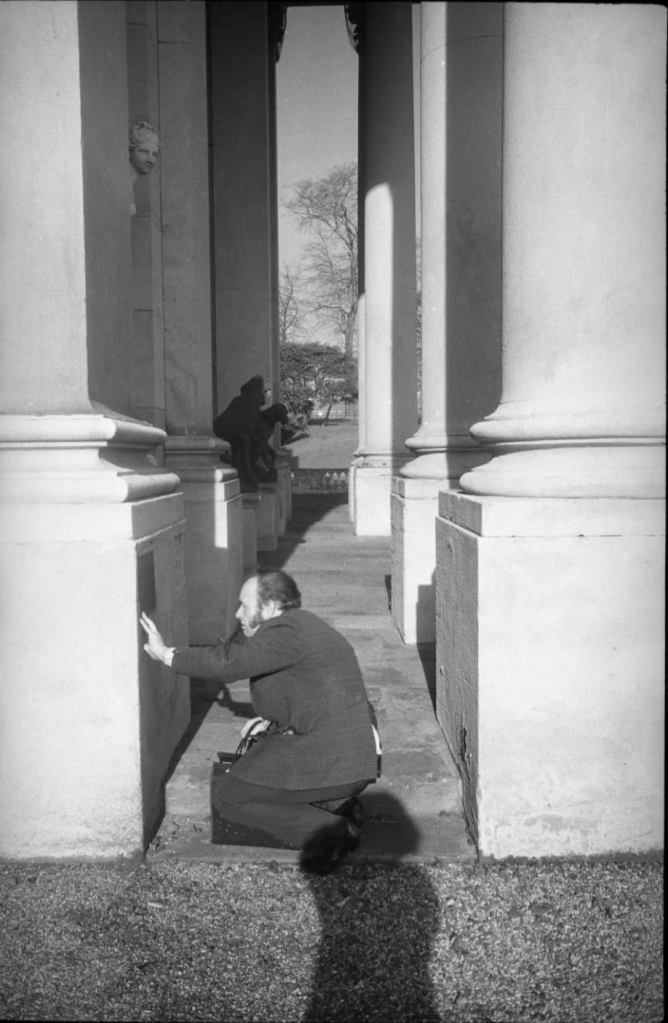
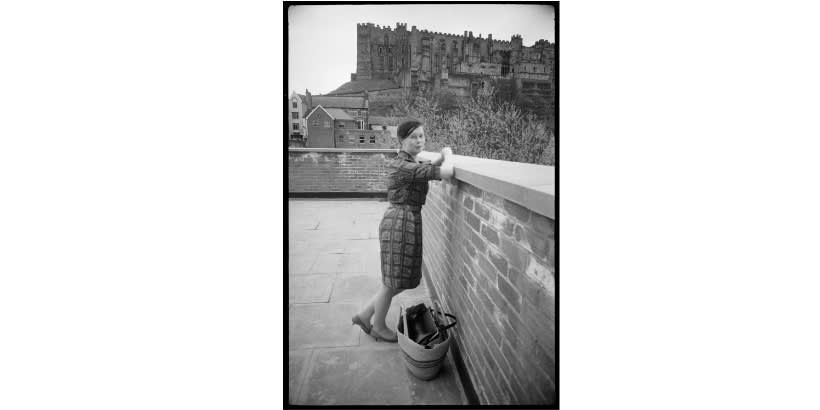
The work of architectural photographer Ursula Clark (1940-2000) is primarily captured in publications produced by Oriel Press of Newcastle upon Tyne.
These include the series of Oriel Guides to England, Scotland, France, Italy and Spain (1963-1969) as well as its Historic Architecture of … series featuring Newcastle upon Tyne (1967), Northumberland (1969), Leeds (1969) and County Durham (1971).
However, these books, many co-authored with Oriel’s Bruce Allsopp, and the quality of Ursula Clark’s images attracted wider attention.
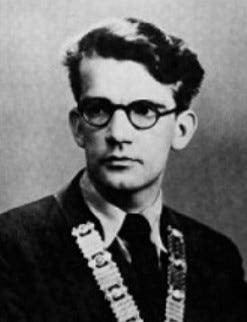
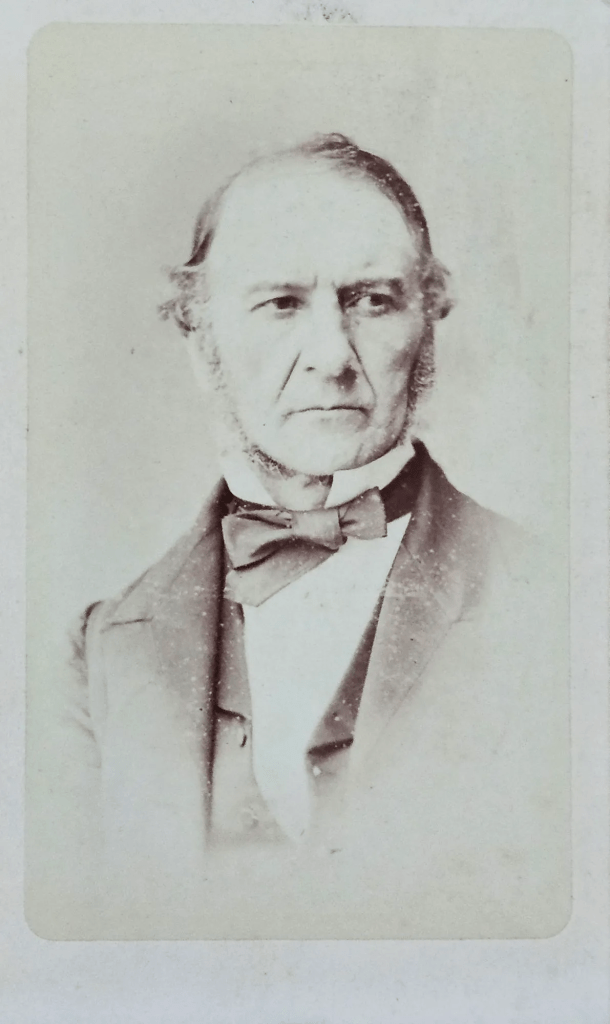
One of their admirers was the celebrated town planner Thomas Sharp (1901-1978) whose many books celebrated the heritage of British architecture.
Thomas Sharp (1901-1978).
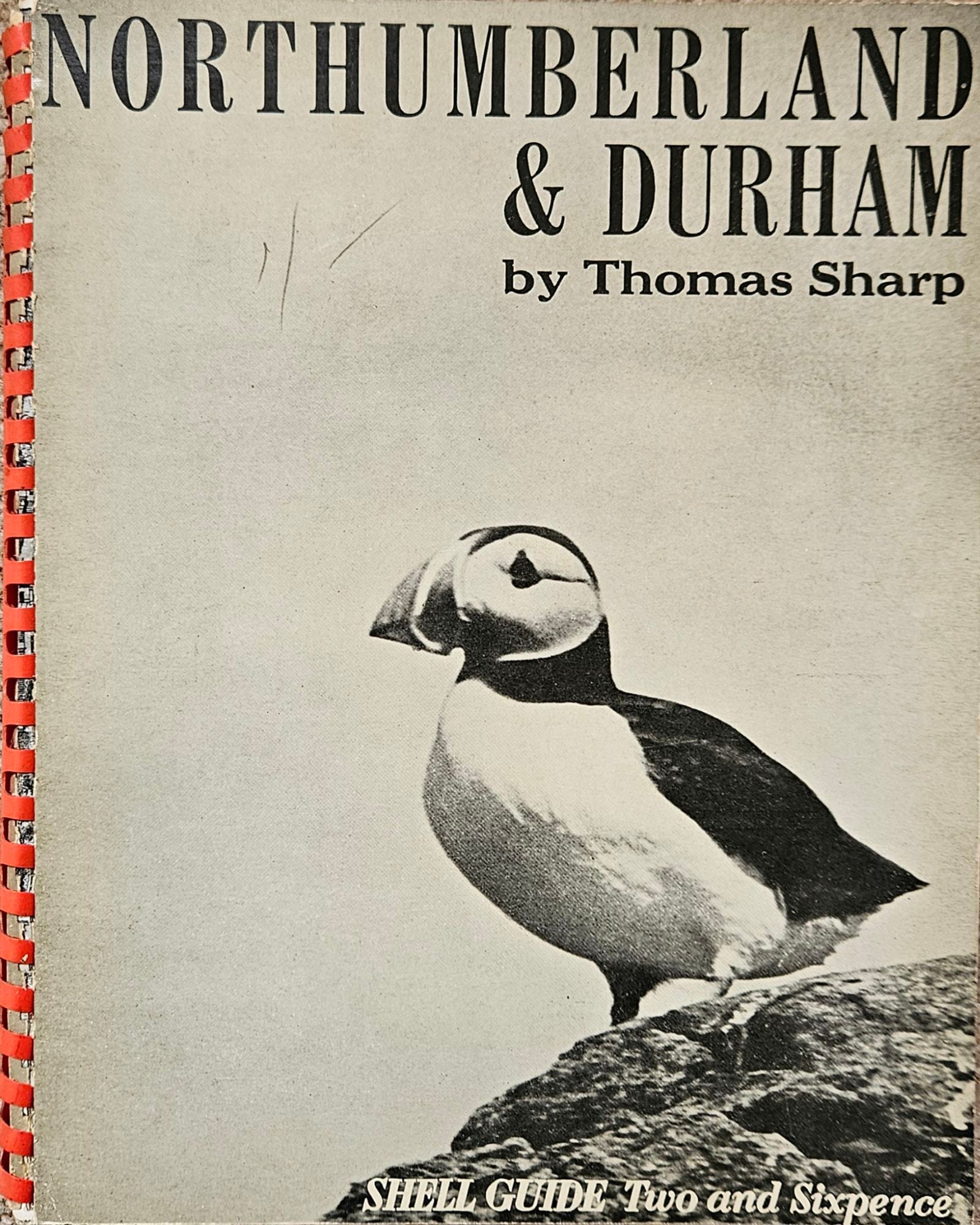
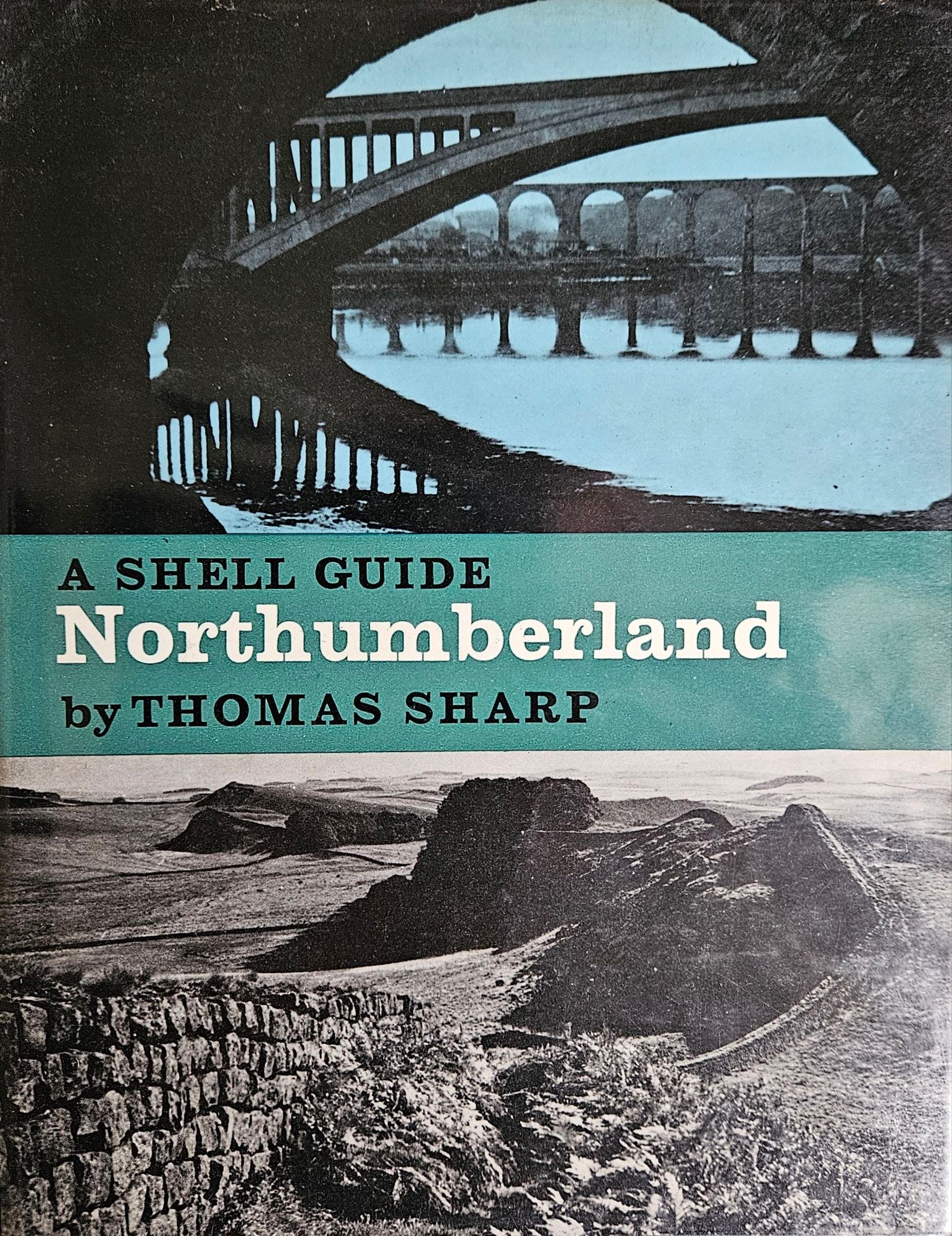
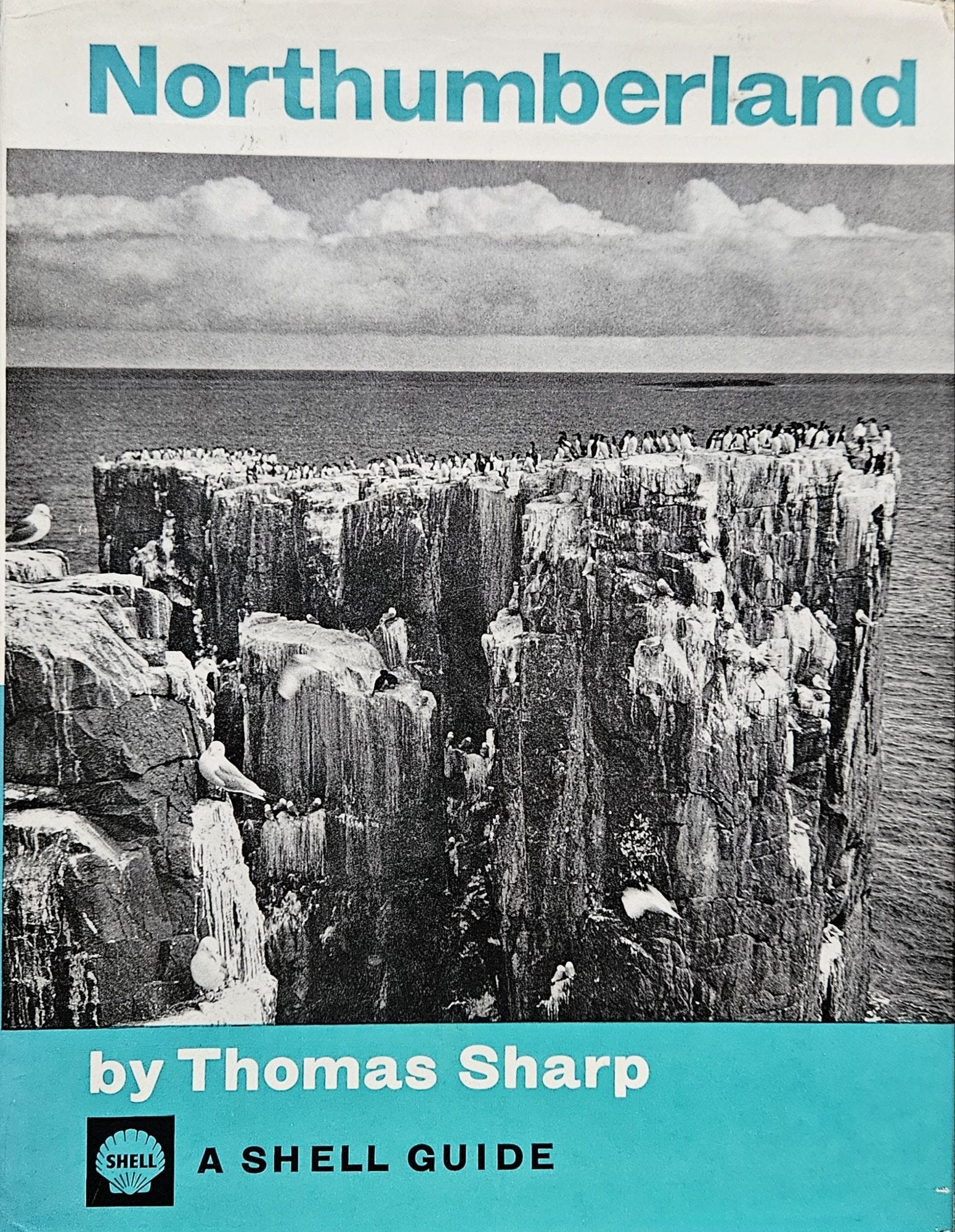
Aimed at motorists and tourists, Sharp had contributed Northumberland& Durham (1937) and Northumberland (1954) to the Shell Guides series masterminded by joint editors John Betjeman and John Piper.
Piper became the series’ sole editor in 1967 and following a request from Faber & Faber, publisher of the Shell Guides, Sharp agreed to revise and update his Northumberland volume for a third edition.
However, correspondence in the Thomas Sharp Archive held by Newcastle University reveals that its production was hindered by a fundamental disagreement about the choice of photographs to be included.
Piper’s biographer Frances Spalding describes Sharp as being “greatly angered” by the issue (Oxford University Press: Oxford, 2009).
In particular, he was “deeply dissatisfied” with some of the proposed images featuring the historic heart of Newcastle upon Tyne which prior to 1974 was part of Northumberland.
In an effort to resolve what had become an impasse, Sharp wrote to Bruce Allsopp at Oriel Press with a photographic request.
“I am most anxious to obtain, as soon as possible, and to be given permission to reproduce, the following illustrations from Historic Architecture of Newcastle upon Tyne.”
He also took the opportunity to request a copy of the book which he described as “so good I should like to possess it” (THS 42.284).
The following day, Allsopp replied positively enclosing copies of the four glossy prints that Sharp had requested (THS 42.285).
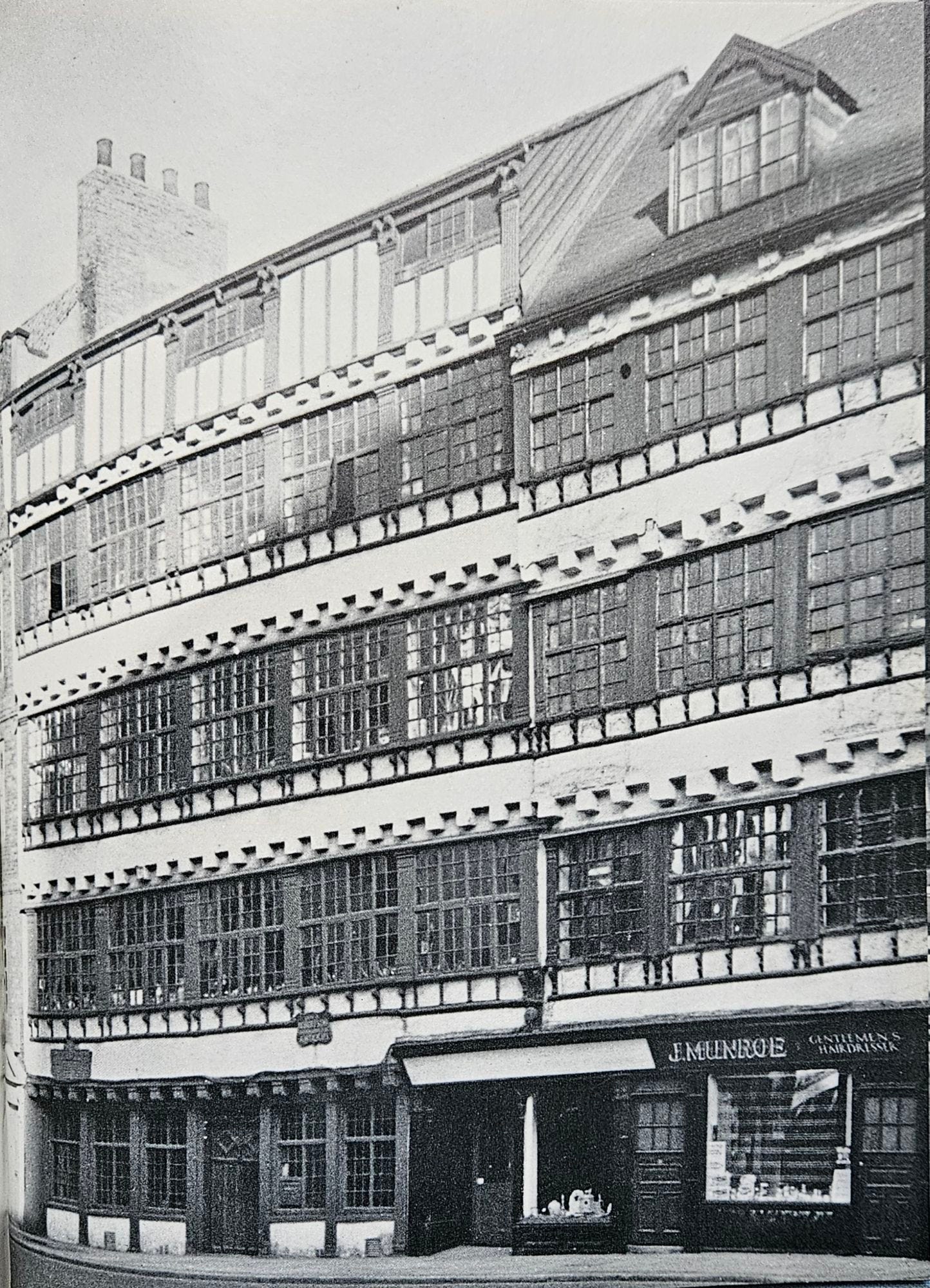
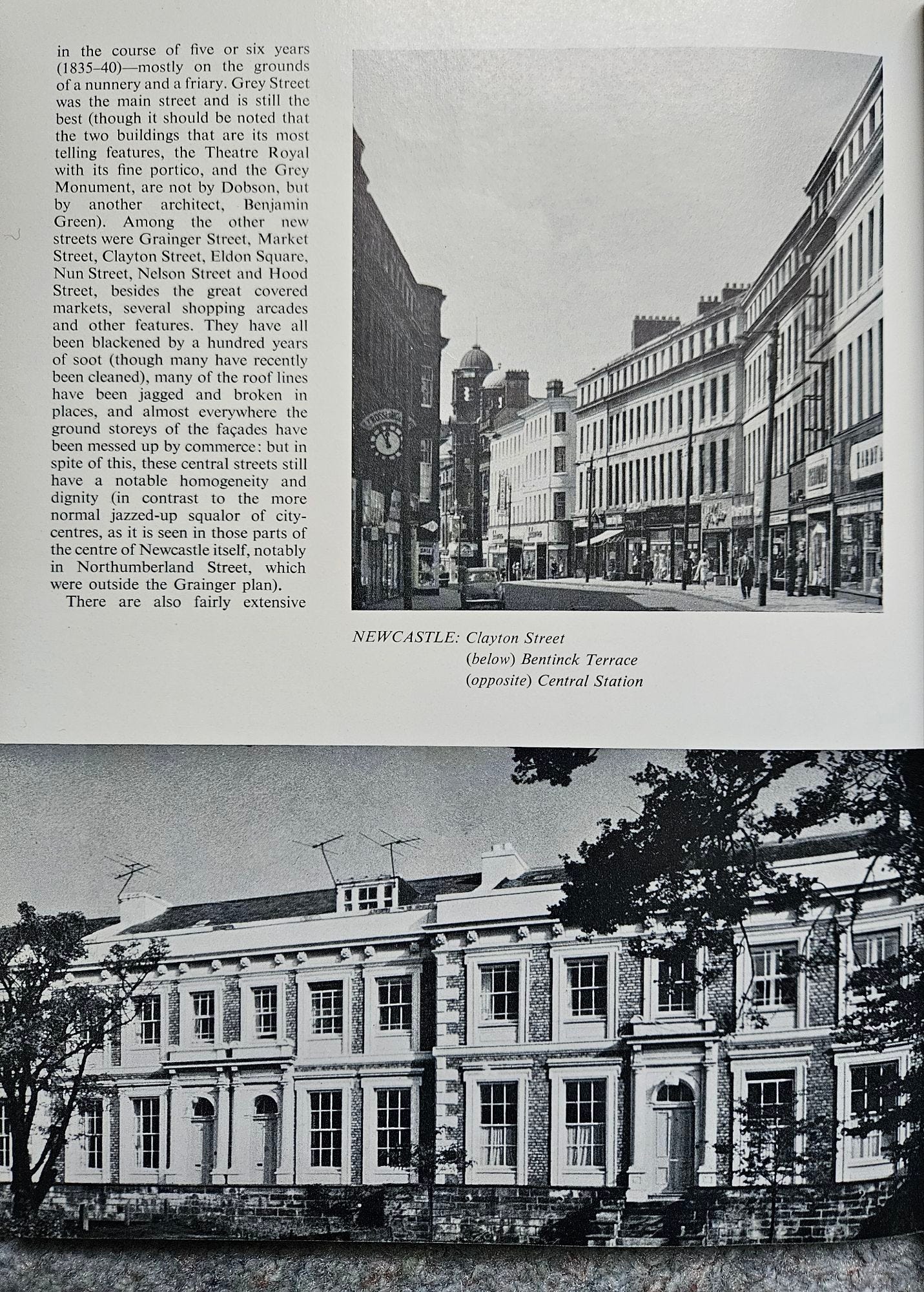
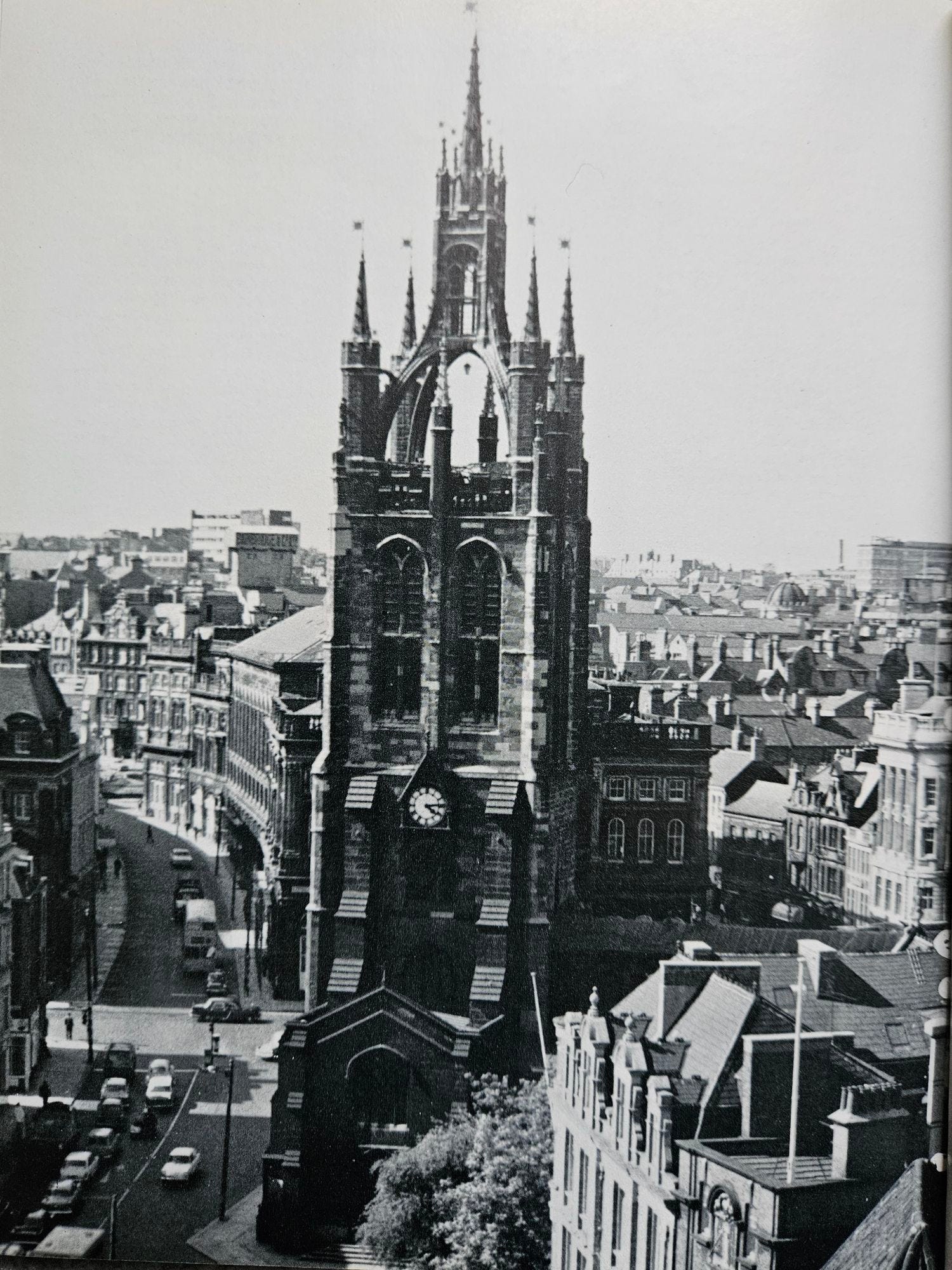
These featured Ursula Clark’s images of (Bessie) Surtees House, Clayton Street, Bentinck Terrace and St. Nicholas Cathedral.
When the book finally appeared, Sharp had succeeded in changing some of the images at the heart of his dispute with Piper including all those obtained from Oriel Press.
Two of Ursula’s shots were given full pages, whilst the other two shared a page with Sharp’s illuminating text.
(Bessie) Surtees House by Ursula Clark. From Northumberland: A Shell Guide by Thomas Sharp (London: Faber & Faber, 1969).Clayton Street and Bentinck Terrace by Ursula Clark. From Northumberland: A Shell Guide by Thomas Sharp (London: Faber & Faber, 1969).St. Nicholas Cathedral by Ursula Clark. From Northumberland: A Shell Guide by Thomas Sharp (London: Faber & Faber, 1969).
Sharp had also suggested an acknowledgement for Ursula Clark which duly appeared in his Prefatory Note alongside a mention for ‘Oriel Studios’ suggested by Bruce Allsopp.
However, the disagreement with John Piper as series’ editor surrounding the final choice of photographs for Northumberland: A Shell Guide continued into its publication.
At Sharp’s request, the following text appeared beneath the list of Illustrations.
Saturday (6th December) marks the Feast of St. Nicholas when celebrations take place in many western Christian countries.
It’s a tradition that dates back to the 4th century when St. Nicholas as Bishop of Lyra was venerated for his generosity to children.
His later transformation into Santa Claus and Father Christmas during the 19th century has rather overshadowed his earlier role in the Christian church.
That said, many churches are named after St. Nicholas including one of my favourite buildings in Britain.
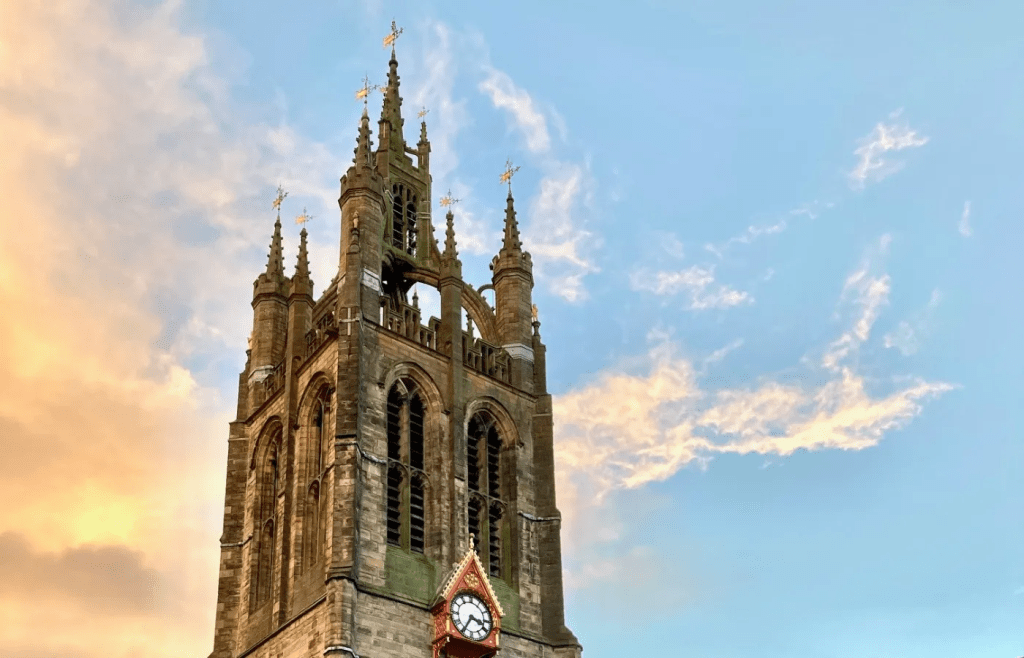
Newcastle Cathedral with its distinctive lantern tower began life during the 12th century as St. Nicholas Parish Church.
It’s a structure that continues to dominate the urban skyline and has been portrayed by successive generations of photographers as my own collection bears witness.
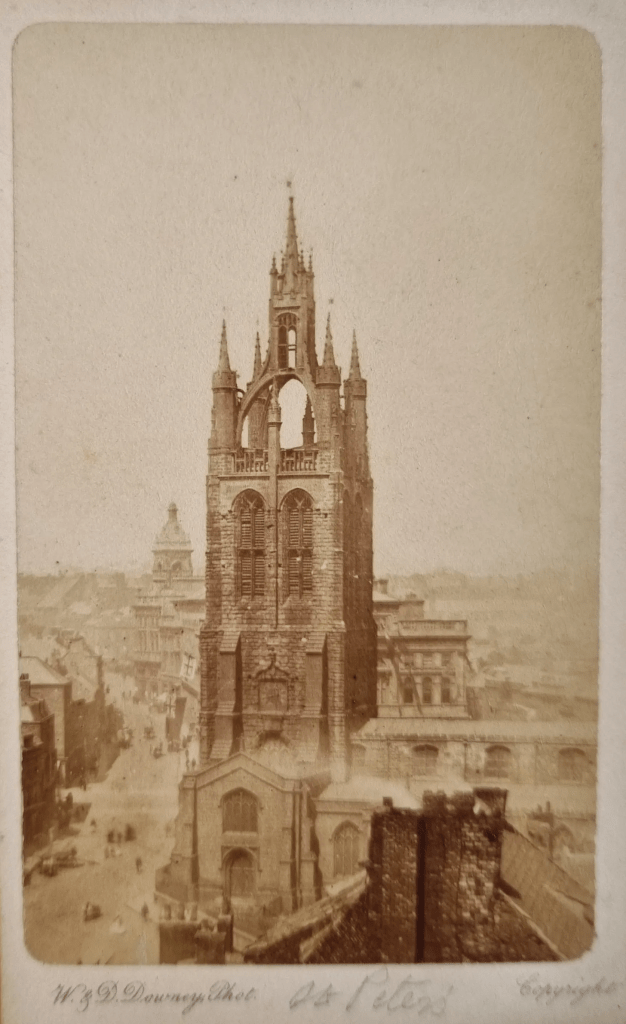
For instance, this carte de visite dates from the mid-1860s when the firm of W. & D. Downey was establishing its Newcastle studio in the heart of the city.
Erroneously titled ‘St. Peter’s’ in an unknown hand, it’s a view that had its origins in a stereoscopic 3D image.
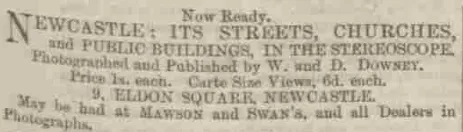
In July 1864 as Downey’s consolidated its reputation for high-quality work, the firm placed one of its regular ‘Now Ready’ advertisements in the local press.
Newcastle Journal (15th July 1864). From British Newspaper Archive.
Like most collectors, the search for a particular image sometimes ends when you are least expecting it.
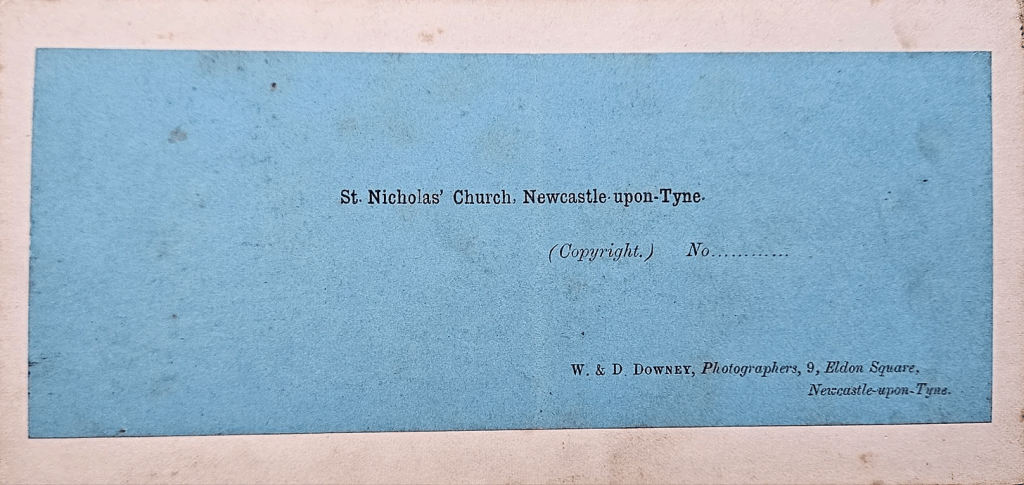
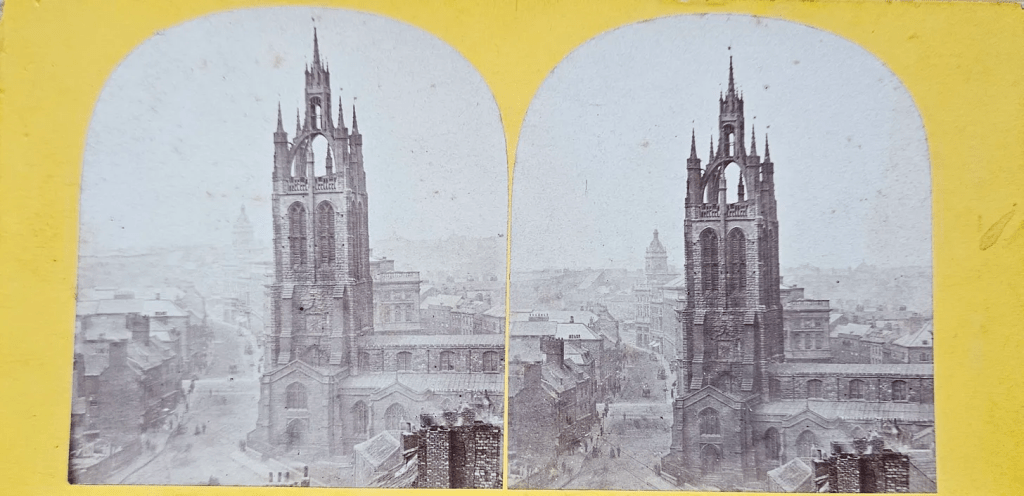
So it proved with a Downey stereo of St. Nicholas’ Church that appeared on a well-known auction site recently courtesy of a seller in the United States.
The first image I saw featured the verso of the stereocard revealing its title details printed on the company’s familar blue sticker.
The only slight disappointment was that, as closer examination of the two stereo halves reveals, the full 3D effect was undermined by the images being slightly out of alignment.
One explanation for this might be a result of the laborious process of cutting the photographic prints to size by hand.
Whether this particular stereo failed to meet Downey’s own high standards and ended up in the bin isn’t known.
Despite this, the pleasure of handling an object that is around 160 years old never fails to pall.
Photography has many memorable names associated with its long and celebrated history.
However, an unusual sounding one caught my attention during a recent research project.
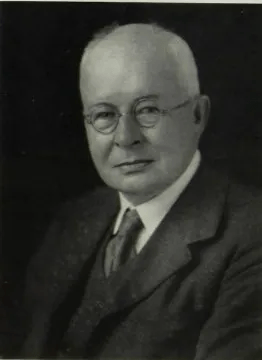
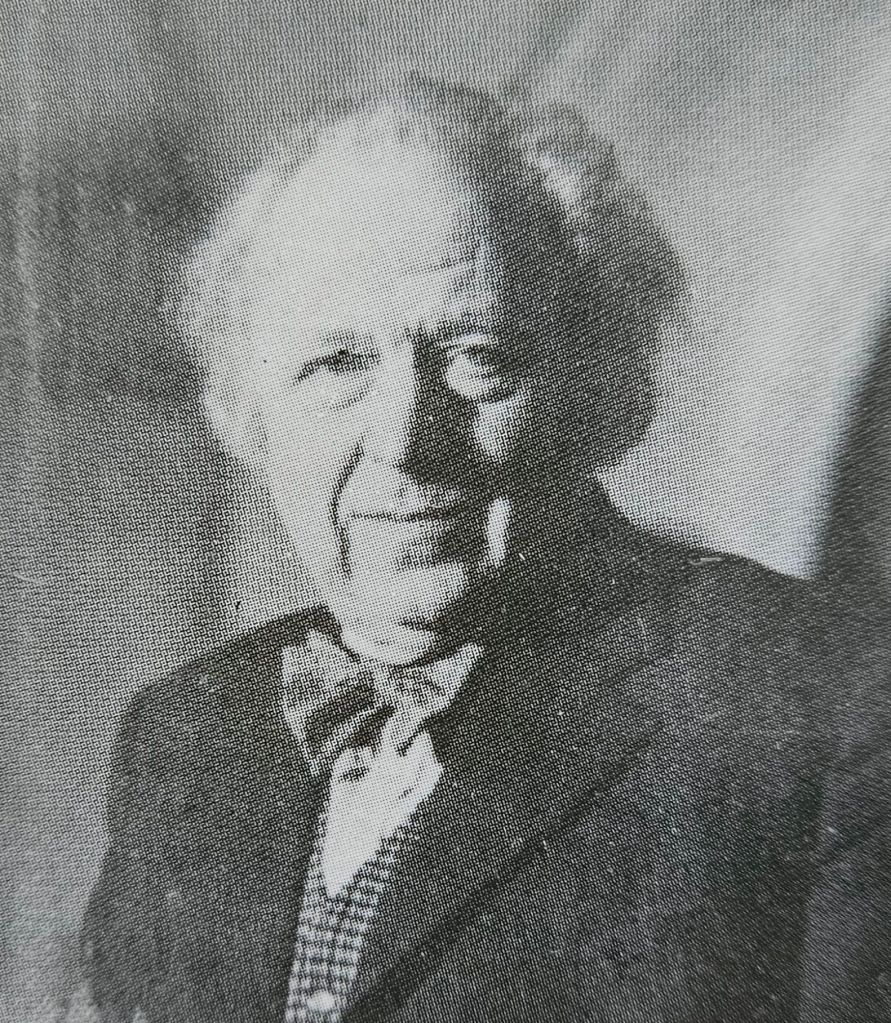
A life-long resident of Newcastle upon Tyne, Burdus Redford FRPS (1868-1951) was an insurance company official by day, but an active and respected photographer in his spare time.
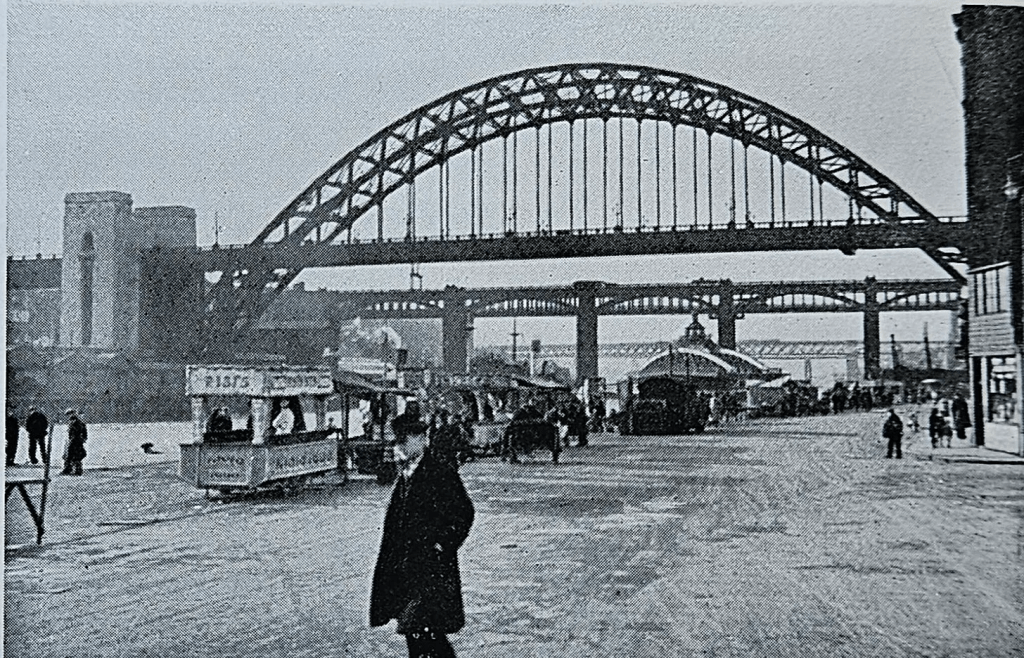
‘Four Bridges’ by Burdus Redford FRPS.Portrait of Burdus Redford FRPS by Philipson & Son Limited, Newcastle upon Tyne. From Royal Photographic Society Journal.
During his life, a number of organisations benefitted from Redford’s skill and expertise, both as a practitioner, who preferred to use plates rather than films, and as a lecturer employing lantern slides to illustrate his talks.
These included Tynemouth Photographic Society which he joined in 1904, later becoming its President; the Northern Counties Photographic Federation; and the Photographic Convention of the United Kingdom of which he was also President in the late-1920s.
This latter accolade seems to have coincided with a period when he became even more photographically active, perhaps in retirement.
For example, his membership of the Royal Photographic Society in 1927 was followed soon after by the award of a coveted fellowship (FRPS).
By this point in his life, Redford’s network of contacts was extensive and included John Betjeman (1906-1984), the celebrated architectural writer and later Poet Laureate
At Betjeman’s suggestion, he was invited to contribute photographs to Thomas Sharp’s Northumberland and Durham: A Shell Guide published in 1937.
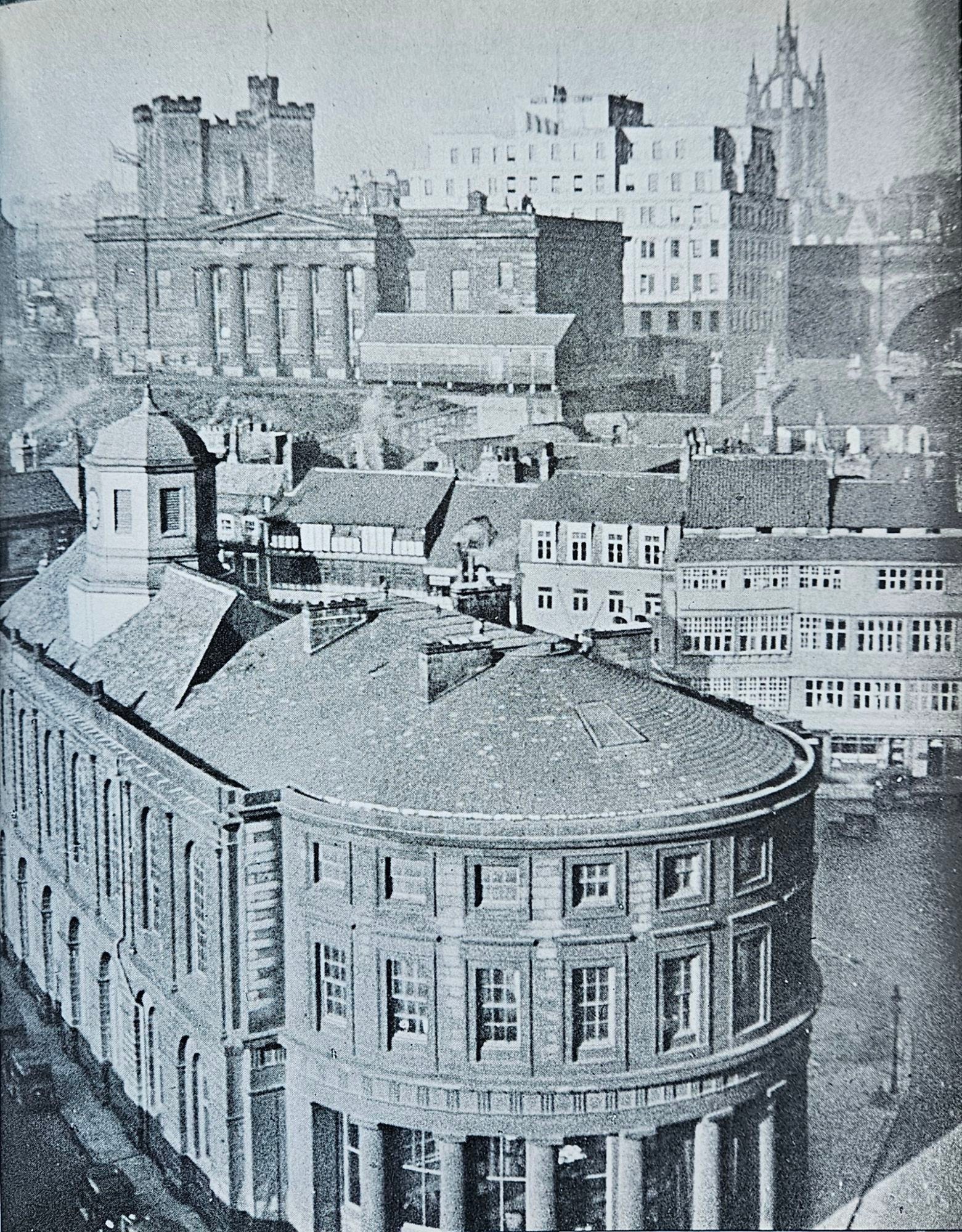
Alongside ‘Four Bridges’ (above), his view of ‘Newcastle’ taken from a high vantage point overlooking the quayside captures a number of prominent landmarks that are still visible nearly a century later.
‘Newcastle’ by Burdus Redford FRPS. From Northumberland and Durham: A Shell Guide by Thomas Sharp (London: B.T. Batsford Ltd., 1937).
The photograph’s quality meant it was still included in a Shell Guide devoted solely to Northumberland published in 1954.
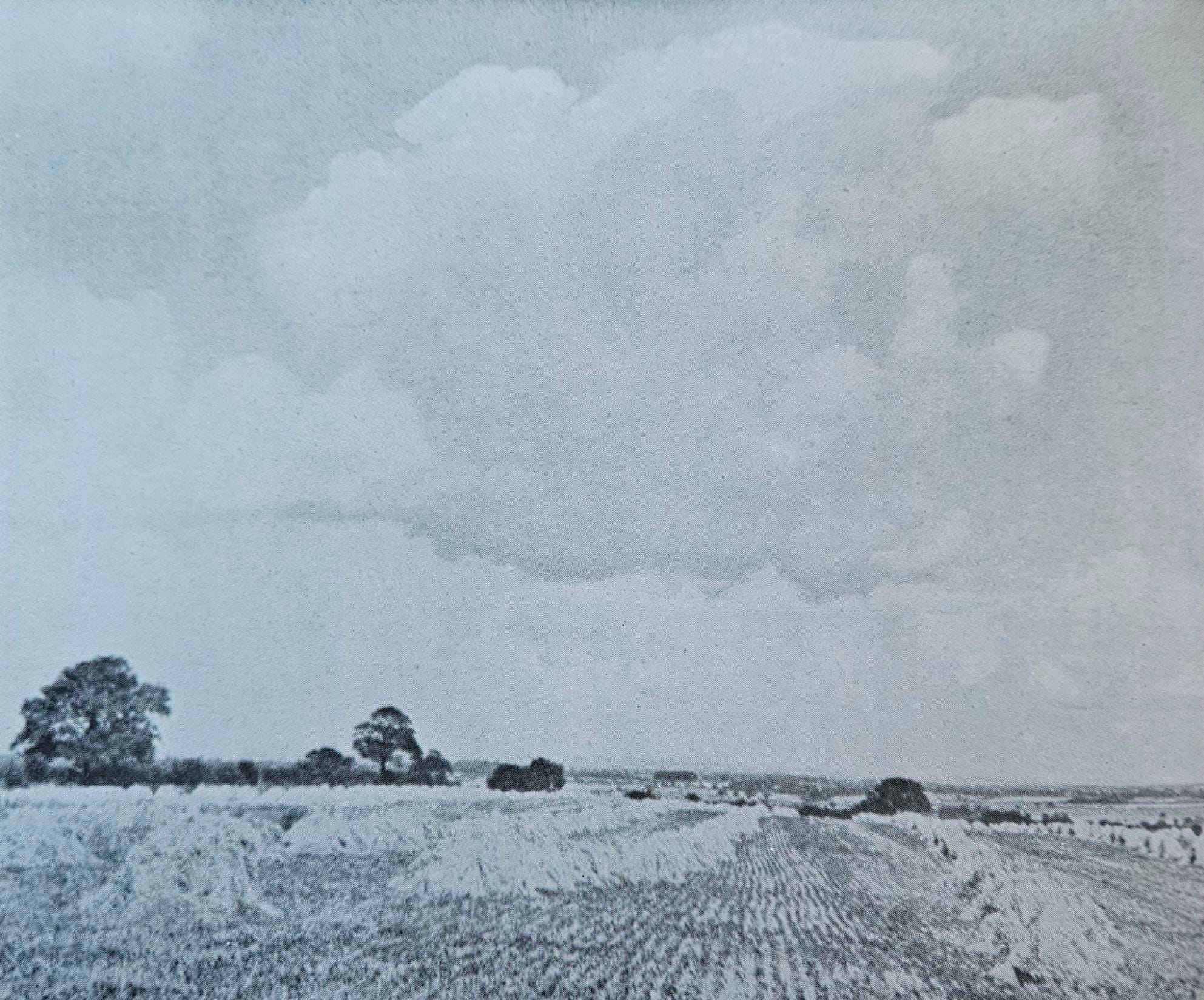
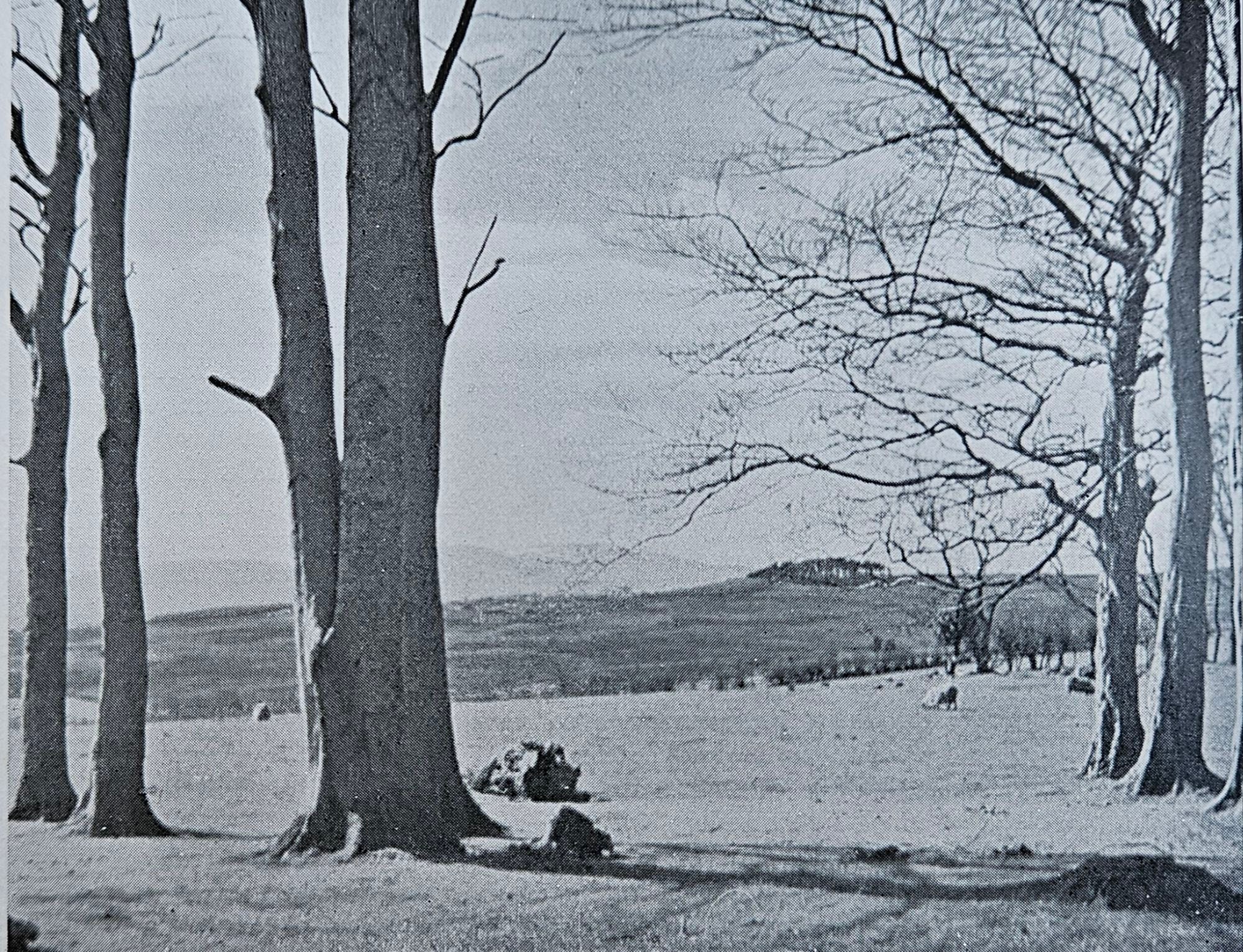
Betjeman was much taken by what he described as Redford’s “really exquisite views”, both rural and industrial.
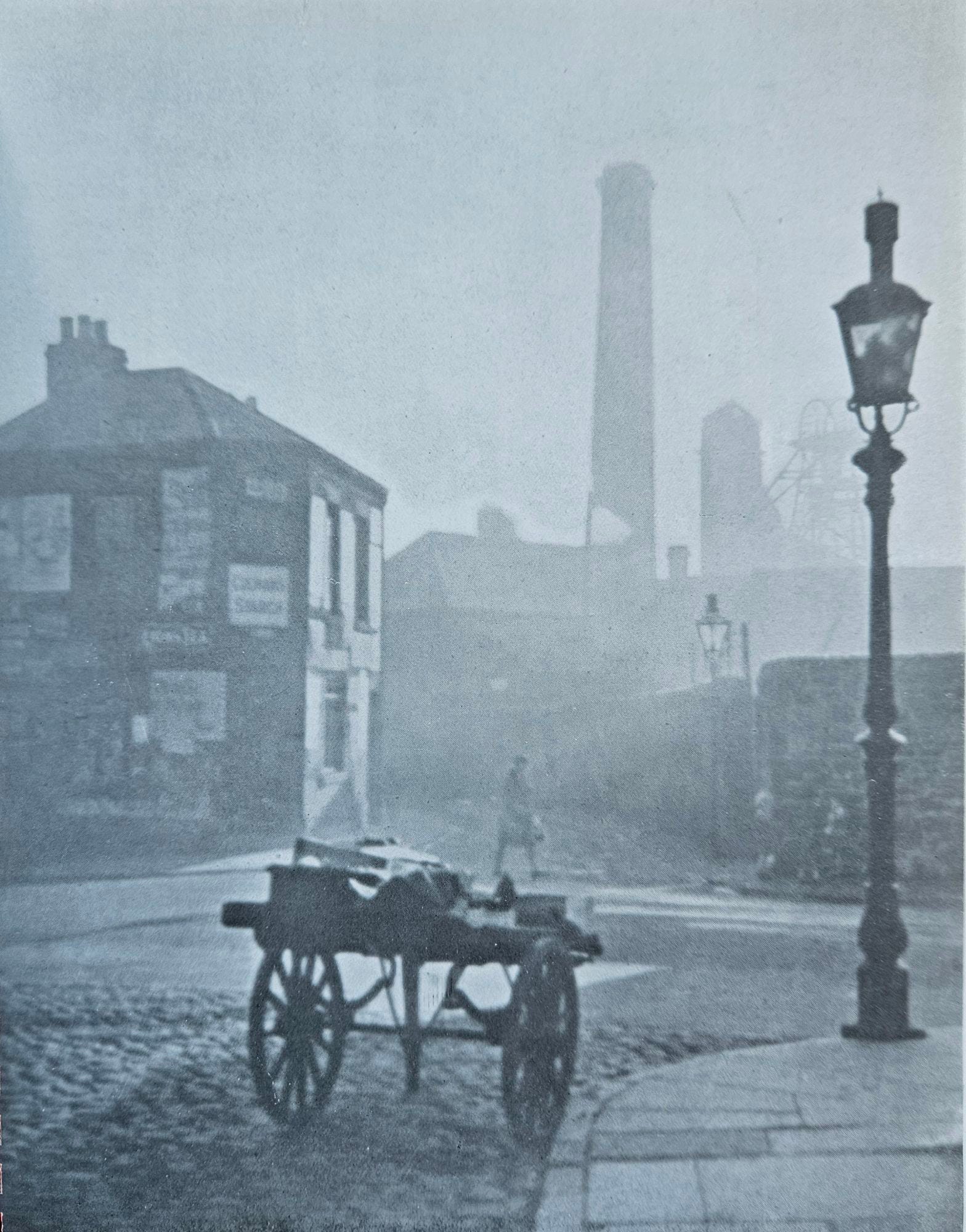
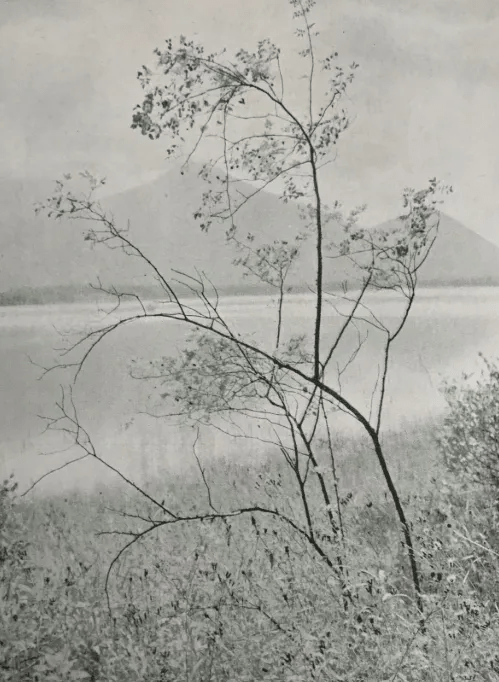
‘Wheatfield’ by Burdus Redford FRPS.‘Hills and Trees’ by Burdus Redford FRPS.‘Colliery’ by Burdus Redford FRPS.
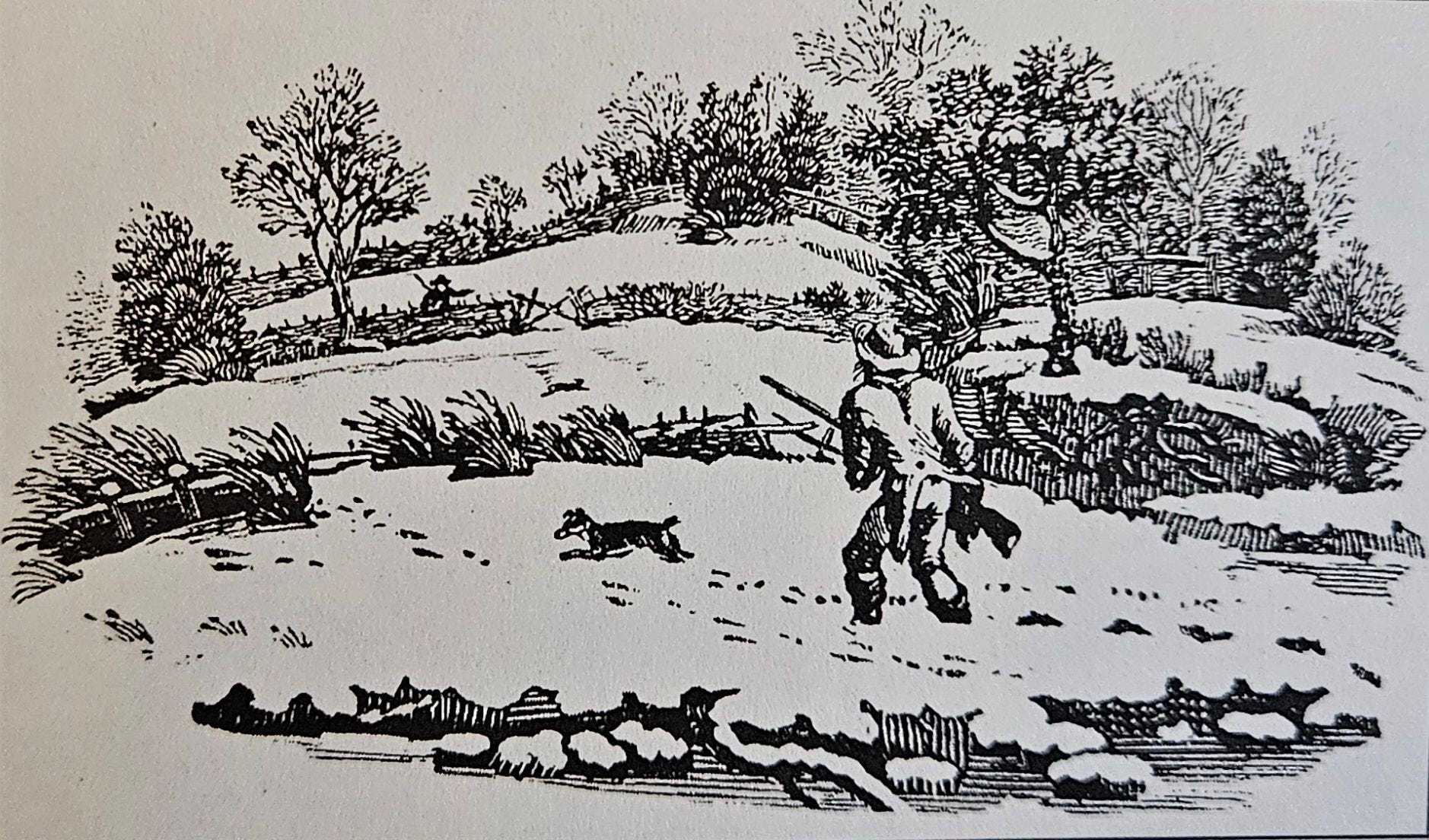
For Northumberland and Durham: A Shell Guide, Redford also supplied reproductions of woodcuts by the legendary North East wood engraver and author Thomas Bewick (1753-1828).
When Burdus Redford died in 1951, aged 82, an obituary published in the Royal Photographic Society Journal described him as “a craftsman … whose work was extremely delicate and showed the meticulous care which so characterised the man himself.”
Bigg Market in the heart of Newcastle upon Tyne is home today to numerous bars and restaurants that are a popular destination for a lively night out.
The name Bigg Market derives from a type of barley – ‘bigg’ – grown in the North of England and Scotland since Neolithic times.
From the early 19th century, varieties of grain from oats to corn were sold at a regular market staged in an area of Newcastle close to St. Nicholas Church, now its Anglican cathedral.
The name Bigg Market stuck.
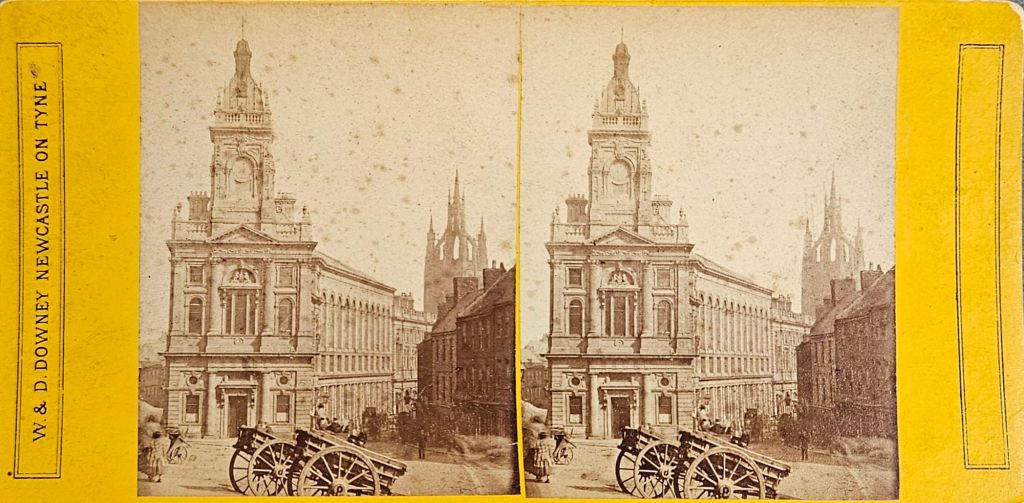
It is a location captured during the late-1860s in this 3D stereocard by W. & D. Downey that has recently become part of the Pressphotoman collection.
Stereoscopically, it has the hallmarks of their work in terms of quality with the two wheeled carts in the immediate foreground acting as a trigger for the three dimensional effect.
Even without a stereo viewer to hand, it is possible to achieve the 3D effect by looking into the heart of the card and relaxing your eyes.
Downey’s had published stereos since its early days in South Shields at the end of the 1850s, but examples are hard to find.
Dating this card is helped by the knowledge that the prominent facade of Newcastle Town Hall (with St. Nicholas Church and its distinctive lantern tower in the background) was completed in 1863.
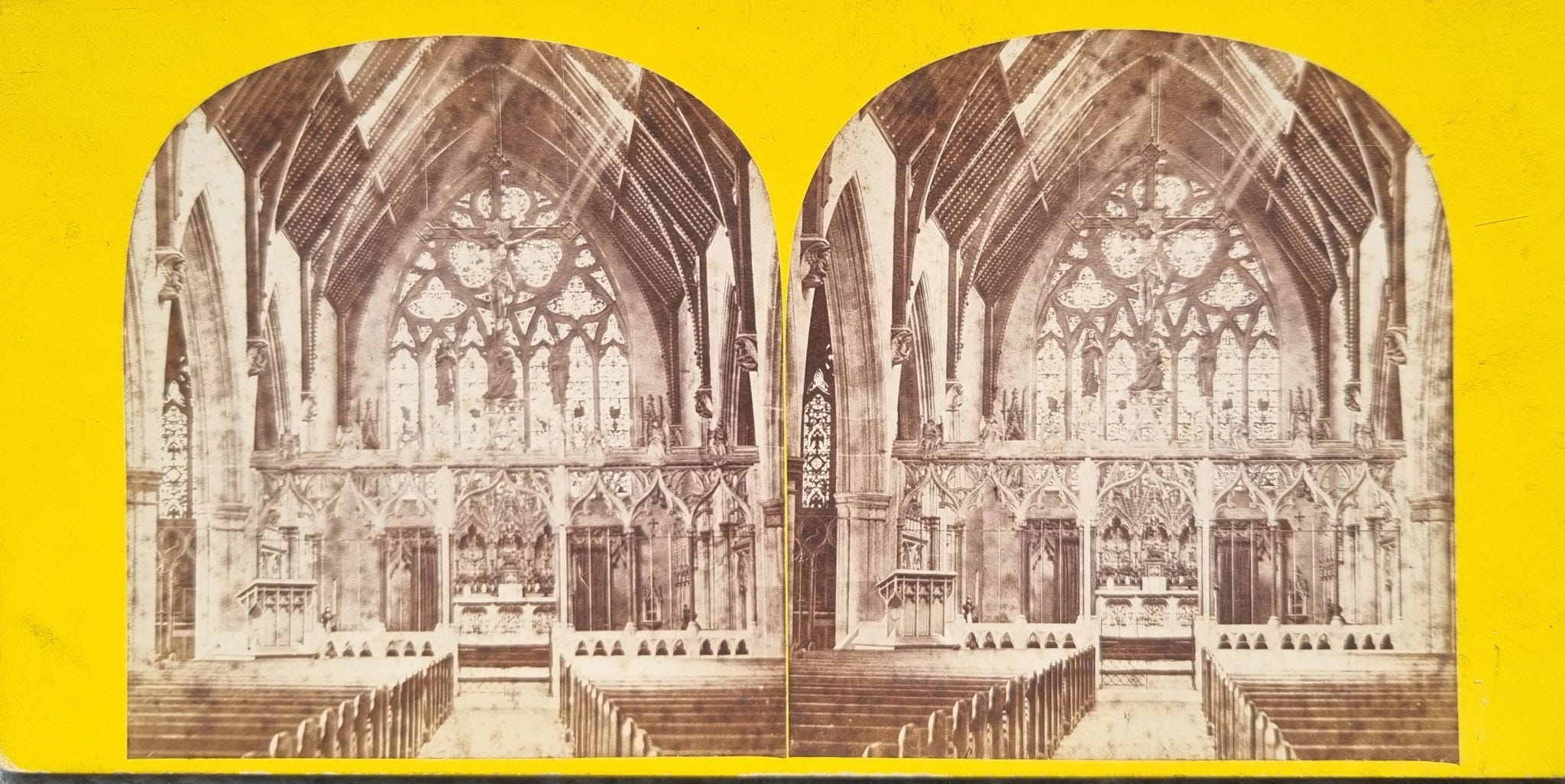
Another Downey stereo in my collection features the town’s catholic cathedral, St. Mary’s, and dates from around the same time when the company was actively promoting its series of ‘views’ of Newcastle in press adverts.
Again, yellow card is used, but the images are arched rather than square; and the verso features a blue coloured sheet of paper pasted onto the card that helped the stereos retain their shape.
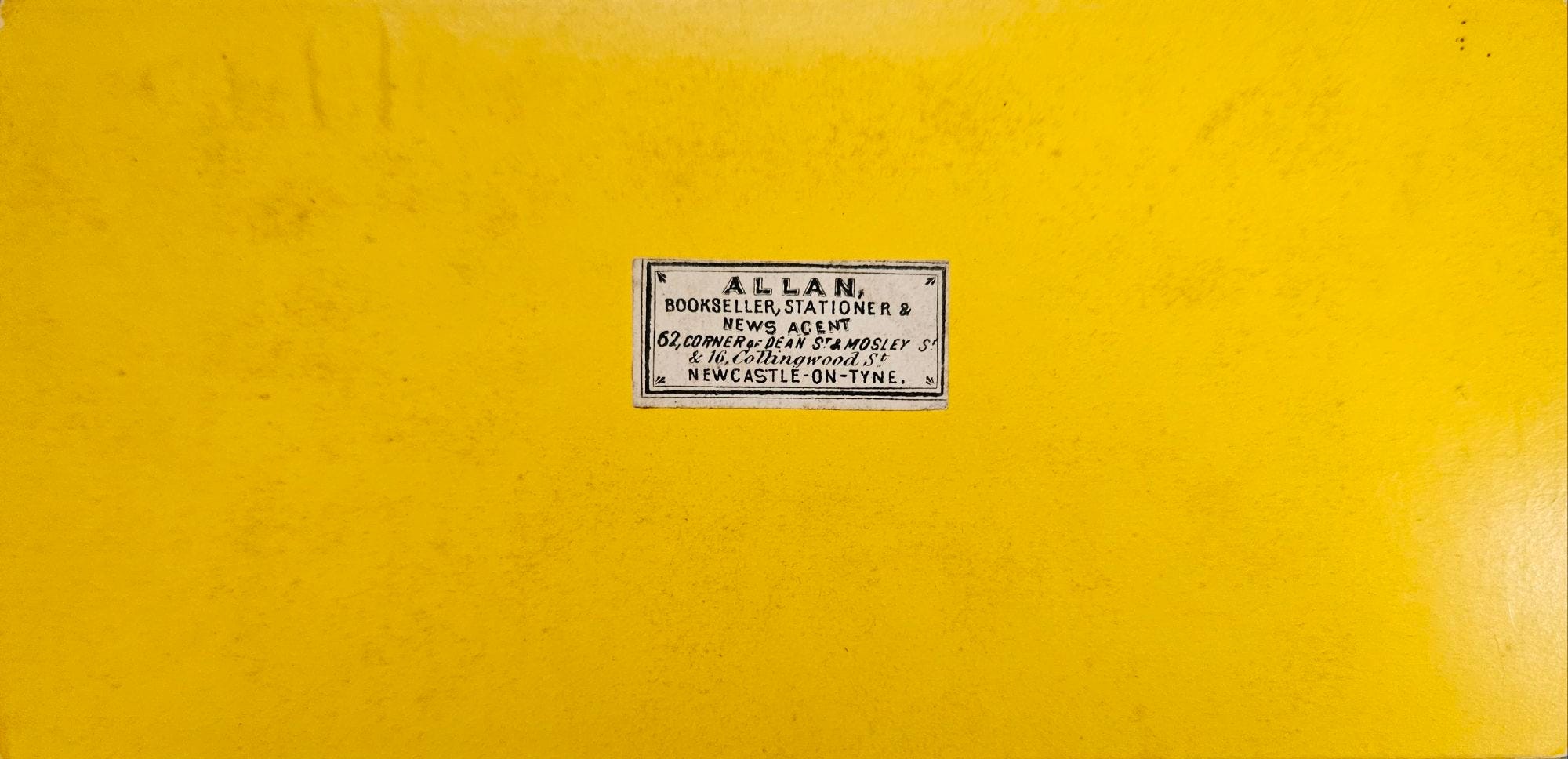
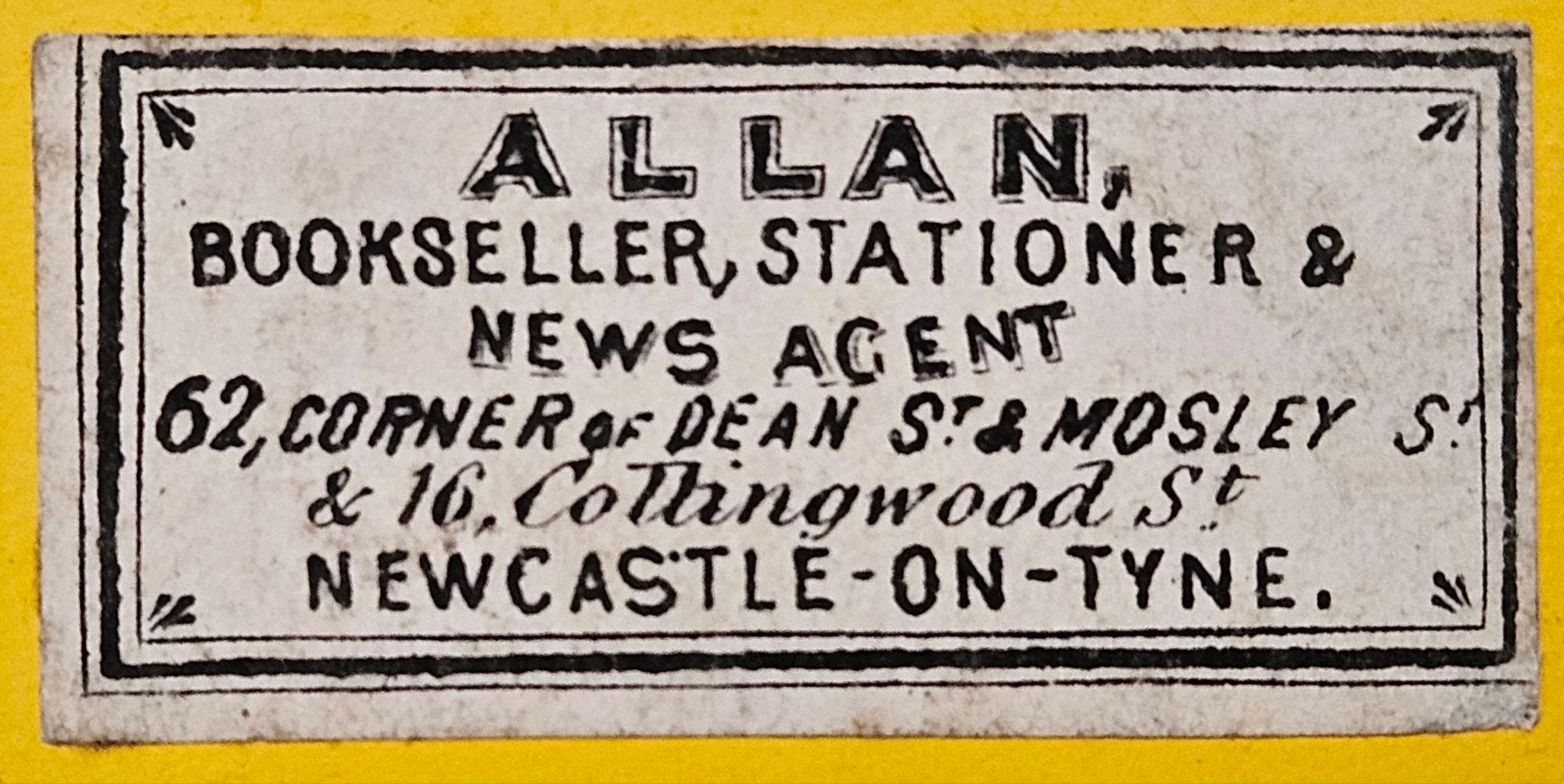
One feature that is common to several Downey items in my collection is the same seller’s stamp on the verso.
‘Allan’ was Thomas Allan (1833-1894), a Newcastle blacksmith with a love of reading who set up in business as a bookseller and newsagent in 1858.
Three years later, he established another branch in nearby Dean Street which then moved to the ‘corner of Dean Street and Mosley Street’ as per his seller’s sticker.
As the company established itself in Newcastle, Downey’s ever-expanding range of carte de visite as well as stereocards were available to customers at all branches of Allan’s.
Thomas Allan joined forces with his brother William in 1881 and the T. & G. Allan company was a thriving concern across the North East of England into the 21st century.
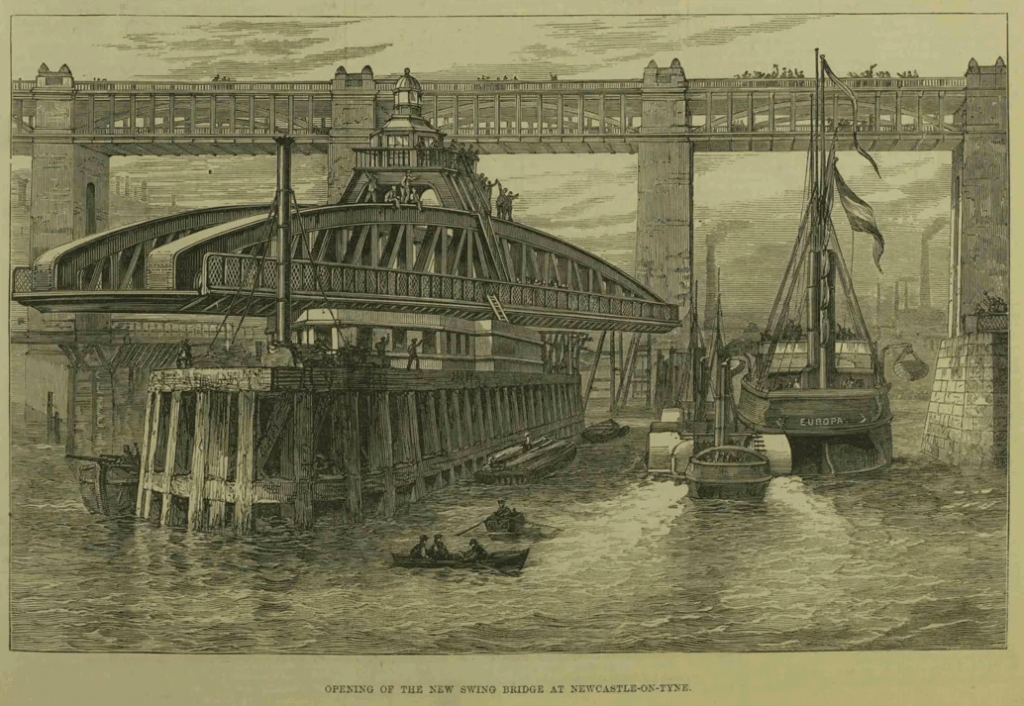
This week in 1876, one of the engineering wonders of the industrial age in Britain opened to river traffic for the first time.
The wrought iron Swing Bridge on the River Tyne linking Newcastle and Gateshead was designed to improve navigation for larger ships and expand trade on its upper reaches.
171 metres long and 14 metres wide, the bridge swung open around a central pivot, creating two unobstructed waterways on either side of its main central pier.
As the fourth structure to be built on the same site spanning Roman and Medieval times, it cost £240,000 (or £24 million in today’s money).
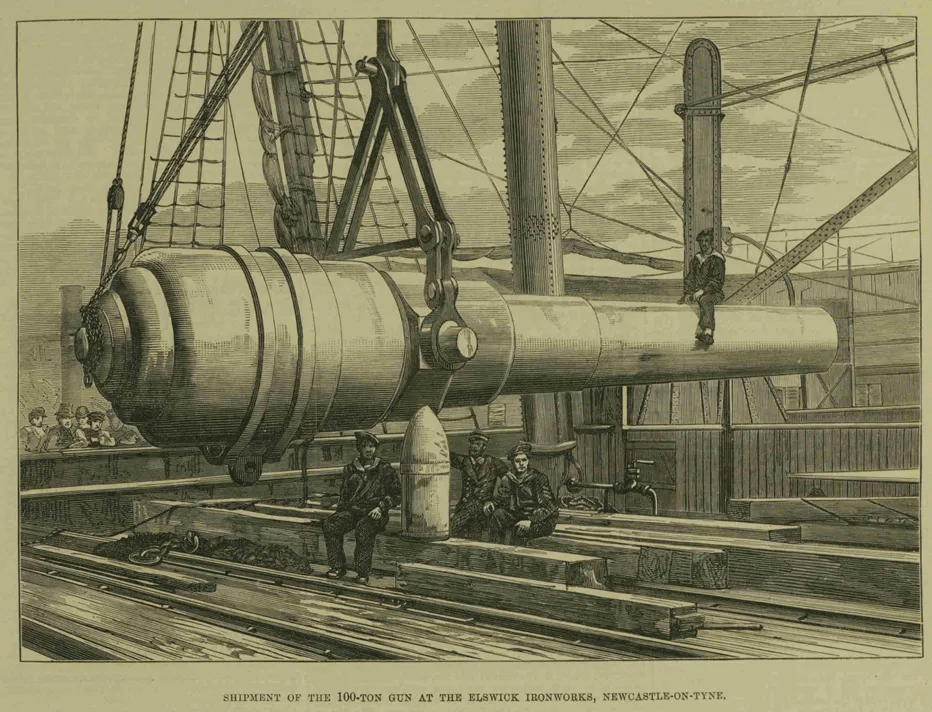
An engraving published in the Illustrated London News captures the moment on Monday 17th July 1876 when The Europa became its first customer.
Illustrated London News (29th July 1876). From British Newspaper Archive.
Dwarfed by the high-level railway bridge in the background, the ship was on her way to pick up a 100 ton gun from the Armstrong works at nearby Elswick for the Italian government.
Illustrated London News (29th July 1876). From British Newspaper Archive.
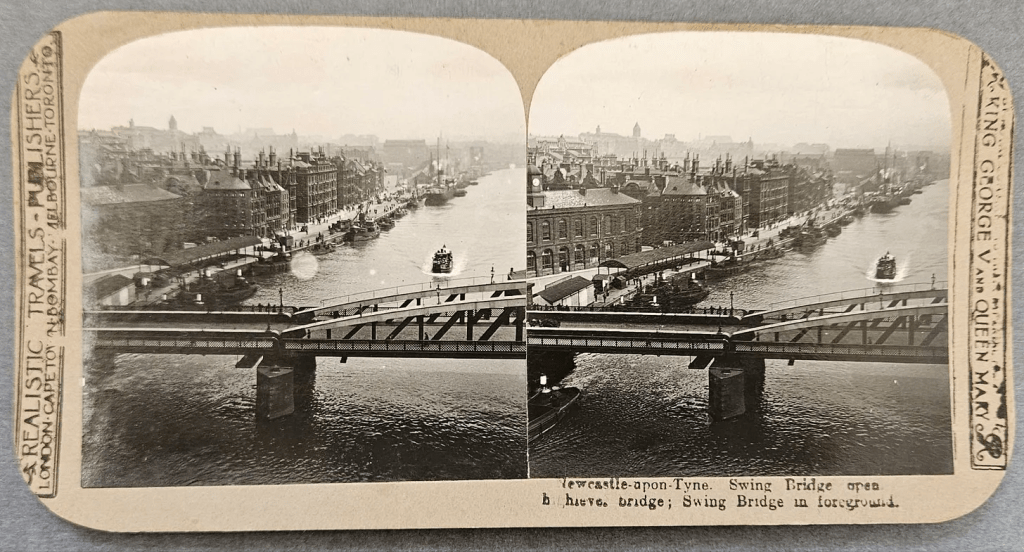
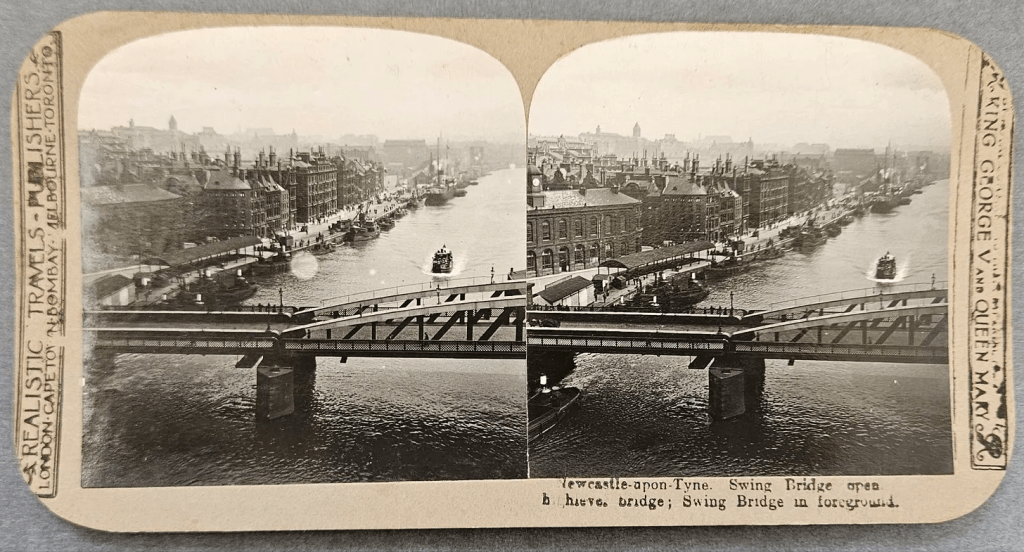
The Swing Bridge has long been a popular photographic subject and its distinctive design was what caught my eye when a stereocard in which it featured recently appeared on eBay.
Produced by Realistic Travels of London, Capetown, Bombay, Melbourne and Toronto, it shows the Newcastle quayside in the background lined with ships and other vessels.
Realistic Travels are best-known for their sets of First World War battle scenes mimicing giant publishers such as Keystone View and Underwood & Underwood.
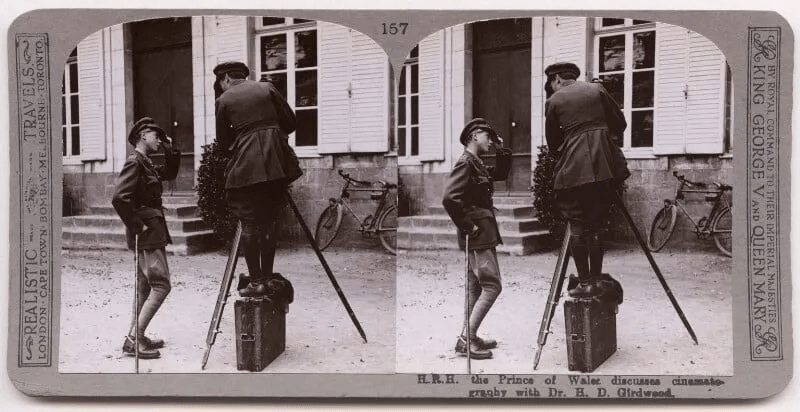
Indeed, one of Realistic’s co-founders, Hilton DeWitt Girdwood (1878-1964), had learned the 3D trade with the Underwood company as a salesman and later as a stereographer.
A stereo titled ‘HRH the Prince of Wales discusses cinematography with Dr. H. D. Girdwood’ is part of the collection of the National Portrait Gallery, London complete with the Realistic Travels branding.
As described by Paul M. Bond in a recent article for Stereo World magazine (January/February 2025), Girdwood and his business partner Henry Creighton Beckett also produced non-war stereos from as early as January 1919.
Realistic Travels operated from a London address at 73 Westwick Gardens, Hammersmith and the small-scale nature of the operation is perhaps reflected in the poor quality printing on view in its Swing Bridge stereo.
It would be several years before the view beyond included the distinctive arch of the Tyne Bridge opened in 1928 and currently being repainted ahead of its centenary.
The Swing Bridge is also undergoing major repairs with the hope that it will be working again in time for its 150th birthday next year.
The previous Pressphotoman piece marking a significant photographic anniversary has sent this blog’s research into the firm of W. & D. Downey of Newcastle on Tyne in fresh directions.
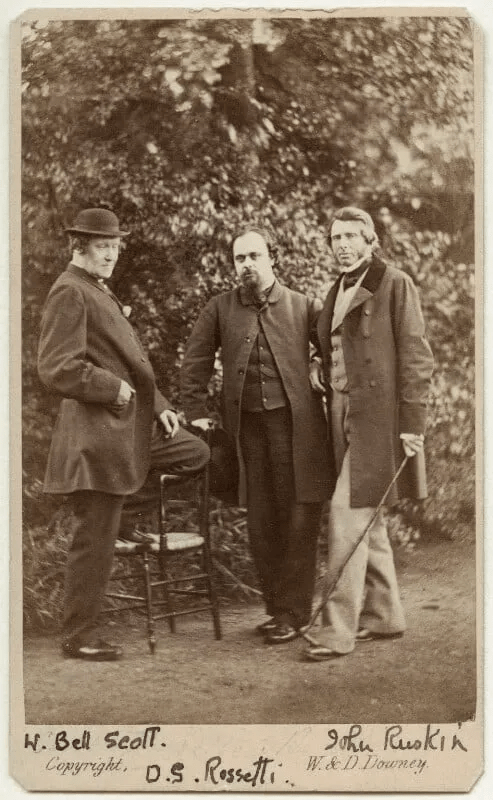
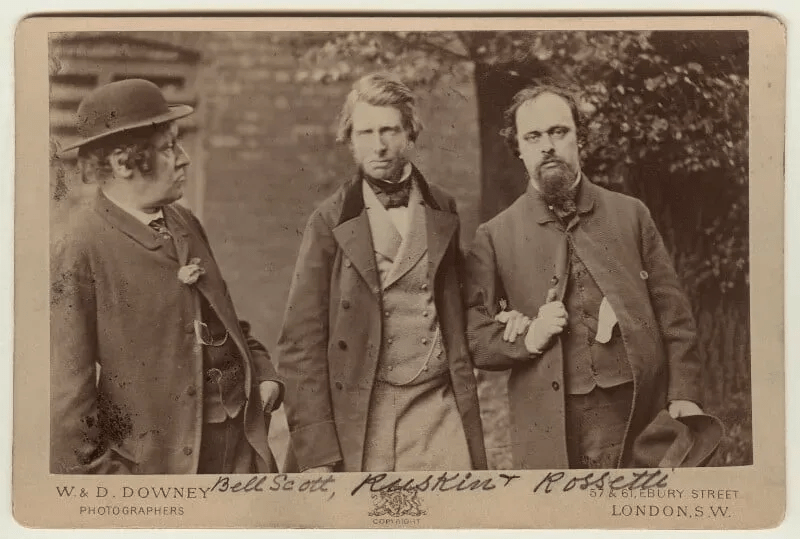
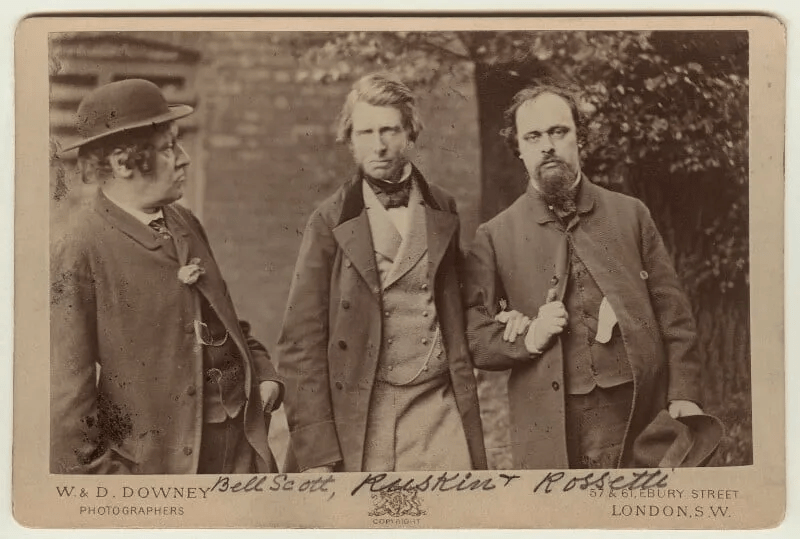
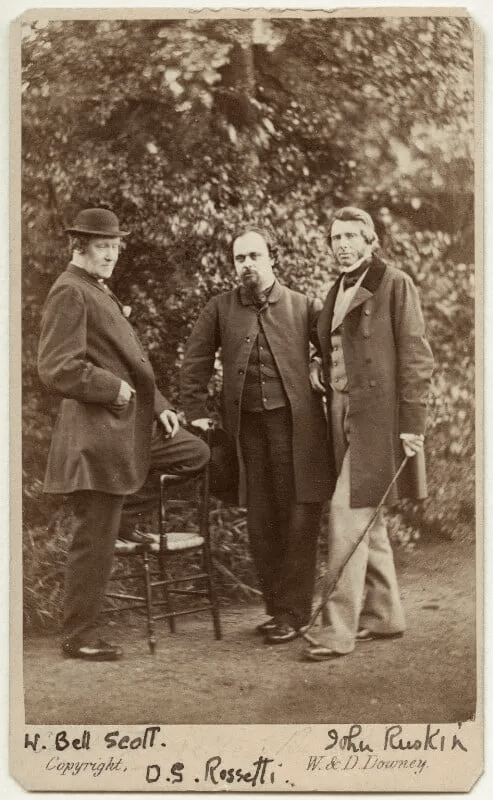
On 29th June 1863, William Downey took this group portrait in the garden of the London home of the Pre-Raphaelite artist Dante Gabriel Rossetti.
It features Rossetti and William Scott Bell, known as the Northern Pre-Raphaelite, together with the movement’s champion John Ruskin.
The explanation for the hat and wig he is wearing is that his facial hair including his eye brows had recently fallen out due to an attack of alopecia.
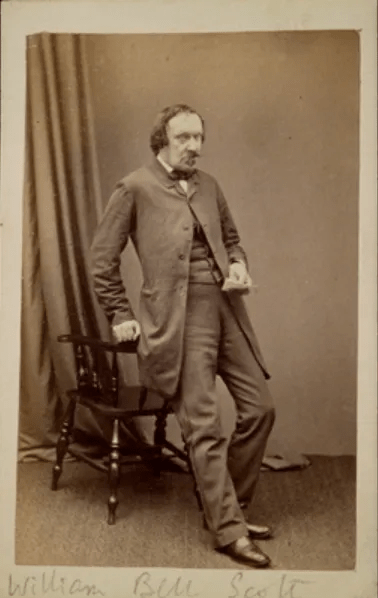
This dramatic change is evident in an earlier Bell Scott portrait, also attributed to W. & D. Downey.
It is one that features in the collection of the Watts Gallery, Surrey (my thanks to Antony Ryan for this information).
The exact dating of the portrait is unknown, but it has the hallmarks of the company’s early celebrity cartes de visite published around 1860 when the Downeys were still based in South Shields.
As head of the Government’s School of Design in nearby Newcastle on Tyne (1843-1864), Bell Scott was a significant figure in the North East of England.
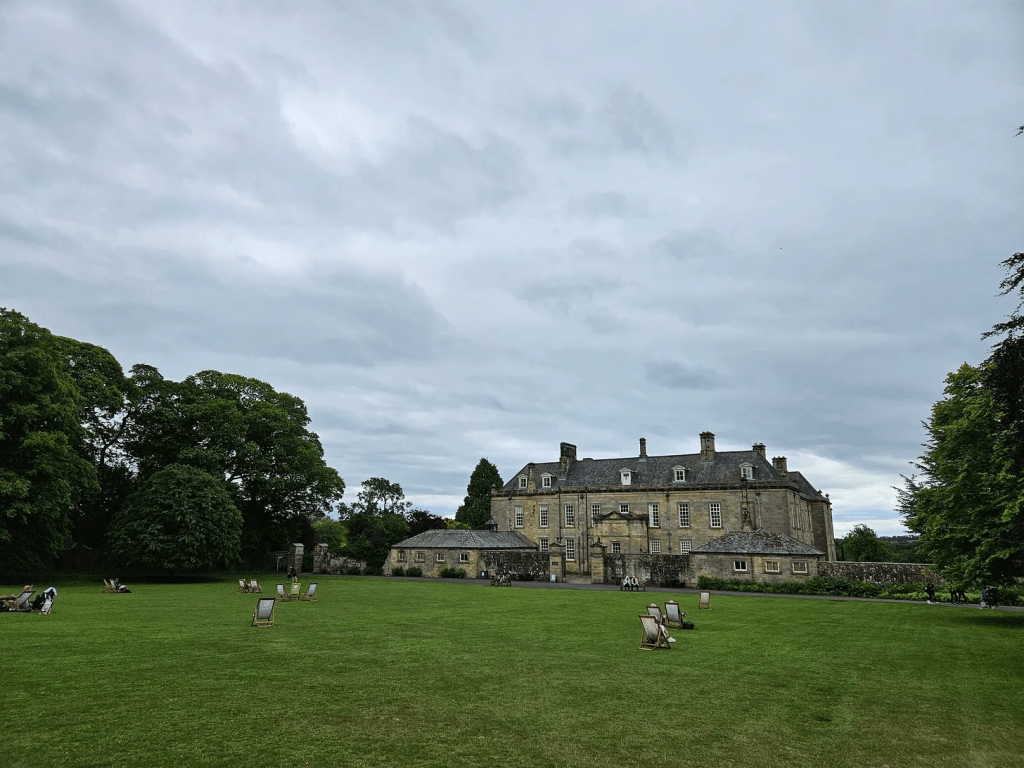
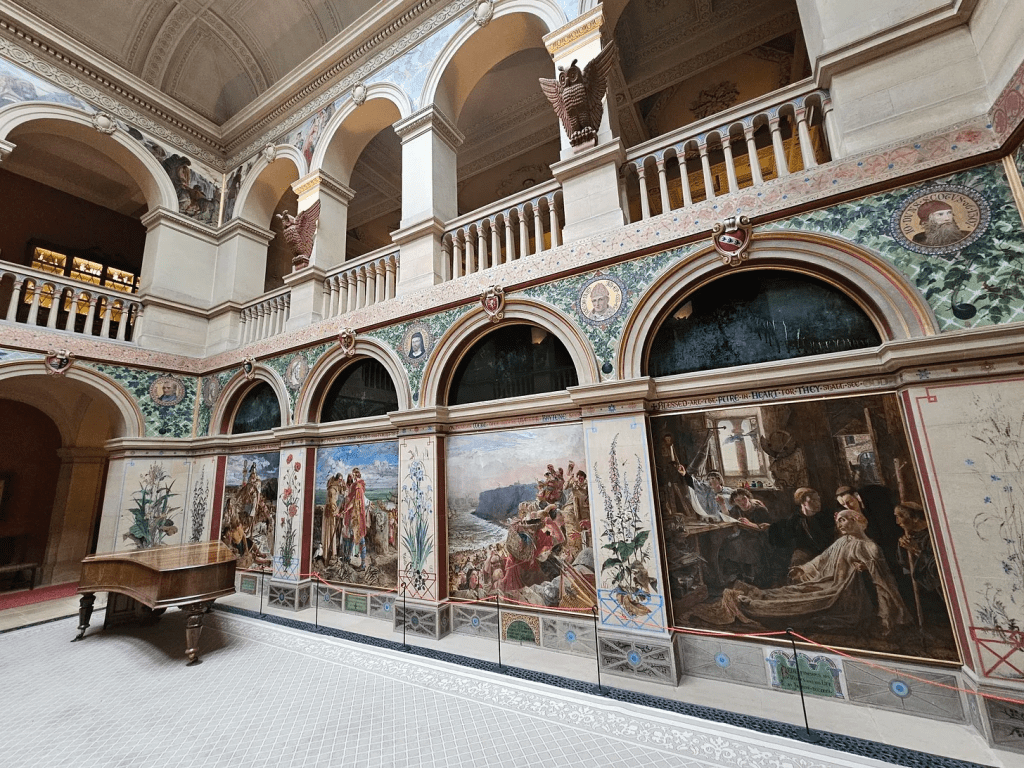
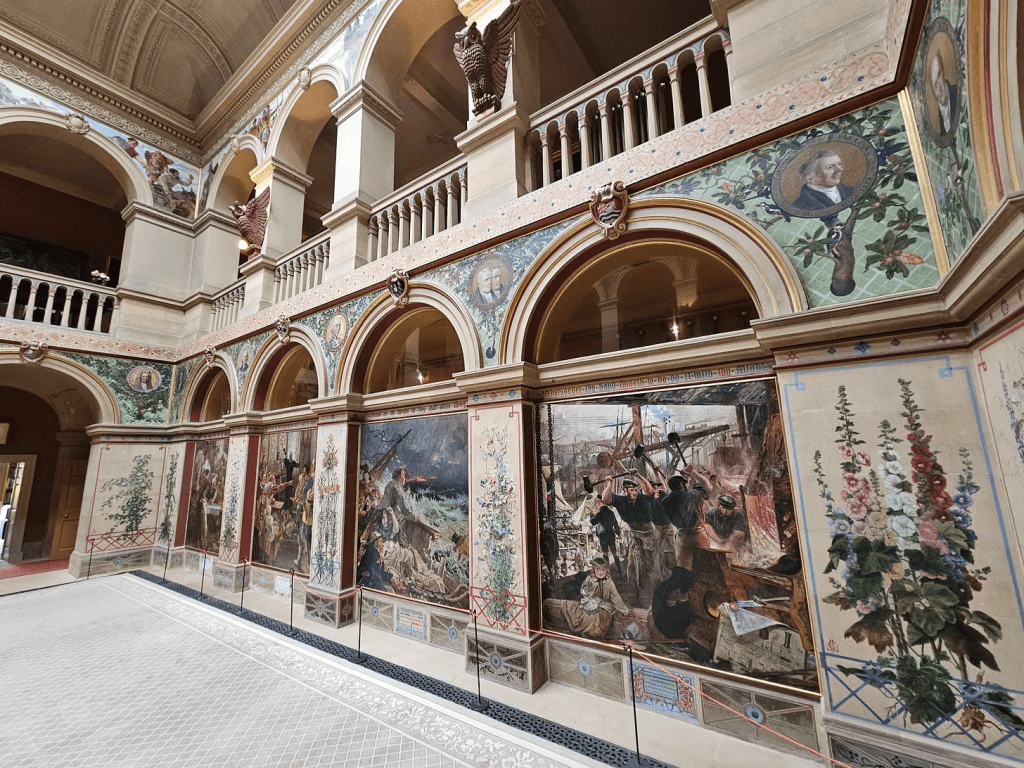
Eight of his best-known artworks completed between 1857 and 1861 feature in the Central Hall of Wallington, Northumberland, a stately home now in the care of the National Trust.
Rear view of Wallington, Northumberland. June 2025. Author’s photo.
Commissioned by Lady Pauline Trevelyan, Bell Scott’s brief was to decorate the hall with ‘wall paintings to illuminate the history and worthies of Northumbria.’
These are titled ‘The Roman Wall,’ ‘King Efrid and Cuthbert,’ ‘The Descent of the Danes,’ ‘The Death of Bede,’ ‘Spur in the Dish,’ ‘Bernard Gilpin,’ ‘Grace Darling’ and ‘Iron & Coal.’
The Central Hall designed by the Newcastle architect John Dobson took its inspiration from John Ruskin’s vision of an Italian Renaissance courtyard.
A recent opportunity to visit Wallington confirmed the impressive nature of both the hall and its paintings.
Central Hall, Wallington. June 2025. Author’s photo.Central Hall, Wallington. June 2025. Author’s photo.
On 29th June 1863, photographer William Downey set up his equipment in the garden of a house in the Chelsea district of London.
The house was home to the poet and illustrator Dante Gabriel Rossetti (1828-1882).
Joining him for the photoshoot were his friend and fellow Pre-Raphaelite artist William Bell Scott (1811-1890) together with the writer and critic John Ruskin (1819-1900).
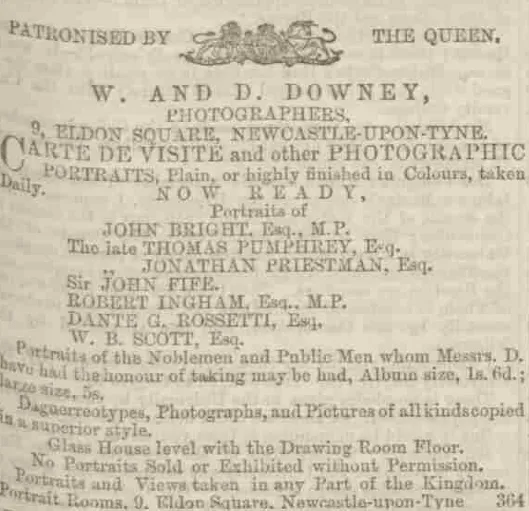
Earlier in the year, Rossetti and Bell Scott had been photographed separately by William and his brother Daniel for their company, W. & D. Downey of Newcastle on Tyne.
Newcastle Daily Journal (21st March 1863). From British Newspaper Archive.
Hence, adding Ruskin to the line-up had a commercial caché.
The resulting photographs featuring the trio were then published by Downey in a variety of formats including cabinet cards and cartes de visite.
As to how the photoshoot came about, Bell Scott may well have been pivotal.
He was a Tyneside connection of the Downey brothers from his years as head of the Government School of Design in Newcastle (1843-1864).
In later years when interviewed about his own career, William Downey (1829-1915) recalled an incident about the Bell Scott/Rossetti/Ruskin photoshoot “hitherto unpublished.”
“I was taking their portraits together, and for the purpose of grouping would have had Mr. Ruskin sit down.
“But no. His reverence for Rossetti was so great that he would not sit down in his presence, and so had to be taken standing” (from ‘The Queen’s Photographer,’ English Illustrated Magazine, March 1896).
For the collector and those with an interest in the Downey photographic dynasty, these images are high on any wish list.
But their scarcity and budgetary constraints make adding such images to the Pressphotoman collection highly unlikely.
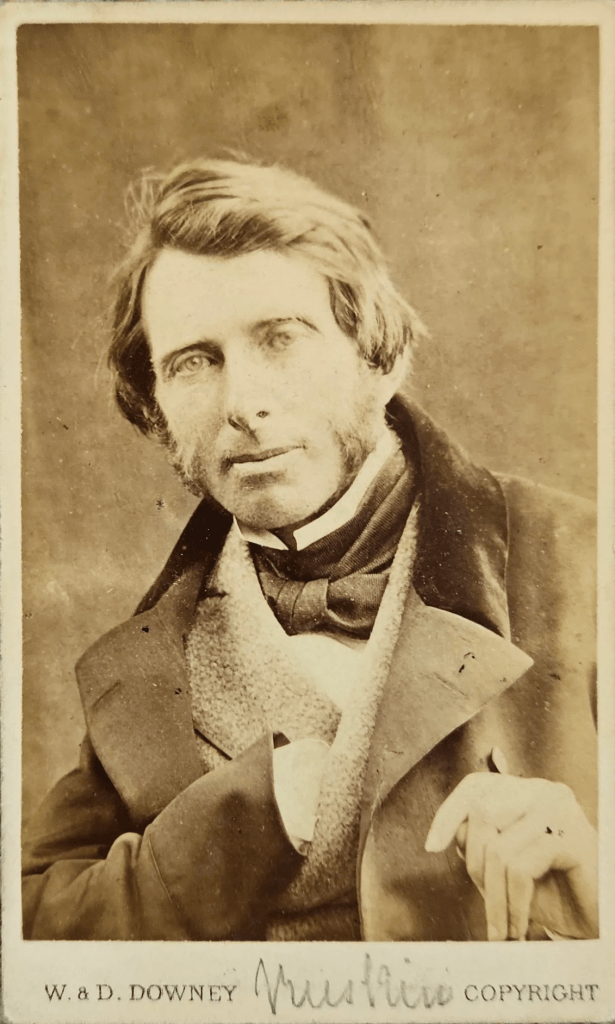
Given this, it was a moment of high excitement this week to obtain this carte portrait of John Ruskin taken on the same occasion.
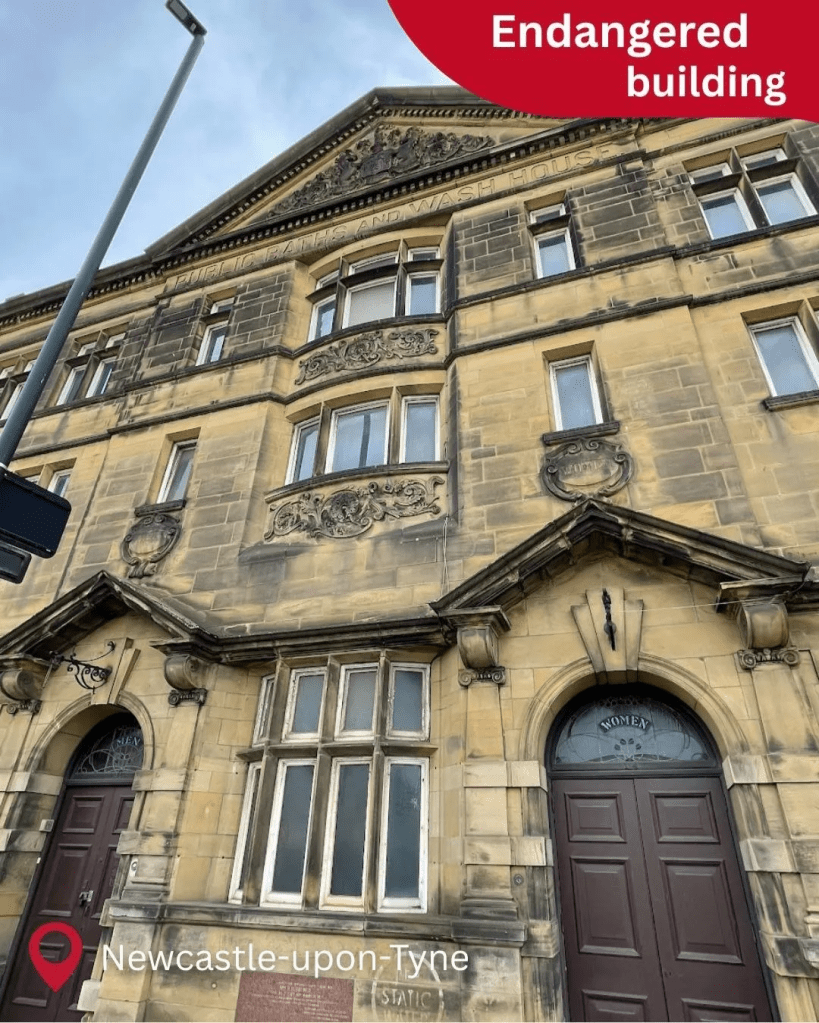
The Victorian Society’s national list of ‘Top Ten Endangered Buildings 2025’ features one building recognisable from regular visits down the decades to Newcastle upon Tyne.
Gibson Street Baths was built in the early 20th century under the 1846 Public Baths and Wash-houses Act that was still in force.
Photo: Graham Tyrrell/Instagram.
A weekly visit to such buildings was part of everyday life for many families including earlier generations of mine.
Now Grade 2 listed, Gibson Street Baths has lain dormant since 2016 and, according to the Victorian Society, “needs a sensitive reuse before restoration costs escalate further.”
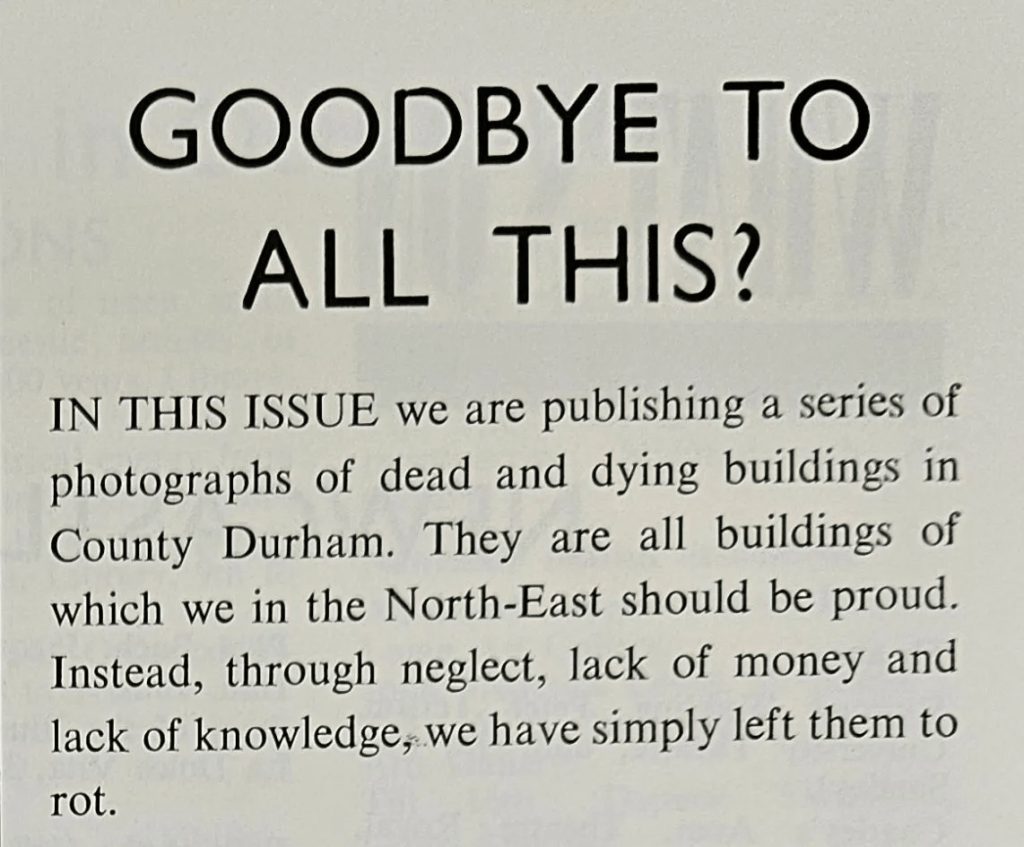
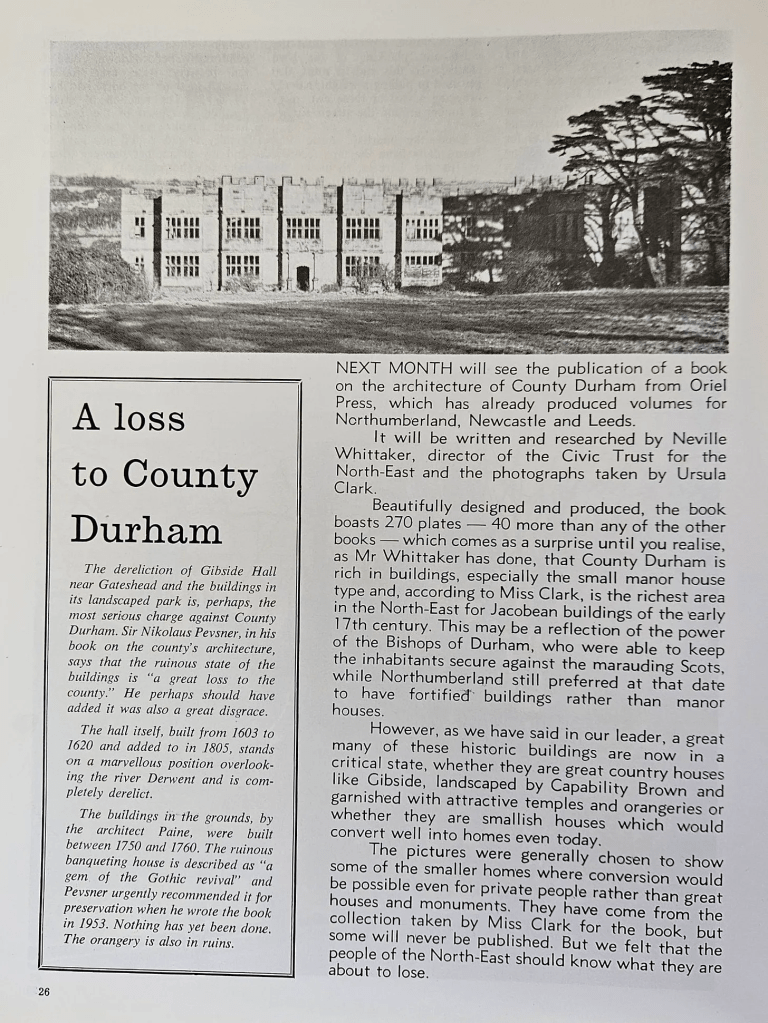
It’s a theme that has echoed down the years as revealed by a 1971 article that recently joined the Pressphotoman collection.
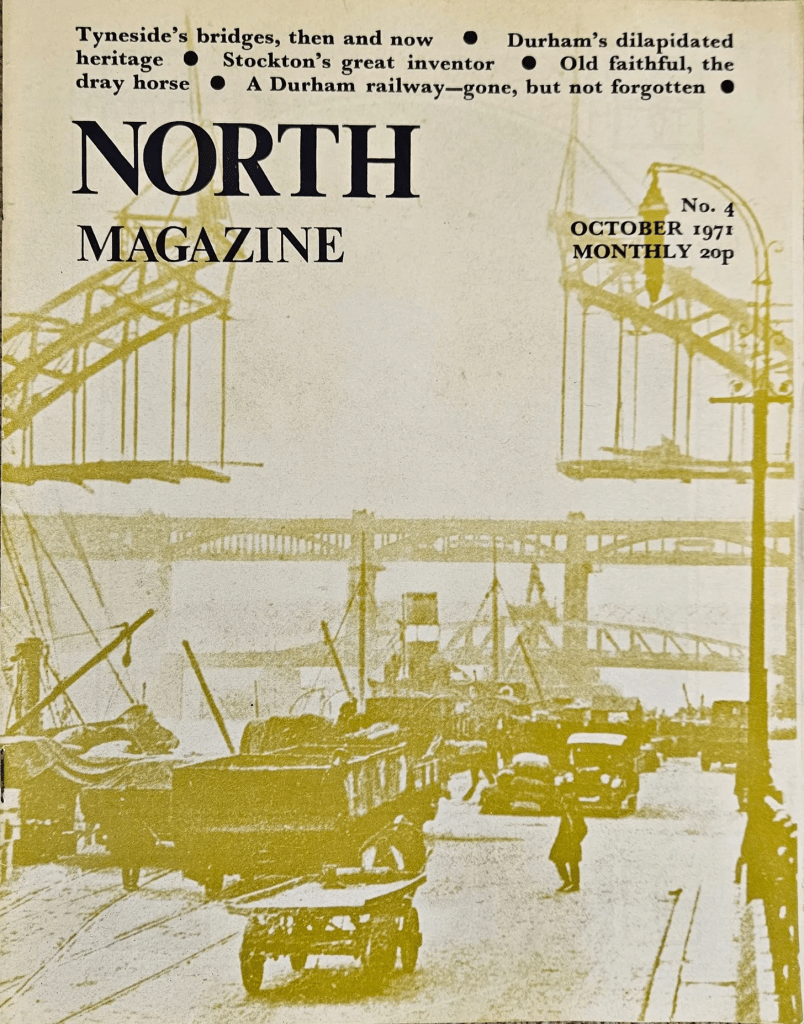
North Magazine was a monthly publication for ‘Durham, Northumberland and North Yorkshire’ edited by the journalist and author Leslie Geddes-Brown (1942-2020).
The cover of the October 1971 issue (vol. 1, no. 4) featured an eye-catching photograph of the Tyne Bridge, which is currently undergoing major renovation as it approaches its centenary in 2028.
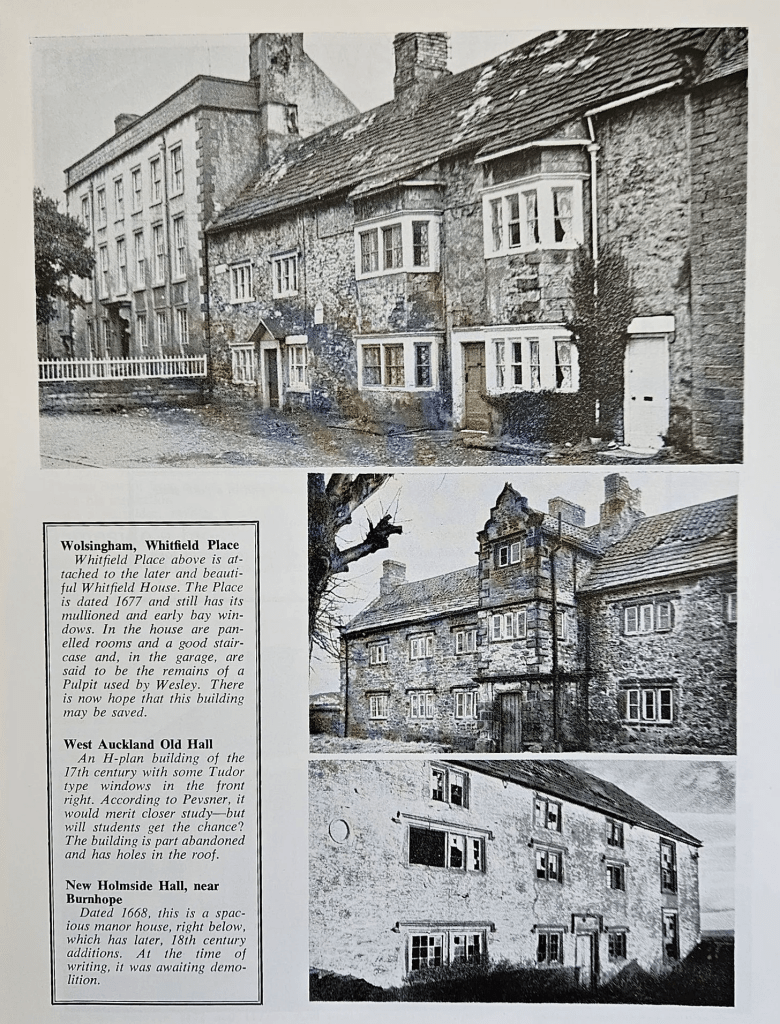
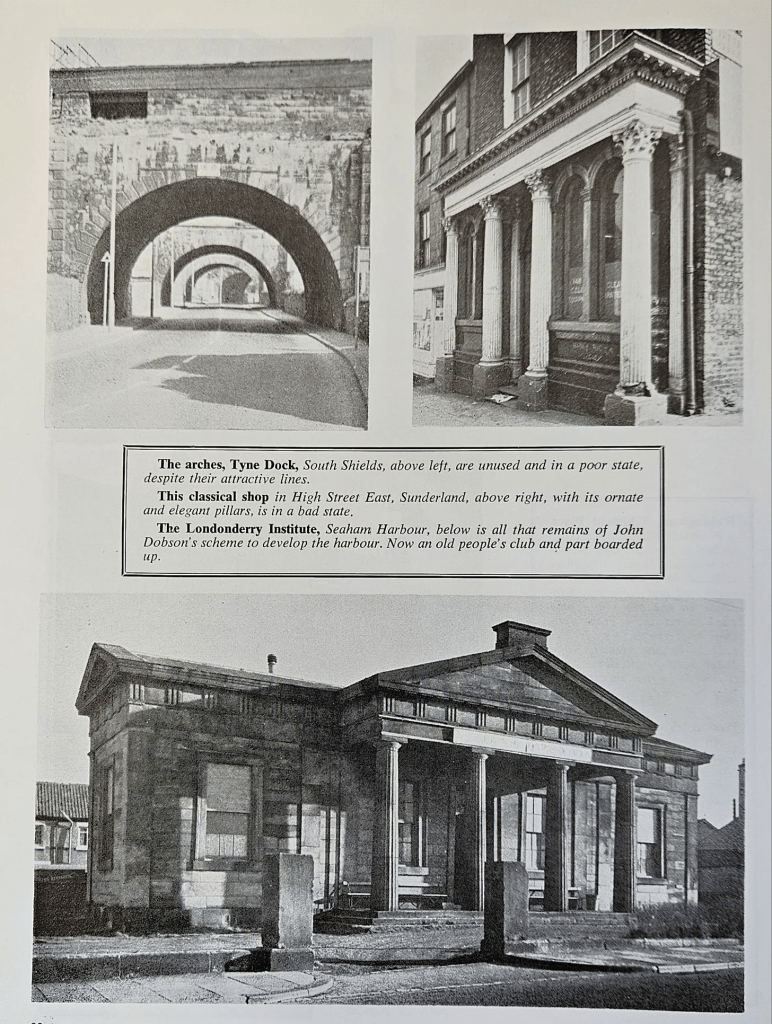
The series of photographs referred to came from Historic Architecture of County Durham by Neville Whittaker and Ursula Clark (Oriel Press) that was about to be published.
Regular readers will recognise the name of Ursula Clark (1940-2000) as the architectural photographer, who featured in my recent talk for the RPS Historical Group marking the 25th anniversary of her death.
The three-page North Magazine article devoted much of its space to Ursula’s photographs and it is instructive to trace what has happened to the featured buildings in the half century since.
In the years since, all three of the featured properties – Whitfield Place, Wolsingham; West Auckland Old Hall; and New Holmside Hall, near Burnhope – have been lovingly restored to their former glory.
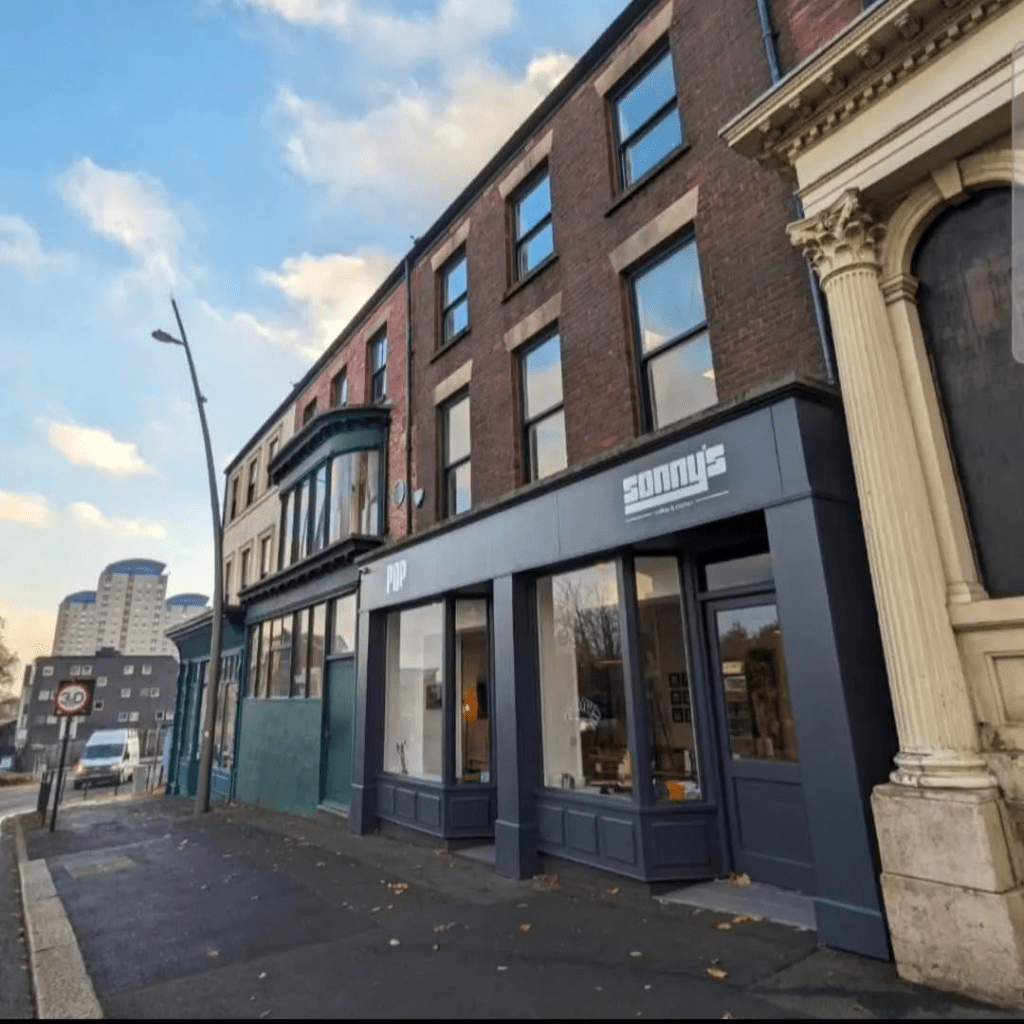
Perhaps the most stunning transformation though is the classical shop front in High Street East, Sunderland (top right below) with its “ornate and elegant pillars” described in 1971 as “in a bad state.”
Thanks to becoming part of Sunderland’s Heritage Action Zone (HAZ), the adjoining terrace initially built as merchants’ houses in the late 18th century is now home to Pop Recs, a café, music and arts venue and community hub.
Photo from Pop Recs Facebook page.
These restorations and reinventions confirm that there is hope for the current crop of endangered buildings of which Newcastle’s Gibson Street Baths is just one.
The attribution ‘Unknown Photographer’ is like catnip to the photohistorian.
Sometimes the pieces of the jigsaw fall neatly into place and a credible name for the author of an image emerges.
That’s exactly what happened during the writing of this blogpost.
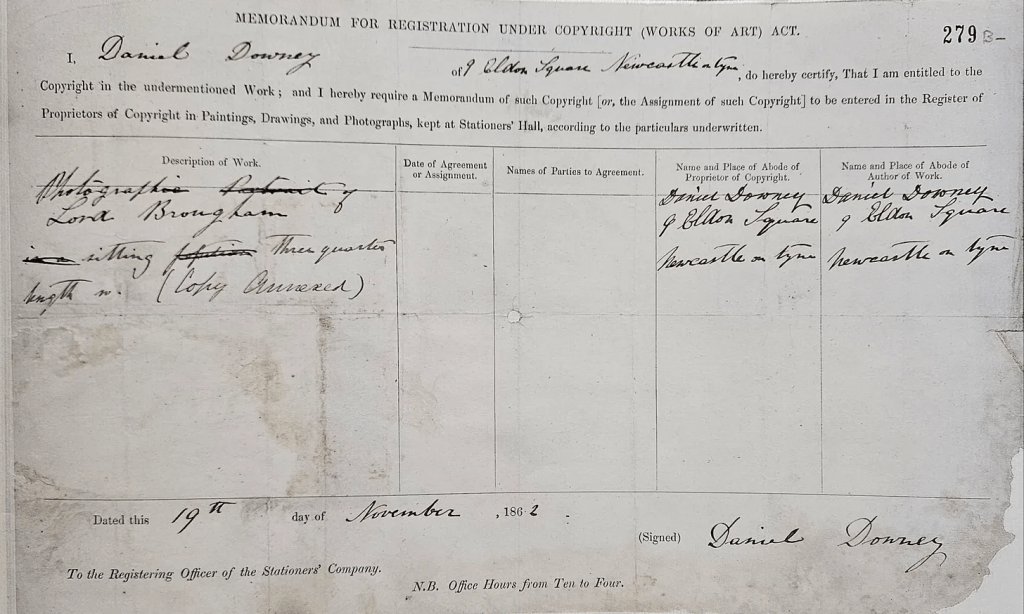
It began with a portrait photograph that is more than 160 years old and among the earliest protected by UK copyright law.
Copy 1/1/279. National Archives/OGL.
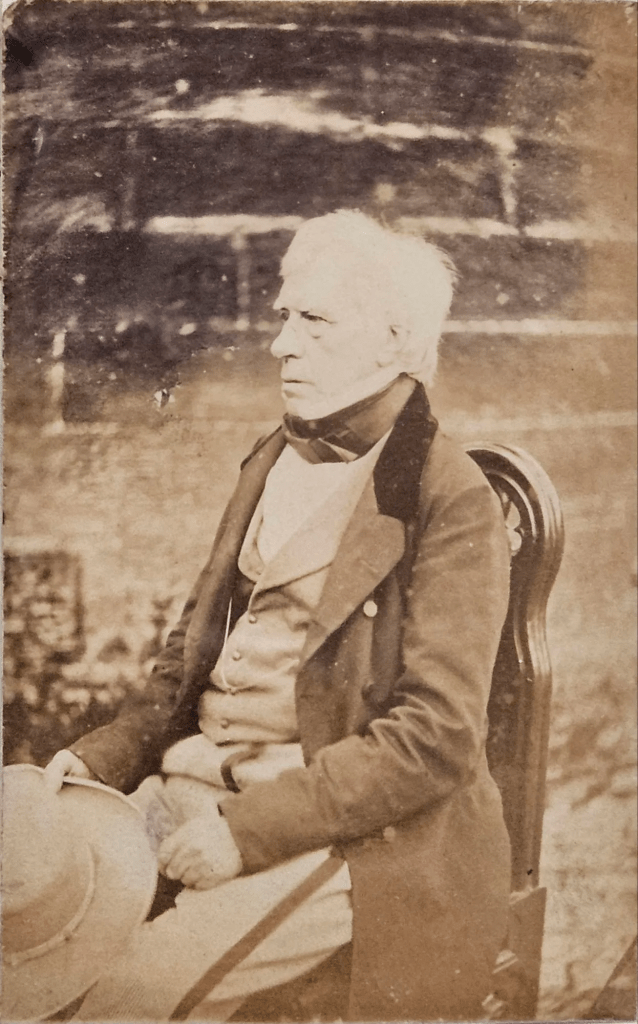
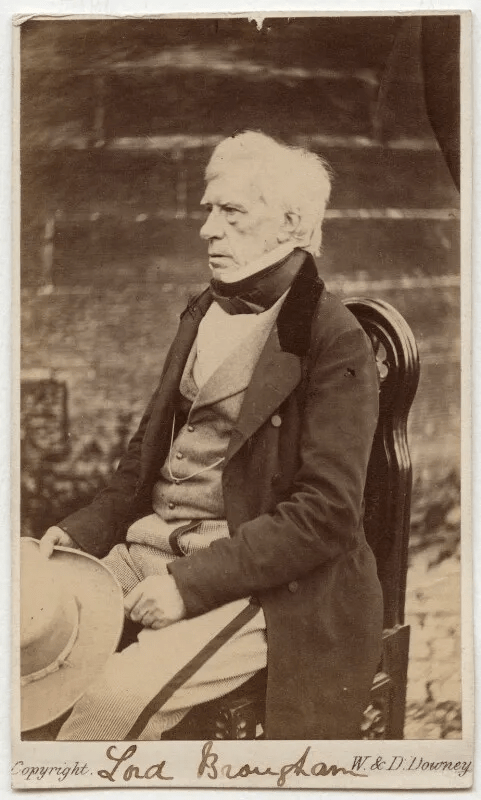
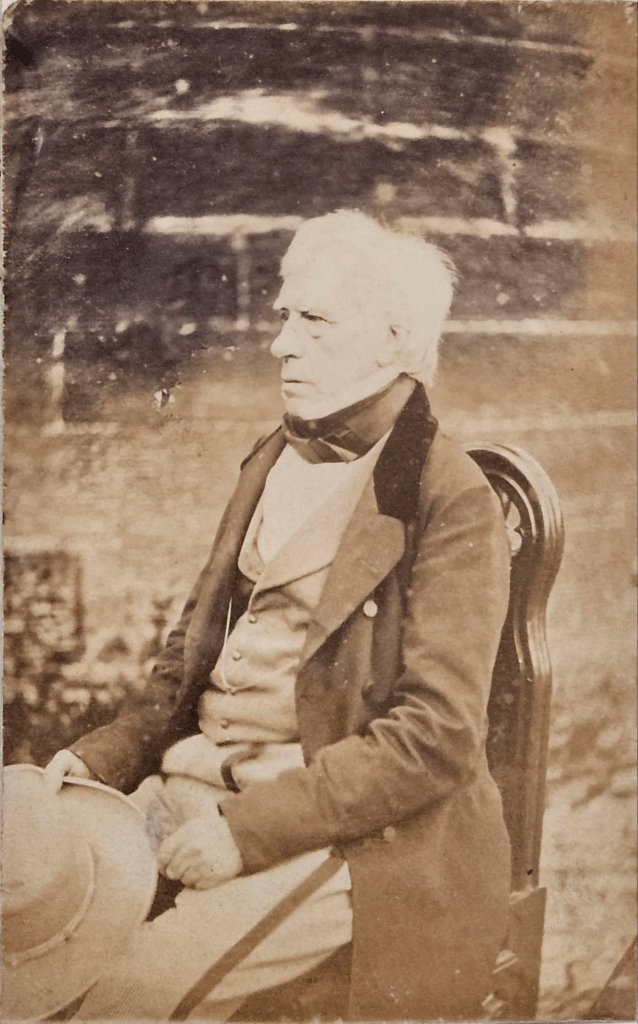
It features the veteran statesman and philosopher Henry, Lord Brougham (1778-1868) and was taken by Daniel Downey, one of the Tyneside brothers behind the celebrated photography firm of W. & D. Downey.
These facts are known because of a vital piece of legislation that early photographers in particular were quick to embrace.
On 29th July 1862, the Fine Arts Copyright Act became law and required anyone wanting to protect their paintings, drawings or photographs to complete a form and attach a copy of the work.
The first photograph (COPY 1/1/1) was registered on 15th August at Stationers Hall in London where the act was administered.
A few months later, according to a document stored in the National Archives at Kew, Daniel Downey submitted a form together with a copy of the photograph (seen above) that he had taken.
Copy 1/1/279. National Archives/OGL.
Dated 19th November 1862, the resulting form complete with his signature is numbered ‘279.’
For a researcher like me with an ongoing interest in charting the history of the Downey company, seeing such a document in the flesh as I did recently was a real privilege.
As regular readers will be aware, 1862 was a pivotal year for the Downey brothers, William and Daniel, who had started their photography business in South Shields several years earlier.
That January, their photographs of the aftermath of the New Hartley pit disaster claiming the lives of 204 men and boys were acclaimed by Queen Victoria.
Then, in March, their new studio at 9 Eldon Square, Newcastle on Tyne opened and quickly became a go-to destination for the great and good seeking a high-quality photographic portrait.
Daniel’s portrait of Lord Brougham was subsequently issued commercially as a carte de visite.
An example of this carte marked ‘Copyright’ and ‘W. & D. Downey’ on the front is part of the collection of the National Portrait Gallery, London.
As to when the photograph was taken, an article in the Newcastle Daily Journal (12th January 1863) reported how Downey had been honoured with repeated commissions from Brougham, who it called “the great opponent of the slave trade.”
The paper went on: “… only recently they were on a professional visit to his residence in Westmoreland, when they had the rare good fortune to obtain, in one small carte de visite, the portraits of both Lord Brougham and Mr. Gladstone.”
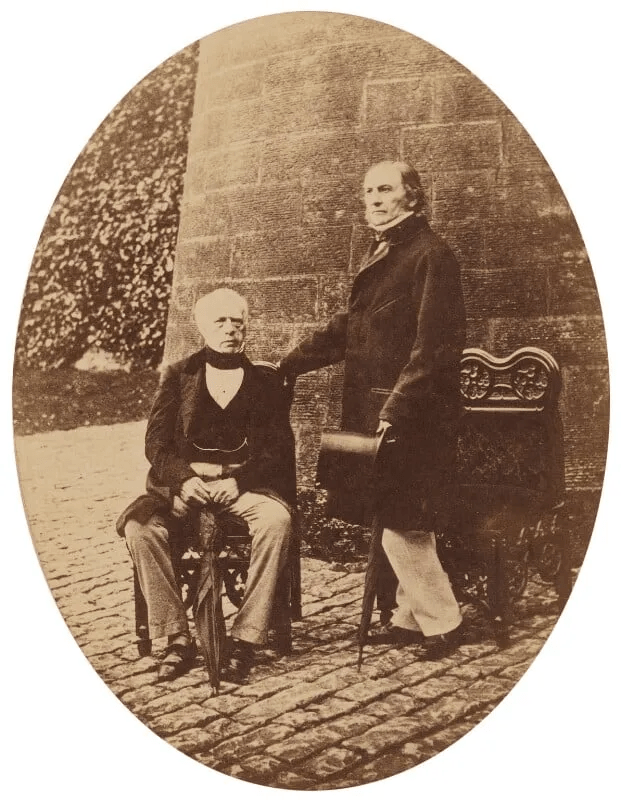
Searching online for this carte featuring Brougham with the then Chancellor of the Exchequer and later Prime Minister in four British governments, I came across this image.
Titled ‘Henry Brougham …. and William Ewart Gladstone’ and described as an ‘albumen print, late 1850s,’ the website of the National Portrait Gallery, London states that it was purchased in 1991 and attributes it to an ‘unknown photographer.’
Looking at the chair being used and the stone wall background, the visual evidence suggests a number of similarities with Daniel Downey’s copyrighted portrait of Lord Brougham.
Copy 1/1/279. National Archives/OGL.
Press reports also help identify a possible date and location at which these portraits featuring Brougham alone and together with Gladstone were taken.
In a report headlined ‘Mr. Gladstone’s visit to Newcastle’, the Newcastle Courant (10th October 1862) described how “the right honourable gentleman [Gladstone] and Mrs. Gladstone, who had been staying with Lord Brougham at Brougham Hall, near Penrith … arrived at Blaydon-on-Tyne, on Monday afternoon, by train from Carlisle.”
Newcastle Courant (10th October 1862). From British Newspaper Archive.
This account points to the period prior to this when the sittings took place with Brougham Hall being a strong candidate as the location.
It would also connect neatly with an event that took place in Newcastle the day after Gladstone and Mrs. Gladstone’s arrival in the city on Monday 7th October 1862.
The next day, the Newcastle Courant reported that Gladstone paid a visit to “the studio of Mr. Downey, photographer, Eldon Square, where the Chancellor of the Exchequer sat for a portrait.”
This resulting carte de visite issued by W. & D. Downey is part of my collection and also features in several versions in the collection of the National Portrait Gallery, London.
Taken together, the sequence of events strongly suggests that Daniel Downey not only took the portraits featuring Lord Brougham and Mr. Gladstone at Brougham Hall, but also as that of Gladstone at Downey’s Eldon Square studio in Newcastle.
Whatever the exact details of their provenance, the resulting photographs capture two of Britain’s best-known politicians in their Victorian pomp.
An article featuring my research about the architectural photographer Ursula Clark (1940-2000) has just been published by The PhotoHistorian (Spring 2025, no. 201).
It follows a recent talk about Ursula’s photography for the Royal Photographic Society Historical Group.
A YouTube recording is fast approaching 4,000 views and has attracted an audience far beyond the niche one anticipated.
‘Ursula Clark: Architectural Photographer’ for RPS Historical Group. 28th February 2025.
As a result of social media interest and wider publicity, I am now following up various research threads, which I hope to share in future Pressphotoman posts.
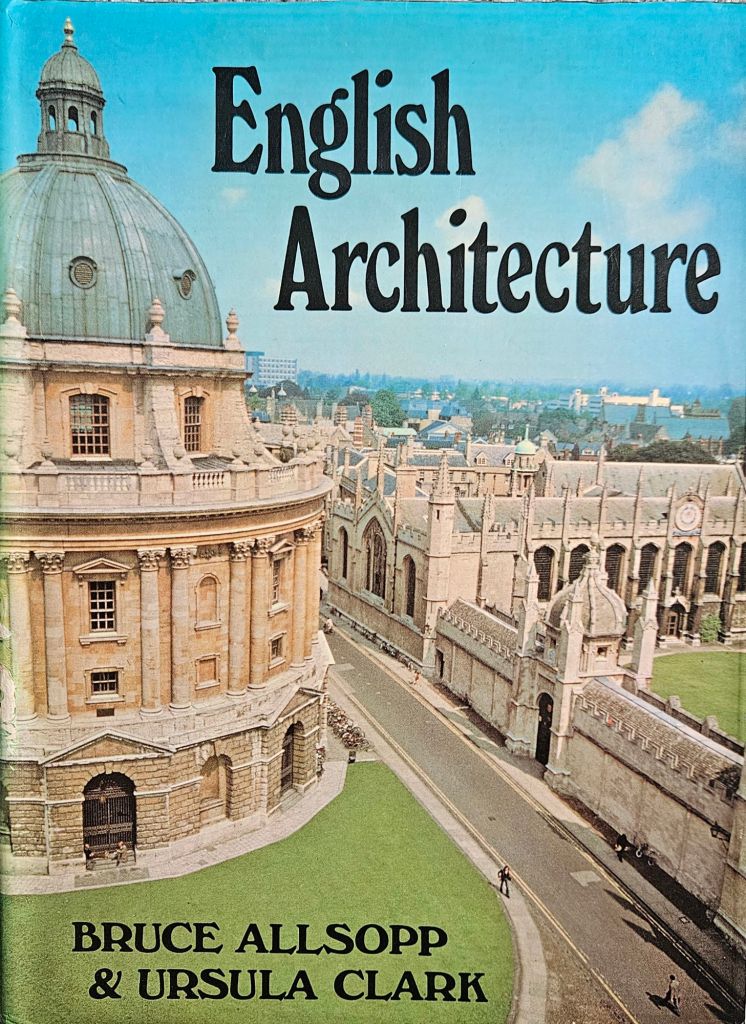
Through two decades, Allsopp & Clark collaborated with other leading authors on a series of popular architectural history guides.
English Architecture (Oriel Press, 1979).
These featured areas of Britain such as Northumberland and County Durham; cities like Newcastle upon Tyne and Leeds; and countries from England and Scotland to France, Italy and Spain.
To mark the 25th anniversaries of Allsopp & Clark’s deaths in 2000, I am presenting a talk later this month about Oriel Press with particular focus on Ursula Clark’s role as a photographer and photographic editor.
The talk will draw on her archive of 20,000 black-and-white negatives now in the care of Historic England.
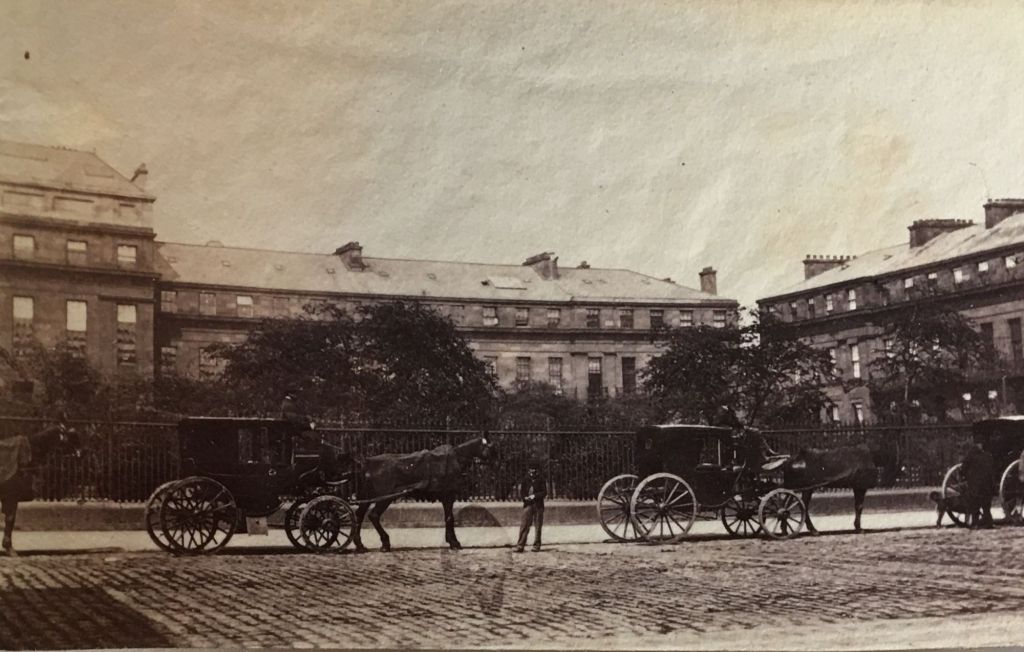
In the 1860s, Newcastle upon Tyne’s Eldon Square was home to two rival commercial photography firms.
As described in parts 1 and 2 of this mini-series of blogposts, W. & D. Downey had a studio at no. 9 whilst W.S. Parry run by William Softley Parry and his wife Christiana were their neighbours at no. 17.
However, photography in one of the city’s most prestigious locations may not have been limited to companies competing for business.
Two stereoscopic ‘3D’ cards recently arrived in the Pressphotoman collection that raise the possibility of other Eldon Square residents being active photographers.
The couple involved were Edward and Eliza Charlton, who married in 1842 uniting two of the region’s prominent Roman Catholic families.
By 1851, the Charltons were living at no. 7 Eldon Square with a ‘groom, cook, house maid and lady’s maid’ and were still there a decade later.
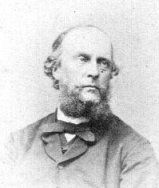
Dr. Edward Charlton was a well-respected medical figure in Newcastle upon Tyne, who had also established a reputation as a ‘scholar, scientist and antiquary.’
Edward Charlton MD (1814-1874) Courtesy of John Edwards.
He was a member and later vice-president of the Literary and Philosophical Society of Newcastle upon Tyne known as the Lit & Phil.
In that capacity, it is likely his path would have crossed those of William and Daniel Downey and William Softley Parry.
Both the Downeys and Parry were regular exhibitors of their photography at the Lit & Phil’s Conversaziones whilst Dr. Edward Charlton presented several lectures during his three decades of involvement with the society.
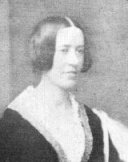
As to Eliza Charlton, Edward’s wife, she was from a prosperous family in the Northumberland town of Hexham, 20 miles west of Newcastle.
Eliza Janet Charlton nee Kirsopp (1816-1862) Courtesy of John Edwards.
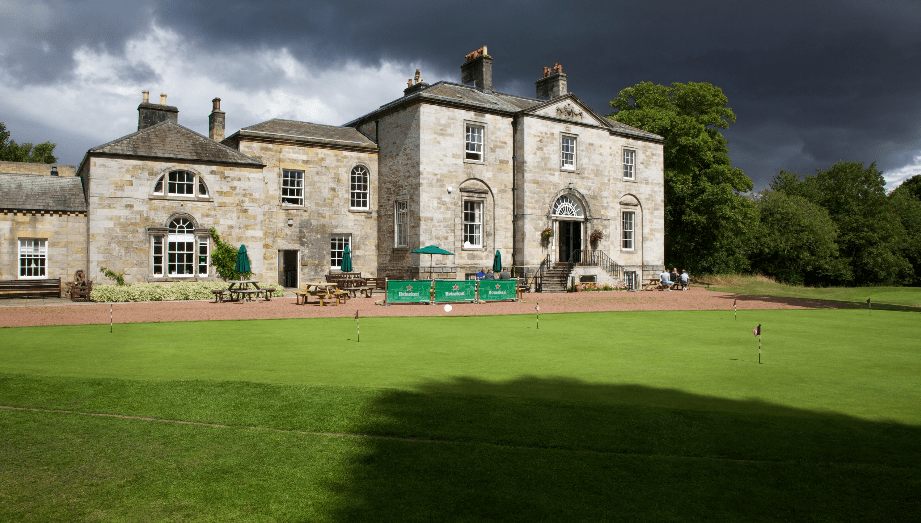
There, her father James Gibson Kirsopp (1775-1836) built a magnificant Georgian mansion on the Spital Estate that today is a Grade 1 listed building and home to Hexham Golf Club.
Spital Estate House. From Hexham Golf Club website.
It is from Hexham that evidence has emerged of the Charlton’s involvement in photography.
The first stereo linked to the couple is titled ‘The Chapter House, Hexham Abbey Church.’
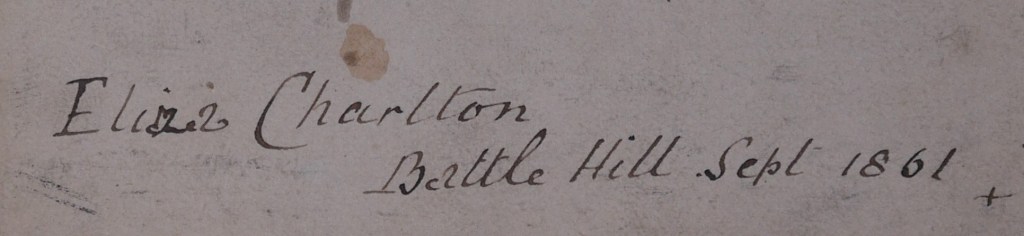
As to its location, Battle Hill is one of the town’s historic principal streets, offering access to nearby Hexham Abbey.
The specific dating – ‘Sept. 28th 1861 – suggests that Edward, if he was the photographer responsible, took the stereo at that location on that particular date.
The second stereo is titled ‘Hexham Abbey Church’ and is another effectively composed three-dimensional shot.
Lines of hazel poles in the foreground lead the eye up the garden path to the historic abbey building in the distance.
On the verso, it is credited with the same location – ‘Battle Hill’ – and the same month and year – ‘September 1861’ – but in this case, the name ‘Eliza Charlton’ appears.
If Eliza was the person responsible for creating the stereo, she clearly was a talented photographer with an eye for 3D.
Sadly, like Christiana Parry in part 2, Eliza died prematurely, in her case in May 1862 at the age of 46 at the Charlton’s home, no.7 Eldon Square.
Further research is required to fully confirm that Edward and Eliza Charlton were indeed the couple responsible for taking these stereos.
But their discovery brings forward two more images of Hexham Abbey Church shortly after its east end had undergone rebuilding works.
Interestingly, the person responsible for the works was John Dobson, who designed Newcastle upon Tyne’s Eldon Square thirty years earlier and the subject of this blogpost mini-series.
If you missed parts 1 and 2, check out the links below.
At no. 9 (on the right of facing terrace above), W. & D. Downey opened a new studio in March 1862, consolidating a growing reputation for supplying high-quality portraits.
Other leading photographers in the city such as P.M. Laws, E. Sawyer, R. Turner, G.C. Warren and T. Worden provided the Downey brothers, William and Daniel, with stiff competition.
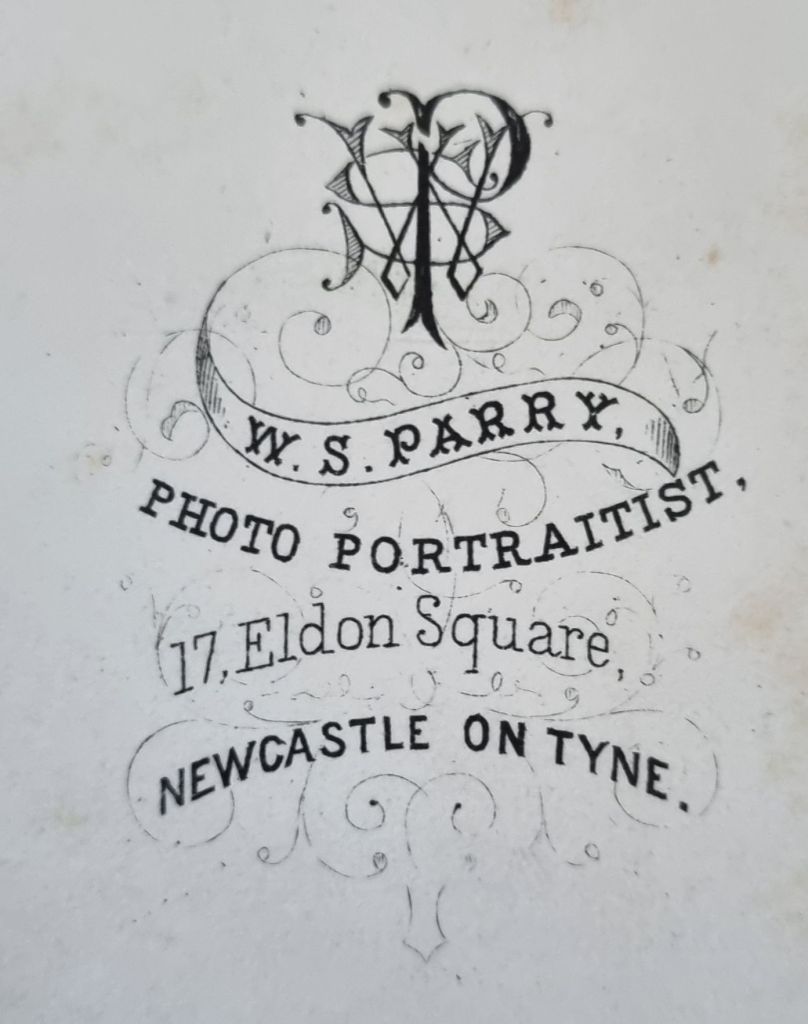
But in 1864, when W.S. Parry moved his long-established studio to no. 17 Eldon Square, a new chapter in Newcastle’s photo wars began.
William Softley Parry was born in 1826 across the River Tyne from Newcastle in Gateshead.
By the late-1840s, he was in business as a window glass merchant in Grainger Street, Newcastle, enjoying the new medium of photography as a hobby.
Initially, he produced paper calotypes which he exhibited at the Annual Conversaziones of the Literary and Philosophical Society of Newcastle upon Tyne (founded 1793), known as the ‘Lit & Phil.’
By 1855, following the invention of the wet collodion process which used glass plates, Parry opened his ‘Photographic Institution’ at 44 Newgate Street (‘nearly opposite St. John’s Lane’).
Press adverts promised ‘female attendance for ladies’ indicating that his wife Christiana was involved in producing the studio’s photographic portraits ‘on paper and glass.’
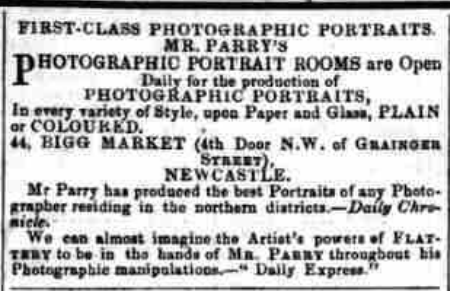
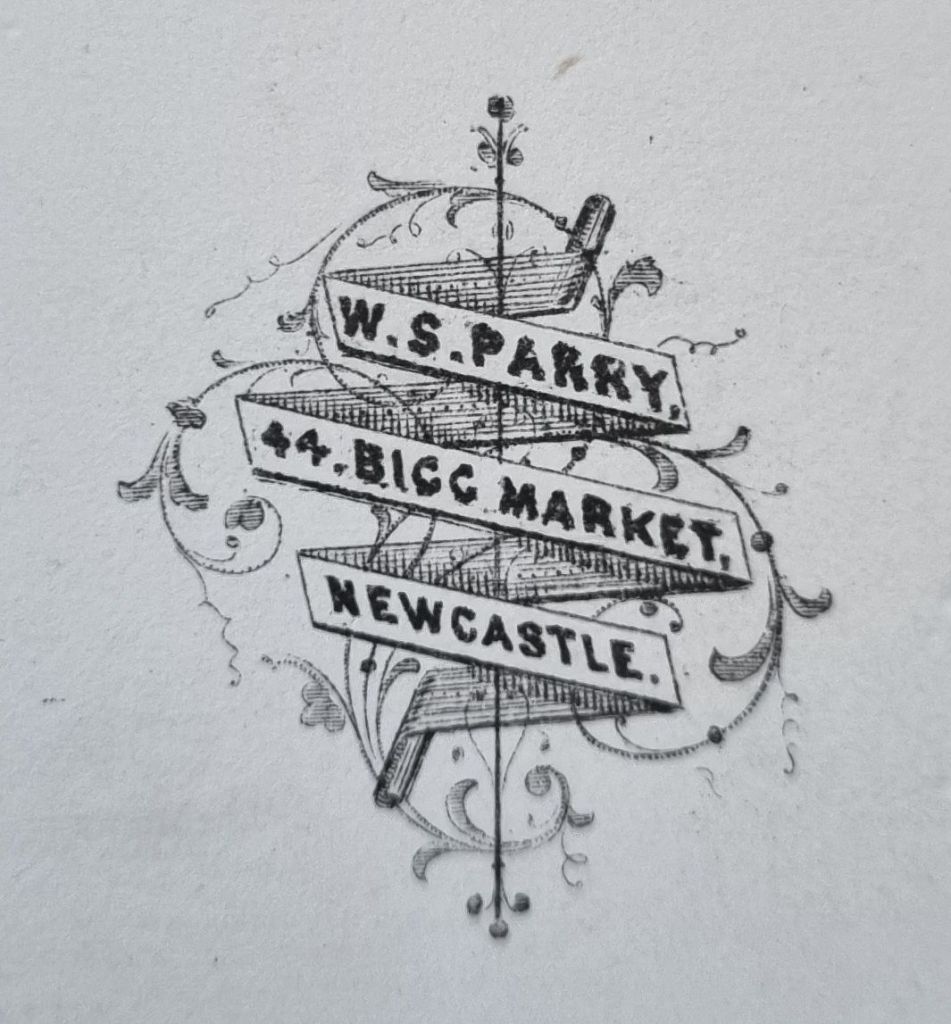
Three years later, the Parry’s business relocated to 44 Bigg Market (‘4th door N.W. of Grainger Street’) and glowing reviews from the national press helped promote its wares.
Advert from North & South Shields Gazette, 15th July 1858. From British Newspaper Archive.
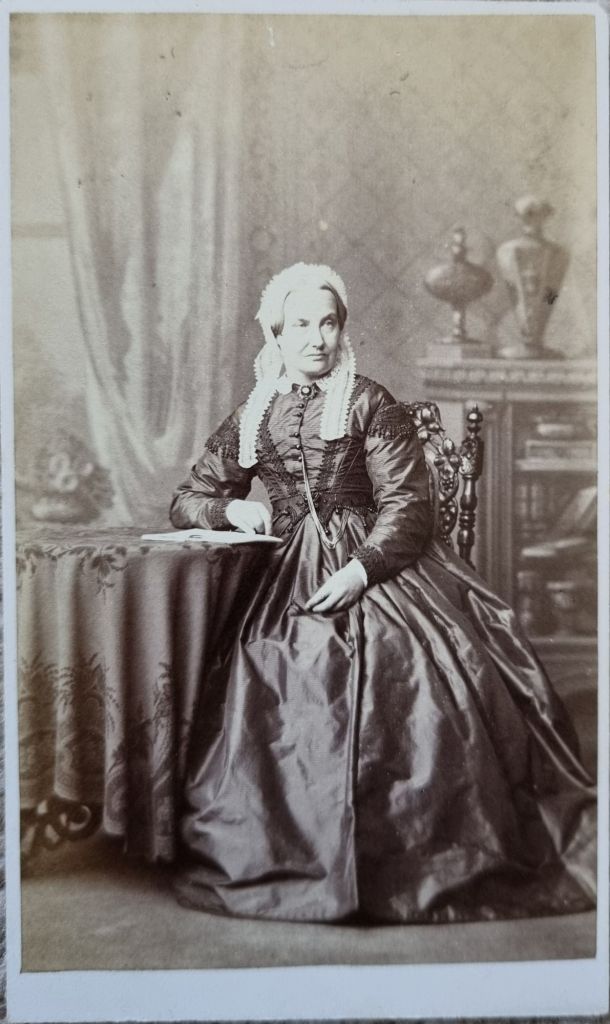
The new fashion of carte de visite portraits attracted a wide variety of clients and offered an affordable opportunity to dress up and look your best.
Then in March 1864 with business evidently booming, an opportunity arose to relocate to the more prestigious surroundings of Eldon Square a few doors down from W. & D. Downey.
According to a notice placed in the Newcastle Courant, no. 17, described as an ‘eligible freehold dwelling house with Coach House and Stable,’ was ‘to be sold by auction.’
Advertisement from Newcastle Courant, 14th March 1864. From British Newspaper Archive.
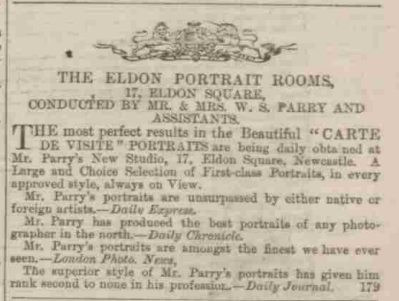
Within a few months, ‘The Eldon Portrait Rooms, 17 Eldon Square, Conducted by Mr. & Mrs. W. S. Parry and Assistants’ were open for business.
Advert from Newcastle Daily Journal, 20th July 1864. From British Newspaper Archive.
The Parry’s arrival cemented Eldon Square’s status as a place to go if you were having your photo portrait taken.
The fact that W. & D. Downey at no. 9 were the Parry’s neighbours and photographic competitors was reflected in subtle changes to their business offer.
For instance, when Downey’s offered a new series of stereoscopic views of Newcastle, Parry raided his photographic archive to advertise ‘local views, and others of general interest … taken from eight to sixteen years ago.’
In the drive for valuable custom, both studios placed almost daily front-page adverts in the Newcastle press.
Downey invariably occupied the top of the left-hand column whilst Parry took a prominent position on the right-hand side of the page.
Then, on 11th July 1868, the Newcastle Daily Journal reported the death of Christiana Parry.
In her late 30s, she had died at no. 17 the previous day though no cause of death was given.
It was the latest tragedy to befall the Parry family whose ‘eldest surviving daughter’ Euphemia died in 1862 aged five.
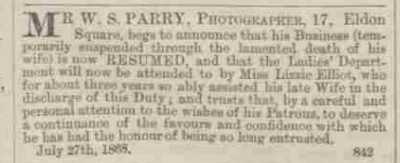
A fortnight after ‘the lamented death of his wife,’ William announced in a press ad that he was resuming business and that the Ladies’ Department would be run by her assistant for the past three years, Miss Lizzie Elliot.
Advert from Newcastle Daily Journal, 24th July 1868. From British Newspaper Archive.
Improvements to the studio in Eldon Square followed.
However, in June 1871, no. 17 was put ‘up for sale’ and William revealed that he would ‘shortly leave for the South.’
The following month, a two-day sale of ‘household furniture and effects’ and ‘the apparatus and working plant of the Photographic Department’ was held at his home.
After leaving Newcastle, W.S. Parry ran at least two photography businesses, one in Berkshire during the 1870s and another in Birmingham in the 1880s.
However, by the time of his death in 1915, his reputation as a pioneering photographer was long forgotten.
Even the Newcastle Journal, which celebrated his many photographic achievements during the Eldon Square years, headlined its report of an inquest into his death: ‘Blown Over By The Wind: An Old Man’s Sad Death At Middlesbrough.’
Despite this, William Softley Parry’s work as a pioneering photographer is chronicled in two respected accounts of the medium’s early years.
Notably John Werge’s History of Photography (1890) and, more recently, Roger Taylor’s Impressed By Light: British Photography from Paper Negatives, 1840-1860 (2007).
What they confirm is that W. S. Parry’s Newcastle years were both influential and productive and helped put the city on the map as a centre of photographic innovation.
Next time in the final part of this mini-series, new Pressphotoman research explores if an amateur husband-and-wife photography team were also living in Eldon Square at the turn of the 1860s.
Preparations are well underway in the UK for events during 2025 to mark the 200th anniversary of railway passenger travel.
On 27th September 1825, the Stockton & Darlington Railway opened with passengers being pulled in carriages behind a steam locomotive designed by George Stephenson (1781-1848).
In his native North East of England, Stephenson’s achievements as inventor and engineer are memorialised in various buildings and plaques.
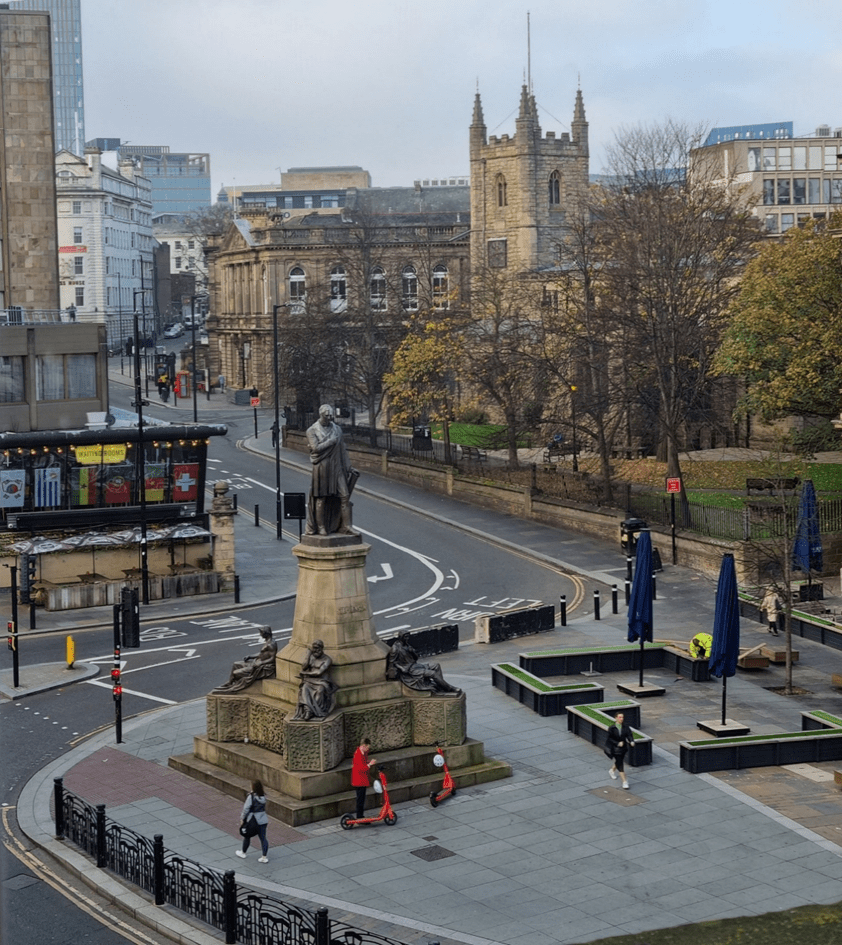
Perhaps the best-known is the Stephenson Memorial in the heart of Newcastle-upon-Tyne.
It can be viewed today as you leave the city’s Central Station and is within a stone’s throw of the pioneering engineering works that bore Stephenson’s name.
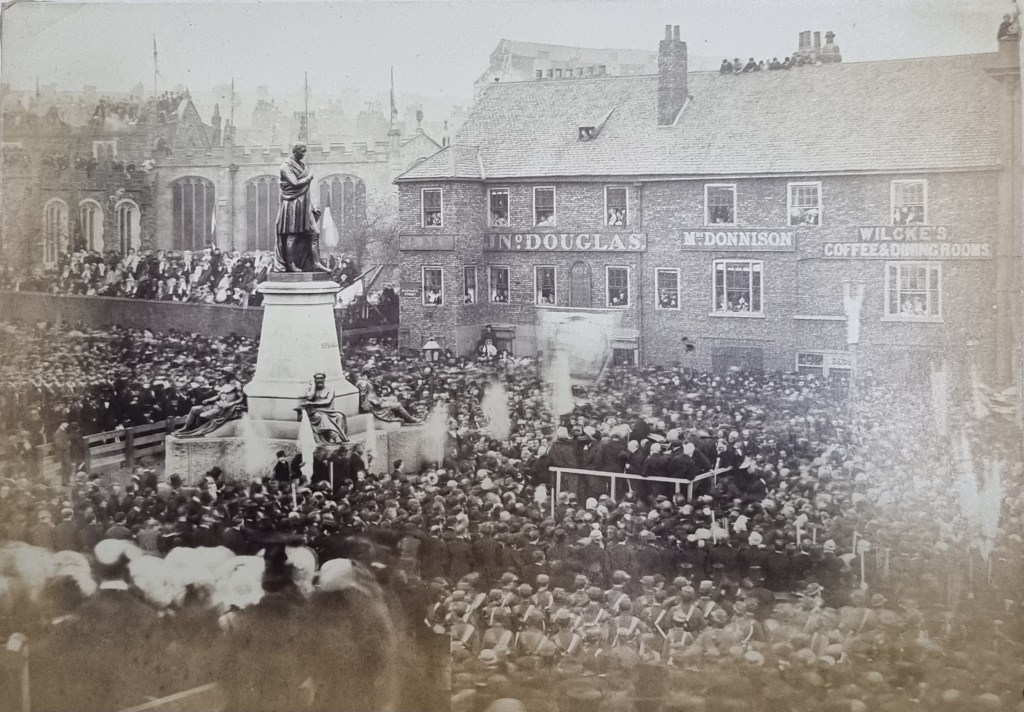
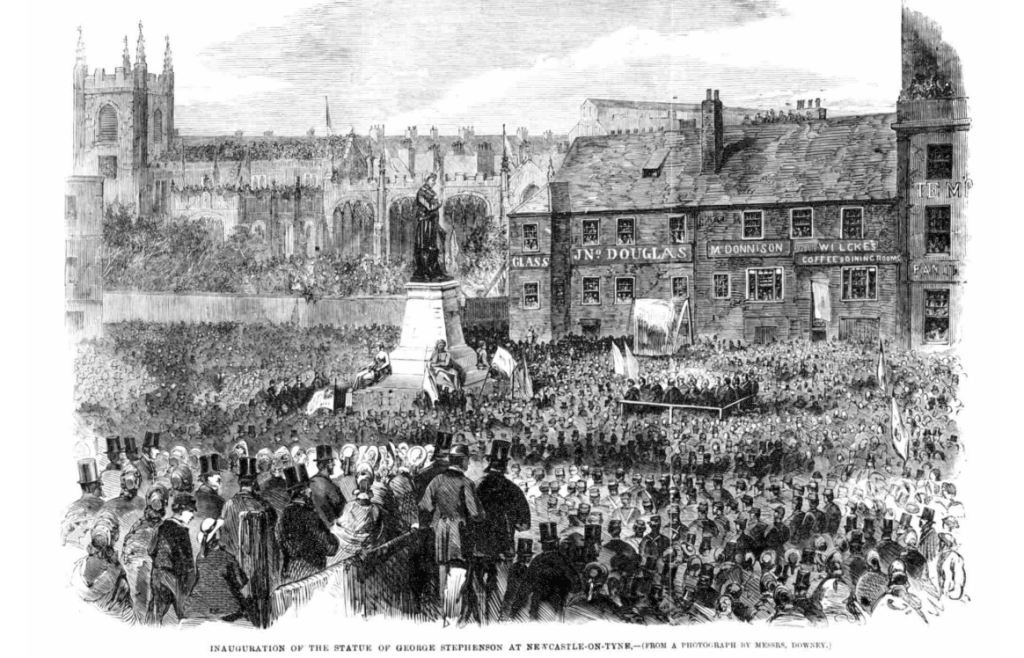
When the statue was unveiled to the public in October 1862, photographers were on hand to record the moment for posterity.
At the base of the statue, the Newcastle Daily Journal identified three of the city’s photography firms together with their equipment, observing “Messrs. Downey, Warren and Laws – pursuing their peaceful and interesting vocation.”
The photograph below taken from an elevated position can be attributed to W. & D. Downey, who advertised prints for sale in various sizes the following day.
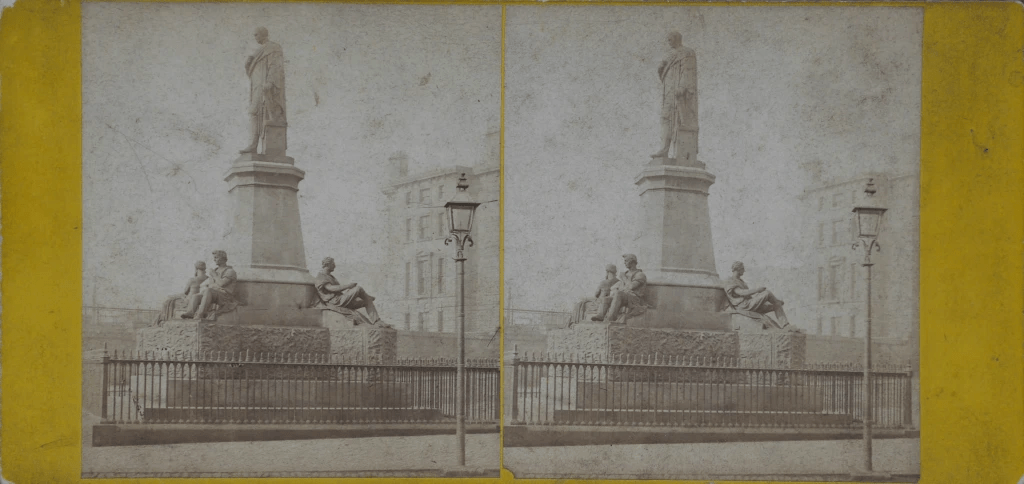
Another view of the Stephenson Memorial comes from this stereocard, which I recently added to my collection and which bears evidence of its age and frequent handling in a stereoscope.
The lamp standard (right of frame) is viewable in the Downey image above, though the metal railings appear to have replaced the wooden palisade that originally surrounded the statue.
Whilst there is no photographer’s stamp or credit, the verso does feature a slightly-faded sticker for “Allan” whose Newcastle business sold stereocards and carte-de-visites during this period.
It’s not everyday that you come across a pile of old newspapers from the middle of the 19th century.
But that was the sight that greeted me in a second-hand bookshop recently within a few steps of the entrance.
The first thing I noticed was the familiar masthead of the Newcastle Courant with its wonderful slogan ‘General Hue and Cry.’
Launched in 1711, the Courant was published as a weekly newspaper for approaching 200 years in Newcastle, North and South Shields, Sunderland, Durham and the “Northern Counties of England.” (British Newspaper Archive).
At the top right-hand corner of each newspaper was the handwritten name ‘Mrs. Dickson,’ who I presumed might be their first owner.
A single-column advertisement informed readers that “Mr. Sarony will take no more portraits in Newcastle after Saturday, the 26th June.”
Mr. Sarony’s was a name that I had come across before during research into pioneering portrait photographers in Newcastle and the North-East of England during the 1850s.
According to the National Portrait Gallery in London, Oliver François Xavier Sarony (1820-1879) was born in Quebec and trained as a daguerreotypist in New York before travelling to England.
A brother of the better-known celebrity portrait photographer Napoleon Sarony (1821-1896), Oliver “was one of the most successful provincial photographers of his time” (NPG website).
Press reports and newspaper advertisements from the period paint a fascinating portrait of a man establishing his reputation.
Shortly before Christmas 1857, the Newcastle Journal announced that “the celebrated American photographer, late of Cambridge, Norwich and Scarborough” would be taking photographic portraits at 69 Blackett Street.
Advertisement from Newcastle Journal, 12th December 1857. From the British Newspaper Archive.
Mr. Sarony’s six month residency in Newcastle upon Tyne may have been brief.
But, as this advertisement reveals, he embedded himself at the heart of the city’s fast-growing photographic community in Blackett Street and neighbouring Grey Street.
I was delighted to find a supporting article on the paper’s back page revealing more details of the photographer’s collaborative approach to business.
Headlined ‘Mr. Sarony,’ it described his success in Newcastle as “truly astonishing.”
It then went on to highlight how the photographer had “at the solicitation of a few friends arranged with T. Carrick, Esq., of London, the well-known and distinguished miniature painter, to colour a few heads for him in this town.”
The said Thomas Heathfield Carrick (1802-1874) was indeed “well-known and distinguished.”
A regular exhibitor at the Royal Academy in London, his miniature portraits were popularised in the form of engravings and mezzotint prints.
However, like many of his artist contemporaries, Carrick’s career was cut short by the arrival of photography.
In that context, Carrick’s advertised collaboration with Oliver Sarony at this point in both their careers can be viewed as a watershed moment for art and photography.
As a result of the aforementioned bookshop visit, two issues of the Newcastle Courant from June and August 1858 now feature in my collection of old newspapers. My bank account is slightly less healthy.











Leave a Reply