
This week in 1876, one of the engineering wonders of the industrial age in Britain opened to river traffic for the first time.
The wrought iron Swing Bridge on the River Tyne linking Newcastle and Gateshead was designed to improve navigation for larger ships and expand trade on its upper reaches.
171 metres long and 14 metres wide, the bridge swung open around a central pivot, creating two unobstructed waterways on either side of its main central pier.
As the fourth structure to be built on the same site spanning Roman and Medieval times, it cost £240,000 (or £24 million in today’s money).
An engraving published in the Illustrated London News captures the moment on Monday 17th July 1876 when The Europa became its first customer.
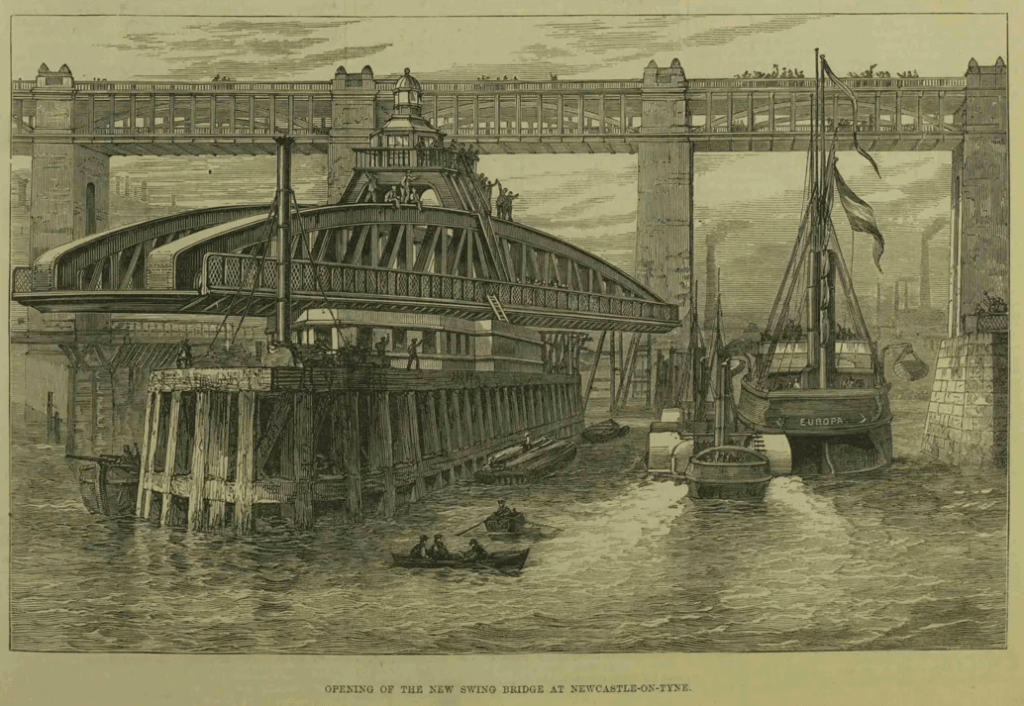
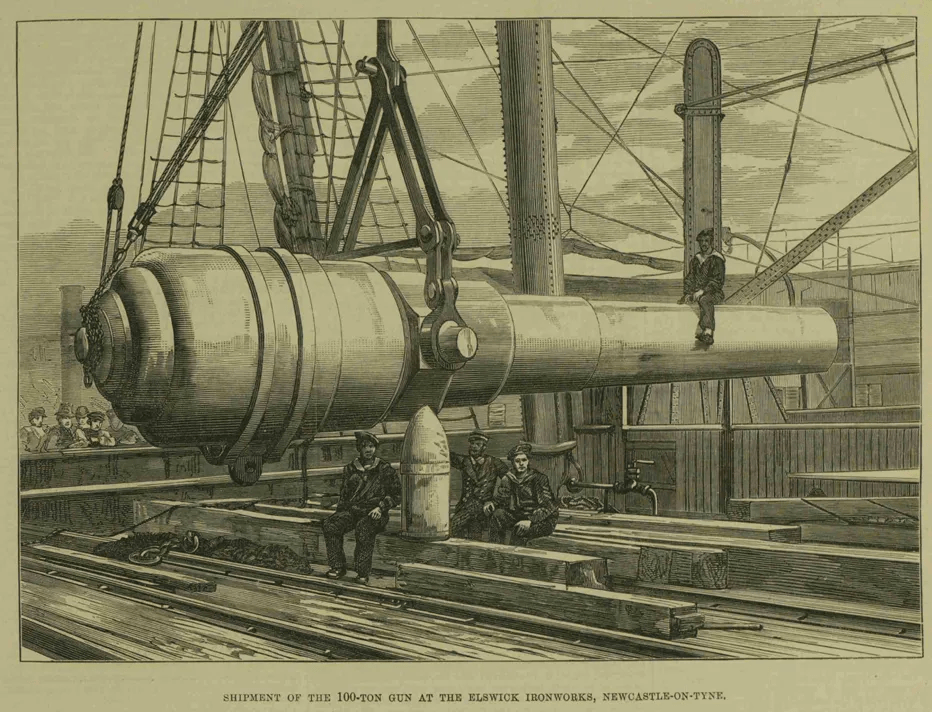
Dwarfed by the high-level railway bridge in the background, the ship was on her way to pick up a 100 ton gun from the Armstrong works at nearby Elswick for the Italian government.
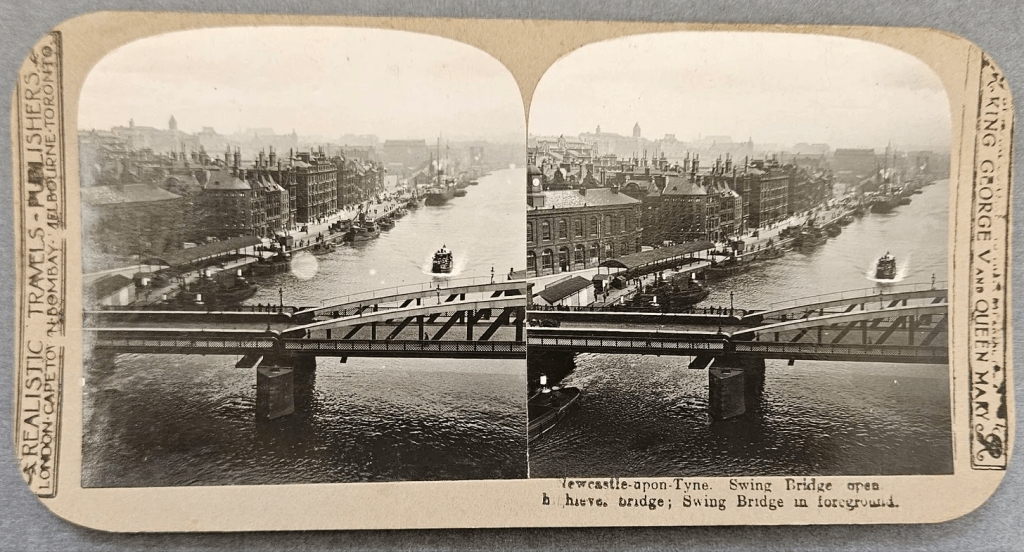
The Swing Bridge has long been a popular photographic subject and its distinctive design was what caught my eye when a stereocard in which it featured recently appeared on eBay.
Produced by Realistic Travels of London, Capetown, Bombay, Melbourne and Toronto, it shows the Newcastle quayside in the background lined with ships and other vessels.
Realistic Travels are best-known for their sets of First World War battle scenes mimicing giant publishers such as Keystone View and Underwood & Underwood.
Indeed, one of Realistic’s co-founders, Hilton DeWitt Girdwood (1878-1964), had learned the 3D trade with the Underwood company as a salesman and later as a stereographer.
A stereo titled ‘HRH the Prince of Wales discusses cinematography with Dr. H. D. Girdwood’ is part of the collection of the National Portrait Gallery, London complete with the Realistic Travels branding.
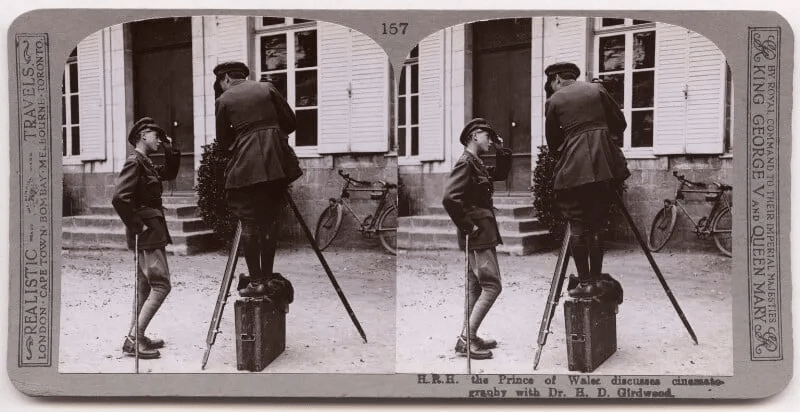
© National Portrait Gallery, London. NPG x196209.
As described by Paul M. Bond in a recent article for Stereo World magazine (January/February 2025), Girdwood and his business partner Henry Creighton Beckett also produced non-war stereos from as early as January 1919.
Realistic Travels operated from a London address at 73 Westwick Gardens, Hammersmith and the small-scale nature of the operation is perhaps reflected in the poor quality printing on view in its Swing Bridge stereo.
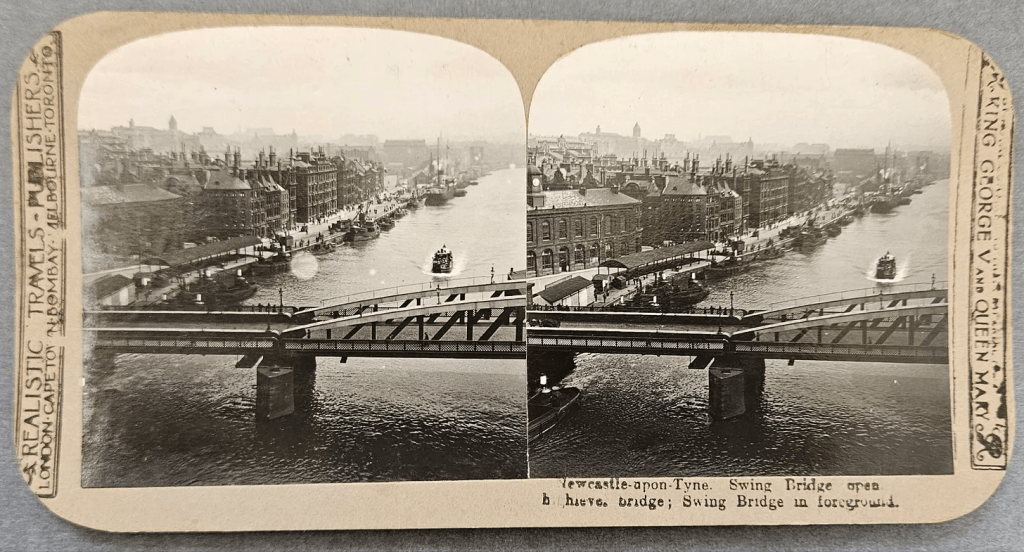
It would be several years before the view beyond included the distinctive arch of the Tyne Bridge opened in 1928 and currently being repainted ahead of its centenary.
The Swing Bridge is also undergoing major repairs with the hope that it will be working again in time for its 150th birthday next year.
 Pressphotoman
Leave a comment