
The subject of last week’s post was a chance discovery of George Washington Wilson’s 3D view of ‘Fingal’s Cave, Staffa’ taken in 1859.

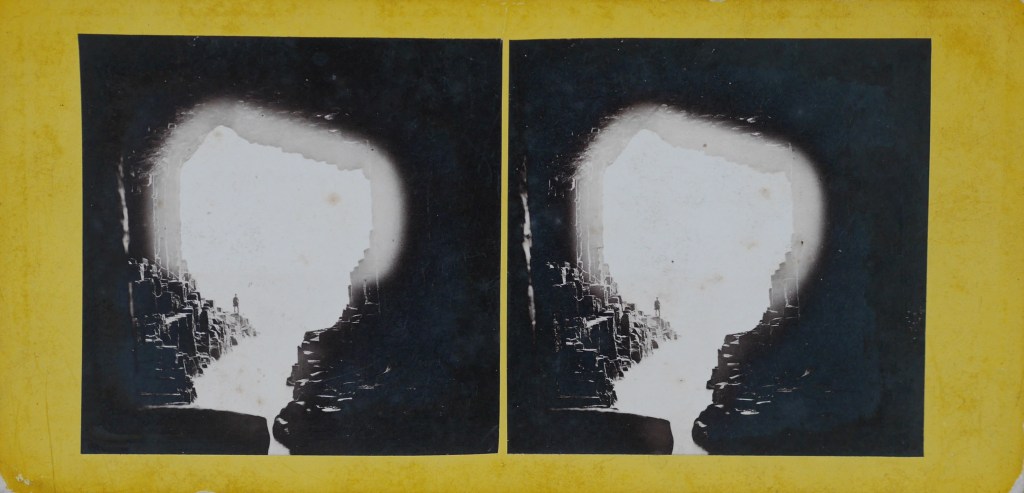
So it was perhaps written in the stars that the reverse view, an ‘Interior of Fingal’s Cave, Staffa,’ by the same G. W. Wilson of Aberdeen has now joined my collection.
To establish its provenance, I again consulted Roger Taylor’s authoritative study George Washington Wilson (1823-1893): Artist and Photographer (London Stereoscopic Company, 2018).
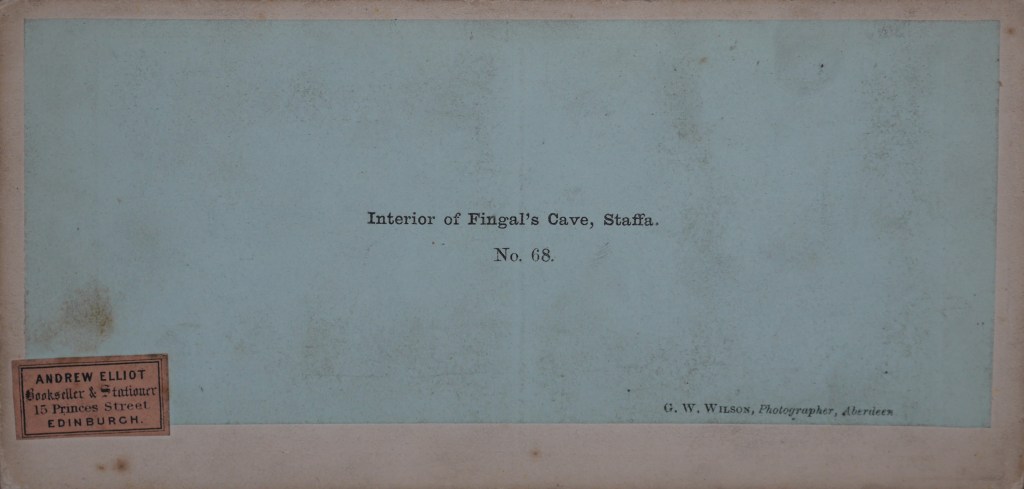
The title, listed as ‘No. 68,’ is included in ‘Wilson’s 1863 List of Stereoscopic and Album Views.’
Again, the verso featured the view’s title and number plus the stereographer’s credit.
Again, it uses blue coloured paper to stop the stereocard from curling.
©️ Author’s collection.
The first thing that strikes the viewer is the technical challenge facing the stereographer in capturing this spectacular scene from the inside out.
Presumably, Wilson used all the available natural light to illuminate the vast space.
As in ‘Fingal’s Cave, Staffa,’ he positioned a human figure at the entrance to give a sense of scale.

Though the card is the same size, the two albumen paper prints are slightly smaller, suggesting that Wilson may have used a different camera.
An added bonus for the photohistorian is the presence on this card’s verso of a seller’s stamp, that of ‘Andrew Elliot, Bookseller & Stationer, 15 Princes Street, Edinburgh.’

Trade directories reveal that his business began operating from one of the city’s most famous locations in the late-1850s.
Elliot’s shop, directly opposite Edinburgh’s Waverley railway station, offered easy access to visiting tourists, who were Wilson’s intended market for such stereos.
Andrew Elliot, who died in 1921 aged 92, was a significant figure in the history of Scottish photography.
A noted collector, his calotypes by pioneering Scottish photographers David Octavius Hill and Robert Adamson were used to illustrate the first monograph about their partnership published in 1928.
Elliot’s family subsequently bequeathed his remarkable photography collection to the National Galleries of Scotland in 1950.

 Pressphotoman
Leave a comment