
In the 1860s, Newcastle upon Tyne’s Eldon Square was a centre of commercial photography.
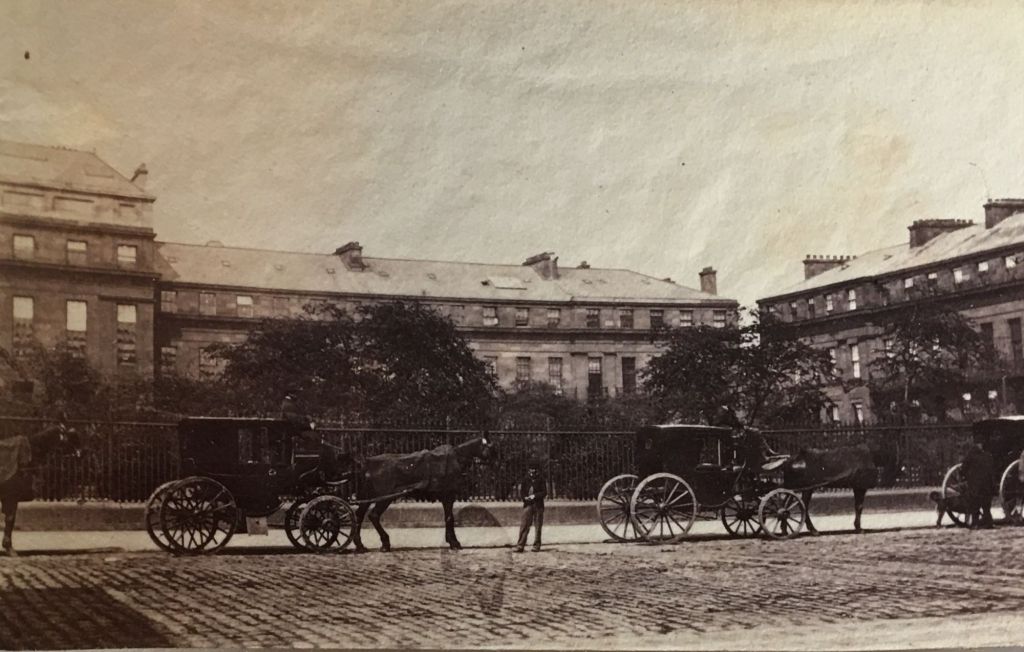
At no. 9 (on the right of facing terrace above), W. & D. Downey opened a new studio in March 1862, consolidating a growing reputation for supplying high-quality portraits.
Other leading photographers in the city such as P.M. Laws, E. Sawyer, R. Turner, G.C. Warren and T. Worden provided the Downey brothers, William and Daniel, with stiff competition.
But in 1864, when W.S. Parry moved his long-established studio to no. 17 Eldon Square, a new chapter in Newcastle’s photo wars began.
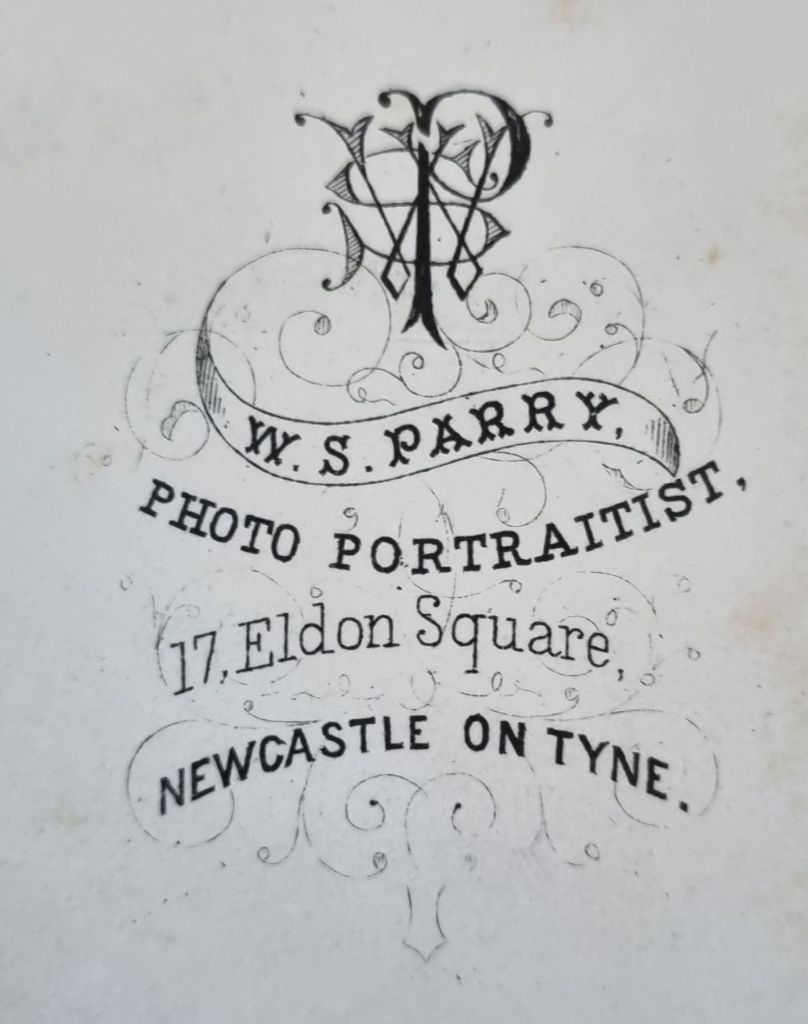
© Author’s collection.
William Softley Parry was born in 1826 across the River Tyne from Newcastle in Gateshead.
By the late-1840s, he was in business as a window glass merchant in Grainger Street, Newcastle, enjoying the new medium of photography as a hobby.
Initially, he produced paper calotypes which he exhibited at the Annual Conversaziones of the Literary and Philosophical Society of Newcastle upon Tyne (founded 1793), known as the ‘Lit & Phil.’
By 1855, following the invention of the wet collodion process which used glass plates, Parry opened his ‘Photographic Institution’ at 44 Newgate Street (‘nearly opposite St. John’s Lane’).
Press adverts promised ‘female attendance for ladies’ indicating that his wife Christiana was involved in producing the studio’s photographic portraits ‘on paper and glass.’
Three years later, the Parry’s business relocated to 44 Bigg Market (‘4th door N.W. of Grainger Street’) and glowing reviews from the national press helped promote its wares.
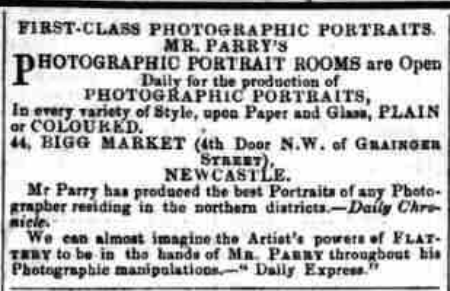
From British Newspaper Archive.
The new fashion of carte de visite portraits attracted a wide variety of clients and offered an affordable opportunity to dress up and look your best.

© Author’s collection.
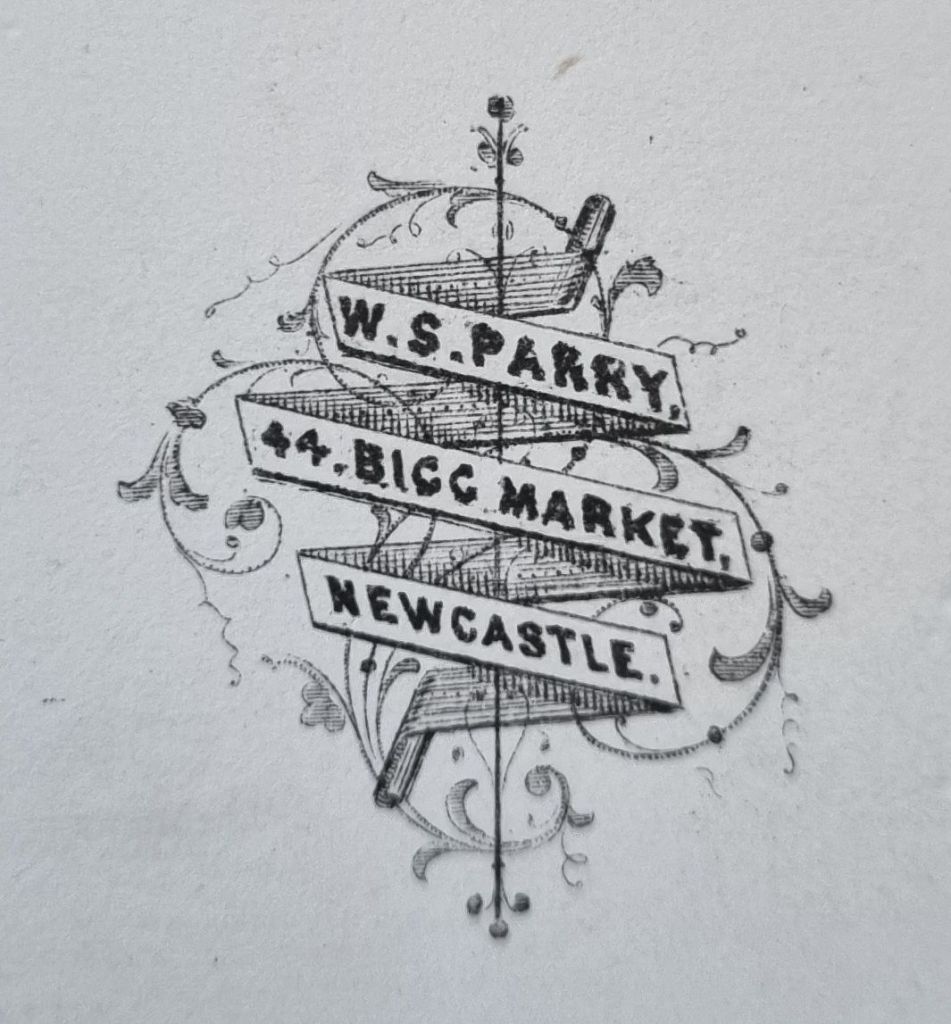
© Author’s collection.
Then in March 1864 with business evidently booming, an opportunity arose to relocate to the more prestigious surroundings of Eldon Square a few doors down from W. & D. Downey.
According to a notice placed in the Newcastle Courant, no. 17, described as an ‘eligible freehold dwelling house with Coach House and Stable,’ was ‘to be sold by auction.’

From British Newspaper Archive.
Within a few months, ‘The Eldon Portrait Rooms, 17 Eldon Square, Conducted by Mr. & Mrs. W. S. Parry and Assistants’ were open for business.
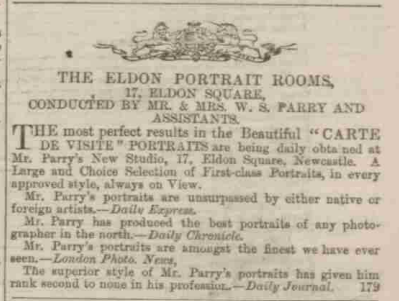
From British Newspaper Archive.
The Parry’s arrival cemented Eldon Square’s status as a place to go if you were having your photo portrait taken.
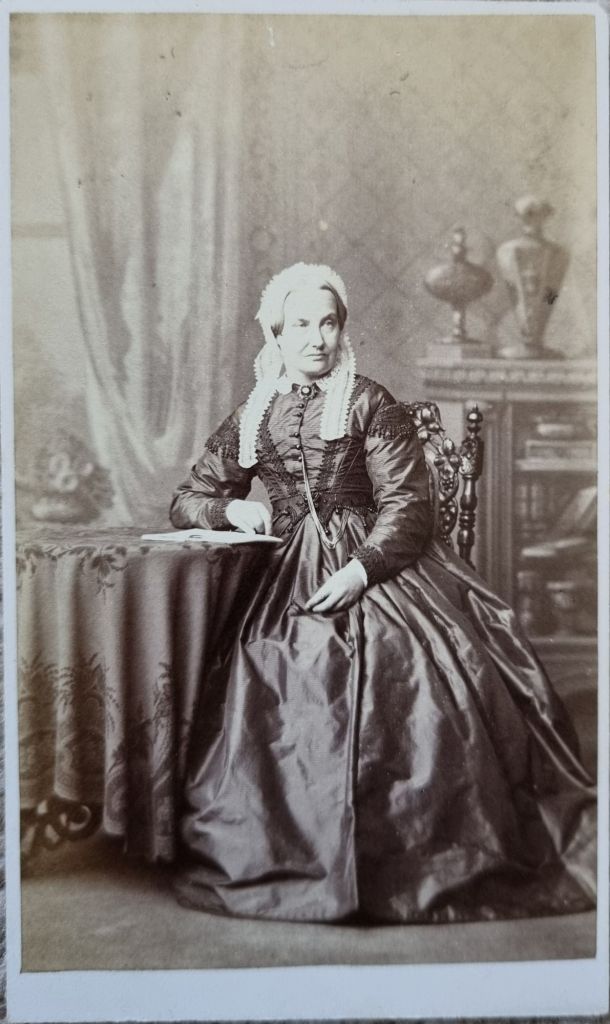
© Author’s collection.
The fact that W. & D. Downey at no. 9 were the Parry’s neighbours and photographic competitors was reflected in subtle changes to their business offer.
For instance, when Downey’s offered a new series of stereoscopic views of Newcastle, Parry raided his photographic archive to advertise ‘local views, and others of general interest … taken from eight to sixteen years ago.’
In the drive for valuable custom, both studios placed almost daily front-page adverts in the Newcastle press.
Downey invariably occupied the top of the left-hand column whilst Parry took a prominent position on the right-hand side of the page.
Then, on 11th July 1868, the Newcastle Daily Journal reported the death of Christiana Parry.
In her late 30s, she had died at no. 17 the previous day though no cause of death was given.
It was the latest tragedy to befall the Parry family whose ‘eldest surviving daughter’ Euphemia died in 1862 aged five.
A fortnight after ‘the lamented death of his wife,’ William announced in a press ad that he was resuming business and that the Ladies’ Department would be run by her assistant for the past three years, Miss Lizzie Elliot.
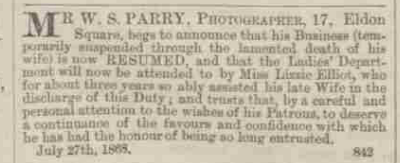
From British Newspaper Archive.
Improvements to the studio in Eldon Square followed.
However, in June 1871, no. 17 was put ‘up for sale’ and William revealed that he would ‘shortly leave for the South.’
The following month, a two-day sale of ‘household furniture and effects’ and ‘the apparatus and working plant of the Photographic Department’ was held at his home.
After leaving Newcastle, W.S. Parry ran at least two photography businesses, one in Berkshire during the 1870s and another in Birmingham in the 1880s.
However, by the time of his death in 1915, his reputation as a pioneering photographer was long forgotten.
Even the Newcastle Journal, which celebrated his many photographic achievements during the Eldon Square years, headlined its report of an inquest into his death: ‘Blown Over By The Wind: An Old Man’s Sad Death At Middlesbrough.’
Despite this, William Softley Parry’s work as a pioneering photographer is chronicled in two respected accounts of the medium’s early years.
Notably John Werge’s History of Photography (1890) and, more recently, Roger Taylor’s Impressed By Light: British Photography from Paper Negatives, 1840-1860 (2007).
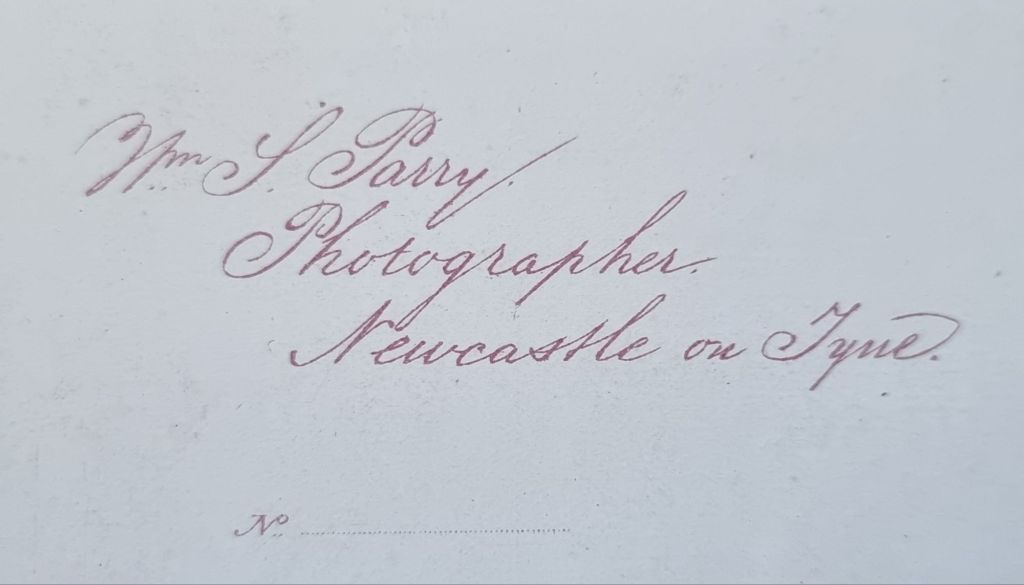
© Author’s collection.
What they confirm is that W. S. Parry’s Newcastle years were both influential and productive and helped put the city on the map as a centre of photographic innovation.
Next time in the final part of this mini-series, new Pressphotoman research explores if an amateur husband-and-wife photography team were also living in Eldon Square at the turn of the 1860s.

 Pressphotoman
Leave a comment