The death of Pope Francis aged 88 followed by his funeral over the weekend attracted the focus of the world’s media.
Speculation about who his successor will be is well underway.
By way of marking this latest chapter in papal history, I’m republishing research into an ambitious 3D photographic project featuring one of Pope Francis’s predecessors.
Following a conclave in 1903, Giuseppe Melchiorre Sarto was appointed Pope as Pius X.
Within months, the leading stereoscopic photography company Underwood & Underwood sent a team from its London offices to produce what became a popular series of 36 stereocards.
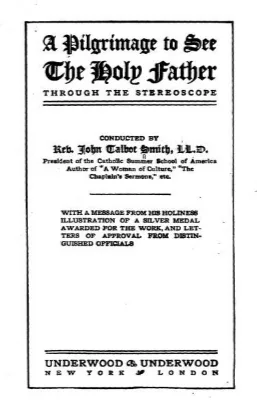
These were published the following year as A Pilgrimage to see the Holy Father through the Stereoscope.
Frontispiece of A Pilgrimage to see the Holy FatherThrough the Stereoscope (1904).
The images, which capture the Pope in relaxed and intimate settings around the Vatican, were reproduced by the press around the world and made available to the public as picture postcards.
Taken together, they highlight the importance of photography more than a century ago as an influential medium of mass communication to a global audience.
The Asia-Pacific Tour currently being undertaken by Pope Francis is attracting a great deal of media attention.
Over the course of 12 days (2nd-13th September 2024), the 87 year-old pontiff is visiting Indonesia, Papua New Guinea, Timor-Leste and Singapore.
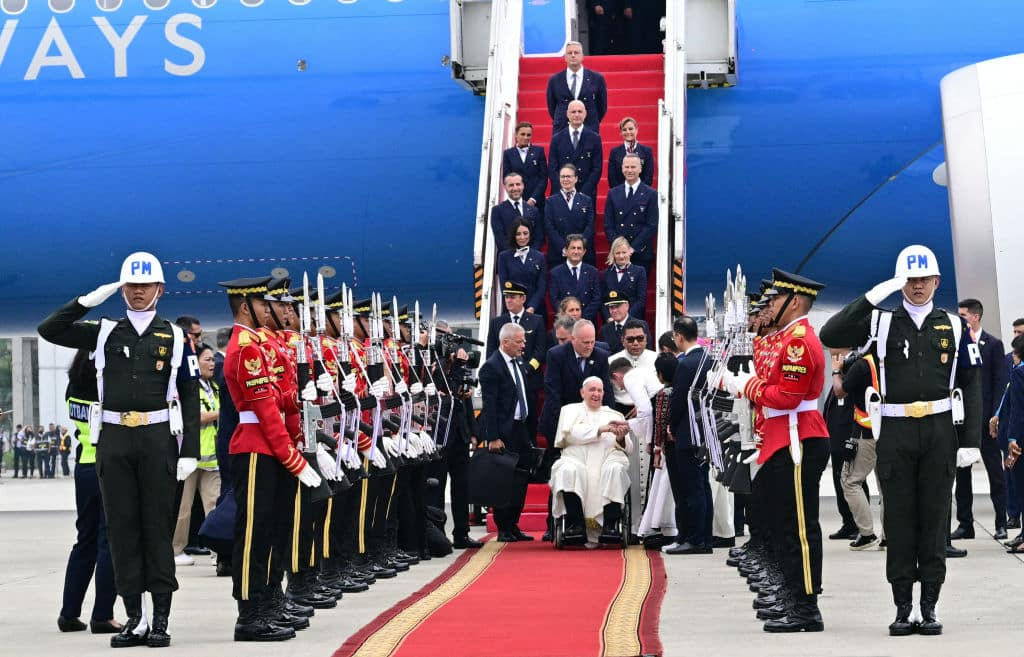
This news photo (below) from the start of the tour attracted my attention as it well illustrates the continuing influence of stereoscopic 3D photography on today’s visual media.
Pope Francis is greeted after his arrival at Soekarno Hatta International Airport, Jakarta, 3rd September 2024. Photo by TIZIANA FABI/AFP via Getty Images.
Shot between two lines of soldiers with the Pope in the distance, its use of different planes along the length of the red carpet and then up the aircraft steps would work perfectly if taken in three dimensions.
The fact that it was published in 2D without any comment underlines a factor in press and website illustration dating back to the turn of the 20th century.
At that point, newspapers and magazines first adopted half-tone printing.
This enabled a variety of publications to re-produce real photographs rather than using line drawings or engravings.
One of the leading players in servicing this demand was Underwood & Underwood of New York & London whose role was the subject of my 2021 doctoral thesis (see ‘Writings.’)
As 3D photographers, Underwood stereographed news events, which they then sold to customers in box sets.
In addition, the company offered prints taken from one-half of a stereo pair for publication by newspapers and magazines.
In time, Underwood’s press photos agency became the biggest in the world.
One of the company’s best-selling sets of 3D photos, published in 1904, was titled A Pilgrimage to see the Holy Father through the Stereoscope.
It featured 36 stereos and a guidebook with maps to shepherd the ‘pilgrim’ from location to location.
Within months of Pope Pius X’s election in the summer of 1903, Underwood sent a team from its London office led by the company’s European manager Eldon R. Ross.
As revealed by copyright forms in the National Archives at Kew (COPY 1/467/107-115), Underwood stereographer James Edward Ellam (1857-1920) took a number of the key images.
These included the new Pope in his pontifical robes in the Vatican’s Throne Room.
In recent months, two of Ellam’s papal stereos have joined my collection, both of which appeared as press photos in the then popular weekly illustrated paper The Sphere.
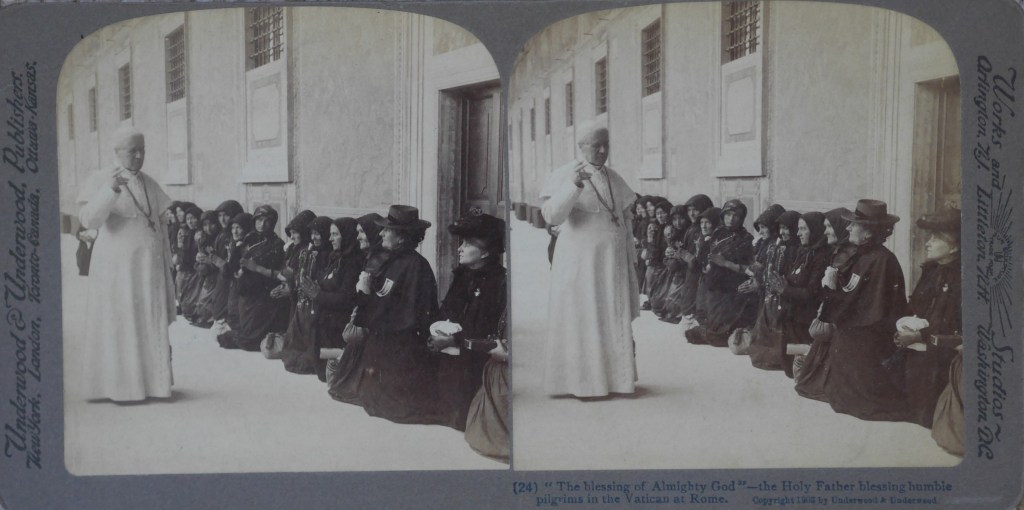
In the first, numbered ’24’ in Underwood’s stereo set, ‘the Holy Father’ is pictured ‘blessing humble pilgrims.’
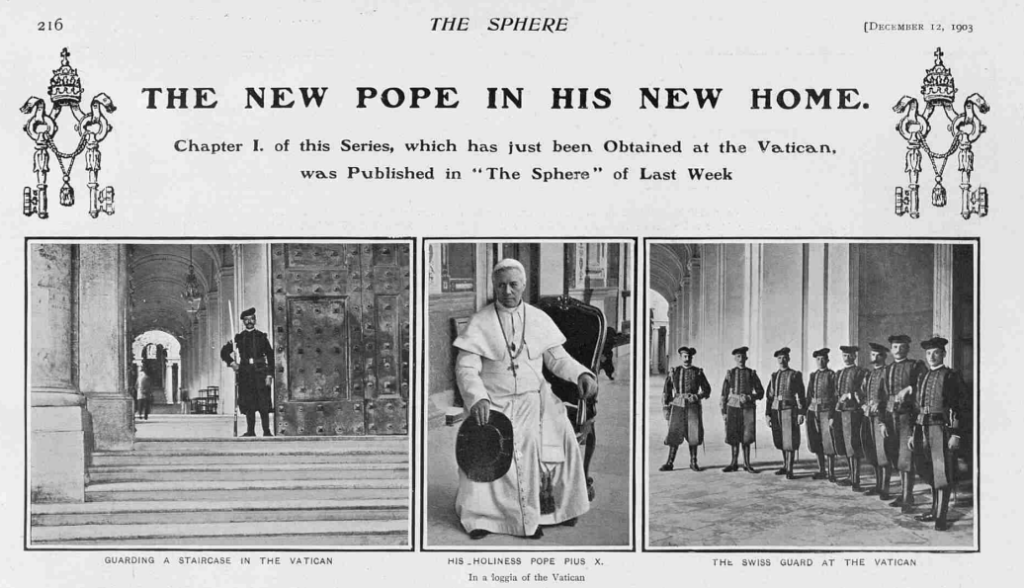
Despite previously having used the standing version, The Sphere used a print of the sitting version in the following week’s issue.
From The Sphere (12th December 1903). From British Newspaper Archive.
As Pope Francis continues his Asia-Pacific Tour, the world’s media will no doubt continue to follow his every move.
This media attention replicates a phenomenon that saw the day-to-day activities of one of his predecessors being viewed for the first time in 3D, generating similar public interest.
The National Stereoscopic Association, which celebrates all things 3D, holds an annual convention for its members each summer in an American city.
This year the 49th event took place in Buffalo in upstate New York, and I was pleased to attend and present my latest research on the influence of stereoscopy on early press photography.
Front cover of brochure for 3D-Con 2023.
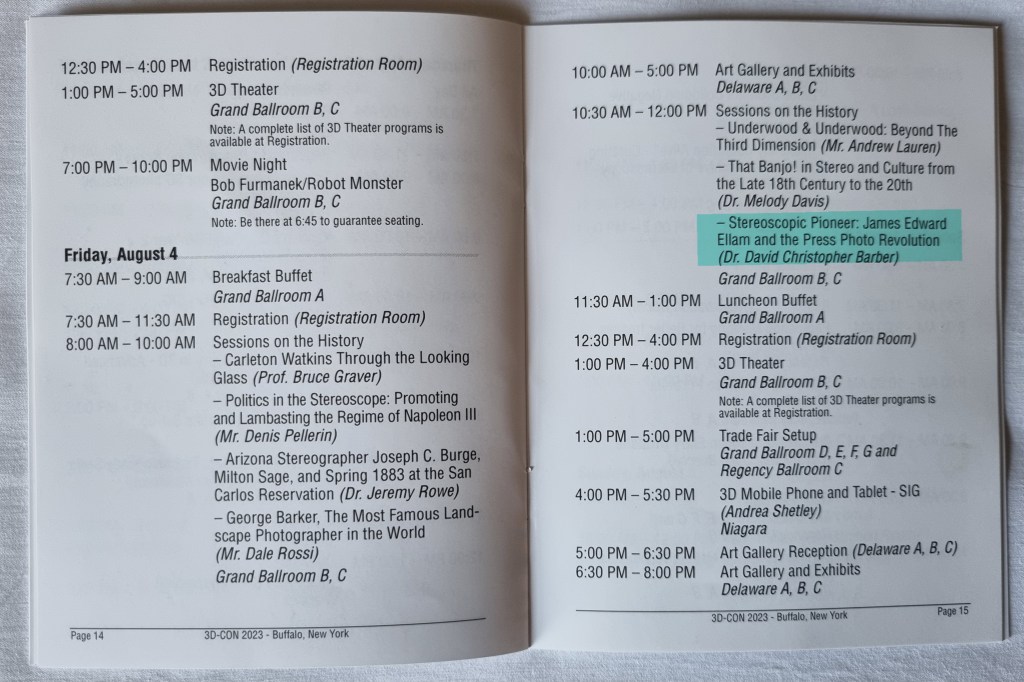
“Sessions of the History of Stereoscopic Photography IV” occupied a whole morning and a total of 7 speakers covered a range of topics.
Programme of talks for “Sessions on the History of Stereoscopy IV.”
These included presentations on Carleton Watkins, Napoleon III, Arizona, George Barker, Underwood & Underwood and the Banjo.
After speaking at conferences in the UK, it was my first overseas presentation to an international audience made up of attendees from all over the world.
My talk, “Stereoscopic Pioneer: James Edward Ellam and the Press Photo Revolution,” looked at the path followed by one amateur stereographer from Yorkshire to Fleet Street where he enjoyed a successful career as a press photographer.
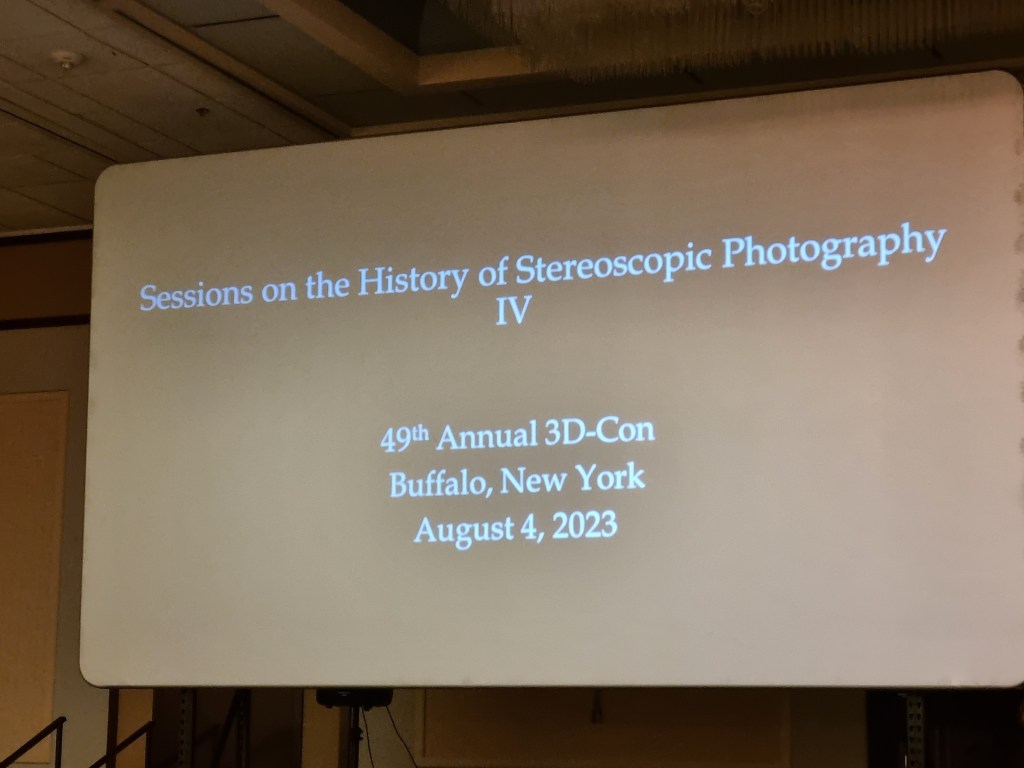
Title slide of my presentation to 3D-Con 2023.
Regular readers of this blog will recognise the name James Edward Ellam from an earlier post (April 28, 2023: Press Photo Pioneer).
However, my 3D-Con talk was greatly informed by a recent discovery I made of a cache of Ellam stereos on a well-known auction website. They largely date from his time in the Yorkshire town of Yarm in the 1890s.
Many bore his name, “J.E. Ellam,” on printed stickers alongside his handwritten titles on the verso.
It’s handwriting that I recognised from various copyright forms I have seen in recent years in the National Archives at Kew that had been filled out and signed by him.
Most exciting of all was that two of the stereos indicated links with Underwood & Underwood with whom he had a productive working relationship as his stereos for U&U featuring Queen Victoria, King Edward VII & Queen Alexandra, and Pope Pius X testify.
Given that there are around 30 stereos, it seems that September offers an ideal opportunity to share these Ellam images day-by-day via this blog with a few new insights that I have learned by viewing them more closely.






 Pressphotoman
Leave a comment