Pressphotoman’s ongoing search for stereoscopic photographs by the early press photographer James Edward Ellam (1857-1920) can report an exciting development.
One of his stereocards has been identified in the archive collection of Queen guitarist Sir Brian May thanks to co-curators Denis Pellerin and Rebecca Sharpe.
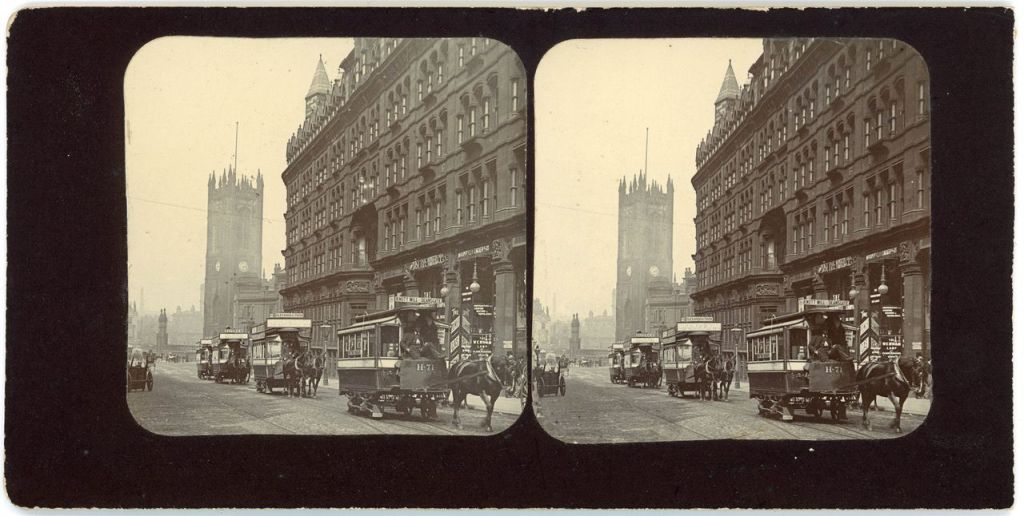
This wonderful 3D image features ‘Deansgate, Manchester’ with the city’s Anglican cathedral in the background
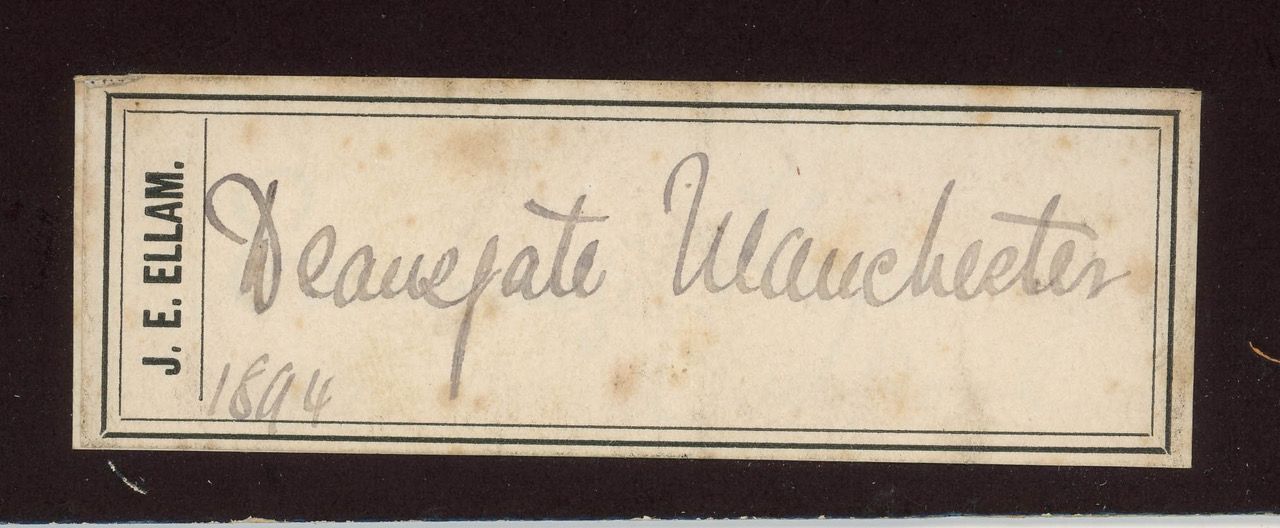
It’s captioned and dated ‘1894’ on the verso in Ellam’s distinctive handwriting.
Courtesy of the Brian May Archive of Stereoscopy (BMAS).Courtesy of the Brian May Archive of Stereoscopy (BMAS).
Rebecca tells me that the card was added to the BMAS collection as part of a lot acquired in 2019.
Looking at the card’s style and colour, this newly-discovered example also appears significant in researching the pioneering Fleet Street photographer’s career.
In 1894, Ellam was working as a chemist’s assistant in the North Yorkshire town of Yarm where he lodged with tailor and fellow amateur stereographer Henry Bradley (1852-1937).
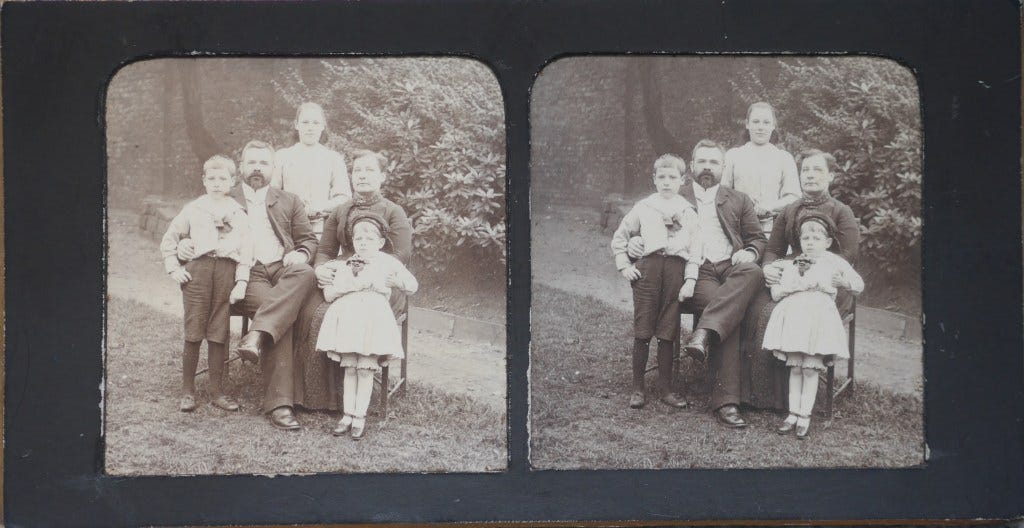
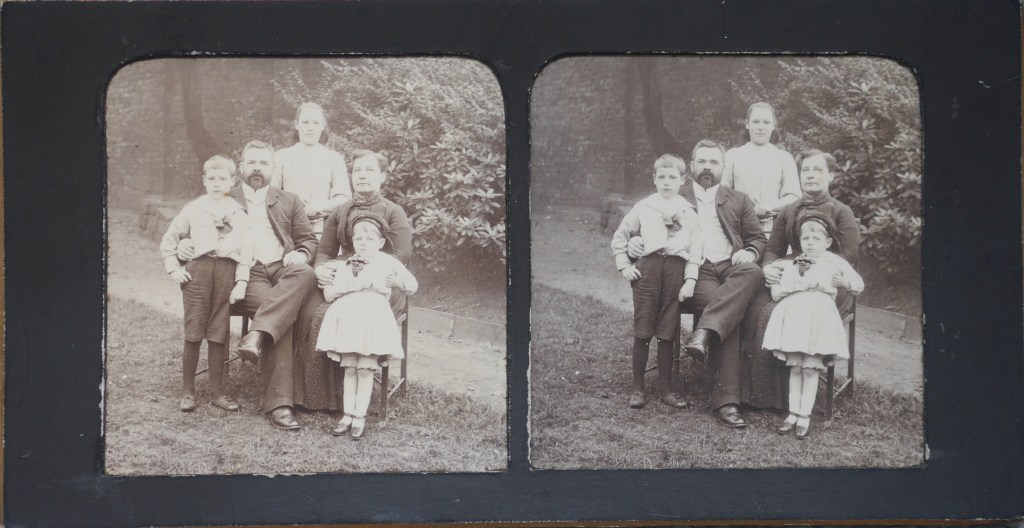
Like ‘Deansgate, Manchester,’ the stereo below also features rounded corners and is presented on black card.
The stereo was one of around 30 acquired by Pressphotoman from an Ebay auction in 2023 that can be attributed to James Edward Ellam.
If, like ‘Deansgate, Manchester’, the group portrait was taken in 1894, the Bradleys and their lodger were soon on the move to Dunmow in Essex where Henry took over another tailoring business.
This relocation gave Ellam proximity to London and allowed him to pursue a professional stereography career, first with Underwood & Underwood and then London News Agency Photos.
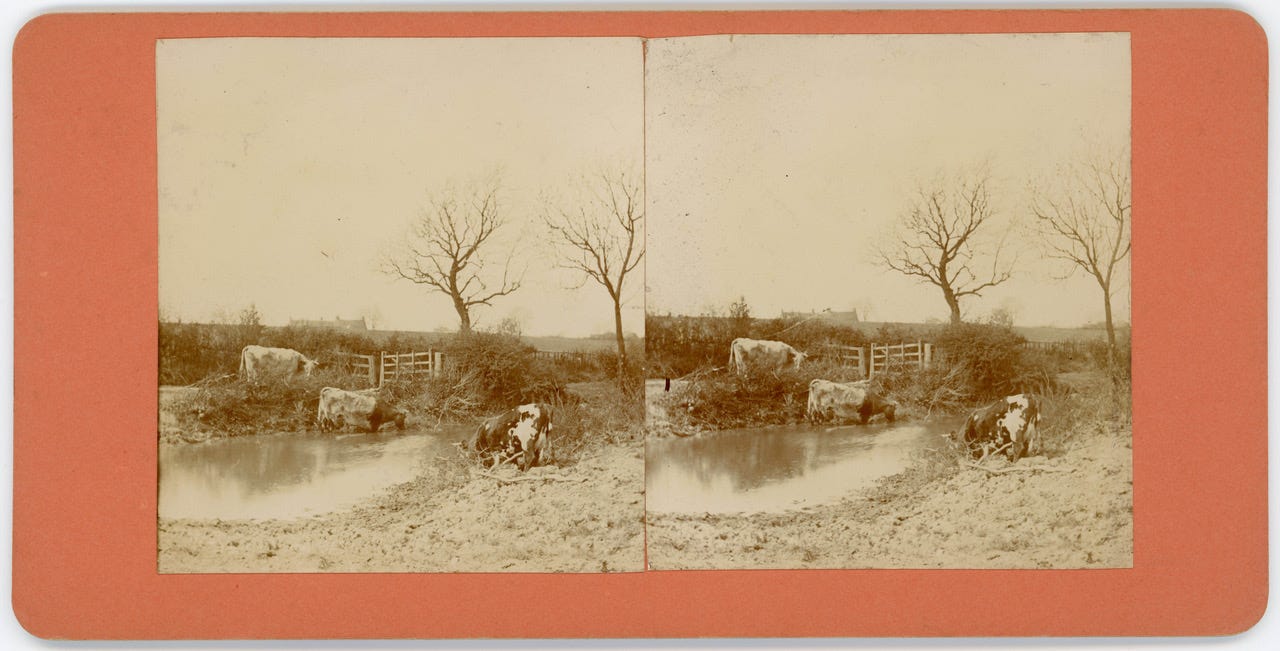
To add to my excitement about the newly discovered Ellam stereo, an example of Henry Bradley’s stereography has also emerged from the Brian May Archive of Stereoscopy (BMAS).
Courtesy of the Brian May Archive of Stereoscopy (BMAS).
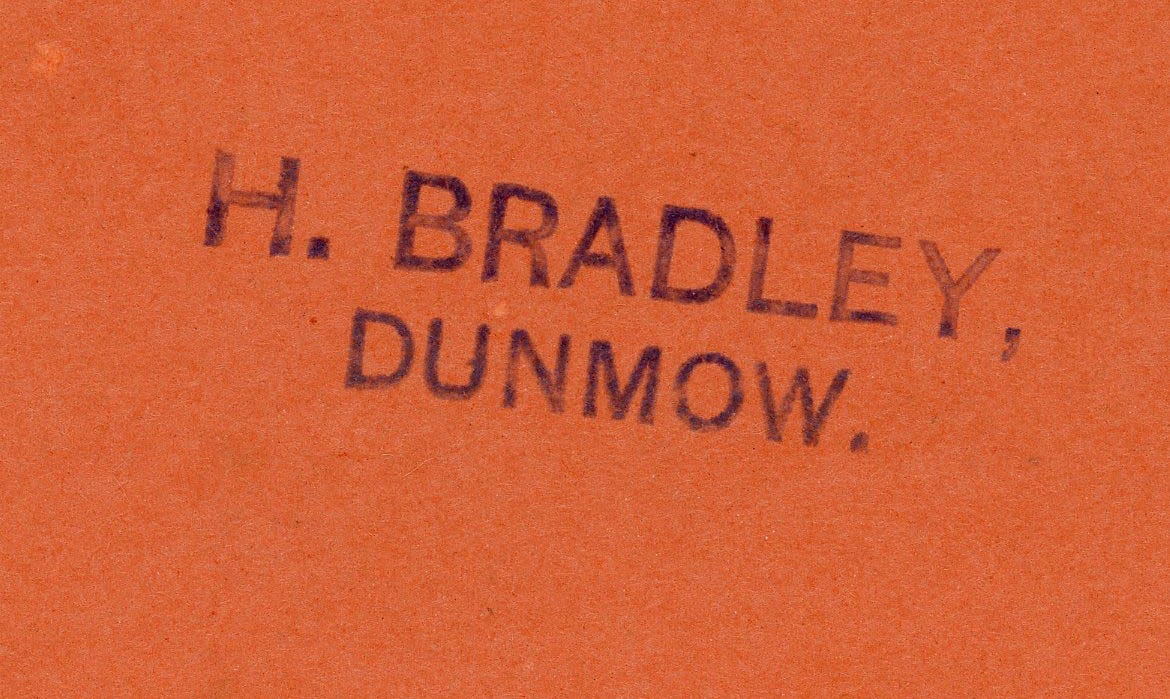
Though untitled, the rural scene features an ‘H. Bradley, Dunmow’ stamp on the verso.
Courtesy of the Brian May Archive Stereoscopy (BMAS).
Research into the stereography of both James Edward Ellam and Henry Bradley continues.
In 1905, the photographer James Edward Ellam was at a turning point in his professional career.
A skilled amateur stereographer in his native Yorkshire, he had journeyed south a decade earlier to pursue opportunities offered in London by the leading American 3D company Underwood & Underwood.
It was a decision that changed his life.
Ellam is best-known for a number of the stereos he took for the Underwood company.
Today they feature in museum collections around the world.
Among them are Queen Victoria’s Golden Jubilee celebrations (1897), King Edward VII and Queen Alexandra in their coronation robes (1902) and Pope Pius X in his pontifical robes in the Vatican’s Throne Room (1903).
Despite these achievements, Ellam’s career path into Fleet Street seems to have included a subsequent period where he created photographs with a distinctly local flavour.
Hence, his decision to register the copyright of two images taken in or around the Essex town of Dunmow where he lodged at weekends.
Last week’s blogpost featured the first of these press photographs.
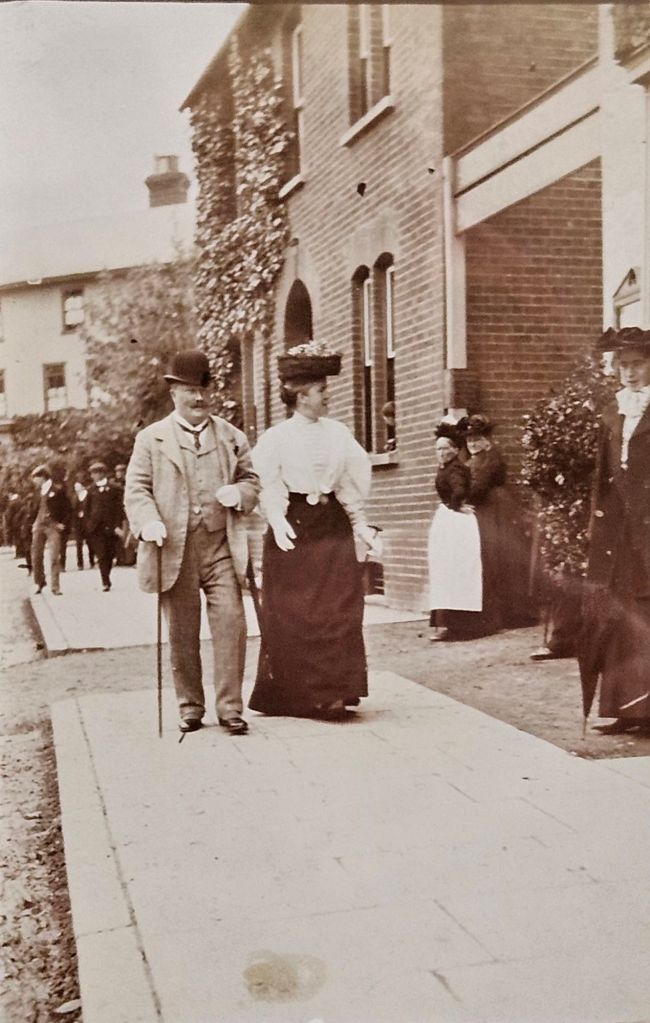
It portrayed the prospective Liberal Member of Parliament Barclay Heward (1853-1914) and his wife strolling along Dunmow High Street in the run-up to 1906 General Election.
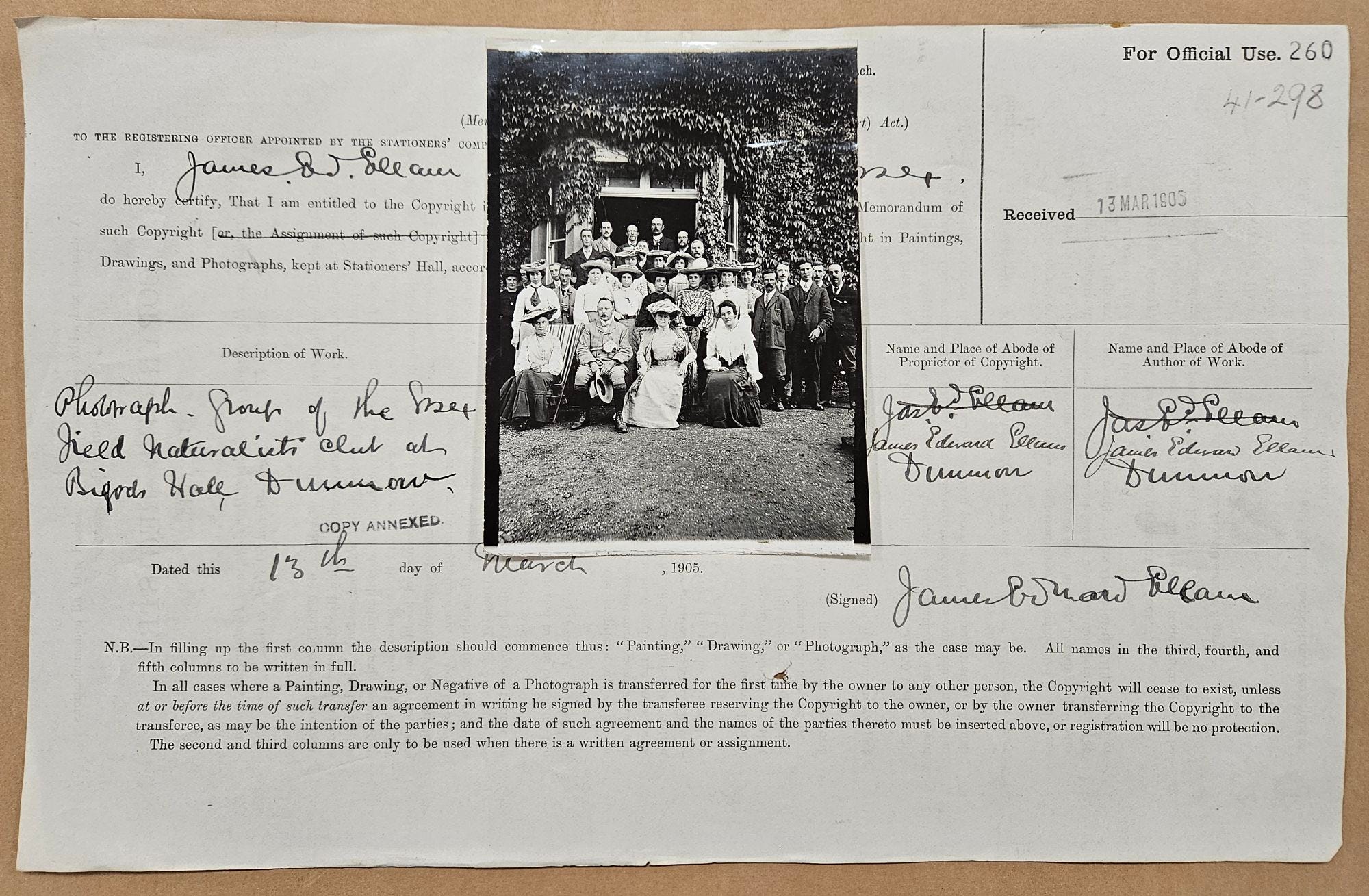
What he omitted to mention was that one of that group was one of the most famous women in the land.
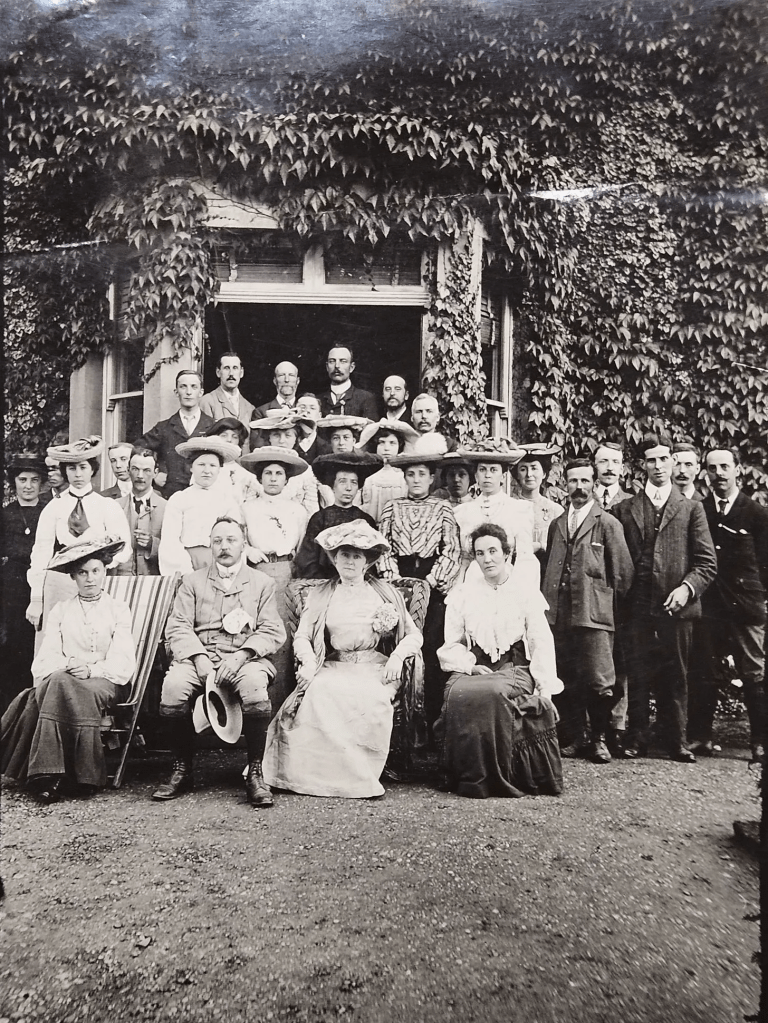
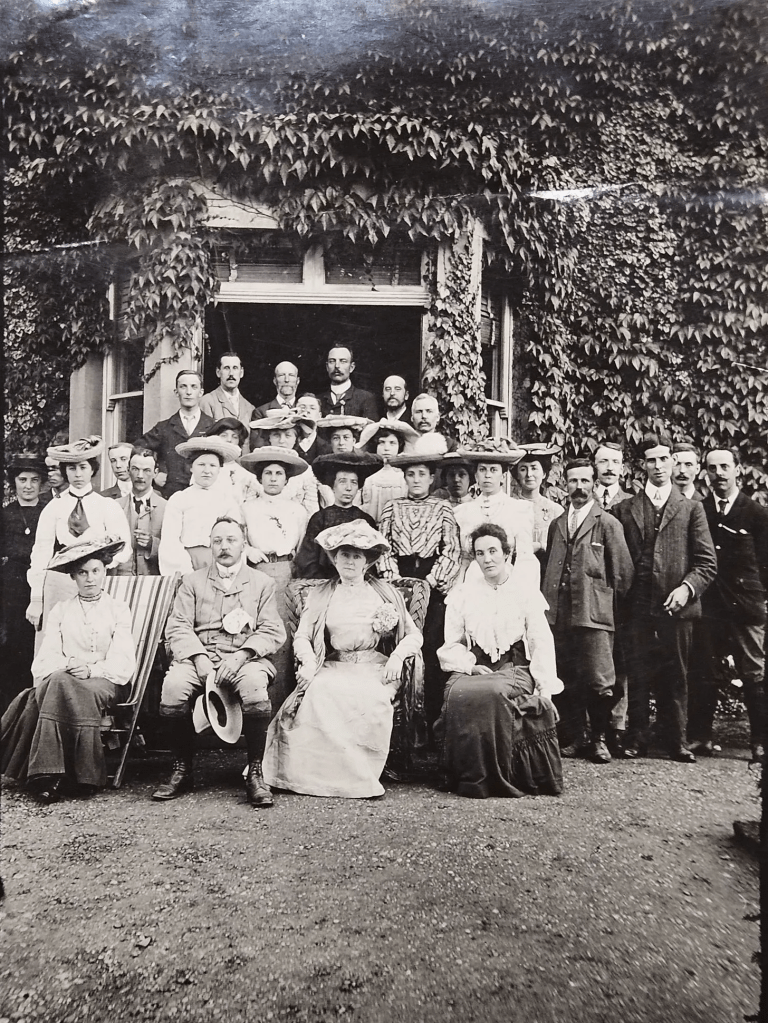
Fashionably-dressed and seated on the front row in a wicker chair, Daisy, Countess of Warwick was a one-time mistress of King Edward VII.
She is pictured at a significant moment in her own life; one that was the subject of almost daily press attention.
During this period, Lady Warwick became actively engaged in politics as a member of the Social Democratic Federation.
However, unlike the Liberal candidate Barclay Heward, who featured in Ellam’s earlier photograph, she was increasingly active in promoting radical socialism ahead of the forthcoming General Election.
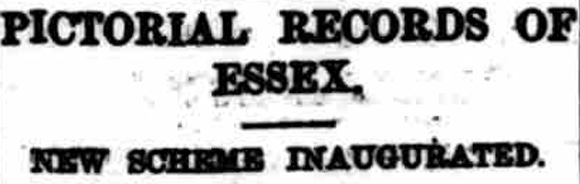
As to the photograph’s genesis, a press report in the East Anglian Daily Times and cited in the Essex Naturalist account of the club’s activities provides the background.
On Saturday 8th July 1905 at the invitation of the Earl and Countess of Warwick, “members of the club and many friends, about seventy in all, assembled … for the purpose of inaugurating ‘the Pictorial and Photographic Record of Essex.’”
The brief of the project was “to write the history of the county in pictures.”
East Anglian Times (10th July 1905). From British Newspaper Archive.
The report described how Lady Warwick presided at a luncheon held at Easton Lodge near Dunmow, her husband’s ancestral Essex home.
She first apologised for the absence of the Earl, who was “at Brest on a yachting cruise.”
After lunch, a meeting to discuss the photography project was held “in a commodious double tent amongst trees at the back of the house.”
Following the meeting, the group paid a visit to nearby Bigods Hall, which the Countess had established years earlier as a secondary and agricultural school.
Those present were then entertained to tea by the Principal, Mr. T. Hacking and Mrs. Hacking.
Though the report refers to “about seventy in all” attending the luncheon and meeting held at Easton Lodge, the smaller group pictured in the Bigods Hall photograph perhaps indicates that not everyone made the line-up.
What is particularly noteworthy is the presence of so many women in the picture, making up around half of the group.
At this point in the medium’s history, photography had become a popular and affordable pastime thanks to the advent of Kodak’s ‘you press the button, we do the rest’ range of cameras.
Ellam’s presence too may well have been directly linked to the photographic project being discussed.
Copyrighting the image does though suggest that he recognised that this photograph of the Essex Field Naturalists Club had a long-term value.
What is slightly confusing is that the copyright form completed by Ellam, with this photograph attached and held by the National Archives, is stamped and dated ‘13th March 1905.’
As the weather during the Bigods Hall visit was reported as “gloriously fine,” the dress of those appearing on camera does suggest a July day rather than one in March.
One explanation may be that the 13th March form referred to an earlier occasion.
Armed with a new photograph of the group featuring the media-friendly Lady Warwick, he simply substituted a copy of that taken on 8th July.
Whatever the explanation, the resulting photograph captures a moment in the changing world of Edwardian Britain.
Political elections and their outcomes are a talking point at the moment particularly in England, Canada and Australia where voters have recently gone to the polls.
Down the centuries, press and media coverage of such landmark events has evolved as demonstrated by this photograph.
More about the photograph’s subjects, its location and how it came to be taken shortly.
As to the photographer responsible, the image was created by James Edward Ellam (1857-1920) whose career as a stereographer and later press photographer is a continuing research thread for this blog.
The photograph’s existence is entirely due to the UK National Archives, formerly the Public Record Office.
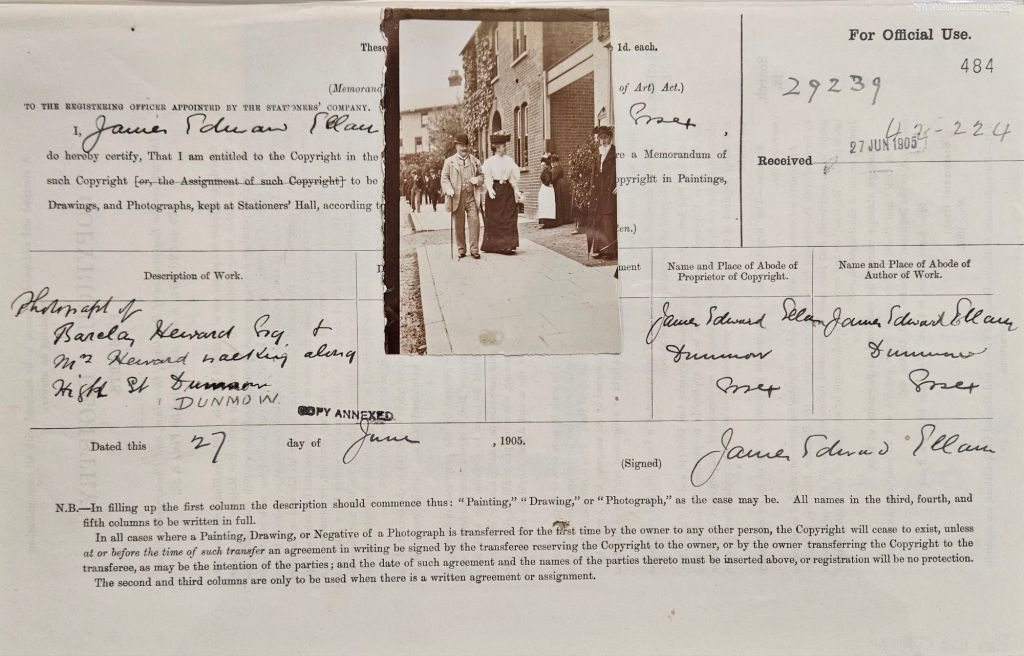
The Fine Arts Copyright Act of 1862 required that anyone registering a photograph for copyright needed to complete a form with a copy of the image attached though not everyone did as they were required.
Today, those copyright records are stored in sturdy grey archival boxes in the National Archives building at Kew in London.
Each box contains a stack of forms preserved in see-through sleeves.
Fortunately for this researcher, Mr. Ellam’s form dated 27th June 1905 and signed by him together with the photograph it related to were intact.
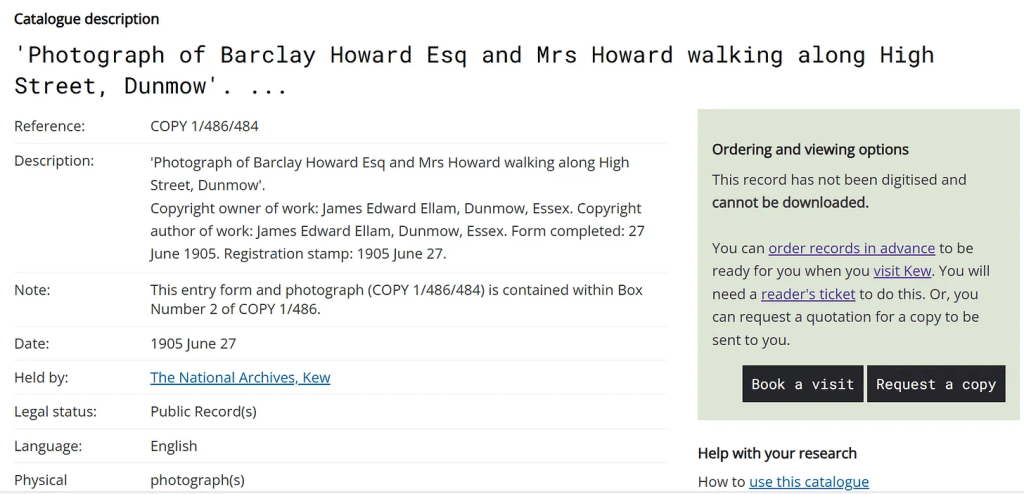
Helpfully, the National Archives have created a digital record of these copyright forms and their contents.
But the contents of the forms are not always accurately recorded and so can send the researcher down a few dead ends as it did in this case.
On further investigation, what the catalogue listed as ‘Photograph of Barclay Howard Esq and Mrs. Howard walking along High Street, Dunmow’ turned out to have mis-spelt the couple’s surname.
Mr and Mrs. Heward (rather than Howard) were Spencer Barclay Heward (1853-1914) and his wife Lina Emily née Sewell, who had married in 1879.
The reason that James Edward Ellam had taken their photograph on a June day in 1905 was all down to politics.
Mr. Heward was a candidate in the forthcoming United Kingdom General Election that took place over several days in late January and early February 1906.
This wasn’t Heward’s first attempt to become a Member of Parliament.
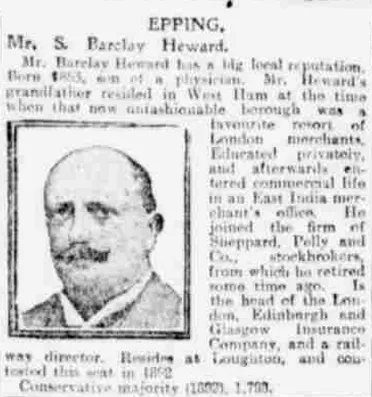
A retired stockbroker, he had stood unsuccessfully in 1892 as the Liberal candidate for the Epping constituency in Essex.
Stratford Express (16th July 1892). From British Newspaper Archive.
In November 1904, he was again selected to fight the seat for the Liberals in a bid to unseat the same Conservative opponent, Colonel Lockwood.
Ellam’s photograph of Mr. and Mrs. Heward captures the couple striding confidently along the pavement, attracting the attention of various onlookers.
One particular point of interest is the photograph’s location as stated on the copyright form: ‘High Street, Dunmow.’
Whilst working during the week as a press photographer servicing London’s Fleet Street, Ellam lodged at weekends with Henry Bradley and his family at their outfitters business on Dunmow High Street in Essex.
Whether the photoshoot with the Hewards had been pre-arranged or came from Ellam’s quick-thinking, it resulted in an image with topical news value.
There was a growing market for such photos among newspapers and magazines.
These though were early days as far as press photography were concerned and even national newspapers previewing the General Election predominantly used line drawings as illustrations.
London Daily Chronicle (1st January 1906). From British Newspaper Archive.
They were early days too for Ellam, who was operating at this point in his career as a freelance press photographer with an eye to selling his images to multiple customers.
Claiming copyright for his work provided a degree of protection for any financial benefits that might accrue if the photograph was reproduced by the press.
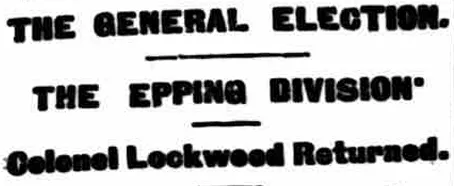
On this occasion though, and despite the Liberal landslide result across the UK, Ellam’s journalistic instinct went unrewarded at the polls.
The Woodford Times (26th January 1906). From British Newspaper Archive.
Also in 1905, Ellam created another photograph aimed at the press that he again copyrighted, which is the subject of the next Pressphotoman blogpost.
During his years living and working in the small Yorkshire town of Yarm, James Edward Ellam (1857-1920) lodged with Henry Bradley and his family who ran its tailors and outfitters.
Whilst James was Honorary Secretary of the nearby Stockton Photographic Society, Henry was a Vice-President.
In July 1896, the local press reported that James and Henry would be leaving the society and the district.
Their joint destination was Dunmow in Essex where the Bradleys took over another outfitters’ business and James again lodged with the family.
It was a domestic arrangement that lasted until the photographer’s death in 1920.
With London only 30 miles away by train, James was able to pursue his photographic ambitions during the week before returning to Dunmow at weekends.
Today’s uncaptioned stereo, taken from a cache of 30 3D cards by him that are the subject of this blogpost-a-day series, almost took my breath away when I viewed it for the first time.
If features an unnamed family group, posing outdoors, in which I recognised the bearded figure of Henry Bradley (1852-1937).
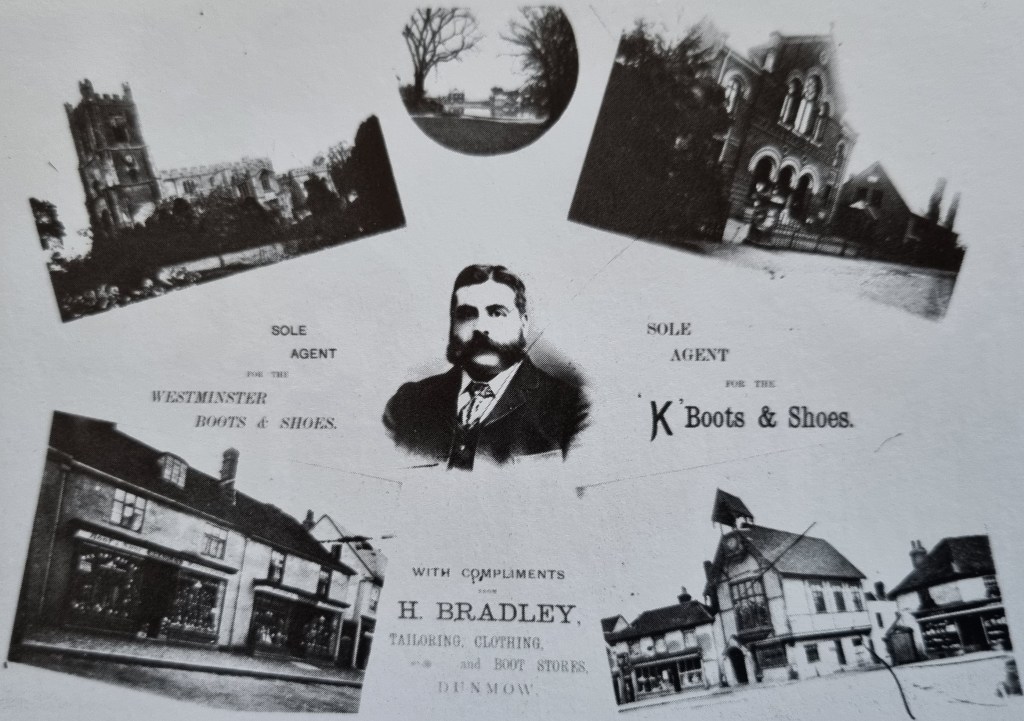
Researching the Bradley family’s years in Dunmow, I came across a postcard Henry produced to promote his new business that included a self-portrait at its heart.
Promotional postcard featuring Henry Bradley from Dunmow in Old Picture Postcards by Stan Jarvis (1986).
Using census records, I learned more about the Bradley family.
The woman to his right in the stereo is likely to be his wife Dorothy (1853-1931).
They are pictured together with three children.
Their eldest Clare Isabel was born in 1884 followed by Ellinor Pauline (1886), Feodora Alice (1887) and Marguerita Annie (1889).
The 1911 England Census records that another child had died by that point.
Parish records for Yarm reveal that a child named Rita Bradley, aged “24 hours,” was buried on 18th July 1883, so perhaps their last-born Marguerita was named partly in tribute to her sister.
Given this biographical information, and if the girl standing between her parents is their eldest, Clare Isabel, the stereo would appear to date from around the time the family left Yarm and moved south to Essex.
Whilst the stereo has no credit or markings on its verso, it would hardly be stretching credibility to think that it was taken by their lodger, James Edward Ellam.
More significantly, it was among the cache of 30 stereos which, I have recently learned, came into my hands via a donation to a charity … in Essex.



 Pressphotoman
Leave a comment