Over the past few days, a significant anniversary in the history of the British monarchy and the media was passed.
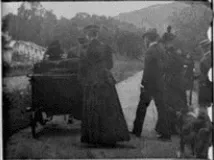
On 3rd October 1896, Queen Victoria together with other members of the royal family were filmed for the first time.
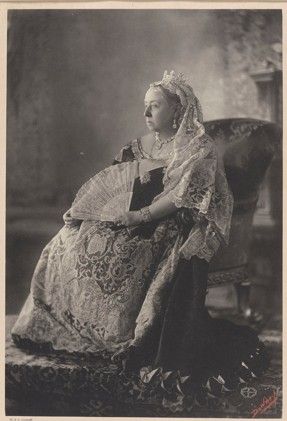
Frame taken from cinefilm of Queen Victoria (3rd October 1896).
Keeping pace with the Queen’s passionate interest in all matters photographic, the shoot took place only ten months after the Lumiére brothers unveiled their first cinematograph films in Paris.
The firm of W. & D. Downey, often regarded as Victoria’s favourite portrait photographers, was tasked with recording the first moving pictures of her.
Given the importance of the assignment, members of the extended Downey photographic family travelled to the Scottish Highlands where the Queen was in residence at Balmoral.
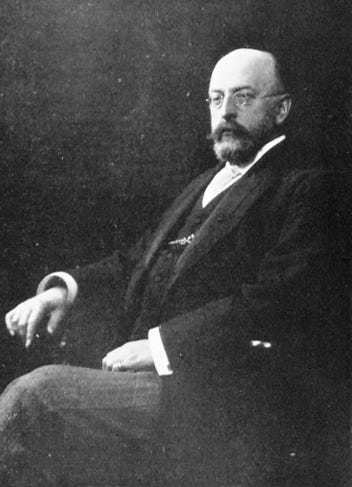
Leading the filming project was William Edward Downey (1855-1908), who by this point had taken over day-to-day running of the firm co-founded in the mid-1850s by his father William (1829-1915).
Mr. W.E. Downey. From The Professional Photographer (1906).
He was joined by his cousins James John Downey (1854-1902) and Frederick Downey (1862-1936), who both travelled from Tyneside where the original Downey business had its roots.
By the 1890s, their own firm, J.J. & F. Downey based in South Shields, was a thriving photographic concern in its own right.
Details of filming at Balmoral and its aftermath can be gleaned from a variety of contemporary sources.
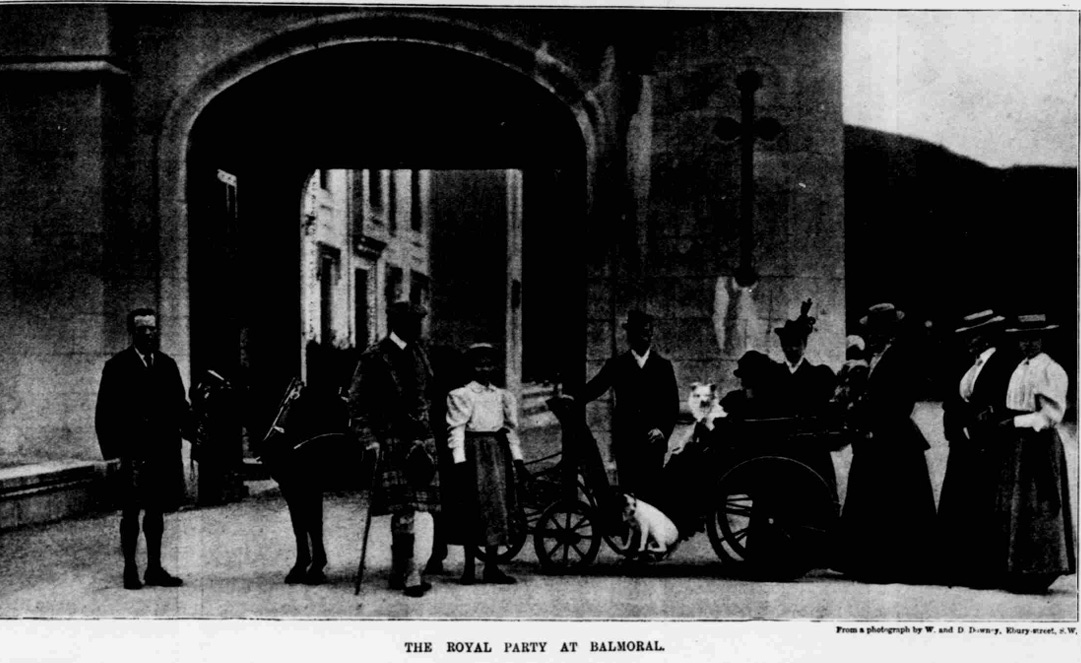
‘From a photograph by W. and D. Downey, Ebury Street, W’.
According to Queen Victoria’s Journals, 3rd October 1896 was “A lovely morning. — Nicky & Arthur breakfasted with us. — At 12 went down to below the Terrace, near the Ball Room, & were all photographed by Downey by the new cinematograph process, which makes moving pictures by winding off a reel of films.”
She continued: “We were walking up & down & the children jumping about. Then took a turn in the pony chair.”
Staying with the Queen were Tsar Nicholas II (known as Nicky) and his wife Tsarina Alexandra of Russia, who added additional glamour and international appeal to the occasion.
Recent research has revealed that unfamiliarity of working with the new technology meant the film was incorrectly loaded into the camera.
This resulted in an unstable image featuring “a severe vertical jumping motion and blurring of the picture.”
Using copies of the footage held by the BFI National Archive and Movietone News, the National Library of Scotland undertook a digitisation project in 2021 that has greatly improved the viewing experience.
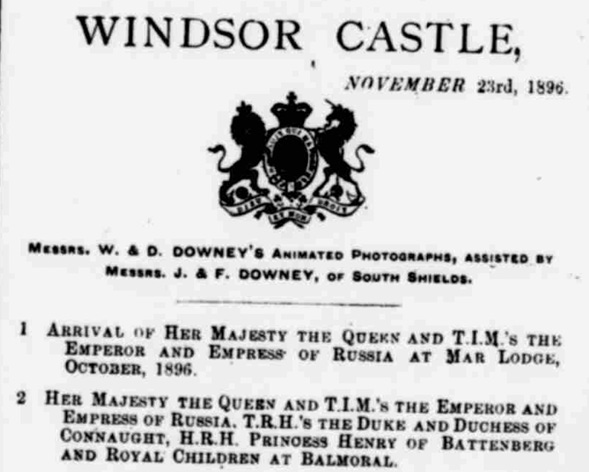
Several weeks later, the national press reported how footage shot by W. & D. Downey, described as ‘animated photographs’, had been shown to the Queen and royal family members during a film and lantern slide show held at Windsor Castle.
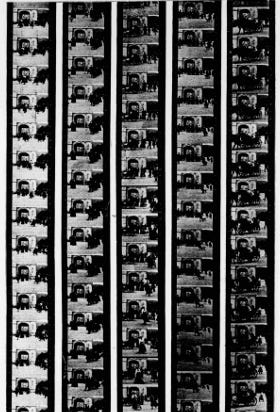
Illustrated newspapers and magazines had only recently begun to employ halftone reproductions alongside engravings.
So to provide readers with an impression of watching moving pictures, Lady’s Pictorial used the latest printing technology to reproduce three pages of frames taken from the film footage.
Lady’s Pictorial Supplement (5th December 1896). From British Newspaper Archive.
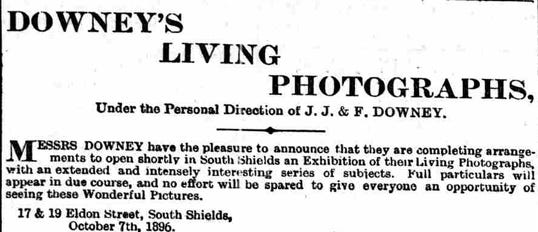
Back on Tyneside, J.J. & F. Downey wasted little time in placing an advert in their local paper, the Shields Daily Gazette, offering the chance to view what they branded ‘Downey’s Living Photographs’.
Shields Daily Gazette (8th October 1896). From British Newspaper Archive.
It was to prove a fruitful avenue for theirs and other photographic businesses in the years that followed as moving pictures took over from portrait galleries and lantern slide shows as forms of mass entertainment.
The very first Pressphotoman post published in December 2022 featured a Channel 5 tv documentary about Queen Alexandra.
Portraying “the little celebrated and long-suffering wife” of King Edward VII, I questioned why a 70-minute programme rich in archive photographs had ignored one particular celebrated carte de visite portrait.
The resulting carte reportedly sold around 300,000 copies at a time when photography offered the public an affordable outlet for their fascination with the royal family.
That fascination continues as evidenced by another royal tv documentary broadcast in Britain last week.
Again, it offered an unmissable opportunity to utilise well-known carte de visite portraits of its subjects.
This time the programme makers did not disappoint.
Titled ‘Queen Victoria: Secret Marriage? Secret Child?’, Dr. Fern Riddell presented new evidence revealing a romantic relationship between Queen Victoria and her Highland servant John Brown.
As its title hinted, this included the claim that they not only married, but even had a child together.
Photohistorians have long pored over carte de visite portraits of the couple that were produced during the 1860s and 1870s.
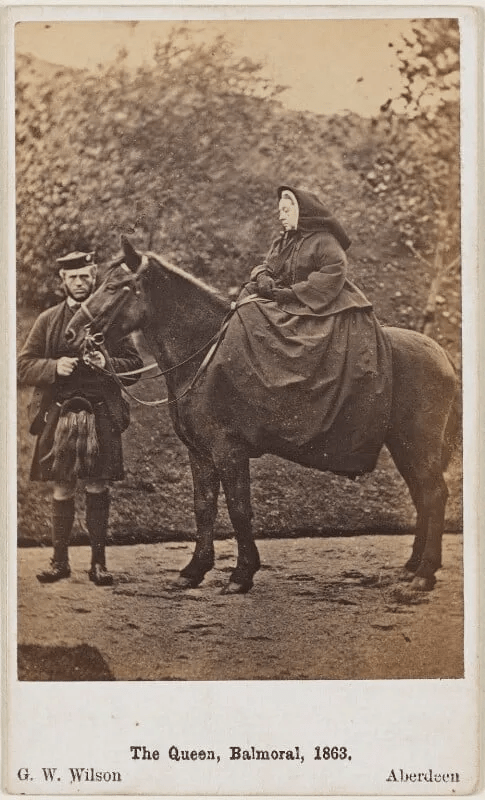
Among the earliest was taken by the Aberdeen photographer George Washington Wilson at the Queen’s Balmoral estate in October 1863.
Marking the anniversary of her last Highland ride with Prince Albert, Victoria together with her pony ‘Fyvie’ were flanked by two of her servants, John Brown and John Grant.
However, when the photograph was published as a commercial carte, Grant was edited out of the shot leaving Brown and the Queen together.
The photograph later became symbolic of the monarch’s deep mourning for her late husband and her relationship with Brown that was already the subject of much gossip.
Sales during the following year were just short of 13,000 copies of this and other portraits made on the same occasion though the ‘Fyvie’ carte was the most popular.
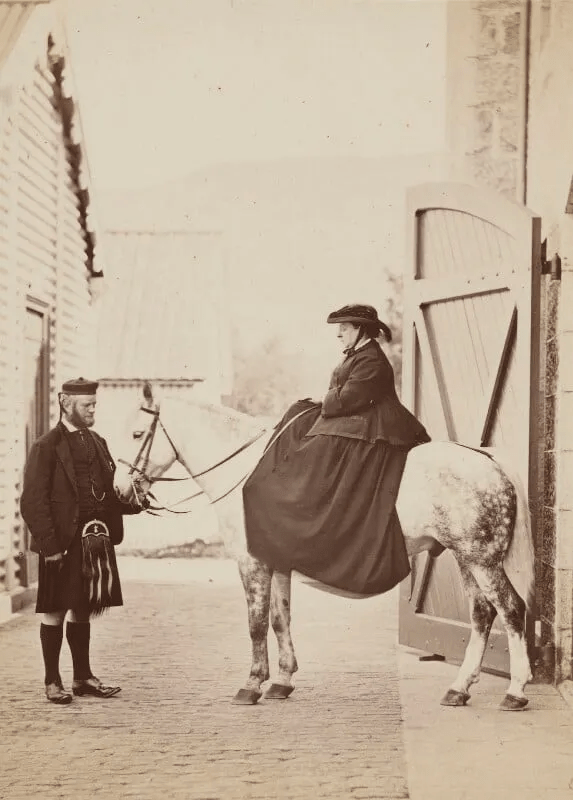
The documentary also made great use of a similar portrait of Victoria and Brown taken five years later.
In the documentary, it was used to provide physical evidence for its argument that the Queen had given birth to a child with Brown the previous year.
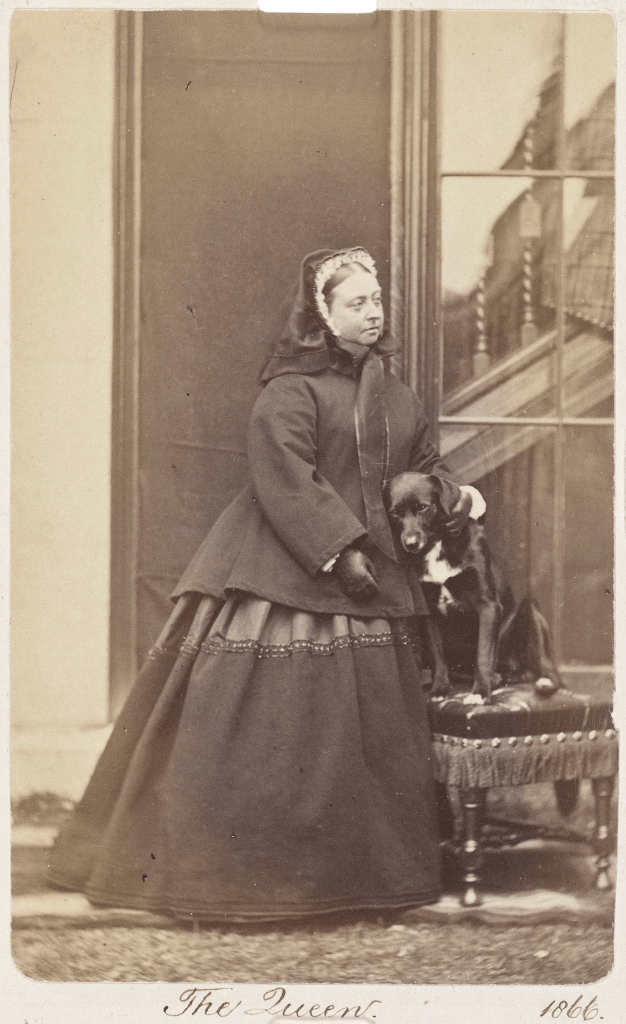
Photographers like the Downey brothers and George Washington Wilson were no doubt privy to all kinds of interactions between the Queen and members of the royal household.
Exactly what they knew and saw would no doubt have interested today’s royal documentary makers.
What these intimate photographs capture only adds to the mystery surrounding Victoria and Brown.
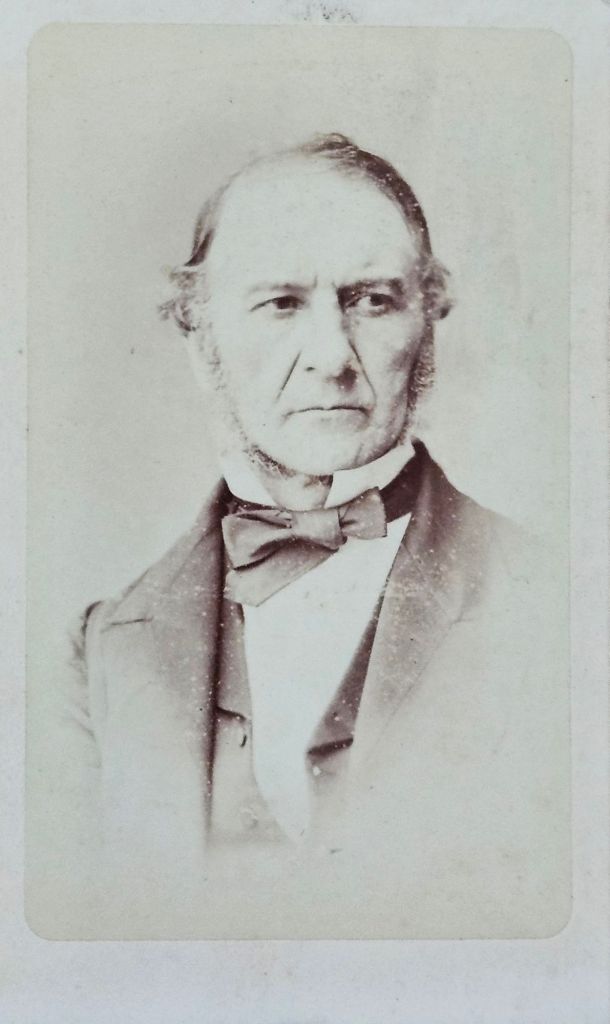
It was taken during a visit to Newcastle on Tyne in October 1862 when he was Chancellor of the Exchequer.
Prior to a lavish banquet in the city’s Town Hall, Mr. Gladstone together with his wife toured several Newcastle locations.
These included the Literary & Philosophical Society, St. Nicholas Church (now the Anglican cathedral), the Castle and Old Norman Keep, and Central Exchange reading room.
According to the Newcastle Courant (10th October 1862): “The next move was to the studio of Mr. Downey, photographer, Eldon Square, where [Gladstone] sat for a portrait, which, our readers will, no doubt, by and by have an opportunity of inspecting.”
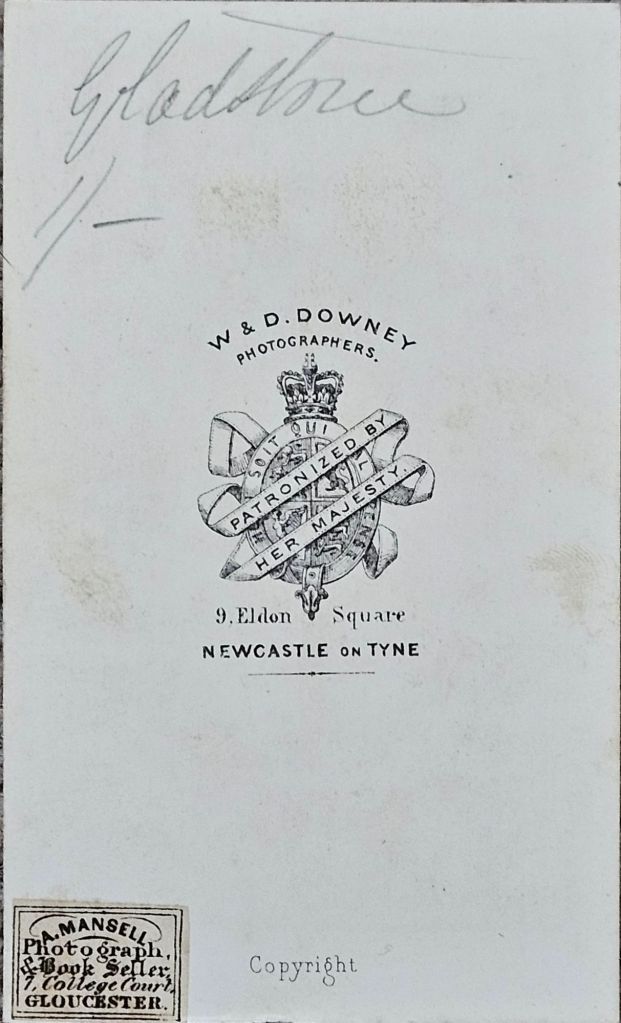
The verso of the resulting carte, with its seller’s stamp (bottom left) for ‘A. Mansell,’ a photograph and bookseller in Gloucester, illustrates the subsequent nationwide appeal of this one shilling photograph.
A copyright form for Downey’s carte of Gladstone was lodged several months later in July 1863.
This gap between the sitting and publication perhaps indicated a delay in securing the politician’s agreement to the photograph being put on general sale.
Indeed, Gladstone was a popular carte subject.
During the period 1862-1870, he was second only to members of the Royal Family with more than 50 registered copyrights for his photographic portrait.
It was only when Disraeli succeeded Lord Derby as Prime Minister in 1868 that Downey secured a sitting with Gladstone’s political adversary.
On 3rd October 1868, the Newcastle Journal reported: “Our townsmen, Messrs. Downey, have had the honour of photographing the Right Hon. B. Disraeli during their sojourn at Balmoral.”
Queen Victoria’s diary records that he stayed at her Scottish home for 10 days during the second half of September.
As Downey busied themselves with the latest round of royal portraits, they also took the opportunity to photograph the Queen’s new Prime Minister.
It well illustrates how Downey set up the shot, allowing for a variety of framings that were used to produce different sized versions.
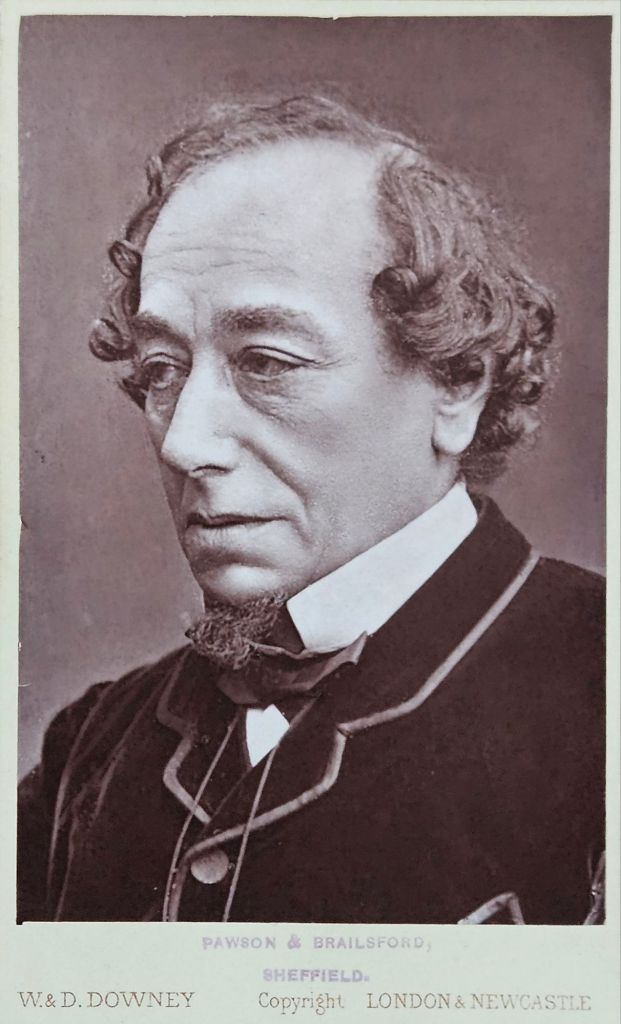
Later ennobled by Queen Victoria as Lord Beaconsfield, his death in 1881 allowed firms like Downey to re-issue its archive of Disraeli portraits to new customers
The carte that recently joined my collection with the company’s later ‘London & Newcastle’ branding falls into that category.
The prominent seller’s stamp for ‘Pawson & Brailsford,’ publishers and stationers in Sheffield, shows that the wider photographic trade was also keen to exploit such commercial opportunities.
stephenmartin81
Interesting to see how the Victorians liked portraits of their Prime Ministers and probably thus treated them with due respect. How times have changed!
Few today would want a portrait of recent Prime Ministers – except perhaps for darts’ practice!!! – and even the present Prime Minister and cabinet have reportedly removed portraits of certain recent Prime Ministers or senior Cabinet ministers from Government offices.
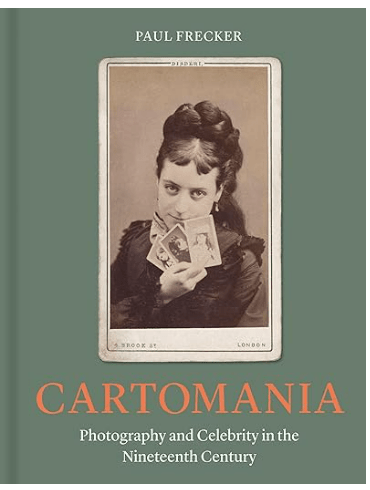
Paul Frecker’s recently published book Cartomania: Photography & Celebrity in the Nineteenth Century (September Publishing) is a veritable feast for collectors of cartes de visite.
Cartomania: Photography & Celebrity in the Nineteenth Century by Paul Frecker. (September Publishing (2024), £40).
It’s the culmination of more than two decades working as a specialist photography dealer.
In particular, it showcases Paul’s collection of the palm-of-the-hand-sized cards that reached peak popularity during the 1860s.
More modest in size, my own collection started amid ongoing research into the photography firm of W. & D. Downey of South Shields, Newcastle on Tyne and later London.
The company’s story, achievements and several examples of their cartes feature in Paul’s book, which I’m thoroughly enjoying reading.
One early Downey carte that I obtained several months ago via a well-known auction site continues to intrigue me.
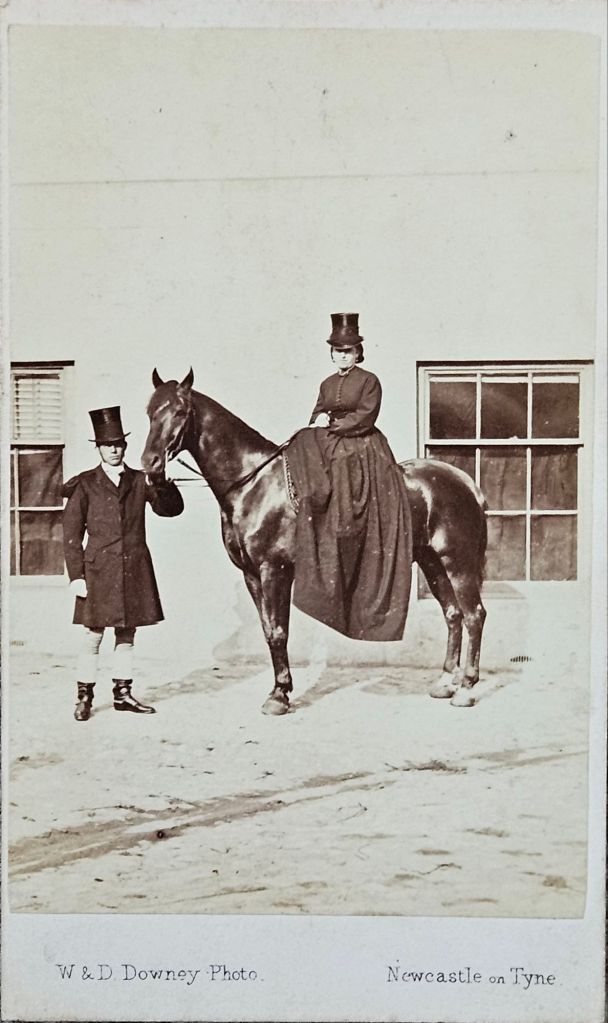
It features a woman in full riding habit and hat sat side-saddle on her horse with a smartly-dressed groom in attendance.
This striking example of the carte format prompted questions in my mind as to who it featured and when and where the photograph was taken.
Looking for clues, what appear to be footprints in the snow in the foreground suggest a winter’s day.
Shadows are cast onto the building in the background.
The low sun has also brought to life the horse’s coat, indicating that its groom had worked extra hard to prepare his charge for the camera.
As to who the carte features and when and where the photograph was taken, further research produced a helpful press report.
In May 1861 under the headline “The Photographic Art,” the North & South Shields Gazette printed an article about Downey’s activities.
It described how “the Messrs Downey” had just added “a series of local portraits” to “their photographs of illustrious men and legislators.”
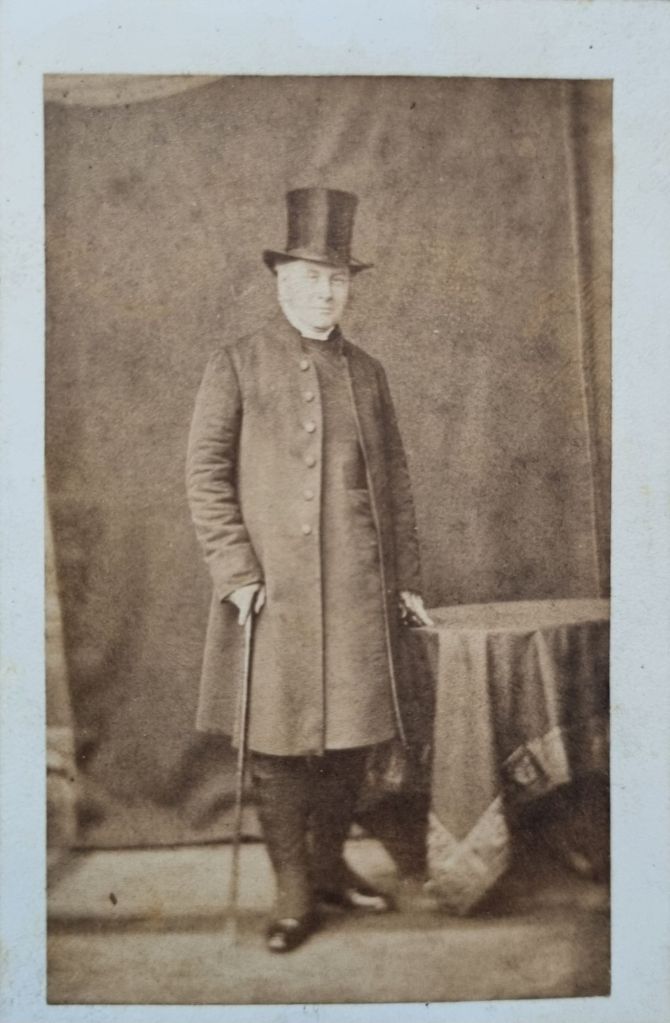
Among those “local portraits” were the Lord Bishop of Durham, Henry Montagu Villiers, and his family, who had “honoured them [Downey] with sittings at Auckland Castle.”
A previous Pressphotoman post (1st July 2024) revealed that the photoshoot for the carte below featuring the Lord Bishop of Durham took place in late-1860.
Among other “local portraits’ credited to Downey were several featuring Sir Edward Blackett and his family “taken at Matfen Hall.”
The Blacketts were a long-established Northumberland family and Matfen Hall near Corbridge, built in the early 1830s, was their stately home.
Today it’s a luxury hotel, spa and golf estate.
But it was the newspaper article’s next sentence that offered a tantalising clue as to the identity of Downey’s woman on horseback.
It continued: “Let us add, as exemplified in the case of one of Sir Edward’s daughters and one of the honourable Misses Villiers [my italics] that the artists have exhibited much felicity in their management of a figure on horseback.”
This information helped narrow the field of likely candidates.
Looking at other sources, the 1861 Census records Sir Edward Blackett in residence at Matfen Hall with his daughters Louisa, Anna Maria and Georgiana Emma, who were all in their twenties.
As to the Villiers family, they were not at Auckland Castle when the census was taken, but at their London residence – 30 Cavendish Place, Marylebone not far from Oxford Street.
It listed the bishop together with his wife Amelia Maria Villiers and three of their daughters.
At the time, Gertrude, Mary and Evelyn Villiers were 17, 14 and 8 respectively though they had an elder sister Amy, who would have been 19.
Given this information, I was pleased to come across a further piece of evidence that points firmly in the direction of a member of the Villiers family being the Downey woman on horseback.
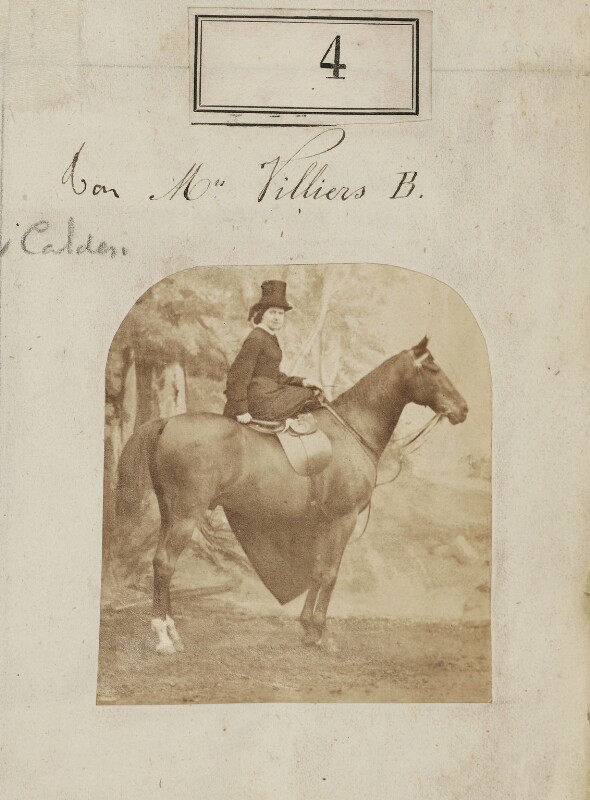
The collection of the National Portrait Gallery, London includes three horseback portraits featuring the ‘Hons. Mrs. Villiers.’
They are all by the celebrated portrait photographer Camille Silvy, who is a significant presence in Paul Frecker’s book Cartomania mentioned at the start of this post.
All three Silvy horseback portraits are dated 1860.
Given the physical similarity to the woman on horseback in Downey’s carte, might the ‘Hon. Mrs. Villiers’ (above) be the mother of “one of the honourable Misses Villiers?’
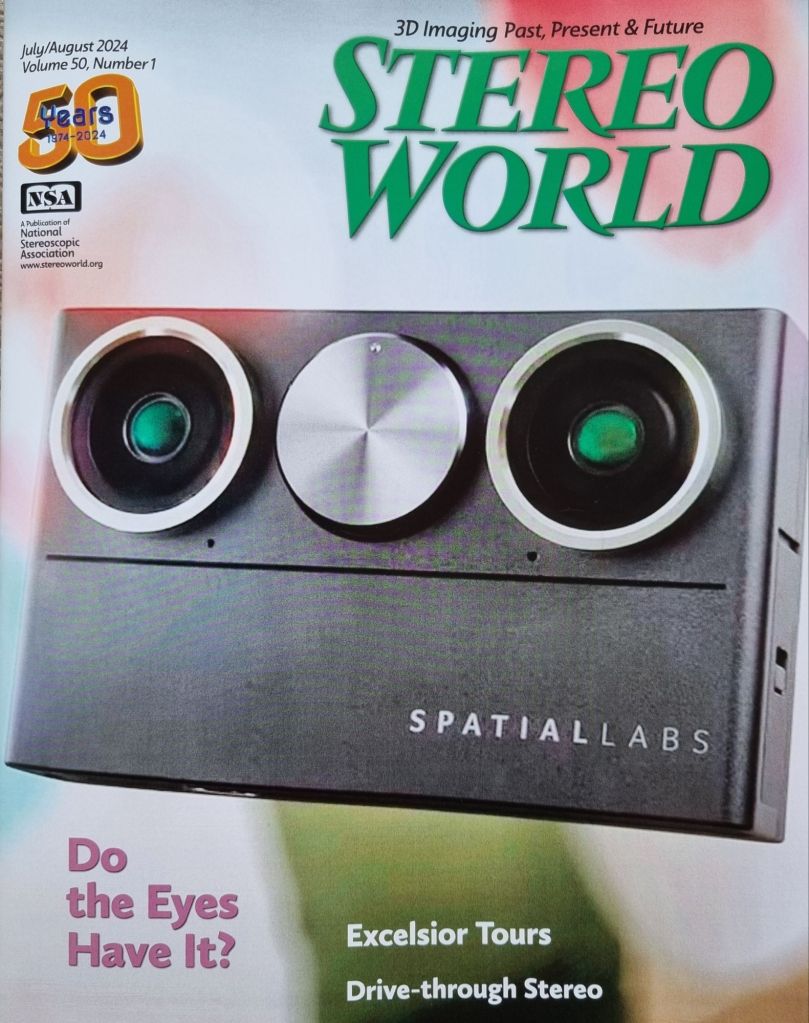
The current issue of Stereo World, a publication of the National Stereoscopic Association in the United States, features an article showcasing original research that first appeared on this blog.
Stereo World (July/August 2024).
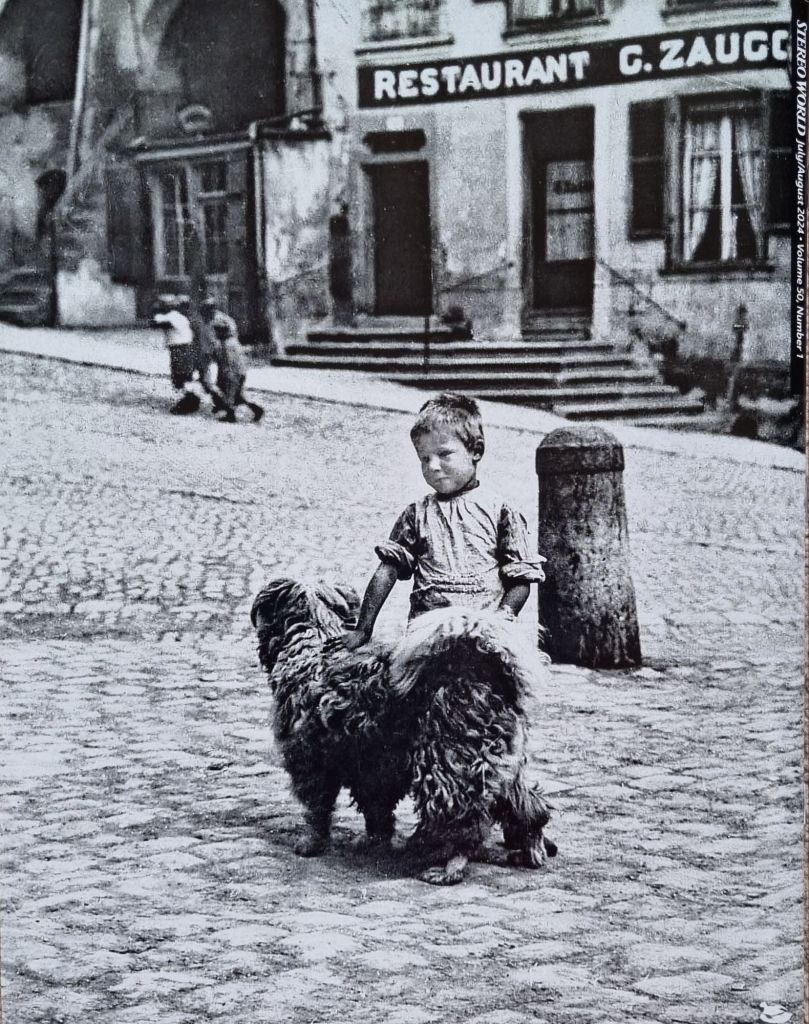
‘Excelsior Stereoscopic Tours of Burnley’ explores the story behind a 3D company established in the Lancashire mill town by Milford Elsworth Wright (1861-1918), a former Underwood & Underwood salesman.
The article includes a total of nine stereocards from my collection, which can be free-viewed within the text, and explores the relationship between Wright and the Underwood company.
My thanks to Stereo World editor John Dennis and his NSA colleagues.
Back cover of Stereo World (July/August 2024) featuring ‘Courtyard Chums, Berne, Switzerland’ by Excelsior Stereoscopic Tours.
The success of W. & D. Downey of South Shields, Newcastle on Tyne and London was built upon its ability to recruit and train the right photographers.
As demonstrated by this mini-series profiling Downey luminaries, an association with the company, as royal warrant holders to Queen Victoria, proved useful when selling their own products.
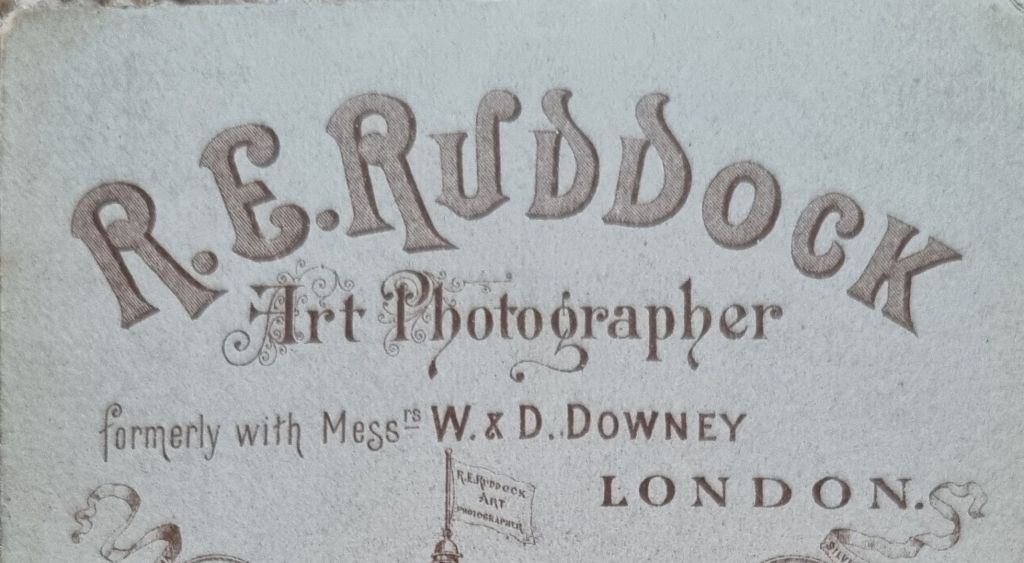
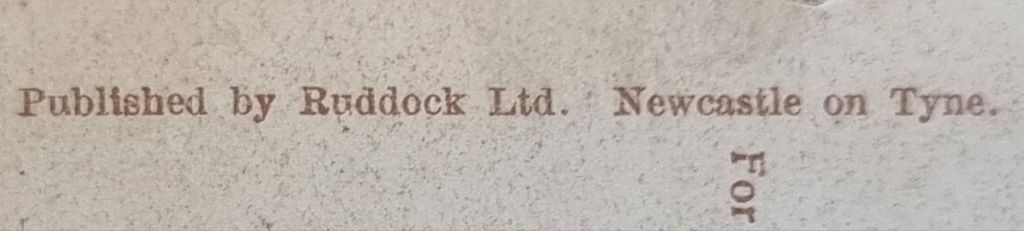
Our final subject also used the verso of his cartes-de-visite to announce that he was ‘formerly with Messrs. W. & D. Downey, London.’
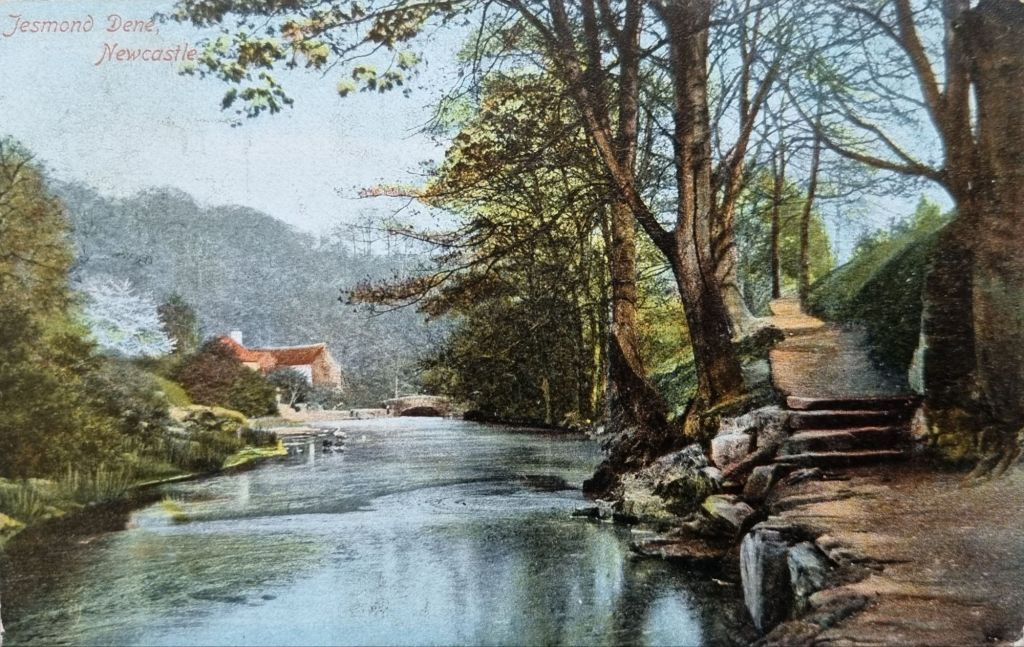
Given Downey’s origins in the North East of England, R. E. Ruddock’s credentials were impeccable.
Born in Bishopwearmouth, Sunderland in 1863, Richard Emerson Ruddock was part of a media family.
His father, also Richard, was a newspaper reporter and later executive with the Newcastle Chronicle for nearly half a century.
By the time he was 18, Ruddock junior was living in the Elswick district of Newcastle, working as an ‘artist and photographer.’
Given his father’s position, an opportunity to work for ‘W. & D. Downey, London’ may well have emerged through family contacts.
Though details of his assignments are not known, a period of employment at Downey’s studio in Ebury Street, Belgravia during the 1880s would have provided invaluable experience.
By the end of the decade, R.E. Ruddock had returned to the North East and formed a partnership with another Tyneside photographer, Matthew Auty (1850-1895).
‘Auty & Ruddock’ operated from the seaside resort of Tynemouth where the Ruddock family including wife Alice and a son, also named Richard, made their home.
However, in March 1892, the ‘Auty & Ruddock’ business partnership was dissolved and six months later, R.E. Ruddock launched his own portrait studio in nearby Newcastle.
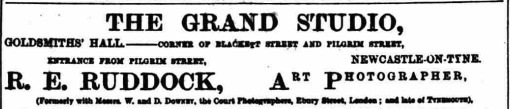
The opening of the Grand Studio in Goldsmiths Hall ‘at the corner of Blackett Street and Pilgrim Street’ was supported by an advertising campaign in the local press.
This included a double-column advertisement in a number of newspapers including the Newcastle Daily Chronicle.
Newcastle Daily Chronicle (6th September 1892). From British Newspaper Archive.
The ad went on to include a detailed description of the new studio and its facilities.
One press report described it as ‘an establishment which, for luxury and artistic refinement, excels anything of the kind either in the provinces or in London itself.’
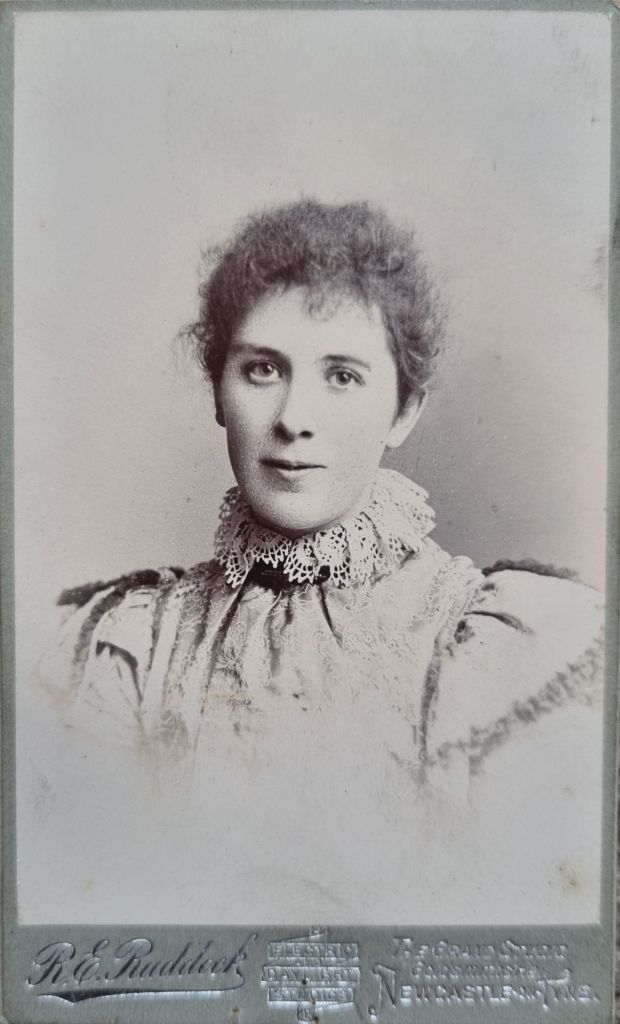
The high-quality theme extended to the design of Ruddock’s products including silver-etched cartes-de-visite.
At some point during the 1890s, ‘R.E. Ruddock’ became ‘Ruddock Ltd’ and extended its range to include portraits mounted within embossed cardboard frames.
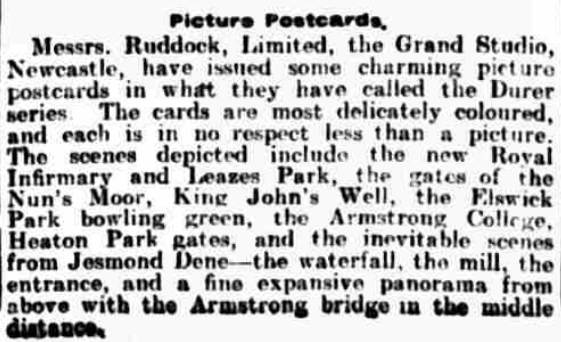
Despite the fact that photographic portraits credited to ‘Ruddock Ltd’ still appeared as illustrations in the Newcastle press, the business was in financial difficulties.
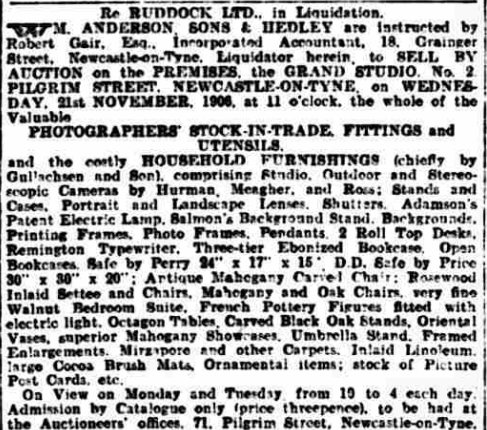
By November, its liquidation was announced and the ‘Grand Studio’ and its high-quality contents including a ‘stock of picture postcards’ were sold by auction, presumably to realise assets and pay off creditors.
Newcastle Daily Chronicle (19th November 1906). From the British Newspaper Archive.
Whatever the reputational damage caused by this business failure, R.E. Ruddock was not yet finished with photography. Far from it.
Within a short time, he took over the long-established studio of ‘Abel Lewis’ on Whiteladies Road in the Clifton district of Bristol.
Lewis, a long-serving member of the Royal Photographic Society, established his award-winning photography studio in the 1860s, first in the Isle of Man and then in Bristol.
Following the Ruddock take-over, photographs credited to ‘Ruddock Ltd, Clifton’ were soon appearing in local newspapers suggesting access to a wider photographic and press network.
However, the death in 1908 of Richard Ruddock senior prompted his son’s return to Newcastle where he was among the funeral’s chief mourners.
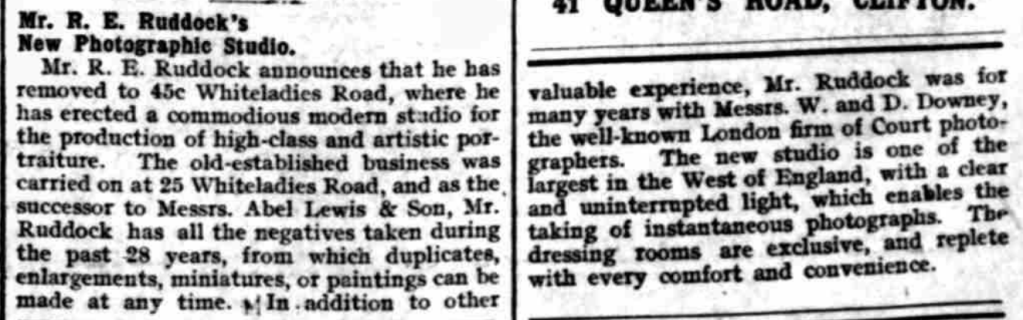
Mr. R.E. Ruddock’s Bristol studio continued to operate and in 1912, he opened a ‘New Photographic Studio’ further along Whiteladies Road.
The press article announcing this news also found space to highlight its proprietor’s connection ‘for many years’ to ‘W. & D. Downey, the well-known firm of court photographers.’
Clifton and Redland Free Press (15th March 1912). From British Newspaper Archive.
However, two years later, the same paper reported: ‘We understand that Mr. Frank Holmes has acquired the goodwill and business of Mr. R. E. Ruddock (late Abel Lewis).’
That August, as the First World War broke out, Ruddock emigrated to the United States where he was then joined by his wife Alice and other family members, settling in Seattle, Washington.
US citizenship followed in 1921 where he continued working as a photographer.
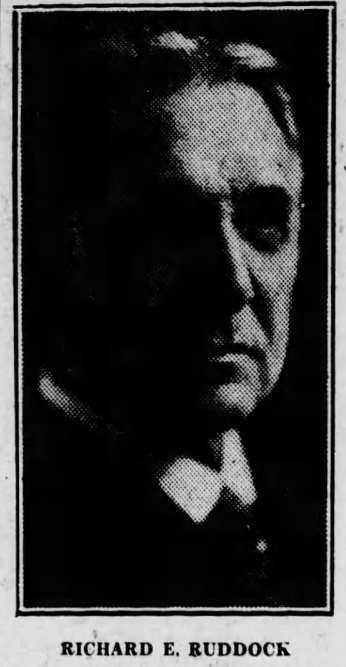
His death a decade later, aged 68 in Scranton, Pennsylvania, was marked by a short newspaper obituaryaccompanied by a poorly reproduced halftone photograph.
The Tribune, Scranton, Pennsylvania(23rd November 1931). From Newspapers.com by MyAncestry.
The paper reported that Ruddock, a widower, died of pneumonia, had ‘been employed at J.B. Schreiver’s [photographic] studio during the past several years’ and ‘was well-known in the city.’
Like his fellow Downey luminaries H.S. Mendelssohn and John Edwards, who featured earlier in this mini-series, a handful of Ruddock’s portraits feature in the collection of the National Portrait Gallery, London.
The value of having worked for W. & D. Downey whether on Tyneside or in London seems to have held all our subjects in good stead during their subsequent careers in photography.
If you can add any information to each of the four photographers profiled or if you know of examples of their work, please use the comments box at the bottom of this blogpost or any of the blogposts below.
Our third subject is someone who Messrs. Mendelssohn and Edwards are likely to have known during their years with Downey.
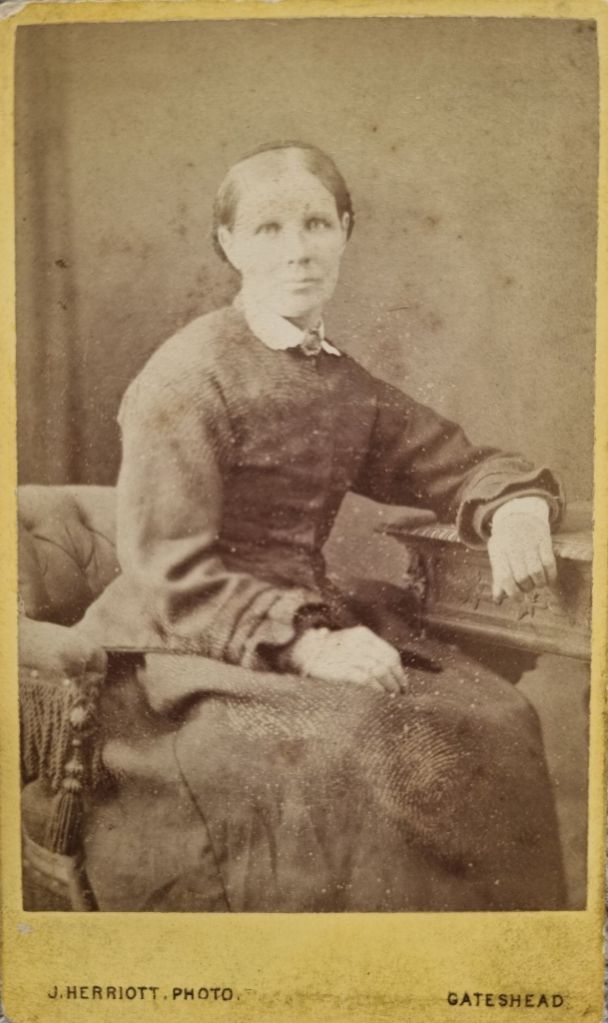
James Herriott was born in 1846 in Blaydon, a town on the Tyne, a few miles across the river from Newcastle.
By his mid-twenties, he was married with a baby daughter and living in nearby Gateshead.
But he had already made valuable connections in the photographic business.
During his teens, he was apprenticed to Mawson & Swan of Newcastle on Tyne, who supplied firms like W. & D. Downey with the latest photographic equipment and chemicals.
Given this background, it’s perhaps unsurprising that James Herriott’s own career in photography was soon underway in Gateshead.
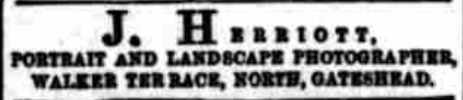
The 1871 census recorded his ‘rank, profession or occupation’ as ‘photographic artist,’ and the following year, a newspaper advertisement described him as a ‘portrait and landscape photographer.’
Advertisement from Gateshead Observer (1st June 1872). From British Newspaper Archive.
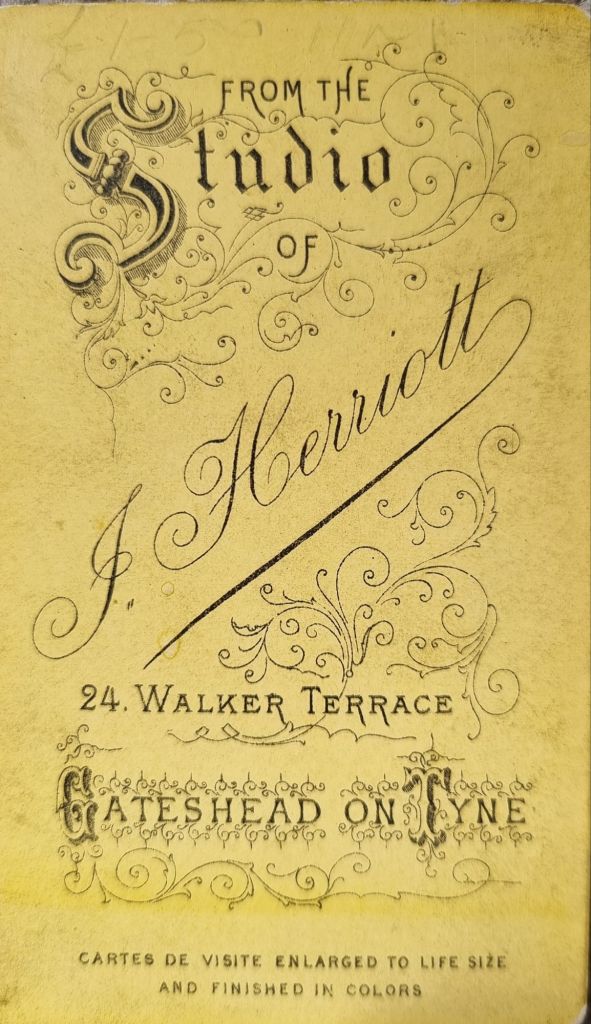
In terms of portraits, he offered customers ‘cartes de visite enlarged to life size and finished in colours.’
Whether his business hit financial or other difficulties, a notice published in the Newcastle Journal in April 1875 signalled a change of direction.
After closing for alterations, the notice stated, the business would re-open ‘under the named management of Downey and Herriott’ and ‘they will be prepared to do the highest class of work in the Art.’
The named ‘Mr. Downey, late of Oxford Street, Newcastle’ was photographer John Downey (1823-1906), elder brother of William and Daniel.
As described in part 1 of this mini-series, John Downey was previously in partnership for two years (1872-73) with Hayman Seleg (H.S.) Mendelssohn, another Downey apprentice.
The Downey & Herriott partnership though appears to have been even more short-lived.
Within a year or so, James Herriott was again advertising his Gateshead business, now with a second studio address in the centre of Newcastle.
Meanwhile, John Downey had set up ‘J & C. Downey, Photo Artists’ with his eldest son Cornelius at a separate address in Gateshead.
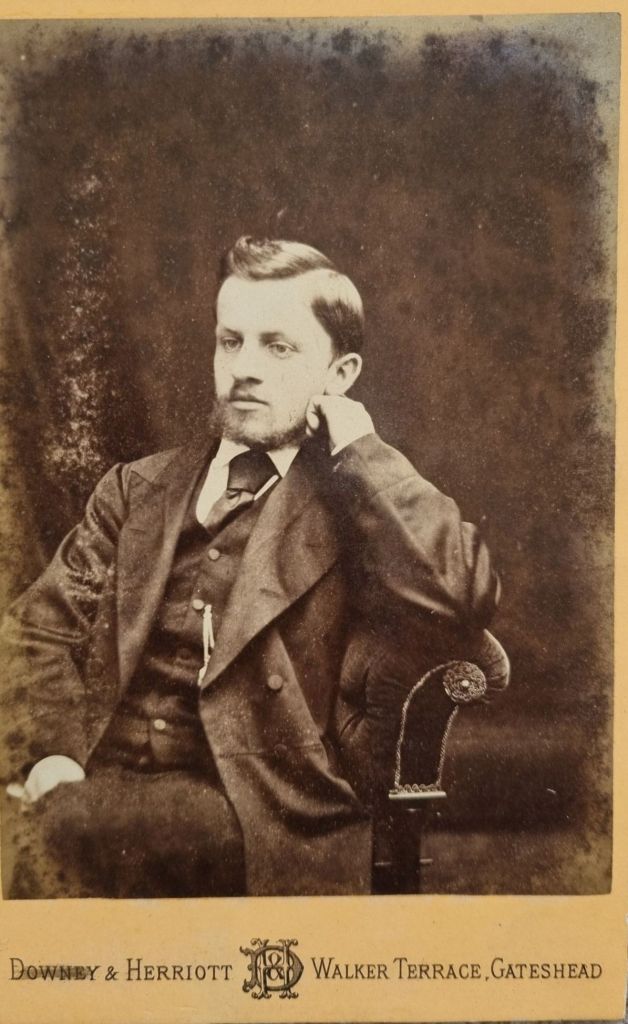
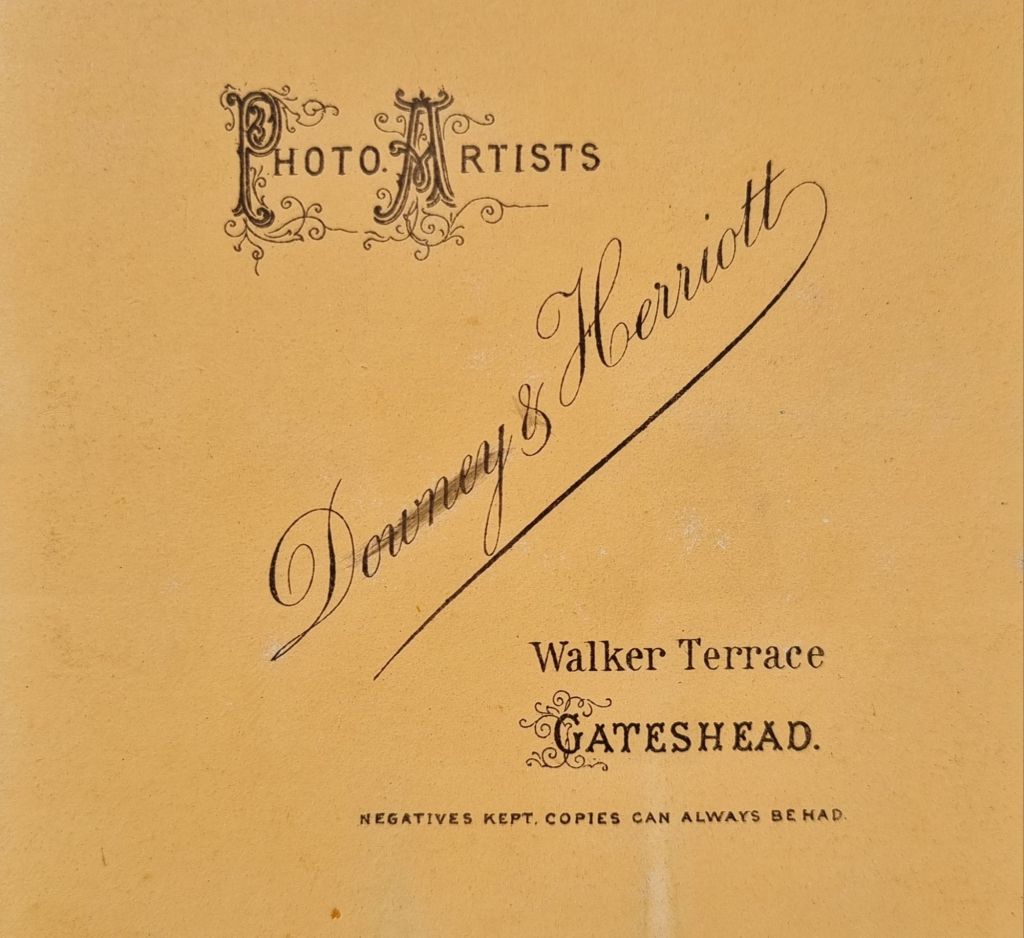
Downey & Herriott portraits are hard to track down, however, this cabinet card is unusual in that it shows the name ‘Downey’ crossed out on both front and the verso.
One explanation might be that card stock printed for the Downey & Herriott partnership was later used by James Herriott alone, perhaps because finances were still tight.
It’s also noticeable that both Downey & Herriott and Downey & Mendelssohn used the same distinctive orange-coloured card for their products.
Herriott’s involvement with the Downey photographic empire points to a long-running relationship.
It was one that perhaps began in the late-1860s following his Mawson & Swan apprenticeship and before opening his own Gateshead studio.
In a 1920s newspaper interview recalling ‘the days of his apprenticeship to W. and D. Downey,’ he recalled assisting ‘Mr. Downey’ in photographing both Queen Victoria and the Prince of Wales (later Edward VII) on separate occasions.
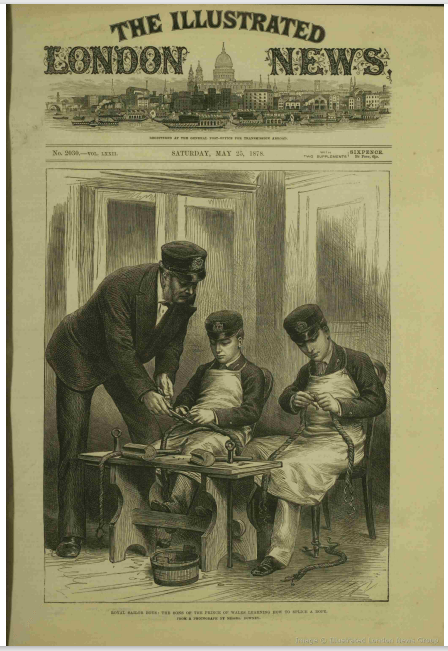
Another memory of a Downey assignment involved photographing Prince Albert (known as Eddy) and Prince George (the future George V) ‘while learning to splice rope’ during naval training aboard HMS Britannia.
In May 1878, the resulting photograph credited to ‘Messrs. Downey’ was reproduced as an engraving by the Illustrated London News.
Supplement to Illustrated London News (25th May 1878). From British Newspaper Archive.
The dating of 1878, at a point when James Herriott was running his own photographic business, reinforces the idea that he was a trusted Downey associate.
Within a few years though, the Tyneside chapter of his life came to an end.
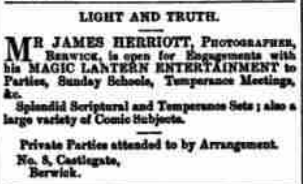
In March 1882, the Berwick Advertiser listed ‘James Herriott, photographer’ among ‘incomers’ to Berwick on Tweed.
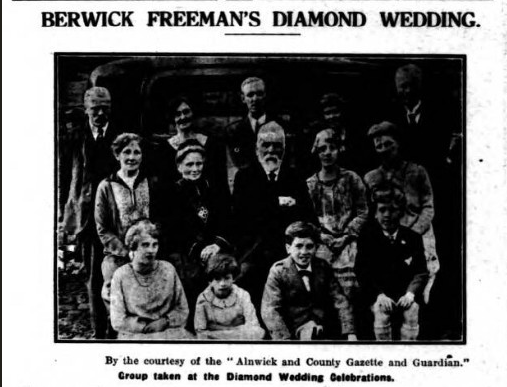
This move together with his wife Martha and their four children might be explained by James’s parents originating from Berwick, the northernmost town in England, where James had become a Freeman at the age of 21.
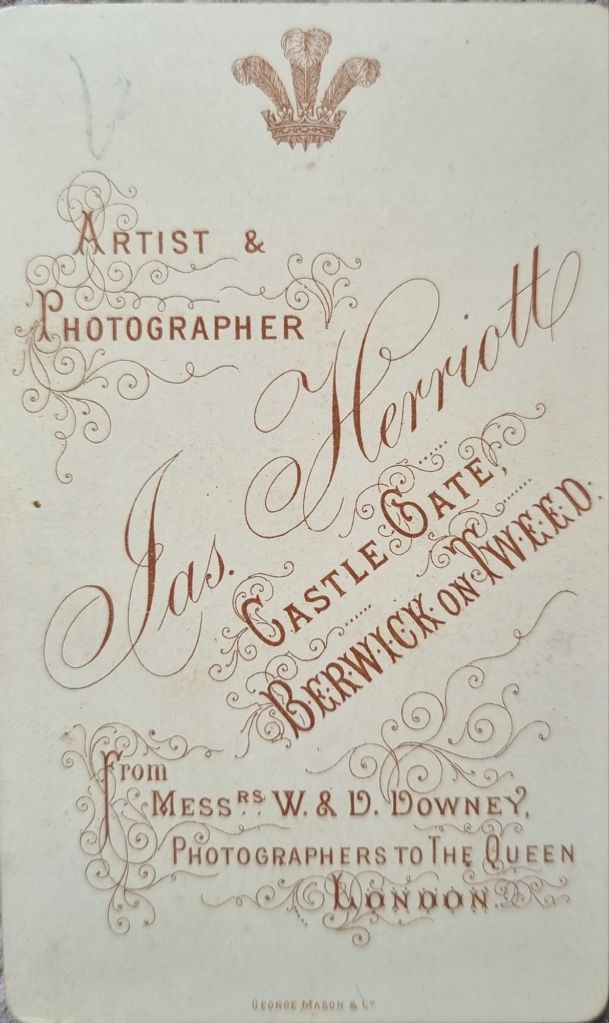
Resuming his photography, he opened a studio in the town’s Castlegate offering a range of portraits.
The verso of his products also took the opportunity to highlight his professional link to ‘Messrs. W. &. D. Downey, Photographers to the Queen, London.’
Research into the photographic firm W. & D. Downey of South Shields, Newcastle upon Tyne and London is regularly published on this blog.
A number of photographers who worked for the Downey brothers, William (1829-1915) and Daniel (1831-1881), later went on to enjoy successful careers of their own.
Over coming weeks, a Pressphotoman mini-series will share new research on a selection of Downey luminaries.
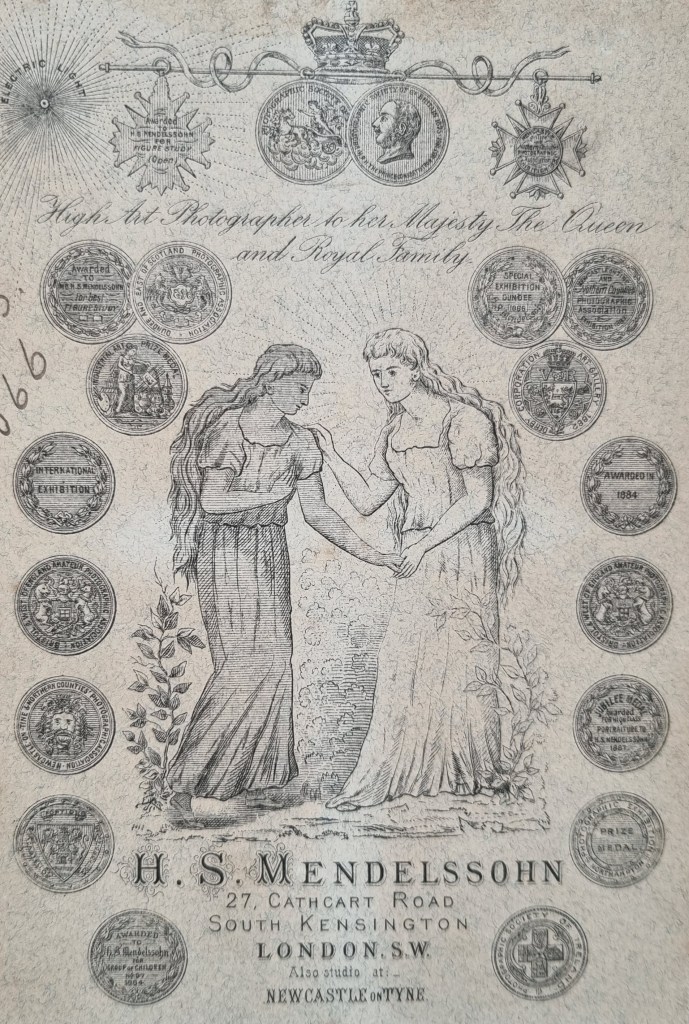
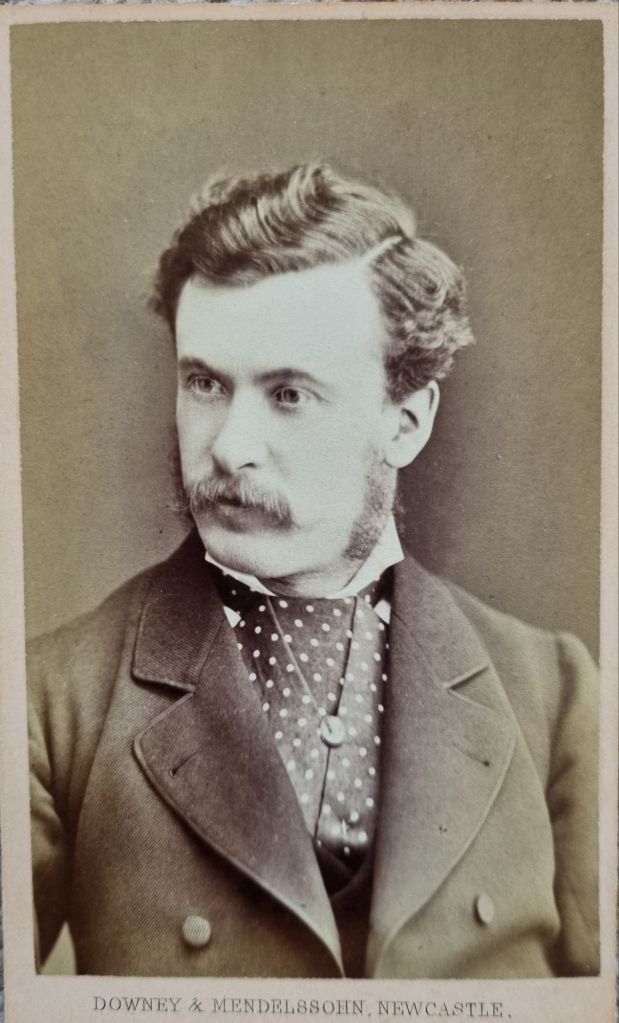
When the celebrated portrait photographer Hayman Seleg (H.S.) Mendelssohn died in 1908, aged 59, a brief obituary in the Royal Photographic Society Journal described how his career began.
Born in 1847 in Germany and raised in Poland, “… political reasons obliged him to leave that country, and he settled at Newcastle-on-Tyne where he commenced his photographic career.”
It went on: “After serving with Mr. D. Downey for some time, he went into business for himself.”
This passing reference to Daniel Downey points to an apprenticeship with the company’s Eldon Square studio in the late 1860s.
W. & D. Downey’s Newcastle on Tyne studio was located in Eldon Square. Courtesy of Private Collection, Zurich.
Married with two very young children, the transition to life in a different country must have been unimaginably hard.
The Mendelssohns were one of only 160 Jewish families living in Newcastle at that time.
By 1871, they were sharing a house with jeweller Simon Falk and his family in Blandford Street, a short walk from the city’s railway station.
Evidently, employment with W. & D. Downey proved life-changing.
In the 1871 census, Mr. Mendelssohn’s stated ‘trade or profession’ was ‘photographer.’
He then formed a business partnership with another of the Downey brothers, John (1823-1906), who was also a photographer.
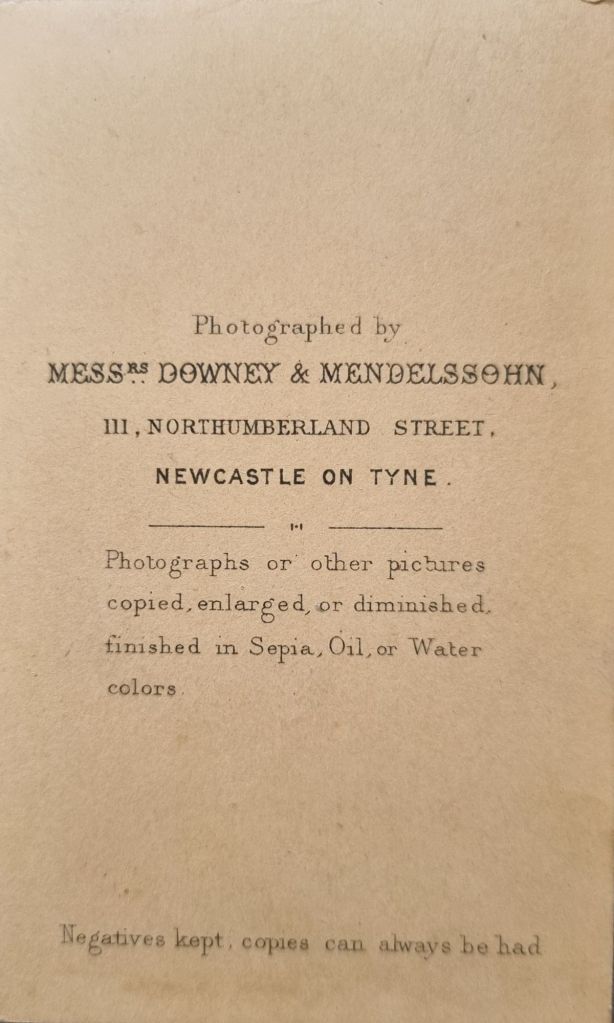
In late-January 1872, the firm of Downey & Mendelssohn opened for business in premises at 111 Northumberland Street.
Interestingly, this was the address that W. & D. Downey used when it opened its first studio in Newcastle on Tyne a decade earlier.
Advertisements placed by Downey & Mendelssohn in the Newcastle press offered a range of services.
These included ‘photographs taken of any animate or inanimate object’ and ‘Rembrandt portraits taken to perfection,’ however conventional portraits were their stock-in-trade.
Another notable detail was the addition of the term ‘Photo Artists’ in line with an array of competitors in the city, adding ‘sepia, oil or water colors [sic]’ to their products.
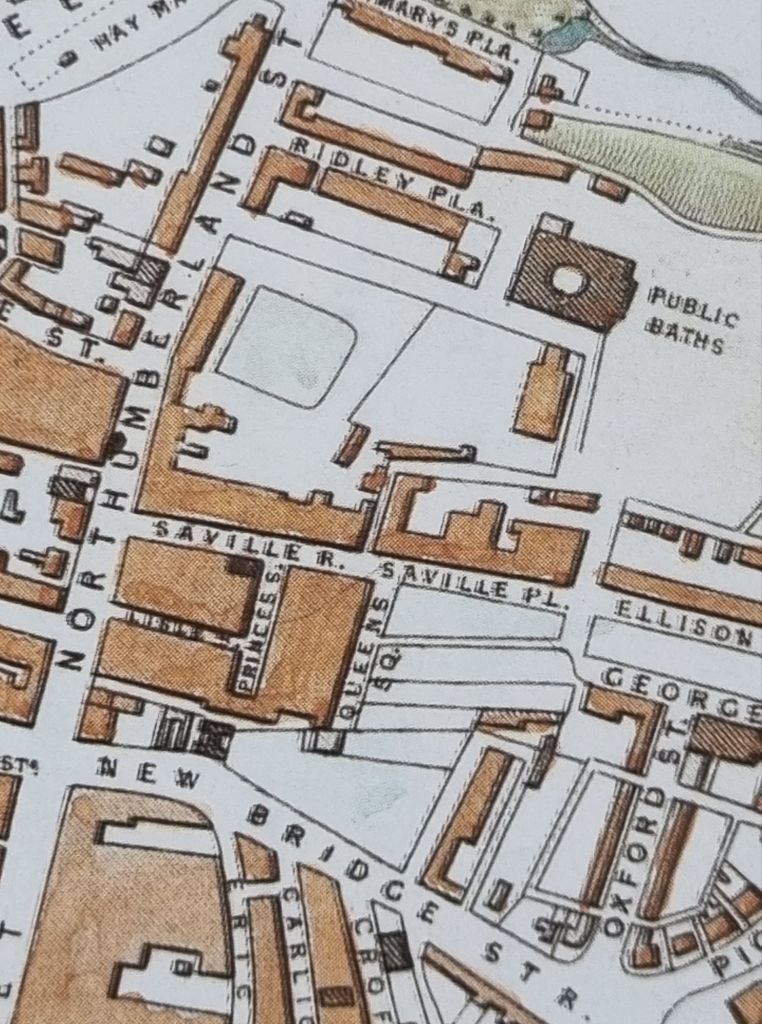
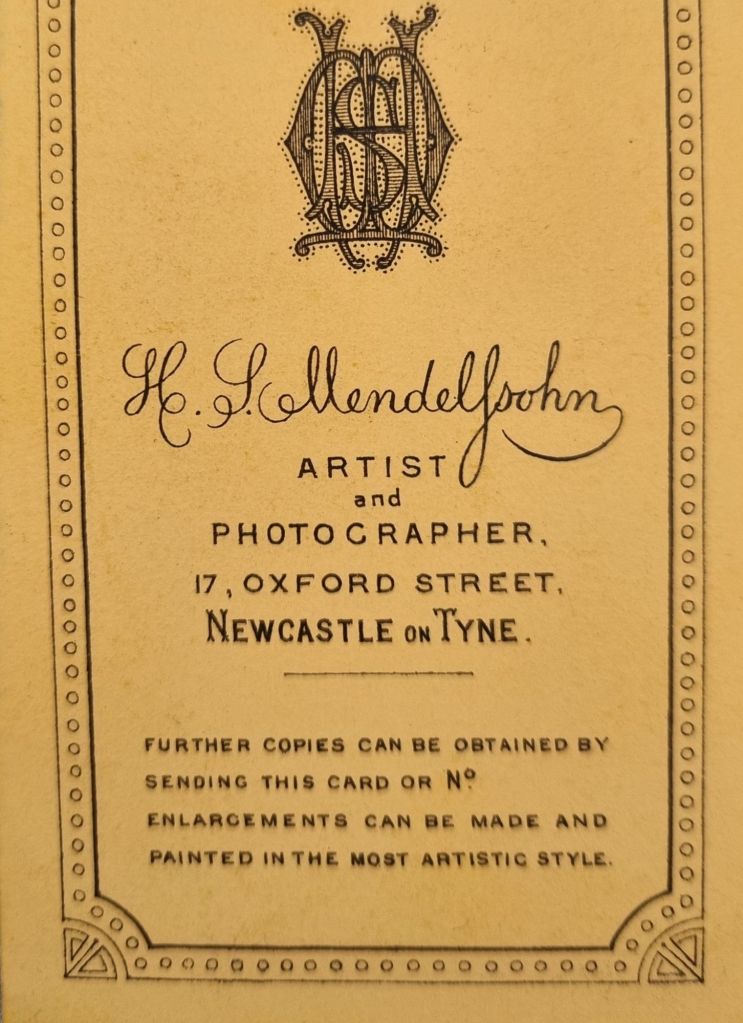
Within 12 months, their studio moved a short distance from 111 Northumberland Street (left of map below) to 17 Oxford Street (bottom right).
Studio moved from Northumberland Street (left) to nearby Oxford Street (bottom right). From John Tallis map of Newcastle on Tyne (1854).
The firm also adopted a distinctive orange-coloured card for presenting its products.
In December 1873, Downey & Mendelssohn’s two-year long partnership came to an end, and ‘H. S. Mendelssohn, Photo Artists’ became sole proprietor of 17 Oxford Street.
By this point, he was an active participant in the photographic life of the city.
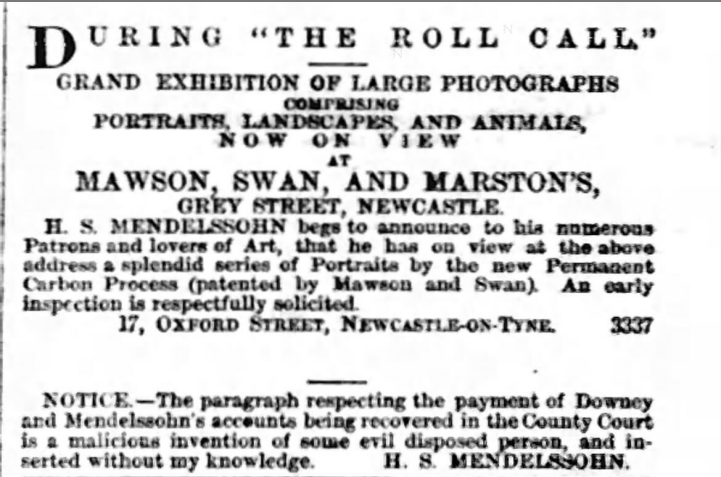
This 1874 newspaper advertisement promoted an exhibition of his portraits using the carbon print process invented in Newcastle by (Sir) Joseph Swan.
Newcastle Daily Journal (15th October 1874). From British Newspaper Archive.
However, the adjoining ‘Notice’ hints at a form of intimidation that could be viewed as anti-semitic, which he was willing to confront publicly.
From this point, H.S. Mendelssohn’s career went from strength to strength.
He opened a further studio in nearby Sunderland in 1881 and the following year, his business expanded to London where his growing reputation attracted prestigious clients.
Queen Victoria’s diary entry for 20th December 1883, made at Osborne House on the Isle of Wight, recorded: “A new photographer, named Mendelssohn, has taken lovely photographs of [Victoria’s grandchildren] Daisy [Margaret of Connaught] and little Arthur [Duke of Connaught].”
Whether W. & D. Downey’s royal warrant to Her Majesty (1879) played a part, it proved to be the first of many royal commissions.
H.S. Mendelssohn’s career is celebrated in various collections including the National Portrait Gallery, London where he is credited with 70 portraits.
This cabinet card featuring the actress Miss Ellen Terry taken in 1883 demonstrates his skills and how far he had travelled since arriving in Newcastle on Tyne as a refugee fleeing persecution.
Miss Ellen Terry by H.S. Mendelssohn. National Portrait Gallery, London. NPG Ax5571.
In the next post in this mini-series, how Downey’s principal photographer in the 1860s and 1870s used that calling card to attract clients to his own successful portrait studio.
An illustrated talk that I presented recently for the Royal Photographic Society’s Historical Group set me thinking about one image in particular.
The subject of the talk was the photography firm of W. & D. Downey and its first decade in the North-East of England in the 1850s and 1860s.
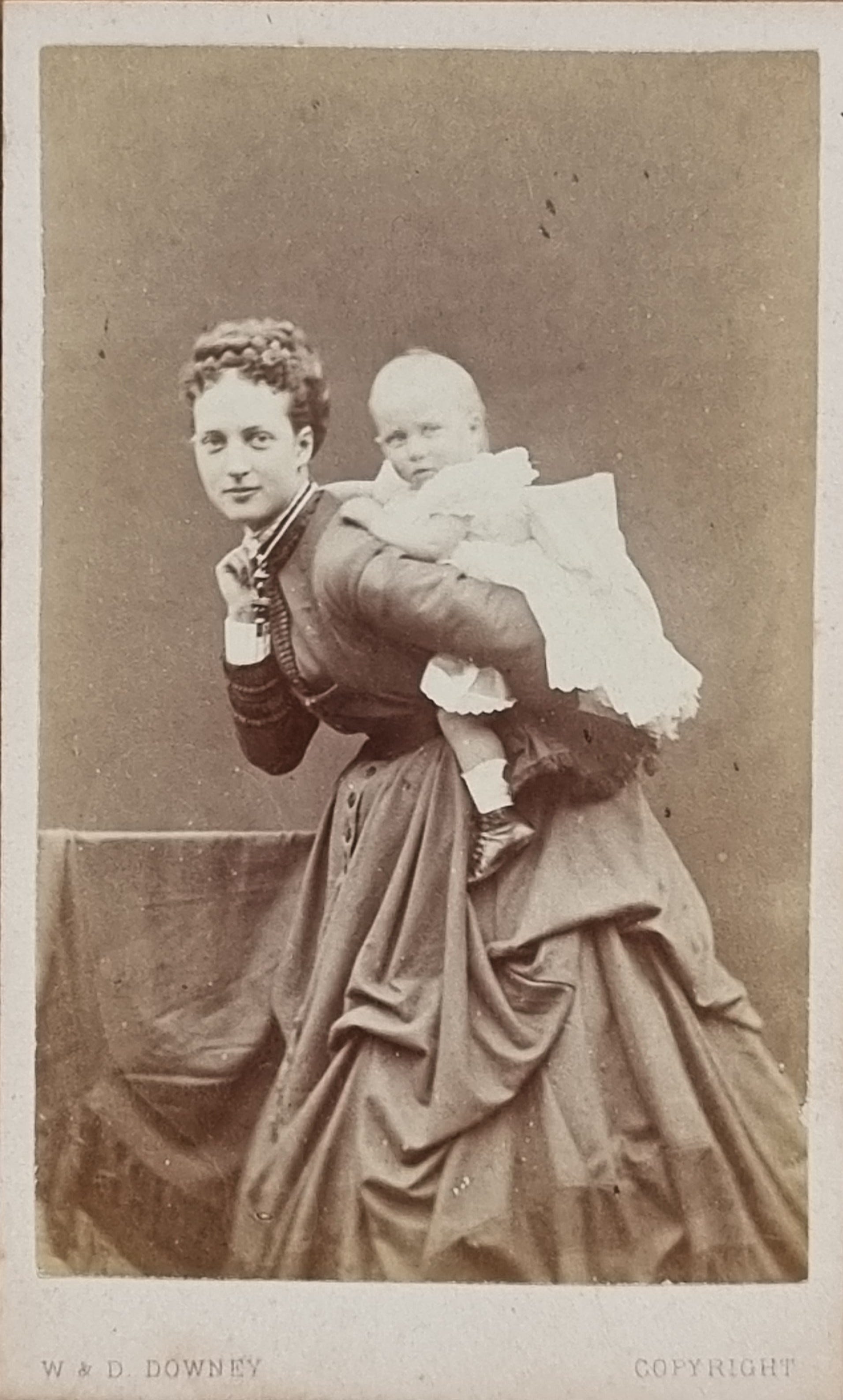
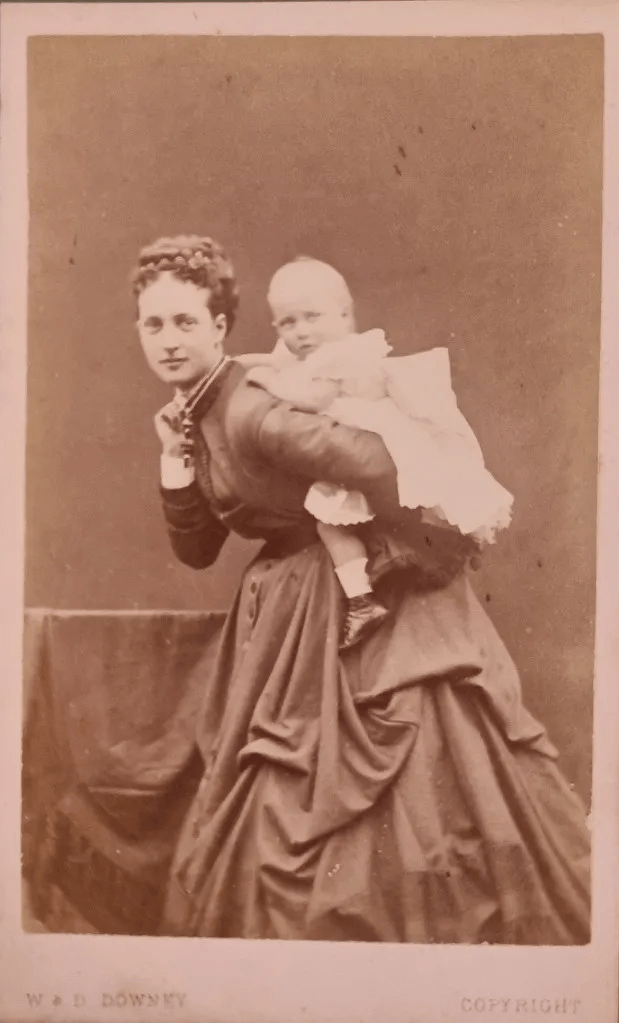
Downey’s celebrated image of Alexandra as Princess of Wales carrying her daughter Louise on her back featured in an earlier post (2nd December 2022).
In the past year, I’ve started collecting Downey carte-de-visites. Such was their ubiquity that many thousands are still in circulation.
The carte-de-visite format appeared in the late-1850s and immediately proved popular with the public.
Aside from its affordability, a carte-de-visite by design nestles conveniently in the palm of your hand
As the talk took place at Newcastle Cathedral, I was pleased to track down a card that featured the building’s distinctive ‘lantern tower’ and then included it in my presentation.
Confusingly though, at some point in its life, an unknown hand has written ‘St Peters’ in pencil on the front of the card, a point that members of my North-East audience were quick to point out.
In fact, the cathedral’s patron saint is St. Nicholas and not St. Peter.
However, that’s not the only aspect of the photograph that prompted a little head scratching.
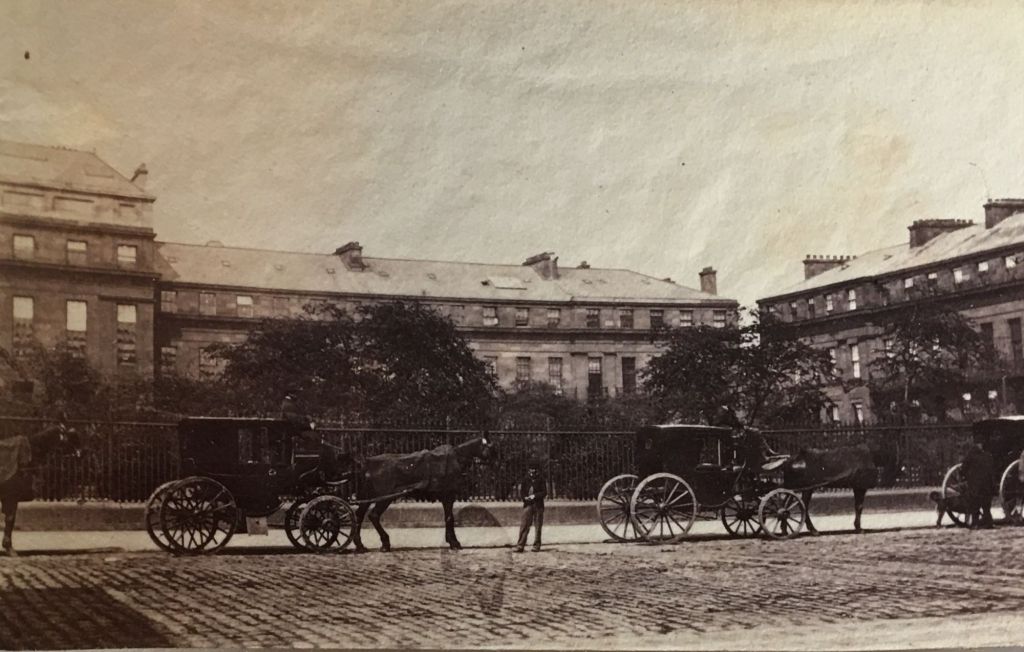
When you turn the card over (to its ‘verso’), it lists ‘W. & D. Downey. Photographers’ as being based at ‘4 Eldon Square, Newcastle on Tyne.’
As proclaimed in regular adverts for its wares in the local press, the company’s studio in the city from 1862 to the late 1880s was at 9 Eldon Square rather than at number 4.
What then might be the explanation for this apparent anomaly?
Eldon Square, a group of impressive townhouses created by the eminent architect John Dobson between 1825 and 1831, became one of the most fashionable addresses in Newcastle by the mid-19th century.
Public records reveal that 4 Eldon Square was home to one ‘Thomas Humble MD,’ a physician who features in both the 1861 and 1871 censuses for that address.
According to a notice he placed in the Newcastle Courant (1st March 1867), Dr. Humble served the Newcastle Dispensary, a medical charity treating the city’s poor and destitute, for nearly 38 years. He was resigning the position, he said, due to his ‘increasing engagements.’
Given this background, is it possible that he needed to let out rooms to his photographer neighbour to earn additional income?
Downey’s photographic business was certainly booming and extra capacity to accommodate its growing clientele may well have been welcome, if only on a temporary basis.
This scenario is partly supported by other information on the card’s verso.
It lists ‘illustrious and eminent persons’ the firm had photographed including Her Majesty Queen Victoria.
This dates the card’s likely production to late 1866/early 1867 by which point Downey had recently photographed the Queen at Balmoral for the first time.
On the other hand, human error might have been responsible.
Simply put, a batch of carte-de-visite produced for Downey were printed with the wrong address featuring number 4 rather than number 9 Eldon Square.
Despite this error, they were used anyway and sold to a public whose main interest lay in a carte-de-visite photograph rather than its ‘advert’ verso.
There is one remaining possibility though and one that needs to be considered by collectors of all kinds of objects.
That the card is a fake.
If so, it’s a very convincing one.
The faker has even gone to the trouble of attaching a sales sticker for Allan, a bookseller, stationer and news agent in 1860s Newcastle, known to have been one of Downey’s sales outlets.
Leave a comment