Saturday (6th December) marks the Feast of St. Nicholas when celebrations take place in many western Christian countries.
It’s a tradition that dates back to the 4th century when St. Nicholas as Bishop of Lyra was venerated for his generosity to children.
His later transformation into Santa Claus and Father Christmas during the 19th century has rather overshadowed his earlier role in the Christian church.
That said, many churches are named after St. Nicholas including one of my favourite buildings in Britain.
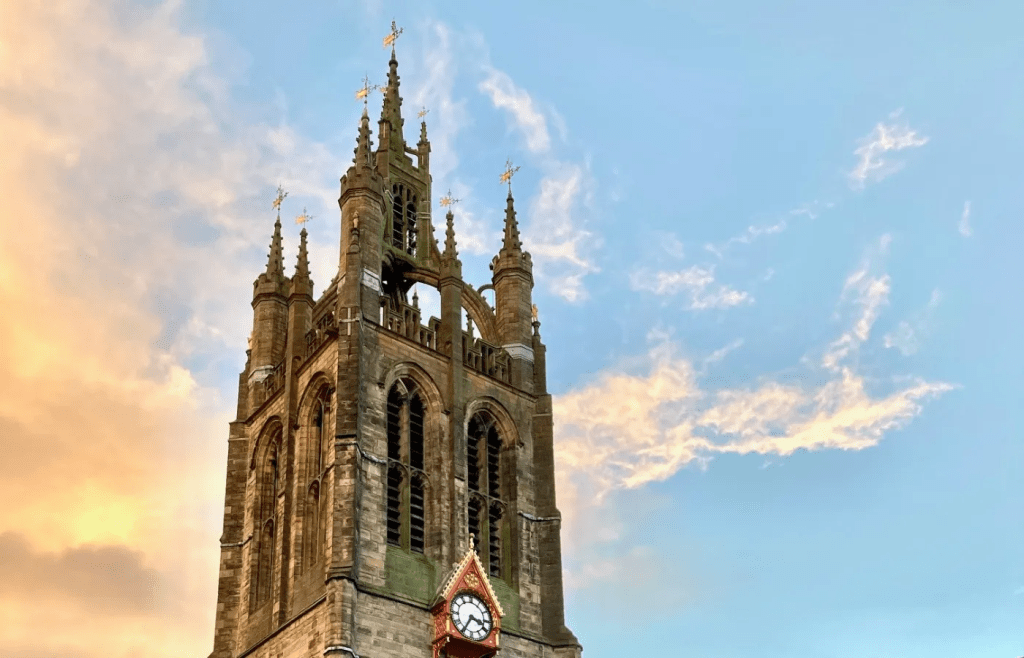
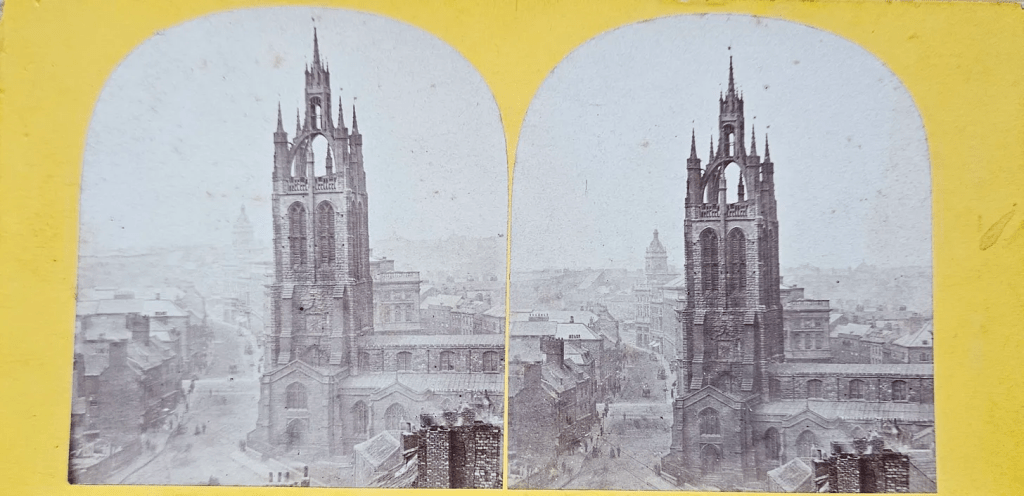
Newcastle Cathedral with its distinctive lantern tower began life during the 12th century as St. Nicholas Parish Church.
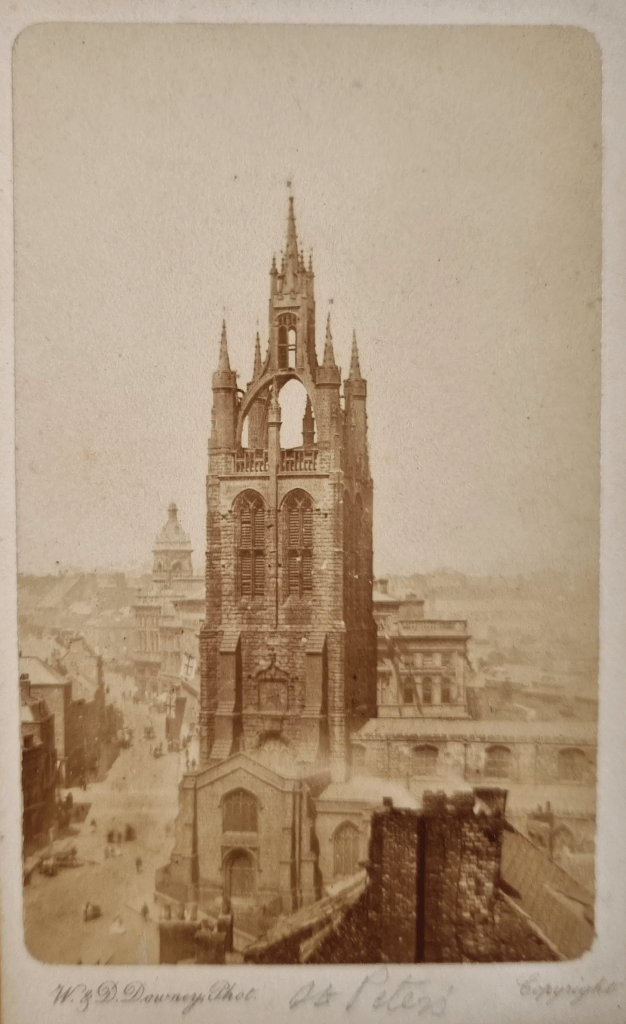
It’s a structure that continues to dominate the urban skyline and has been portrayed by successive generations of photographers as my own collection bears witness.
For instance, this carte de visite dates from the mid-1860s when the firm of W. & D. Downey was establishing its Newcastle studio in the heart of the city.
Erroneously titled ‘St. Peter’s’ in an unknown hand, it’s a view that had its origins in a stereoscopic 3D image.
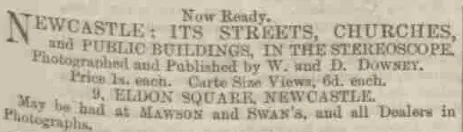
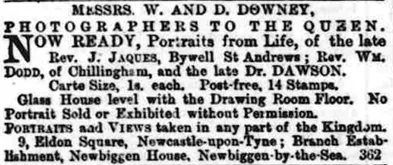
In July 1864 as Downey’s consolidated its reputation for high-quality work, the firm placed one of its regular ‘Now Ready’ advertisements in the local press.
Newcastle Journal (15th July 1864). From British Newspaper Archive.
Like most collectors, the search for a particular image sometimes ends when you are least expecting it.
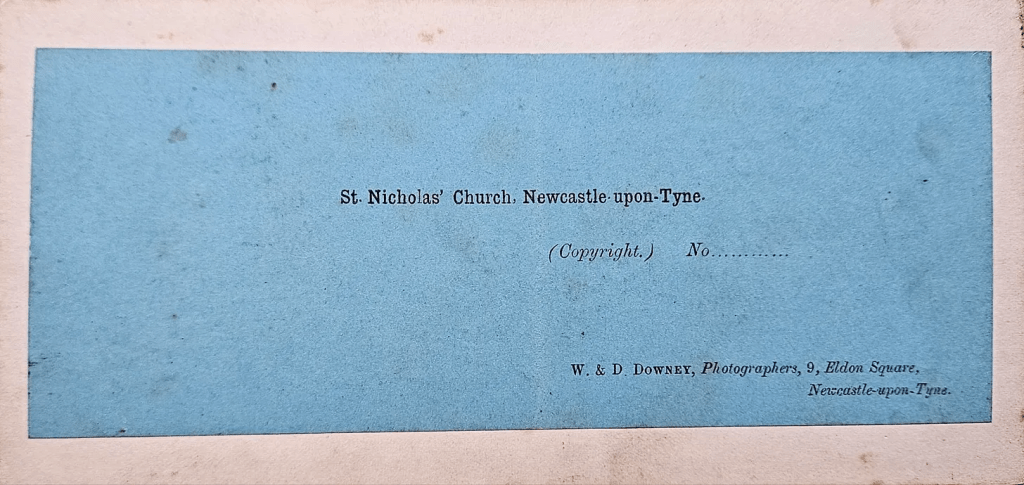
So it proved with a Downey stereo of St. Nicholas’ Church that appeared on a well-known auction site recently courtesy of a seller in the United States.
The first image I saw featured the verso of the stereocard revealing its title details printed on the company’s familar blue sticker.
The only slight disappointment was that, as closer examination of the two stereo halves reveals, the full 3D effect was undermined by the images being slightly out of alignment.
One explanation for this might be a result of the laborious process of cutting the photographic prints to size by hand.
Whether this particular stereo failed to meet Downey’s own high standards and ended up in the bin isn’t known.
Despite this, the pleasure of handling an object that is around 160 years old never fails to pall.
During the summer of 1866, the celebrated photographic firm of W. & D. Downey named after its founding brothers William and Daniel placed a series of advertisements in the regional press.
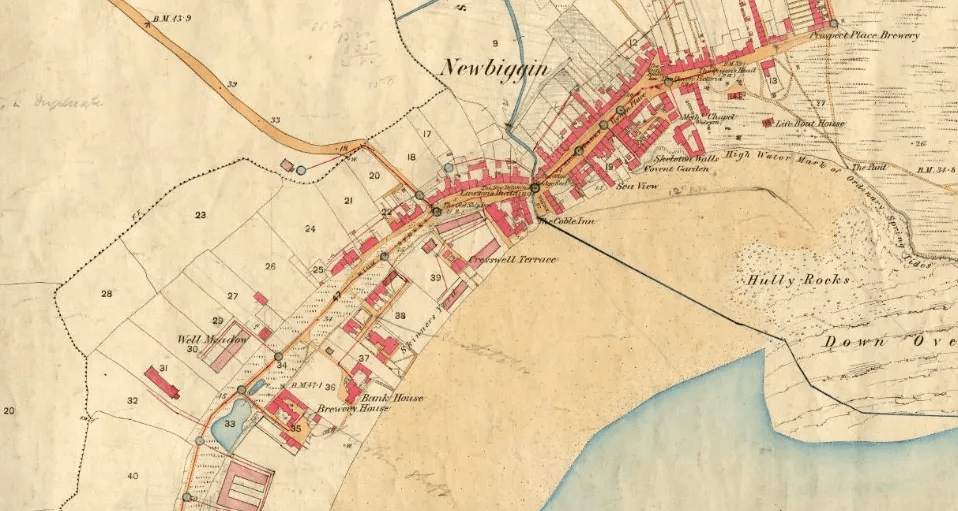
These announced that they had opened a ‘branch establishment’ in the Northumberland seaside resort of Newbiggin by the Sea (last line below).
Newcastle Weekly Chronicle (16th June 1866). From British Newspaper Archive.
The choice of Newbiggin, fifteen miles along the North Sea coast from Downey’s main studio in Newcastle upon Tyne, was rooted in a significant family moment.
It was in Newbiggin that on 18th April 1866, Daniel Downey’s wife Elizabeth gave birth to a daughter.
Shields Daily News (20th April 1866). From British Newspaper Archive.
The couple’s choice of location for the baby’s delivery may well have been informed by the health benefits of escaping the pollution of an industrial city where child mortality rates were high.
Indeed, the couple, who married in 1863, had lost their first child, a boy named William Daniel, early the following year.
The safe arrival of Elizabeth Jane Downey was followed by a period of entrepreneurial photographic activity that characterised the firm throughout its long history.
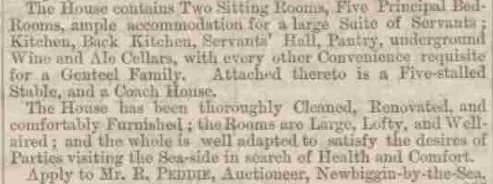
Newspaper adverts reveal that by mid-July, the Downey’s had moved their seaside studio to Monck House, a property once occupied by Sir Charles Monck of Belsay.
A leading aristocrat in the region, Monck had previously sat for the Downey’s at Belsay Hall and was part of their expanding network of influential figures.
Monck House was certainly more in keeping with the facilities on offer at their 9 Eldon Square base in Newcastle as this newspaper advert confirms.
Newcastle Daily Journal (3rd August 1861). From British Newspaper Archive.
On 14th July 1866, an advert carried by the Morpeth Herald announced that Downey’s Newbiggin branch, now with its Monck House address, was open “for a short season, for the convenience of visitors to this beautiful watering place.”
It also advised that “to prevent disappointment, or having to wait, it will be better to make an appointment.”
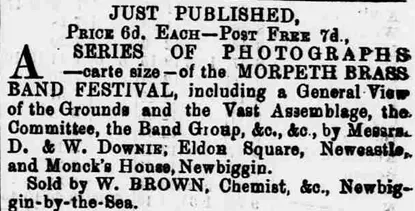
Together with a series of views of “Newcastle, Woodhorn and Newbiggin-by-the-Sea”, another of the paper’s small ads made its readers aware of yet more Downey product that could be purchased in the resort.
Morpeth Herald (14th July 1866). From British Newspaper Archive.
Apart from mis-spelling its surname, the use of ‘Messrs. D & W.’ reversing the usual order of ‘W. & D.’ suggests that Daniel was combining his duties as a new father with this varied photographic schedule.
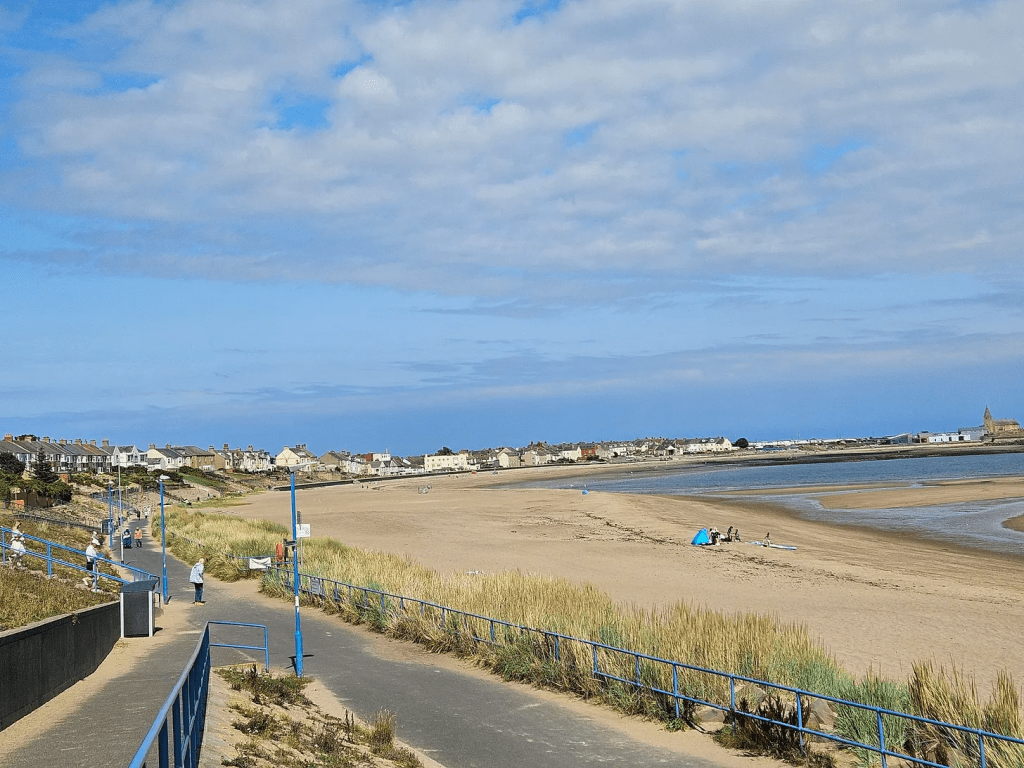
What a recent Pressphotoman visit to Newbiggin revealed was that the mid-1860s were pivotal years in the resort’s development.
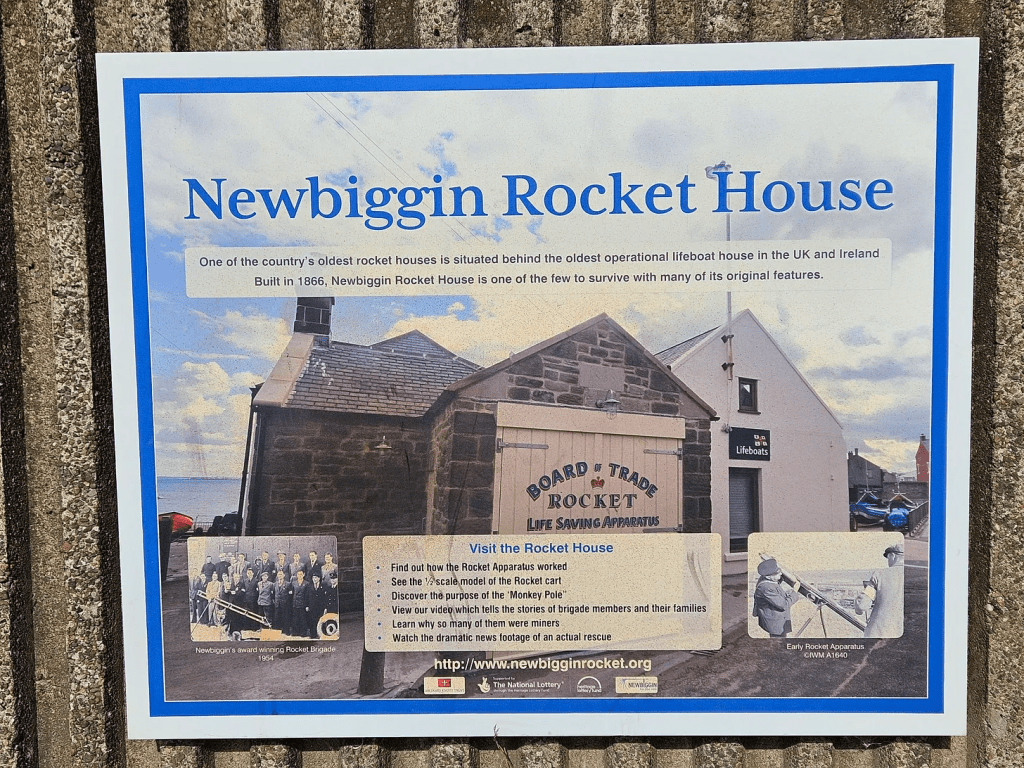
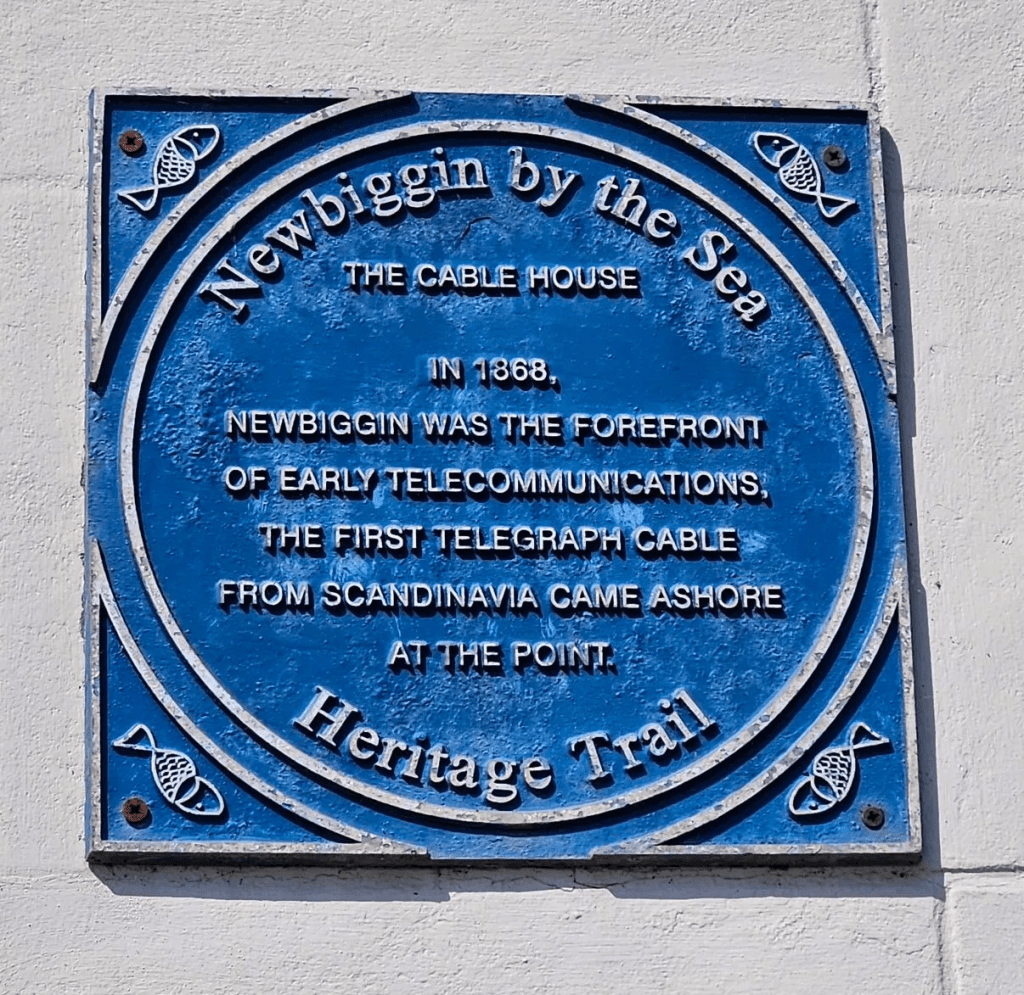
1866 itself saw the building of Newbiggin Rocket House, one of Britain’s oldest and one that was involved in life-saving ship rescues well into the 20th century.
Within weeks of their summer season at Newbiggin by the Sea, the Downey brothers began a ground-breaking new chapter in their firm’s illustrious history.
For the first time, they were summoned by Queen Victoria to Balmoral where her diary for Saturday 22nd September 1866 records that “on coming home was photographed by a very good photographer Downey from Newcastle”.
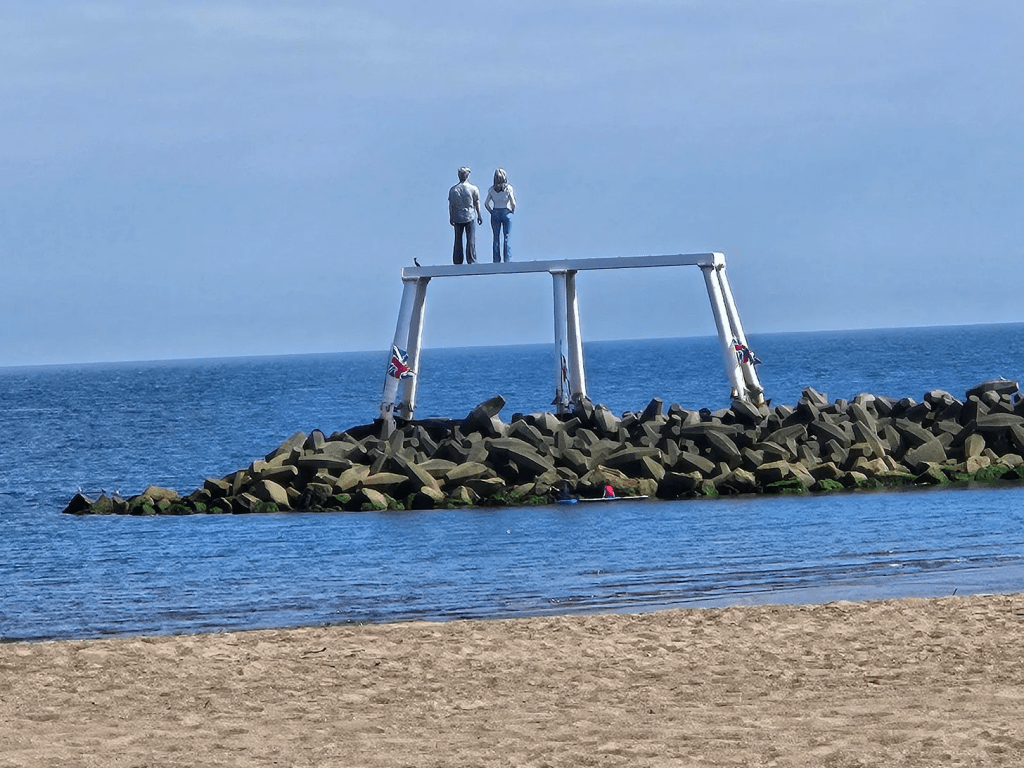
Like the couple featured in a giant sculpture that watches over Newbiggin by the Sea today, the Downey’s never looked back.
The attribution ‘Unknown Photographer’ is like catnip to the photohistorian.
Sometimes the pieces of the jigsaw fall neatly into place and a credible name for the author of an image emerges.
That’s exactly what happened during the writing of this blogpost.
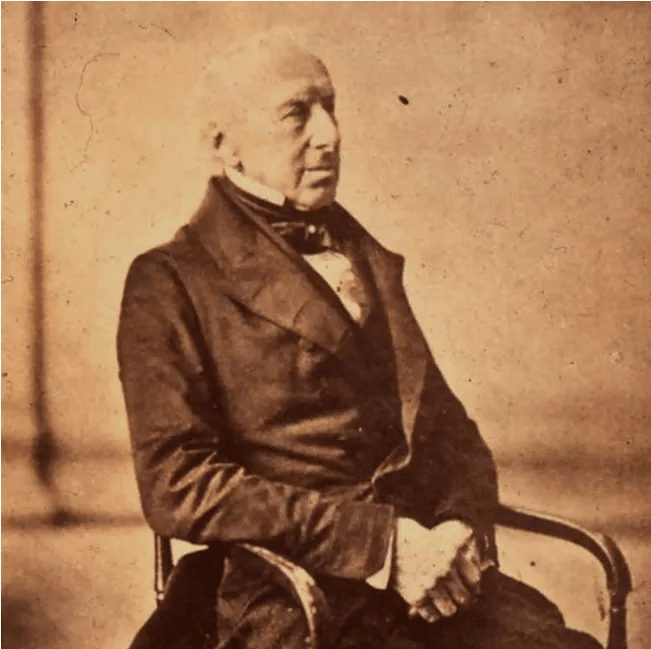
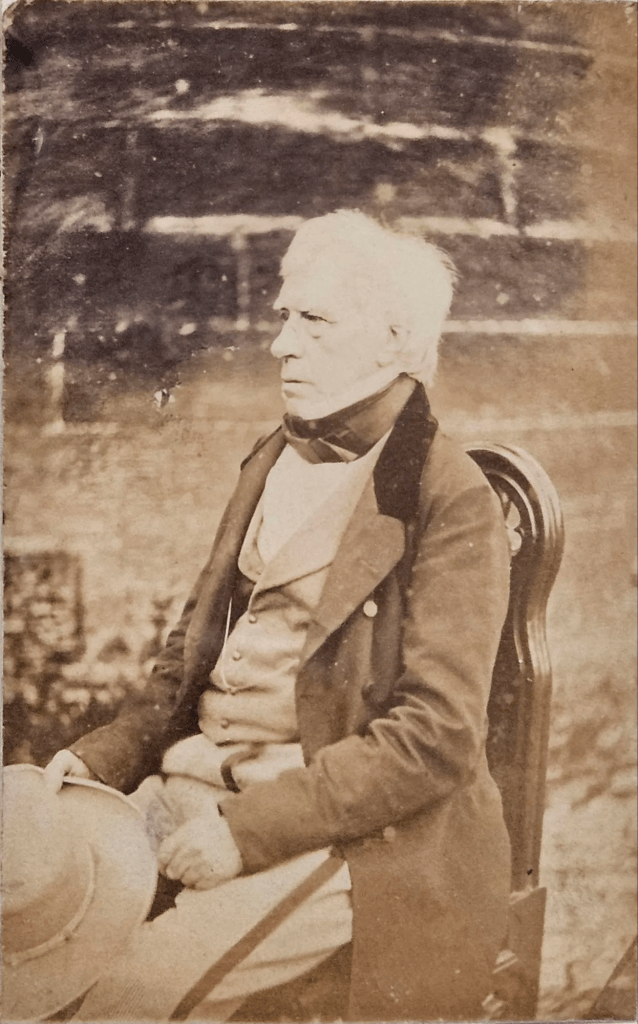
It began with a portrait photograph that is more than 160 years old and among the earliest protected by UK copyright law.
Copy 1/1/279. National Archives/OGL.
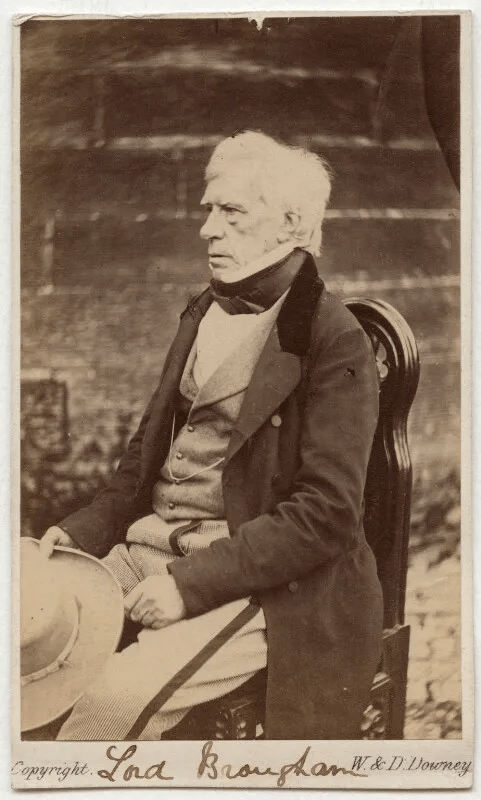
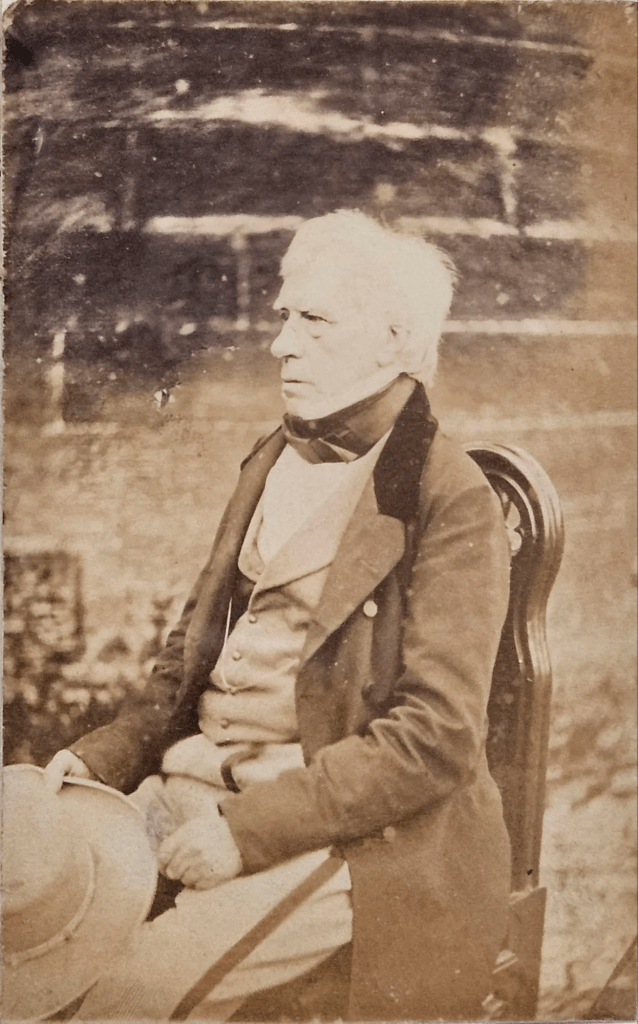
It features the veteran statesman and philosopher Henry, Lord Brougham (1778-1868) and was taken by Daniel Downey, one of the Tyneside brothers behind the celebrated photography firm of W. & D. Downey.
These facts are known because of a vital piece of legislation that early photographers in particular were quick to embrace.
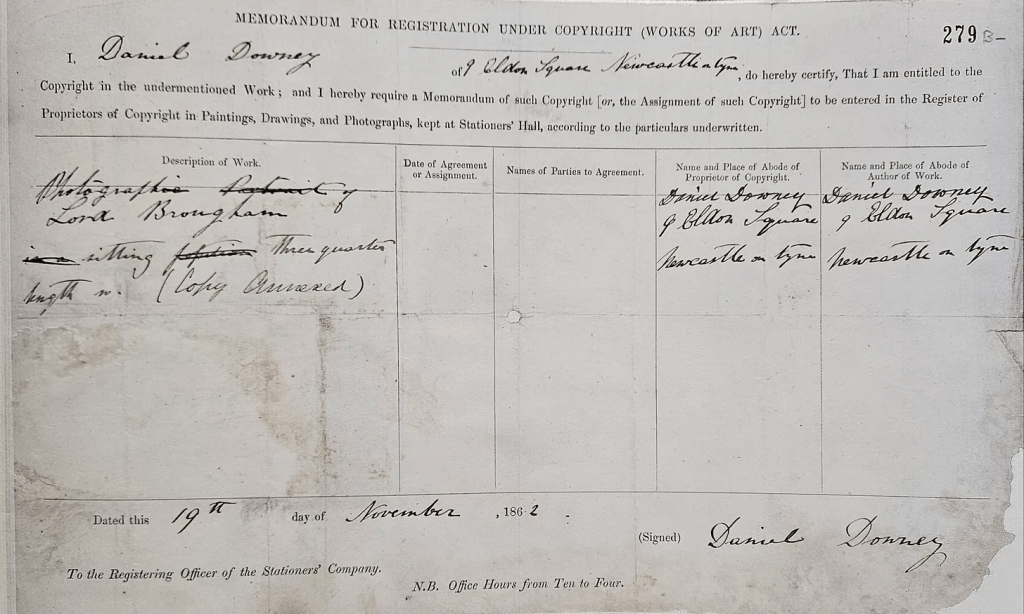
On 29th July 1862, the Fine Arts Copyright Act became law and required anyone wanting to protect their paintings, drawings or photographs to complete a form and attach a copy of the work.
The first photograph (COPY 1/1/1) was registered on 15th August at Stationers Hall in London where the act was administered.
A few months later, according to a document stored in the National Archives at Kew, Daniel Downey submitted a form together with a copy of the photograph (seen above) that he had taken.
Copy 1/1/279. National Archives/OGL.
Dated 19th November 1862, the resulting form complete with his signature is numbered ‘279.’
For a researcher like me with an ongoing interest in charting the history of the Downey company, seeing such a document in the flesh as I did recently was a real privilege.
As regular readers will be aware, 1862 was a pivotal year for the Downey brothers, William and Daniel, who had started their photography business in South Shields several years earlier.
That January, their photographs of the aftermath of the New Hartley pit disaster claiming the lives of 204 men and boys were acclaimed by Queen Victoria.
Then, in March, their new studio at 9 Eldon Square, Newcastle on Tyne opened and quickly became a go-to destination for the great and good seeking a high-quality photographic portrait.
Daniel’s portrait of Lord Brougham was subsequently issued commercially as a carte de visite.
An example of this carte marked ‘Copyright’ and ‘W. & D. Downey’ on the front is part of the collection of the National Portrait Gallery, London.
As to when the photograph was taken, an article in the Newcastle Daily Journal (12th January 1863) reported how Downey had been honoured with repeated commissions from Brougham, who it called “the great opponent of the slave trade.”
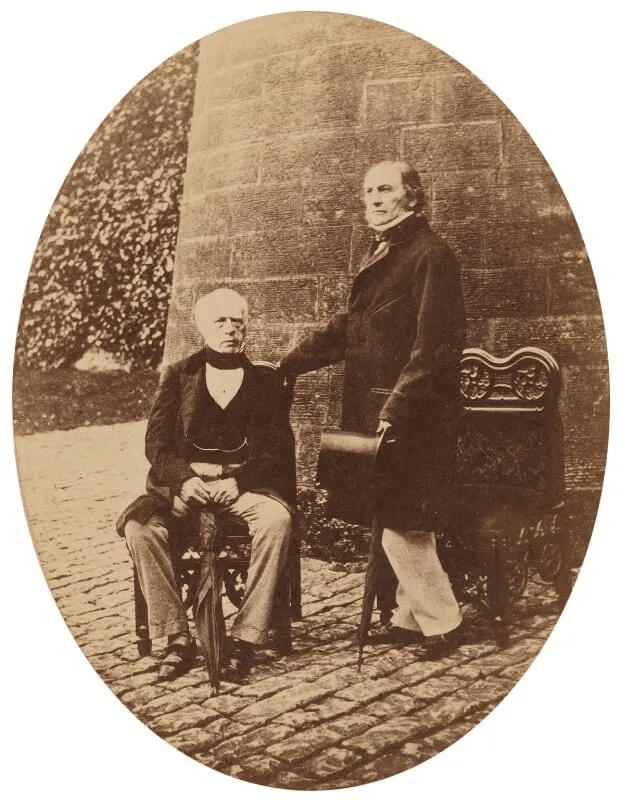
The paper went on: “… only recently they were on a professional visit to his residence in Westmoreland, when they had the rare good fortune to obtain, in one small carte de visite, the portraits of both Lord Brougham and Mr. Gladstone.”
Searching online for this carte featuring Brougham with the then Chancellor of the Exchequer and later Prime Minister in four British governments, I came across this image.
Titled ‘Henry Brougham …. and William Ewart Gladstone’ and described as an ‘albumen print, late 1850s,’ the website of the National Portrait Gallery, London states that it was purchased in 1991 and attributes it to an ‘unknown photographer.’
Looking at the chair being used and the stone wall background, the visual evidence suggests a number of similarities with Daniel Downey’s copyrighted portrait of Lord Brougham.
Copy 1/1/279. National Archives/OGL.
Press reports also help identify a possible date and location at which these portraits featuring Brougham alone and together with Gladstone were taken.
In a report headlined ‘Mr. Gladstone’s visit to Newcastle’, the Newcastle Courant (10th October 1862) described how “the right honourable gentleman [Gladstone] and Mrs. Gladstone, who had been staying with Lord Brougham at Brougham Hall, near Penrith … arrived at Blaydon-on-Tyne, on Monday afternoon, by train from Carlisle.”
Newcastle Courant (10th October 1862). From British Newspaper Archive.
This account points to the period prior to this when the sittings took place with Brougham Hall being a strong candidate as the location.
It would also connect neatly with an event that took place in Newcastle the day after Gladstone and Mrs. Gladstone’s arrival in the city on Monday 7th October 1862.
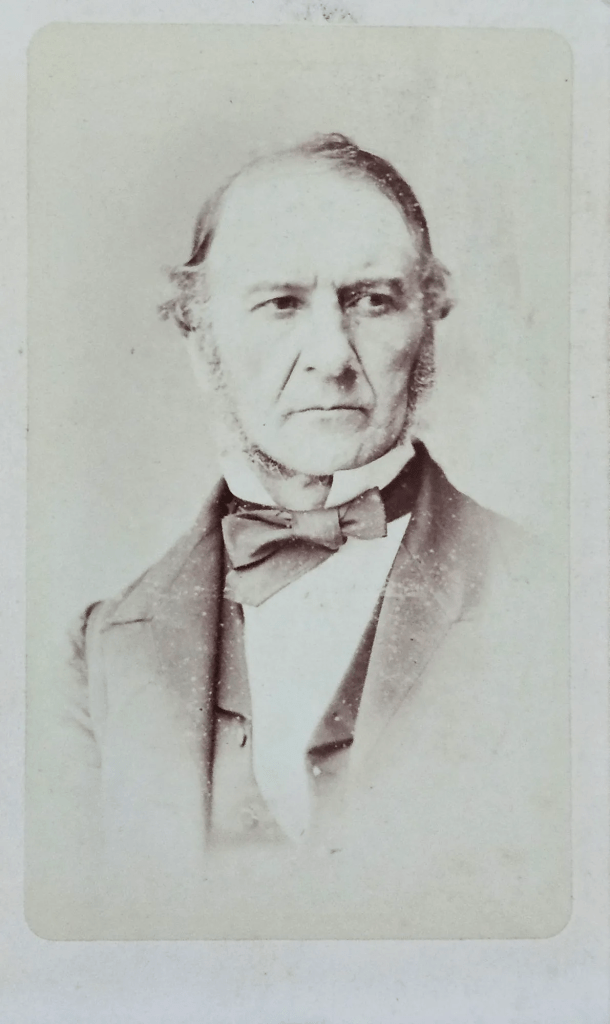
The next day, the Newcastle Courant reported that Gladstone paid a visit to “the studio of Mr. Downey, photographer, Eldon Square, where the Chancellor of the Exchequer sat for a portrait.”
This resulting carte de visite issued by W. & D. Downey is part of my collection and also features in several versions in the collection of the National Portrait Gallery, London.
Taken together, the sequence of events strongly suggests that Daniel Downey not only took the portraits featuring Lord Brougham and Mr. Gladstone at Brougham Hall, but also as that of Gladstone at Downey’s Eldon Square studio in Newcastle.
Whatever the exact details of their provenance, the resulting photographs capture two of Britain’s best-known politicians in their Victorian pomp.
Collecting carte de visite photographs is a never-ending journey of discovery.
Regular readers will be aware of my research into the studio of W. & D. Downey in South Shields and Newcastle on Tyne during the late-1850s and 1860s before relocating to London.
Their cartes of the great and good are a particular fascination of mine and my collection features not only single portraits, but others from the same sitting.
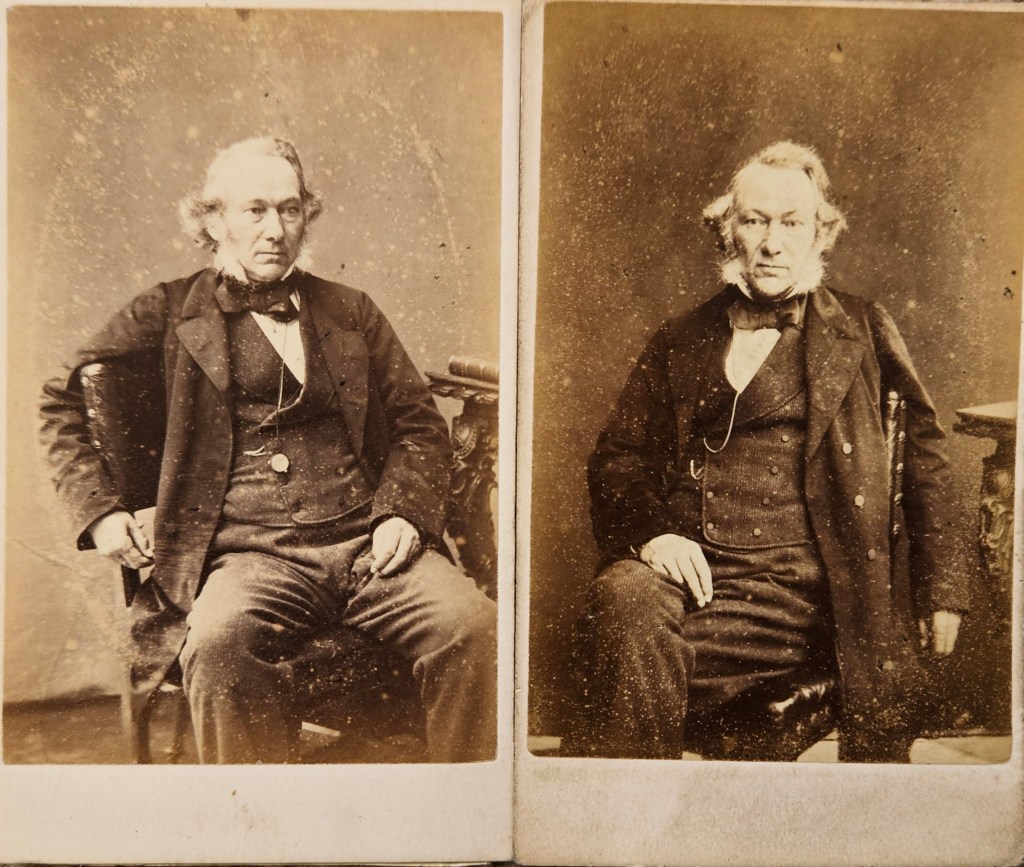
For example, Richard Cobden (1804-1865) was a Manchester businessman turned politician who became an MP.
He is best-known, together with his parliamentary colleague John Bright (1811-1889), for spearheading a successful campaign to repeal the Corn Laws, which penalised the poor.
In Cobden’s case, the two cartes published by Downey in my collection demonstrate how one man sitting on a chair could be successfully repositioned and reorientated for the camera to provide different images.
In one, he is looking to the left of the operator; in the second, he is looking straight down the lens.
In one, his right arm is draped over the back of the chair; in the second, it’s his left arm.
As for props, the table on the right hand side also reveals how a book, often a visible sign of the sitter’s learning and erudition, was part of one shot, but not the second.
The carte on the left is part of the collection of the National Portrait Gallery, London where the two examples it holds of the same card are distinguished by text in the white border at the bottom of the card.
These include the words ‘Copyright,’ ‘W. & D. Downey’ and ‘Mr. Cobden.’
A further two examples in the NPG collection are close-up head-and-shoulders shots taken from the same image where the original negative has been cropped by Downey to produce a more intimate portrait.
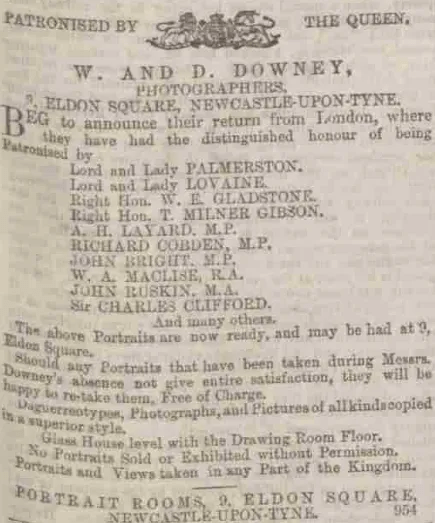
Cobden sat for his Downey portrait in the summer of 1863 during a visit to London by the firm as this newspaper advert confirms.
Newcastle Journal (30th July 1863). From British Newspaper Archive.
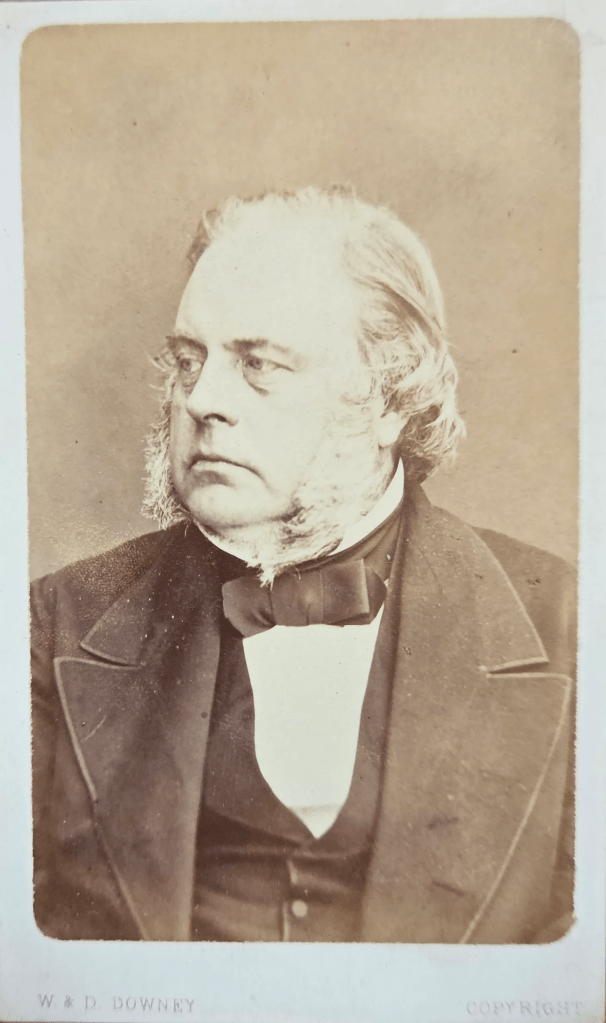
The Downey portrait of John Bright MP, listed above together with Cobden, also features in my collection and is equally distinguished.
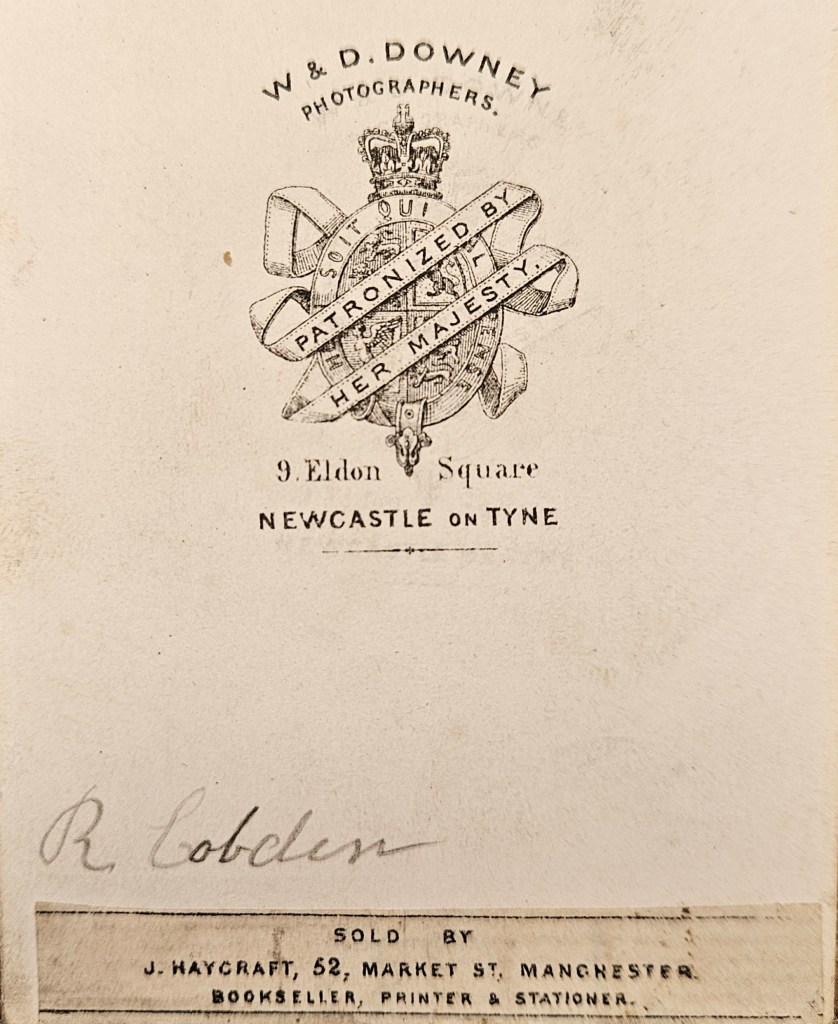
The seller was Kent-born Joseph Haycraft, who had been a printer and later bookseller and stationer in Manchester from the 1840s.
Like many in his trade, the cartomania phenomenon had given a considerable boost to business.
Politicians were among those figures conveyed celebrity status by these affordable photographs.
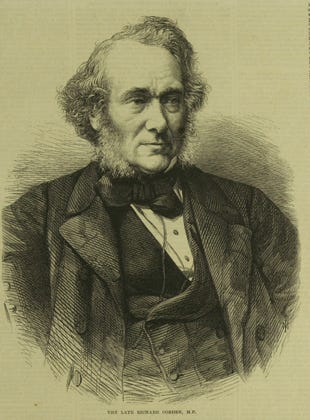
In the final years of his political career, Richard Cobden was MP for Rochdale, so cartes featuring his distinctive visage would have proved popular sellers in nearby Manchester.
When Cobden died in April 1865, Downey’s various portraits of him gained another lease of life.
Indeed, many previously unissued images may well have been marketed precisely because there was a public appetite to memorialise the late MP.
Downey portraits also featured in press tributes such as this engraving used by the Illustrated London News in its obituary though, as was sometimes the case, the photographer’s work was not credited in the press.
Illustrated London News (16th April 1865). From British Newspaper Archive.
As for Haycraft, he died only a year after Cobden in May 1866.
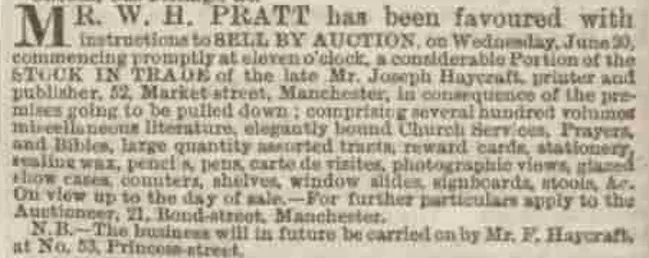
The following month, an advertisement in the Manchester Courier revealed that his premises at 52 Market Street were “going to be pulled down” and that an auction of his ‘stock in trade’ would take place.
Manchester Courier (16th June 1866). From British Newspaper Archive.
Following the auction, his son Frederick Taylor Haycraft, who had assisted him in the business, took over its running at new premises in nearby Princess Street.
However, the story does not have a happy ending as was the case for many who rode the carte de visite wave.
By the end of the decade, Frederick was listed as a ‘bankrupt bookseller’ by the London press.
The name of John Hunter Rutherford (1826-1890) lives on in a number of educational institutions.
An evangelical preacher from the Scottish Borders, he came to Newcastle on Tyne in 1850.
Among his many achievements as an educationalist, he is best known for setting up a series of elementary schools in the surrounding area.
Rutherford College named after him gave birth to what today is Northumbria University.
When Dr. Rutherford died suddenly, his reputation was such that 5,000 people took part in his funeral procession.
Newcastle Daily Chronicle (28th March 1890). From British Newspaper Archive.
In addition, the Newcastle WeeklyChronicle estimated that more 100,000 lined the processional route.
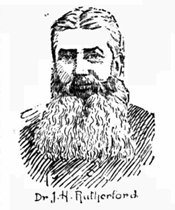
This line drawing of him in later life accompanied the newspaper’s three-column report of the occasion.
Newcastle Weekly Chronicle (28th March 1890). From British Newspaper Archive.
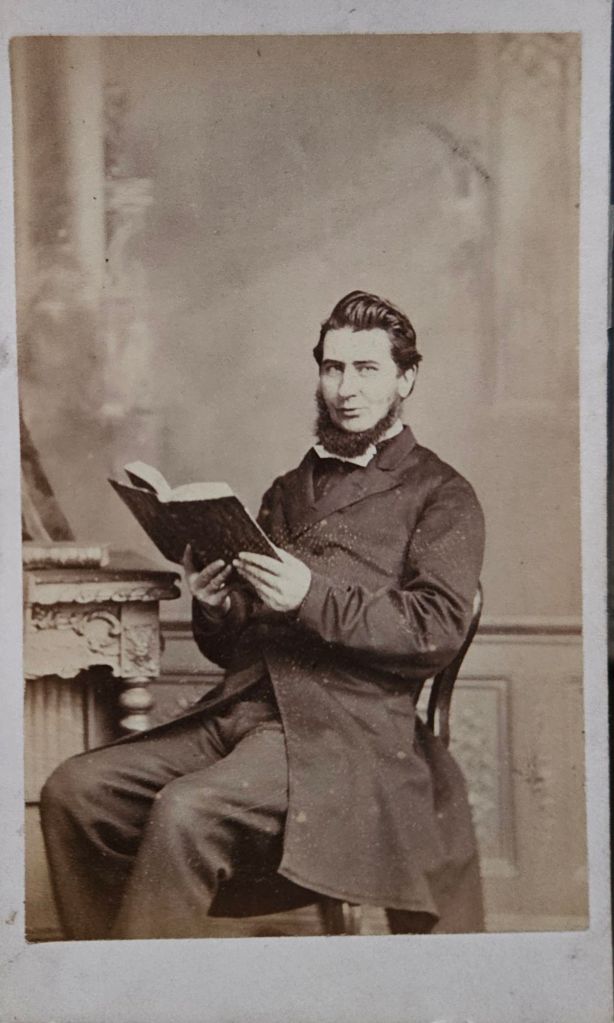
However, in his younger days, a recent addition to the Pressphotoman collection reveals that he posed for his portrait with leading Newcastle photographers W. & D. Downey.
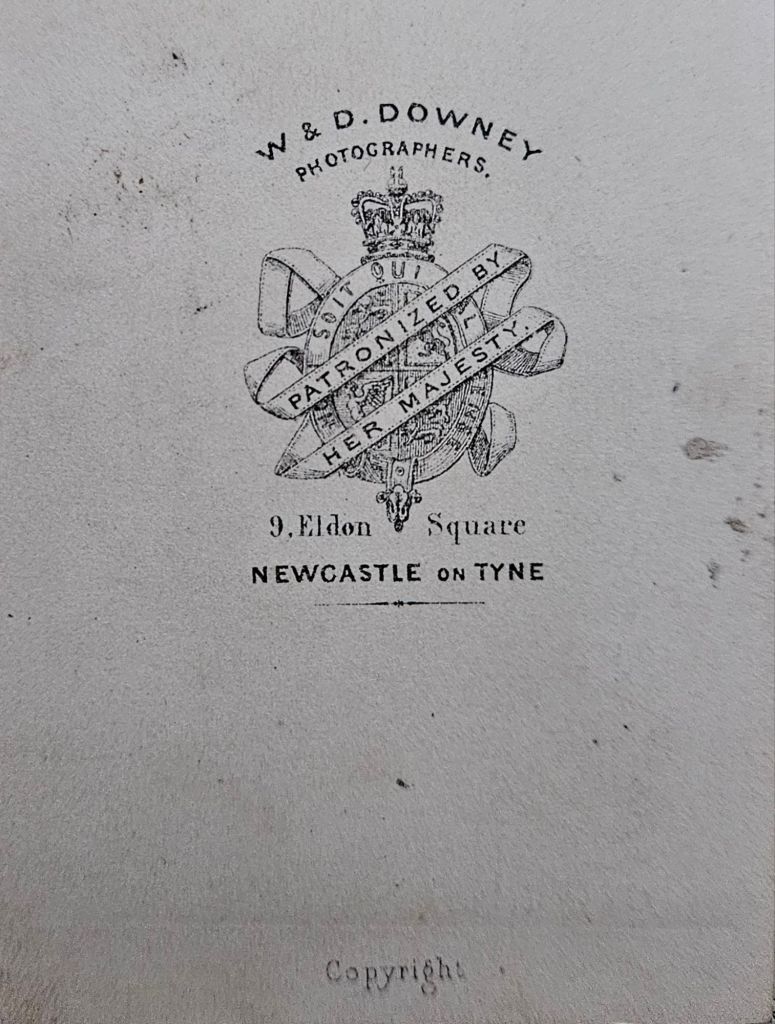
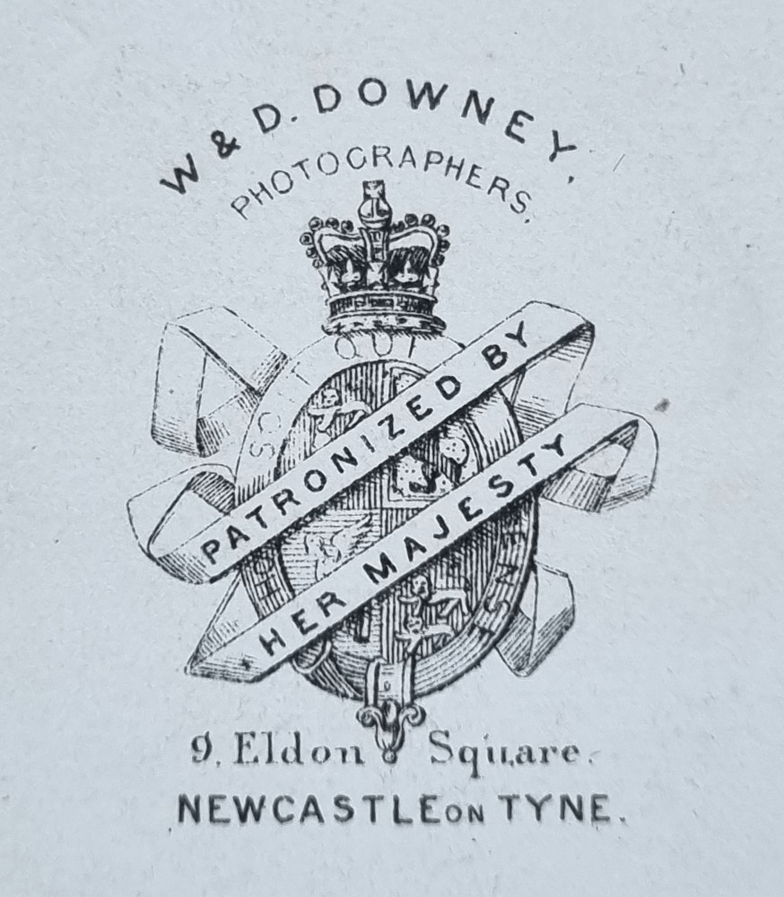
The slogan ‘Patronized By Her Majesty’ was used by the company before being replaced by ‘Photographers To Her Majesty’ in the middle of the decade.
This information and the lack of Downey branding on the front of the carte allows it to be dated c. 1862-1866.
At that point, Dr. Rutherford was in his late-30s and in the midst of his studies as a medical doctor.
A surprising twist to this blogpost is that his death occurred only a few doors away from where the Downey carte portrait was taken.
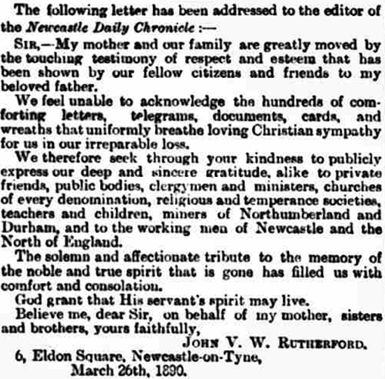
As part of its funeral report, the Newcastle Weekly Chronicle published a letter from Dr. Rutherford’s son John sent from 6 Eldon Square, the family home.
It indicates the esteem in which his father was held.
Newcastle Weekly Chronicle (28th March 1890). From British Newspaper Archive.
Given this, the Downey carte de visite of John Hunter Rutherford as a younger man making his way in the world seems all the more poignant.
Research into the photographic firm W. & D. Downey of South Shields, Newcastle upon Tyne and London is regularly published on this blog.
A number of photographers who worked for the Downey brothers, William (1829-1915) and Daniel (1831-1881), later went on to enjoy successful careers of their own.
Over coming weeks, a Pressphotoman mini-series will share new research on a selection of Downey luminaries.
When the celebrated portrait photographer Hayman Seleg (H.S.) Mendelssohn died in 1908, aged 59, a brief obituary in the Royal Photographic Society Journal described how his career began.
Born in 1847 in Germany and raised in Poland, “… political reasons obliged him to leave that country, and he settled at Newcastle-on-Tyne where he commenced his photographic career.”
It went on: “After serving with Mr. D. Downey for some time, he went into business for himself.”
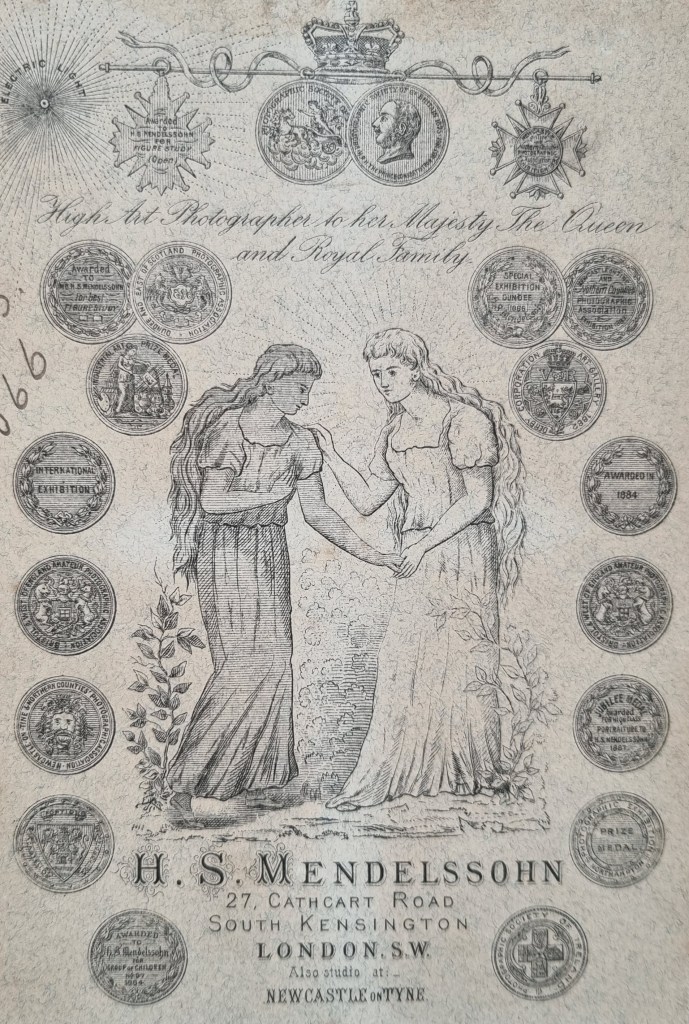
This passing reference to Daniel Downey points to an apprenticeship with the company’s Eldon Square studio in the late 1860s.
W. & D. Downey’s Newcastle on Tyne studio was located in Eldon Square. Courtesy of Private Collection, Zurich.
Married with two very young children, the transition to life in a different country must have been unimaginably hard.
The Mendelssohns were one of only 160 Jewish families living in Newcastle at that time.
By 1871, they were sharing a house with jeweller Simon Falk and his family in Blandford Street, a short walk from the city’s railway station.
Evidently, employment with W. & D. Downey proved life-changing.
In the 1871 census, Mr. Mendelssohn’s stated ‘trade or profession’ was ‘photographer.’
He then formed a business partnership with another of the Downey brothers, John (1823-1906), who was also a photographer.
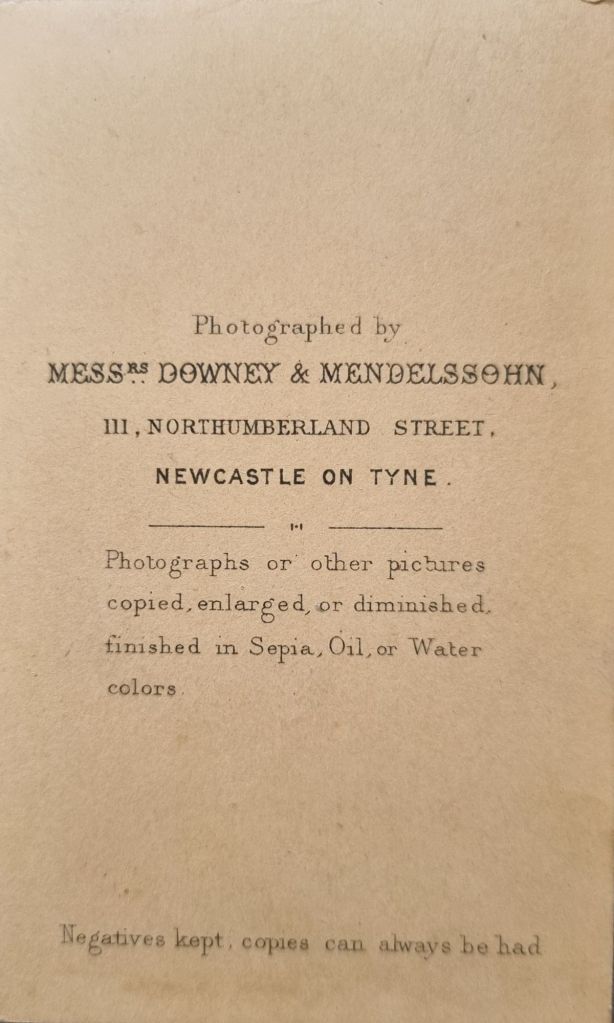
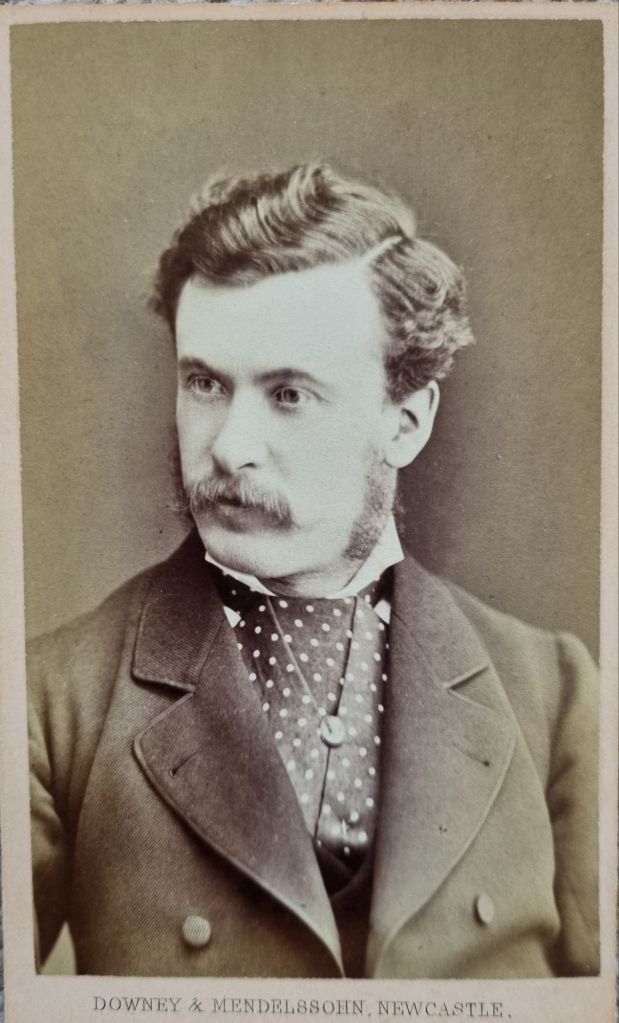
In late-January 1872, the firm of Downey & Mendelssohn opened for business in premises at 111 Northumberland Street.
Interestingly, this was the address that W. & D. Downey used when it opened its first studio in Newcastle on Tyne a decade earlier.
Advertisements placed by Downey & Mendelssohn in the Newcastle press offered a range of services.
These included ‘photographs taken of any animate or inanimate object’ and ‘Rembrandt portraits taken to perfection,’ however conventional portraits were their stock-in-trade.
Another notable detail was the addition of the term ‘Photo Artists’ in line with an array of competitors in the city, adding ‘sepia, oil or water colors [sic]’ to their products.
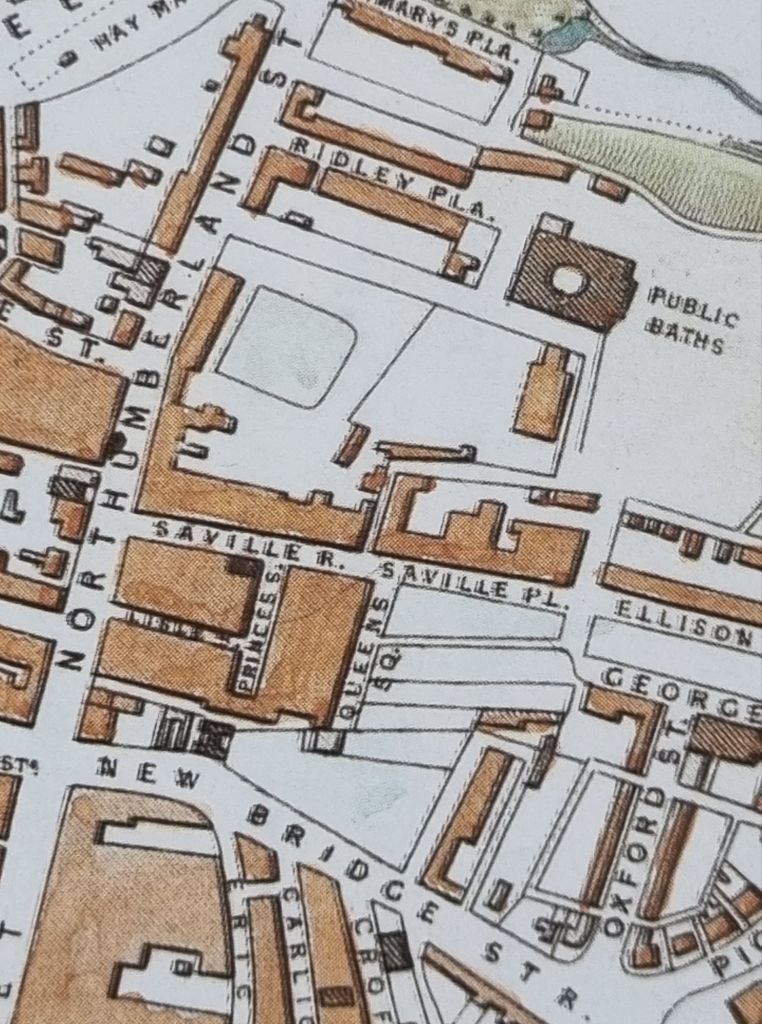
Within 12 months, their studio moved a short distance from 111 Northumberland Street (left of map below) to 17 Oxford Street (bottom right).
Studio moved from Northumberland Street (left) to nearby Oxford Street (bottom right). From John Tallis map of Newcastle on Tyne (1854).
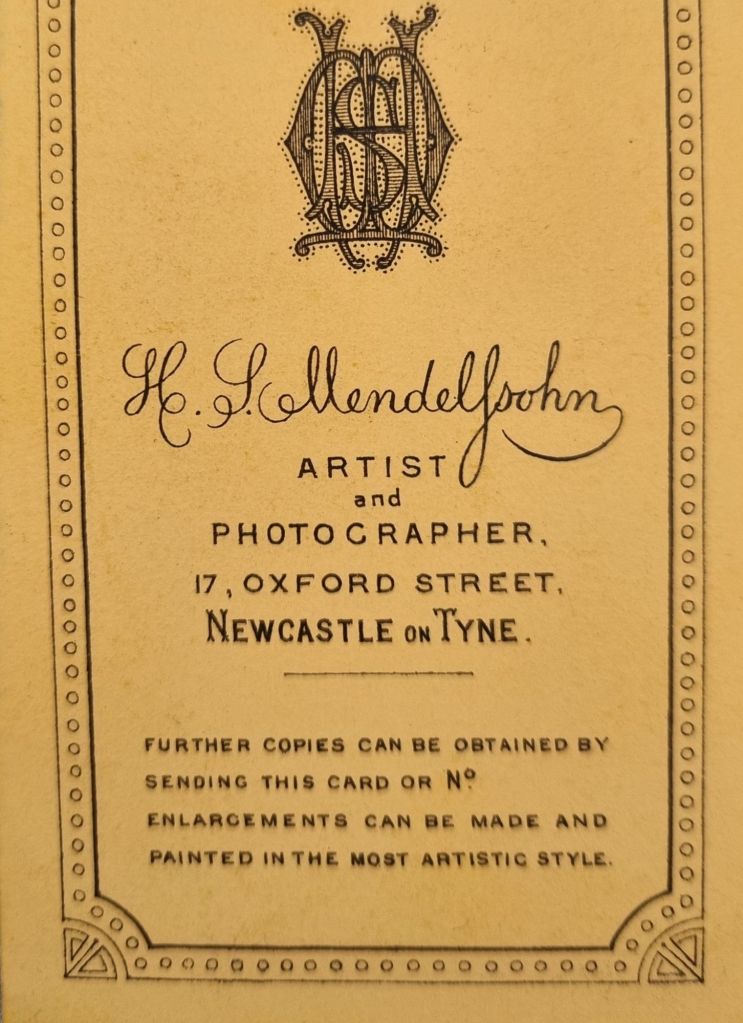
The firm also adopted a distinctive orange-coloured card for presenting its products.
In December 1873, Downey & Mendelssohn’s two-year long partnership came to an end, and ‘H. S. Mendelssohn, Photo Artists’ became sole proprietor of 17 Oxford Street.
By this point, he was an active participant in the photographic life of the city.
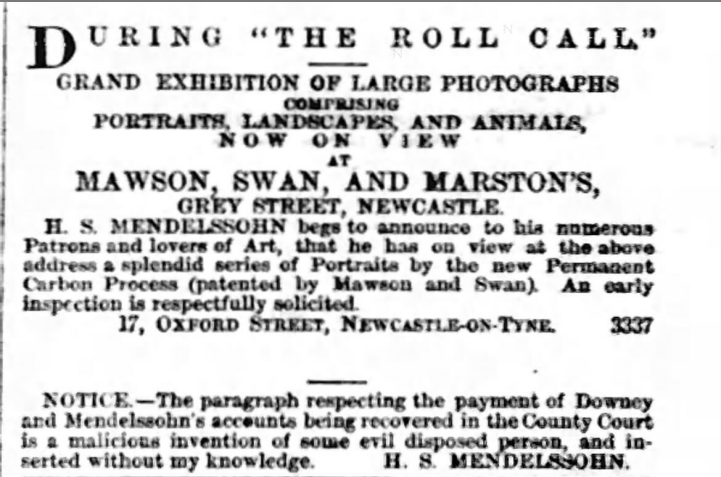
This 1874 newspaper advertisement promoted an exhibition of his portraits using the carbon print process invented in Newcastle by (Sir) Joseph Swan.
Newcastle Daily Journal (15th October 1874). From British Newspaper Archive.
However, the adjoining ‘Notice’ hints at a form of intimidation that could be viewed as anti-semitic, which he was willing to confront publicly.
From this point, H.S. Mendelssohn’s career went from strength to strength.
He opened a further studio in nearby Sunderland in 1881 and the following year, his business expanded to London where his growing reputation attracted prestigious clients.
Queen Victoria’s diary entry for 20th December 1883, made at Osborne House on the Isle of Wight, recorded: “A new photographer, named Mendelssohn, has taken lovely photographs of [Victoria’s grandchildren] Daisy [Margaret of Connaught] and little Arthur [Duke of Connaught].”
Whether W. & D. Downey’s royal warrant to Her Majesty (1879) played a part, it proved to be the first of many royal commissions.
H.S. Mendelssohn’s career is celebrated in various collections including the National Portrait Gallery, London where he is credited with 70 portraits.
This cabinet card featuring the actress Miss Ellen Terry taken in 1883 demonstrates his skills and how far he had travelled since arriving in Newcastle on Tyne as a refugee fleeing persecution.
Miss Ellen Terry by H.S. Mendelssohn. National Portrait Gallery, London. NPG Ax5571.
In the next post in this mini-series, how Downey’s principal photographer in the 1860s and 1870s used that calling card to attract clients to his own successful portrait studio.
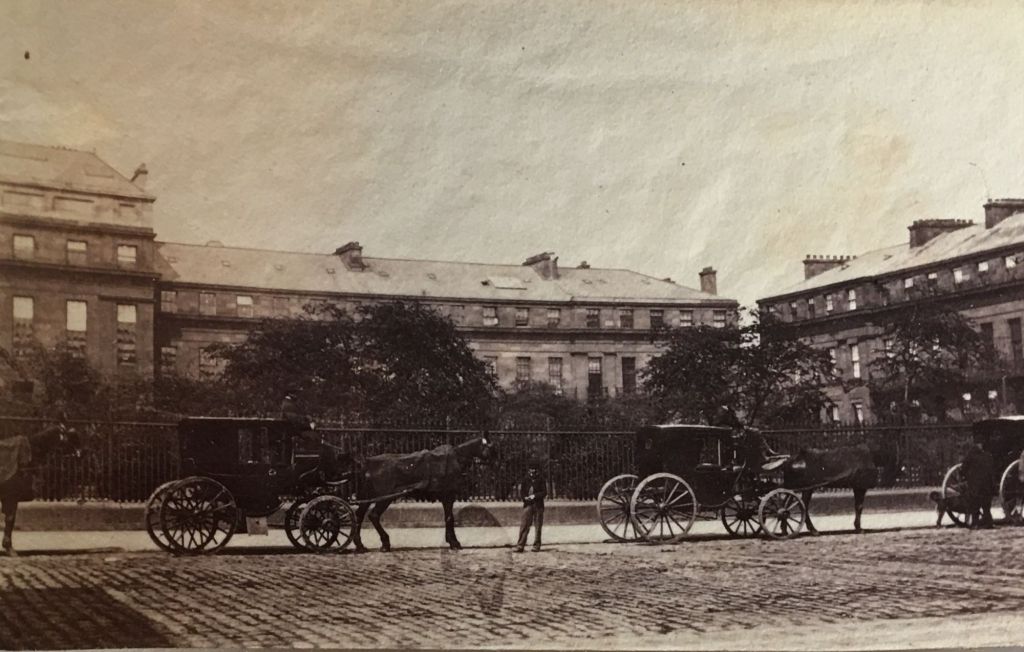
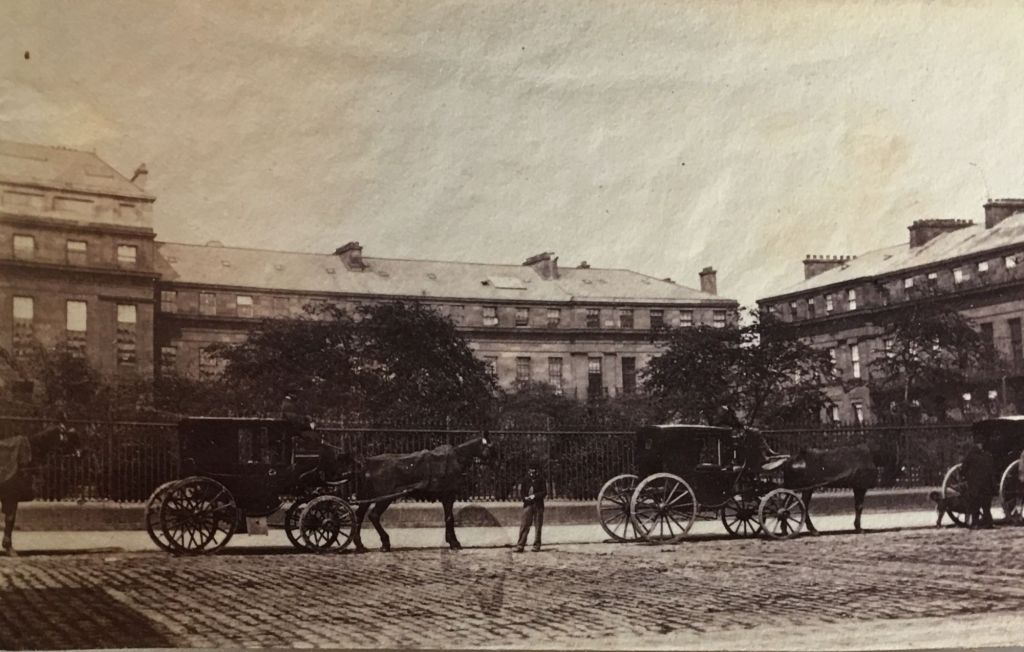
At no. 9 (on the right of facing terrace above), W. & D. Downey opened a new studio in March 1862, consolidating a growing reputation for supplying high-quality portraits.
Other leading photographers in the city such as P.M. Laws, E. Sawyer, R. Turner, G.C. Warren and T. Worden provided the Downey brothers, William and Daniel, with stiff competition.
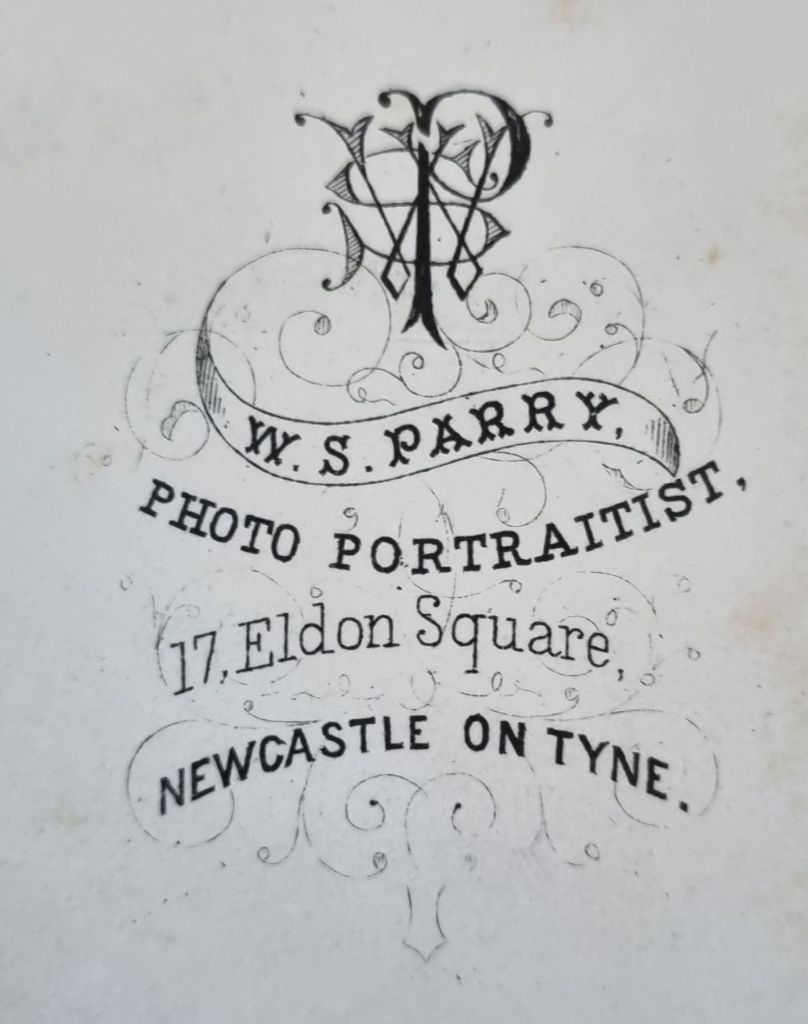
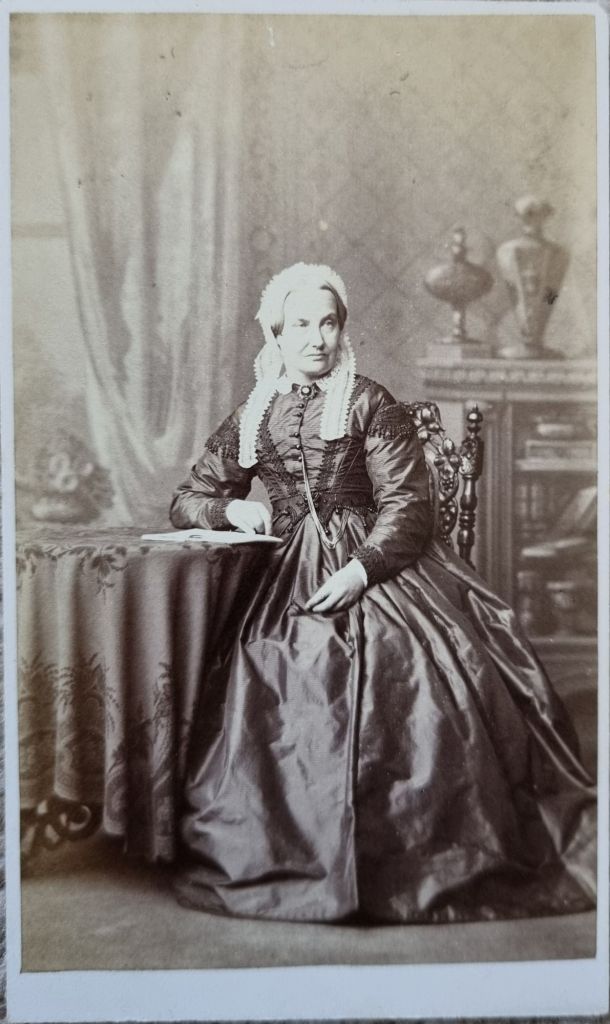
But in 1864, when W.S. Parry moved his long-established studio to no. 17 Eldon Square, a new chapter in Newcastle’s photo wars began.
William Softley Parry was born in 1826 across the River Tyne from Newcastle in Gateshead.
By the late-1840s, he was in business as a window glass merchant in Grainger Street, Newcastle, enjoying the new medium of photography as a hobby.
Initially, he produced paper calotypes which he exhibited at the Annual Conversaziones of the Literary and Philosophical Society of Newcastle upon Tyne (founded 1793), known as the ‘Lit & Phil.’
By 1855, following the invention of the wet collodion process which used glass plates, Parry opened his ‘Photographic Institution’ at 44 Newgate Street (‘nearly opposite St. John’s Lane’).
Press adverts promised ‘female attendance for ladies’ indicating that his wife Christiana was involved in producing the studio’s photographic portraits ‘on paper and glass.’
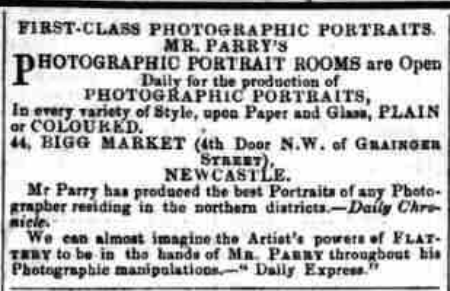
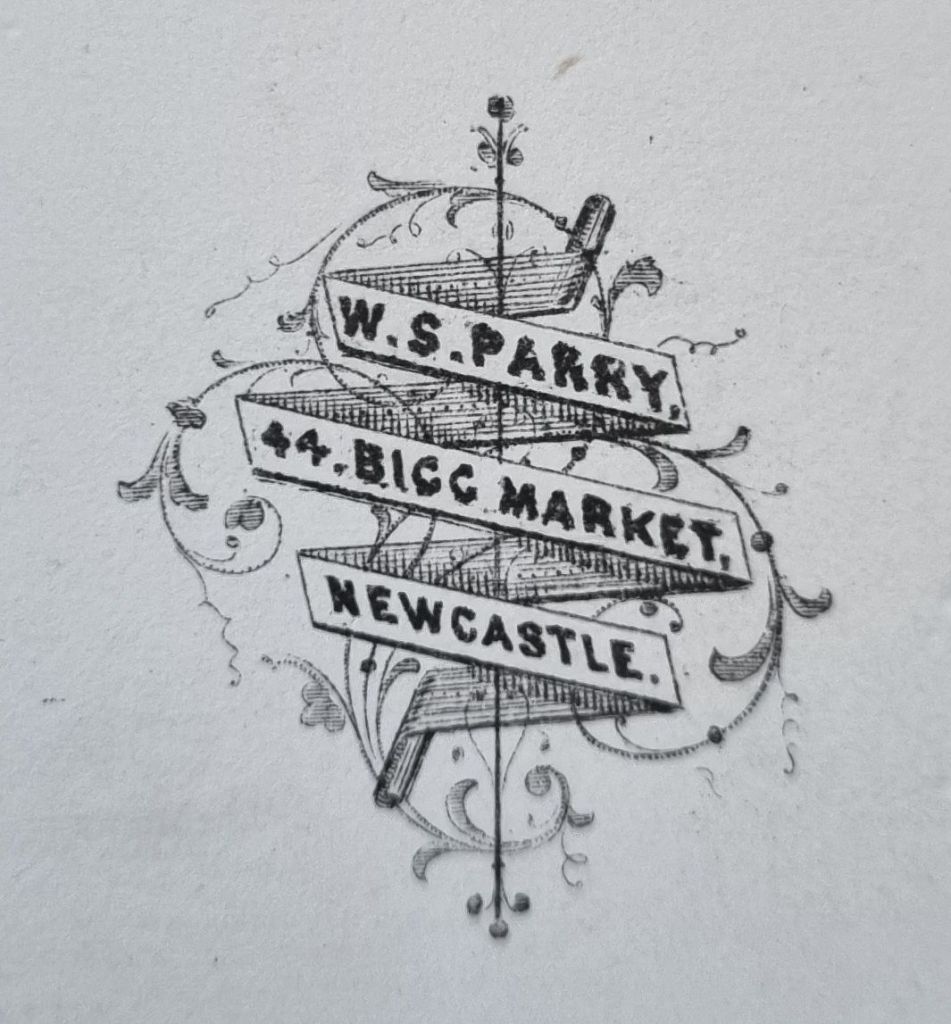
Three years later, the Parry’s business relocated to 44 Bigg Market (‘4th door N.W. of Grainger Street’) and glowing reviews from the national press helped promote its wares.
Advert from North & South Shields Gazette, 15th July 1858. From British Newspaper Archive.
The new fashion of carte de visite portraits attracted a wide variety of clients and offered an affordable opportunity to dress up and look your best.
Then in March 1864 with business evidently booming, an opportunity arose to relocate to the more prestigious surroundings of Eldon Square a few doors down from W. & D. Downey.
According to a notice placed in the Newcastle Courant, no. 17, described as an ‘eligible freehold dwelling house with Coach House and Stable,’ was ‘to be sold by auction.’
Advertisement from Newcastle Courant, 14th March 1864. From British Newspaper Archive.
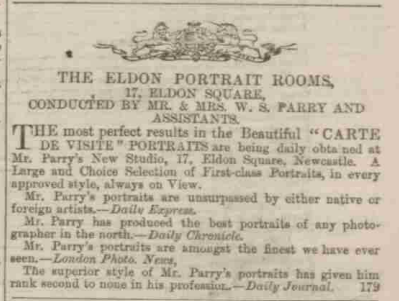
Within a few months, ‘The Eldon Portrait Rooms, 17 Eldon Square, Conducted by Mr. & Mrs. W. S. Parry and Assistants’ were open for business.
Advert from Newcastle Daily Journal, 20th July 1864. From British Newspaper Archive.
The Parry’s arrival cemented Eldon Square’s status as a place to go if you were having your photo portrait taken.
The fact that W. & D. Downey at no. 9 were the Parry’s neighbours and photographic competitors was reflected in subtle changes to their business offer.
For instance, when Downey’s offered a new series of stereoscopic views of Newcastle, Parry raided his photographic archive to advertise ‘local views, and others of general interest … taken from eight to sixteen years ago.’
In the drive for valuable custom, both studios placed almost daily front-page adverts in the Newcastle press.
Downey invariably occupied the top of the left-hand column whilst Parry took a prominent position on the right-hand side of the page.
Then, on 11th July 1868, the Newcastle Daily Journal reported the death of Christiana Parry.
In her late 30s, she had died at no. 17 the previous day though no cause of death was given.
It was the latest tragedy to befall the Parry family whose ‘eldest surviving daughter’ Euphemia died in 1862 aged five.
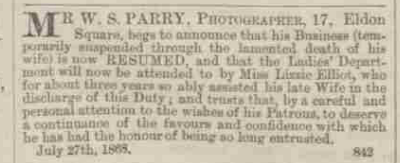
A fortnight after ‘the lamented death of his wife,’ William announced in a press ad that he was resuming business and that the Ladies’ Department would be run by her assistant for the past three years, Miss Lizzie Elliot.
Advert from Newcastle Daily Journal, 24th July 1868. From British Newspaper Archive.
Improvements to the studio in Eldon Square followed.
However, in June 1871, no. 17 was put ‘up for sale’ and William revealed that he would ‘shortly leave for the South.’
The following month, a two-day sale of ‘household furniture and effects’ and ‘the apparatus and working plant of the Photographic Department’ was held at his home.
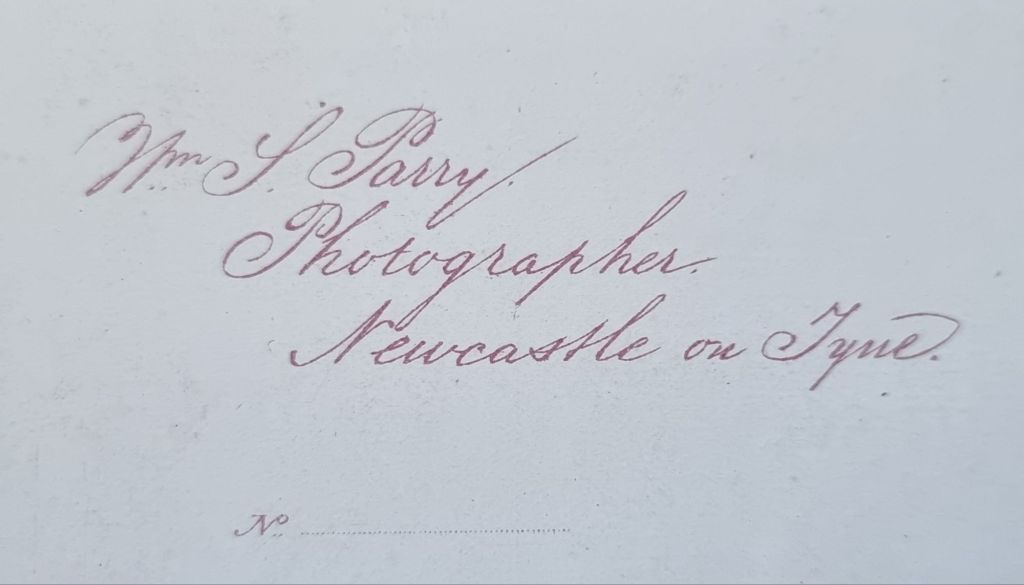
After leaving Newcastle, W.S. Parry ran at least two photography businesses, one in Berkshire during the 1870s and another in Birmingham in the 1880s.
However, by the time of his death in 1915, his reputation as a pioneering photographer was long forgotten.
Even the Newcastle Journal, which celebrated his many photographic achievements during the Eldon Square years, headlined its report of an inquest into his death: ‘Blown Over By The Wind: An Old Man’s Sad Death At Middlesbrough.’
Despite this, William Softley Parry’s work as a pioneering photographer is chronicled in two respected accounts of the medium’s early years.
Notably John Werge’s History of Photography (1890) and, more recently, Roger Taylor’s Impressed By Light: British Photography from Paper Negatives, 1840-1860 (2007).
What they confirm is that W. S. Parry’s Newcastle years were both influential and productive and helped put the city on the map as a centre of photographic innovation.
Next time in the final part of this mini-series, new Pressphotoman research explores if an amateur husband-and-wife photography team were also living in Eldon Square at the turn of the 1860s.
This photograph taken in the 1860s shows its terrace of grand houses designed by architects John Dobson and Thomas Oliver and built by Richard Grainger between 1825 and 1831 (Pevsner and Richmond).
Over the next few weeks, Pressphotoman will shine a spotlight on particular houses, exploring their contribution to photography’s growing popularity during the medium’s early decades.
To launch this mini-series, 9 Eldon Square will be an address familiar to regular readers of this blog as the long-time home of commercial photography firm W. & D. Downey.
For new readers, brothers William and Daniel Downey started in business in their native South Shields around 1856, opening a studio in Newcastle upon Tyne at 111 Northumberland Street in the autumn of 1861.
Within six months, the Downey’s had moved studios again and secured a prime location in Eldon Square, one of the city’s most fashionable addresses.
As the census reveals, its residents were typically medical practitioners, dental surgeons, lawyers and well-connected ladies and gentlemen of means with the necessary domestic staff to maintain such a lifestyle.
Research into how no. 9 became home to W. & D. Downey reveals a tragic tale played out in the columns of the local press.
On 7th June 1861, the Newcastle Courant reported an inquest into the death of Richard Downing Esq., a 63 year-old surgeon dentist.
London-born, he had lived with his ‘landed proprietor’ father in Eldon Square since it was built, first at no. 17, then at no. 9.
Under the headline ‘Distressing Suicide,’ the paper reported how Mr. Downing had been in a depressed state of mind during the previous fortnight.
After going upstairs to his bedroom after dinner, his younger sister Jane “heard something fall heavily in the deceased’s room.
“She entered the apartment, and then saw Mr. Downing laying on his back with a deep and large gash in his throat and in a state of insensibility.”
A servant was despatched to bring Dr. De May, “the family medical man,” who lived at no. 15, accompanied by Dr. Heath.
The newspaper account continued: “The deceased was unhappily beyond the reach of medical skill, and within five or six minutes after the arrival of the professional gentleman he expired.”
The nature of Downing’s depression was not disclosed, but he had ended a business partnership with his father and brother in March 1860, and the following month, 9 Eldon Square was put up for ‘sale by auction.’
A year later though, as recorded by the 1861 census, Richard Downing, his sister Jane and a house servant and maid servant were still in residence.
Following Downing’s death, efforts to put his affairs in order moved at speed.
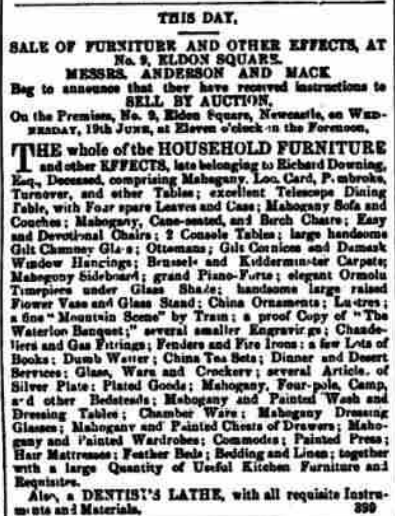
Within a fortnight, an auction of his ‘household furniture and other effects’ took place at no. 9.
Ad for sale of ‘household furniture and effects’ at 9 Eldon Square. Daily Chronicle, 19th June 1861. From British Newspaper Archive.
By August, the house was again on the property market, this time ‘to be let and entered upon immediately,’ suggesting no. 9 was empty and that Downing’s sister and domestic staff had moved out.
Ad from Newcastle Daily Journal, 19th August 1861. From British Newspaper Archive.
Described as a ‘desirable dwelling house’ complete with Coach House, the same ad appeared regularly in the local press for several months.
Attempts to find a suitable tenant may have been hampered in part by the property’s association with Mr. Downing’s death.
Eventually in March 1862, Downey’s used one of its regular ads in the Newcastle papers to announce that no. 9 had new occupants.
Newcastle Daily Journal, 1st March 1862. From British Newspaper Archive.
From a commercial point of view, the timing could not have been better.
Two months earlier, Downey’s had taken a series of photographs in the aftermath of the Hartley Pit Disaster, 15 miles away, which claimed the lives of more than 200 men and boys.
Using its entrepreneurial instincts, the company sent copies to Queen Victoria, enabling it to re-brand its products with a new logo advertising both its royal patronage and new Newcastle address.
The move signalled the start of a highly successful chapter in the history of W. & D. Downey and 9 Eldon Square became a go-to destination for those in the region and beyond wanting a photographic portrait in the latest style.
In the next blogpost in this mini-series, a rival commercial photographer moves into Eldon Square, signalling a battle for customers that lasted into the 1870s.
An illustrated talk that I presented recently for the Royal Photographic Society’s Historical Group set me thinking about one image in particular.
The subject of the talk was the photography firm of W. & D. Downey and its first decade in the North-East of England in the 1850s and 1860s.
Downey’s celebrated image of Alexandra as Princess of Wales carrying her daughter Louise on her back featured in an earlier post (2nd December 2022).
In the past year, I’ve started collecting Downey carte-de-visites. Such was their ubiquity that many thousands are still in circulation.
The carte-de-visite format appeared in the late-1850s and immediately proved popular with the public.
Aside from its affordability, a carte-de-visite by design nestles conveniently in the palm of your hand
As the talk took place at Newcastle Cathedral, I was pleased to track down a card that featured the building’s distinctive ‘lantern tower’ and then included it in my presentation.
Confusingly though, at some point in its life, an unknown hand has written ‘St Peters’ in pencil on the front of the card, a point that members of my North-East audience were quick to point out.
In fact, the cathedral’s patron saint is St. Nicholas and not St. Peter.
However, that’s not the only aspect of the photograph that prompted a little head scratching.
When you turn the card over (to its ‘verso’), it lists ‘W. & D. Downey. Photographers’ as being based at ‘4 Eldon Square, Newcastle on Tyne.’
As proclaimed in regular adverts for its wares in the local press, the company’s studio in the city from 1862 to the late 1880s was at 9 Eldon Square rather than at number 4.
What then might be the explanation for this apparent anomaly?
Eldon Square, a group of impressive townhouses created by the eminent architect John Dobson between 1825 and 1831, became one of the most fashionable addresses in Newcastle by the mid-19th century.
Public records reveal that 4 Eldon Square was home to one ‘Thomas Humble MD,’ a physician who features in both the 1861 and 1871 censuses for that address.
According to a notice he placed in the Newcastle Courant (1st March 1867), Dr. Humble served the Newcastle Dispensary, a medical charity treating the city’s poor and destitute, for nearly 38 years. He was resigning the position, he said, due to his ‘increasing engagements.’
Given this background, is it possible that he needed to let out rooms to his photographer neighbour to earn additional income?
Downey’s photographic business was certainly booming and extra capacity to accommodate its growing clientele may well have been welcome, if only on a temporary basis.
This scenario is partly supported by other information on the card’s verso.
It lists ‘illustrious and eminent persons’ the firm had photographed including Her Majesty Queen Victoria.
This dates the card’s likely production to late 1866/early 1867 by which point Downey had recently photographed the Queen at Balmoral for the first time.
On the other hand, human error might have been responsible.
Simply put, a batch of carte-de-visite produced for Downey were printed with the wrong address featuring number 4 rather than number 9 Eldon Square.
Despite this error, they were used anyway and sold to a public whose main interest lay in a carte-de-visite photograph rather than its ‘advert’ verso.
There is one remaining possibility though and one that needs to be considered by collectors of all kinds of objects.
That the card is a fake.
If so, it’s a very convincing one.
The faker has even gone to the trouble of attaching a sales sticker for Allan, a bookseller, stationer and news agent in 1860s Newcastle, known to have been one of Downey’s sales outlets.















 Pressphotoman
Leave a comment