
The daguerreotype, the earliest commercial photographic process, was announced in 1839 by Louis Jacques Mandé Daguerre.
His discovery allowed for the production of a one-off positive image on a polished silver surface.
Perhaps unsurprisingly, surviving examples are highly prized by collectors and institutions.
Knowing of my interest in early photography in North East England, Dr. Michael Pritchard, fellow member of the Royal Photographic Society Historical Group, recently alerted me to an interesting auction.
Amongst hundreds of miscellaneous items were two daguerreotypes produced in Newcastle on Tyne featuring ‘a gentleman in formal dress’ and ‘a young female.’
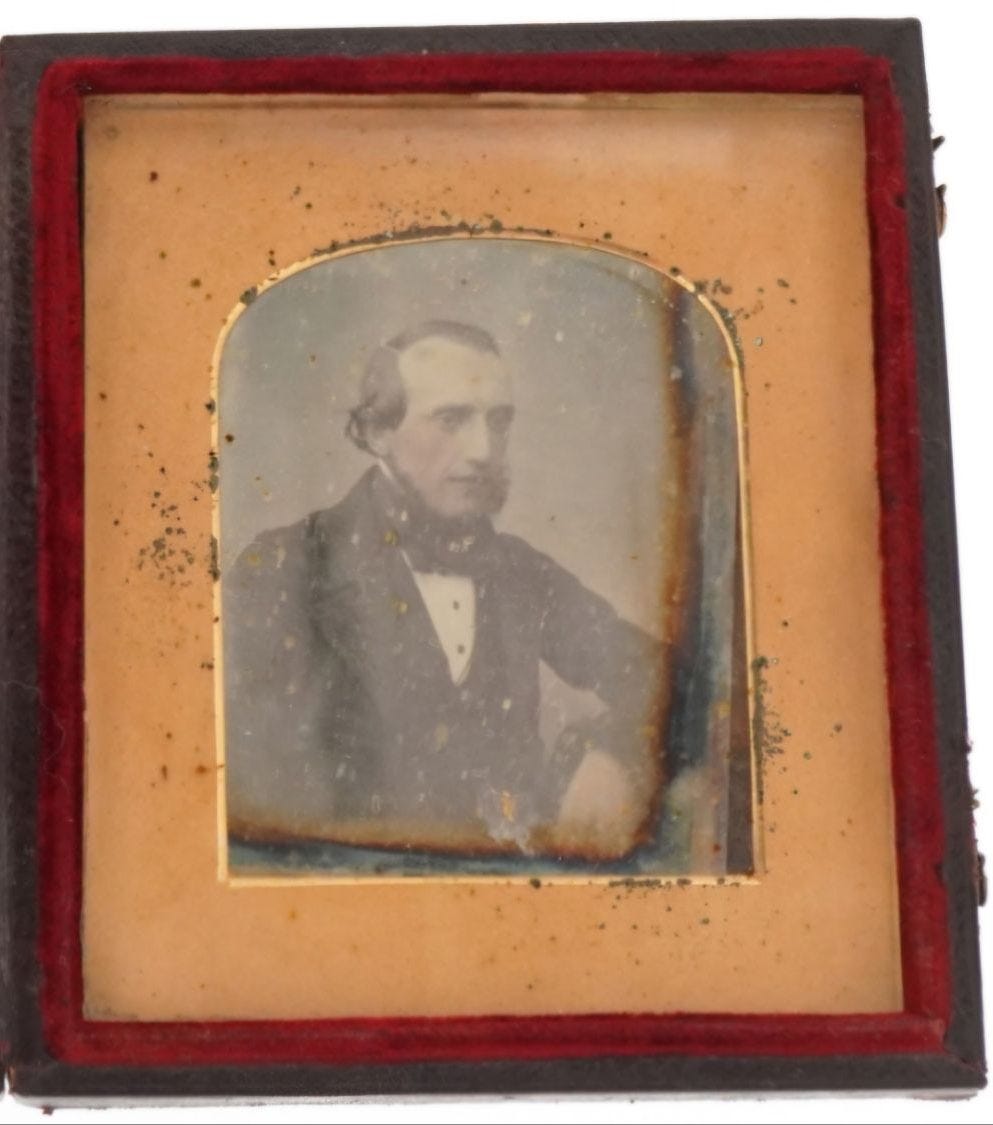
© Eastbourne Auctions
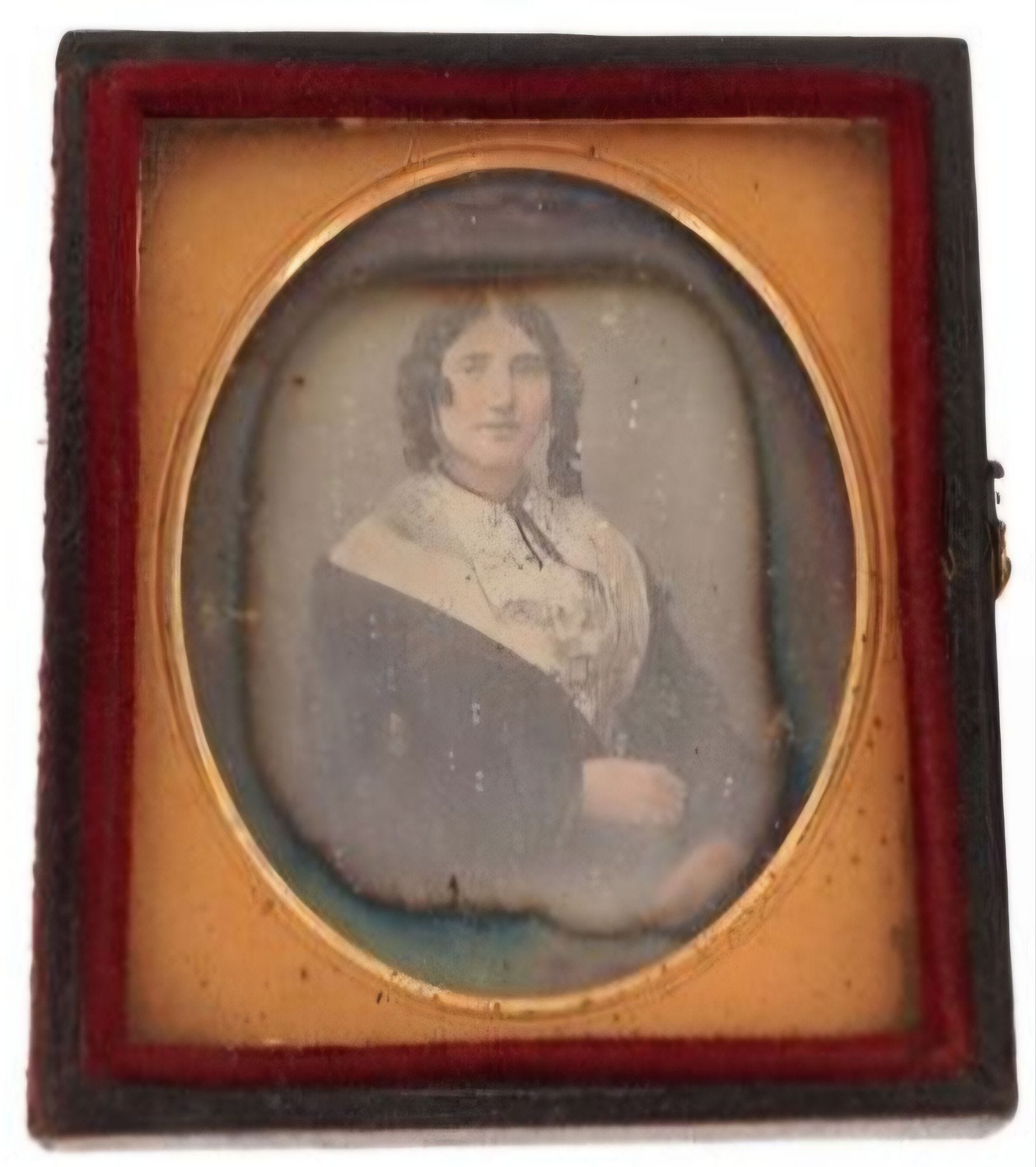
Both images were presented in velvet-lined presentation cases fastened by clasps.
Both objects also offered valuable clues about their provenance that reveal a fascinating glimpse into Newcastle’s photographic past.
On the verso of the gentleman’s daguerreotype (9cms x 8 cms) was embossed ‘Portrait Rooms, 35 Grainger Street, Newcastle on Tyne’ in gold lettering.
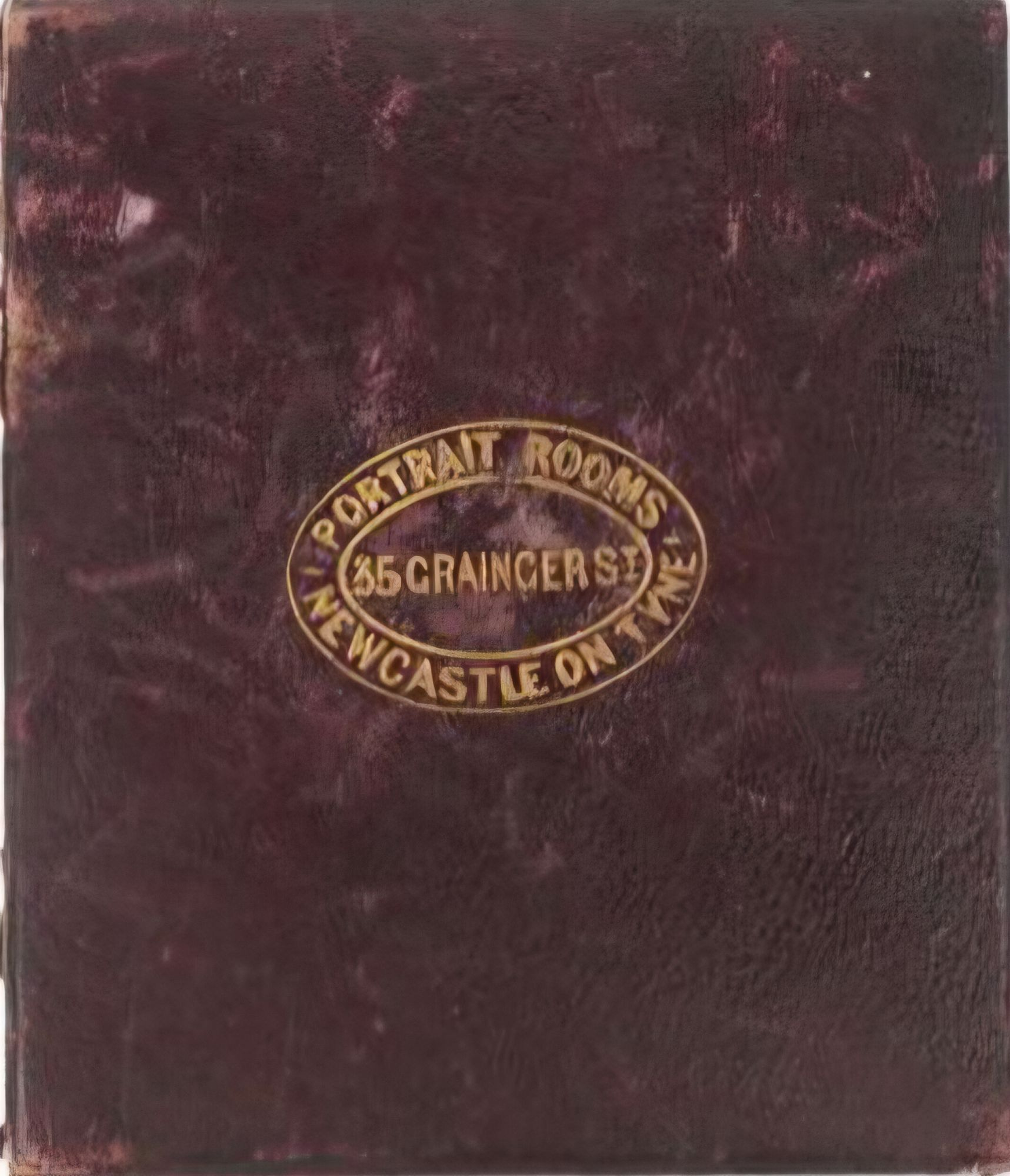
This was a significant address in the city’s photographic history at the very heart of Victorian Newcastle.
Named after Richard Grainger whose buildings and street lay-out transformed the then town, Grainger Street linked its Central railway station with Grey’s Monument.
The Portrait Rooms at number 35 were located close to the 134-feet tall monument that still stands today.
An advertisement from the Newcastle Journal (25th May 1850) provides more information about what photographic services were on offer to customers.
“Photographic Portraits In Colours. Taken Daily from Ten till Four,” it stated and went on: “The Public are respectfully invited to inspect the Specimens and compare them with those taken a few years ago. Specimen Room upstairs.”
In fact, the premises at number 35 were shared with other businesses and situated within a building referred to as ‘Mr. Cameron’s.’
At this point, according to the Newcastle Journal (8th November 1850), the building also housed Monsieur Meyer’s Magasin Francais offering “new importations of Parisien novelties in the Cloak, Dress and Millinery departments.”
The man responsible for the Portrait Rooms was a daguerreotypist named George Brown whose adverts appeared regularly in the Newcastle press from 1849 and during the first half of the 1850s.
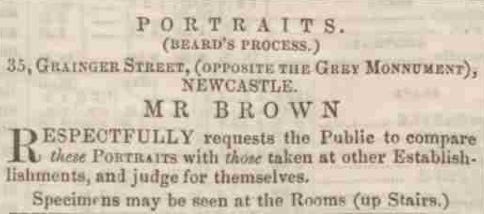
The reference in his ads to ‘Beard’s Process’ related to the fact that Brown had worked in London as an ‘operator’ for the entrepreneur and photographer Richard Beard (1801-1885).
It was Beard who had purchased the sole patent rights of the daguerreotype process for England and Wales.
He then set up the world’s first photographic studio on the roof of London’s Royal Polytechnic Institution in 1841, and issued licenses to interested parties.
However, research has shown that not all early daguerreotypists actually possessed a licence including many on Tyneside.
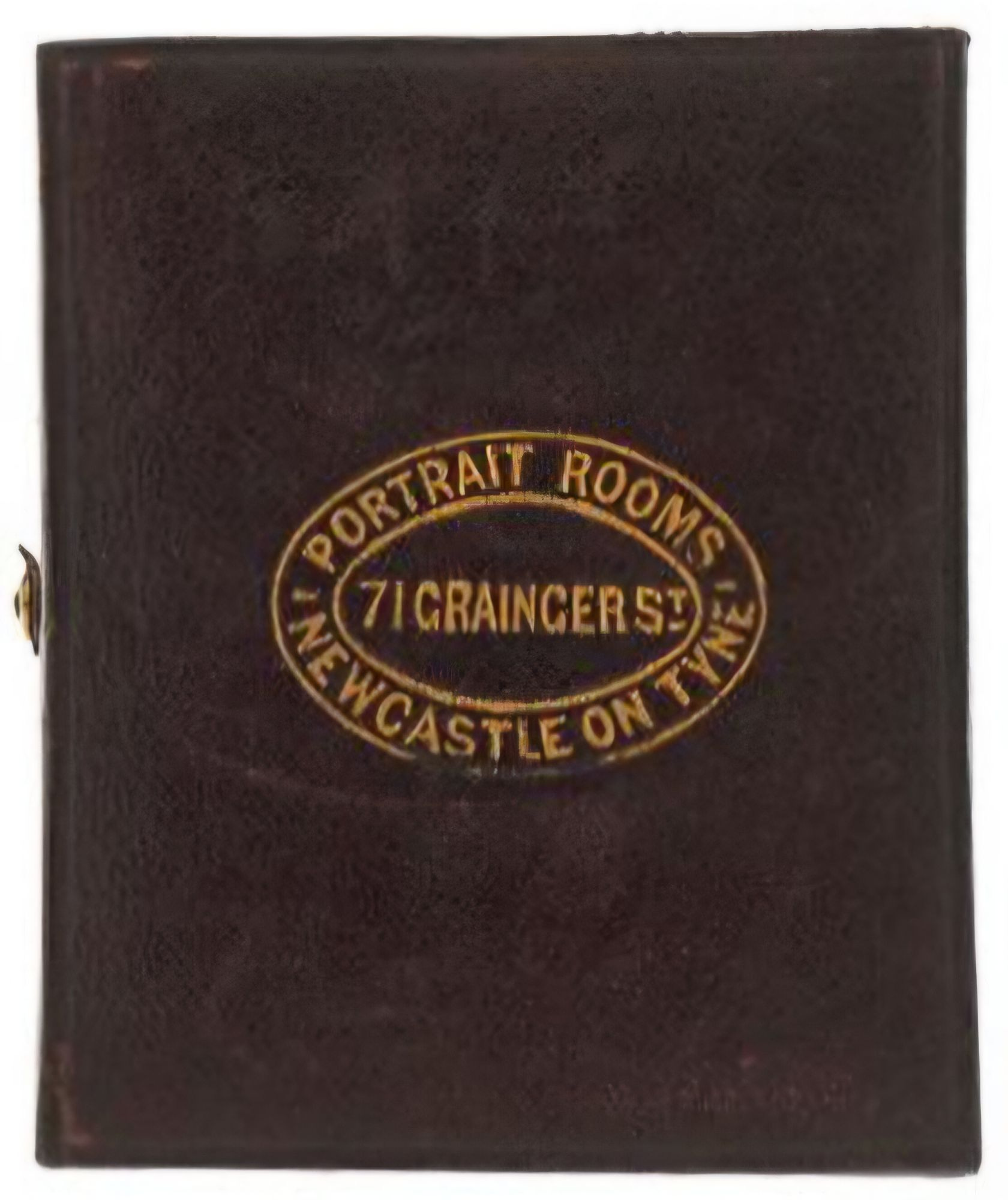
As revealed on its verso, the Newcastle daguerreotype of ‘a young female’ (7cms x 6 cms) can be dated to the mid-1850s by which time Brown’s Portraits Rooms had relocated to 69 and then 71 Grainger Street.
By March 1856, Brown was described as being “late of 71 Grainger Street” and that he was opening new premises at “39 Market Street, next door to Mr. Wilson’s Boot Shop.”
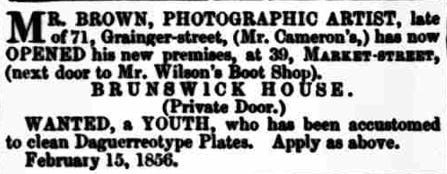
However, the daguerreotype era was passing.
By the end of the 1850s, 39 Market Street had become a calotype studio offering customers the promise of multiple copies of their portraits taken from the same negative in the form of cartes de visite.
Knowledge about this formative period in Newcastle’s photographic history is further enhanced by a memoir published in 1890 titled The Evolution of Photography.
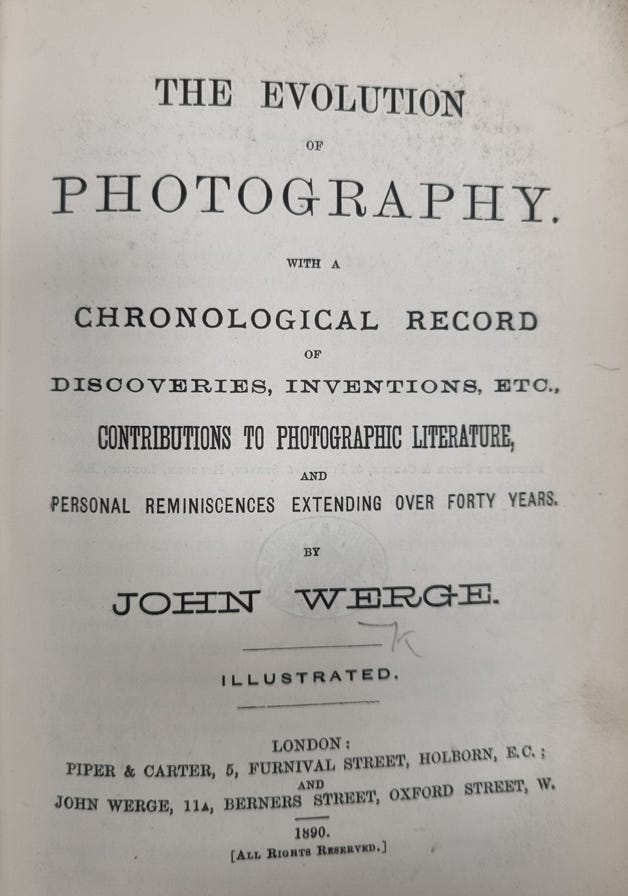
Its author was Newcastle-born John Werge (1825-1911), an apprentice engraver from his teens, who fell in love with the daguerreotype process and harboured ambitions to open his own photographic business.
Noticing that George Brown was operating as a daguerreotypist in the town, his memoir records: “I engaged myself to assist him for six months at a small salary.”
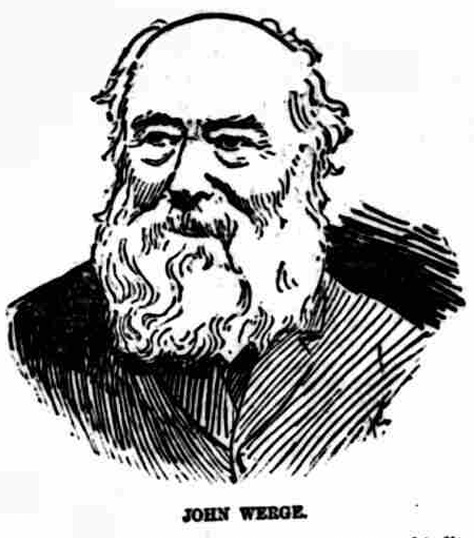
Werge dates this period of apprenticeship with Brown at his 35 Grainger Street Portrait Rooms to 1849 and 1850 after which he set up on his own as a daguerreotypist in neighbouring Hexham.
This timeline raises the tantalising possibility that both George Brown and John Werge may have been involved in creating the daguerreotype of ‘a gentleman in formal dress.’
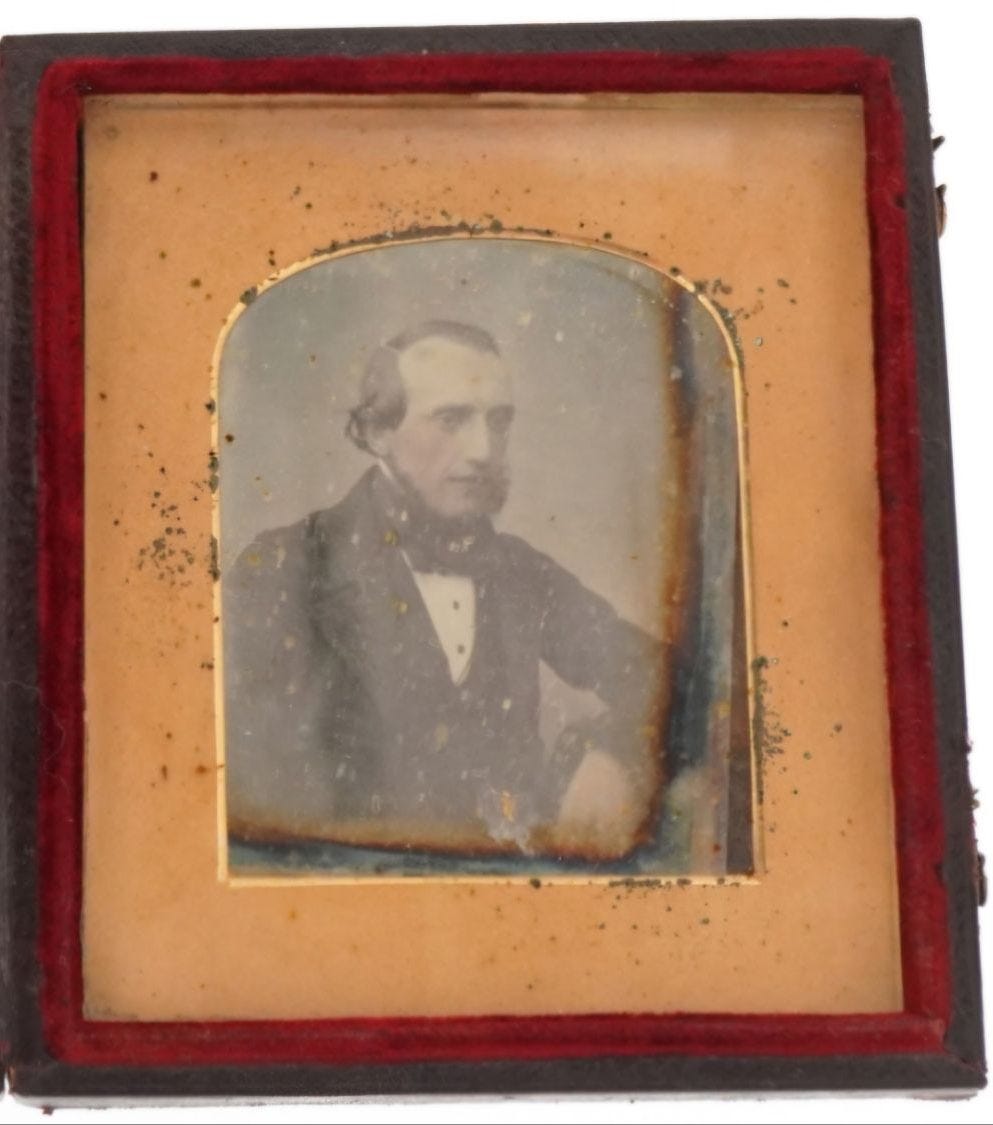
Research into the identity of both the ‘gentlemen in formal dress’ and ‘a young female’ continues.
 Pressphotoman
Leave a comment