
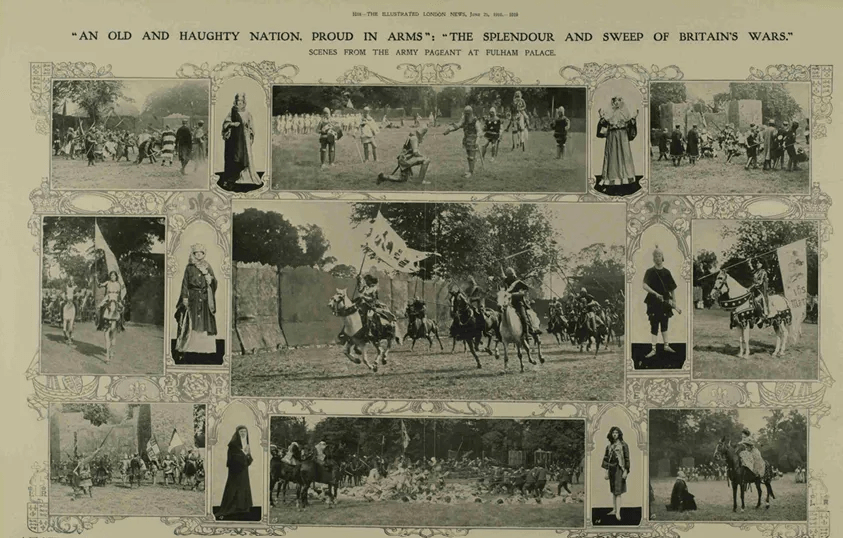
The Army Pageant staged during the summer of 1910 in the grounds of Fulham Palace, London was by all accounts quite a spectacle.

From British Newspaper Archive.
It featured around 5,000 performers and was witnessed by an estimated 100,000 spectators during its 21-performance run, according to The Times.
The Historical Pageants in Britain website describes what pulled in the crowds as “a disparate selection of episodes that illustrated the development of military conflict and the British armed forces.”
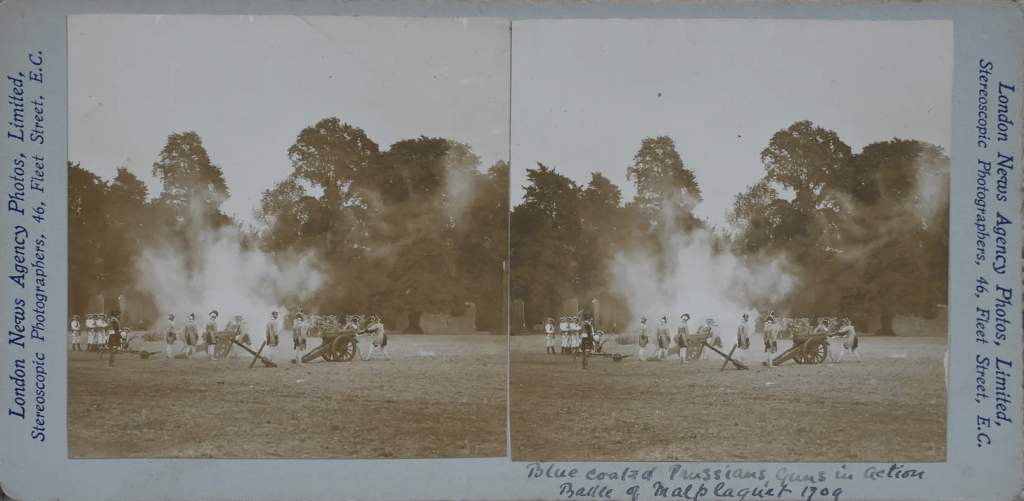
Among the press photographers on hand to record the action was James Edward Ellam (1857-1920), whose stereoscopic camera recorded various scenes for London News Agency Photos based in Fleet Street.
The Fulham and District organiser for the Army Pageant was Stanley Cave, a gentlemen’s outfitter with a shop at 815 Fulham Road, SW.
Interviewed earlier that year by the Fulham Chronicle, he explained that an estimated 600 local residents of all ages would be needed to stage its allocated Elizabethan episode.
As to costumes, they could be designed, cut and, if necessary, made to order under the supervision of Miss Lorna Burn-Murdoch, Mistress of the Robes.
Mr Cave went on to tell the paper: “The cost of the costumes will have to be borne by the players, who can spend practically what they like on them, from a few shillings to a few pounds.
He continued: “They will, of course, be the property of the wearers once the Pageant is over, and will serve as costumes for fancy dress balls and skating carnivals and will also be an interesting souvenir of the event.”
Press reports confirm that Mr. Cave took part in the Elizabethan episode of the pageant as one of the “Courtiers (mounted).”
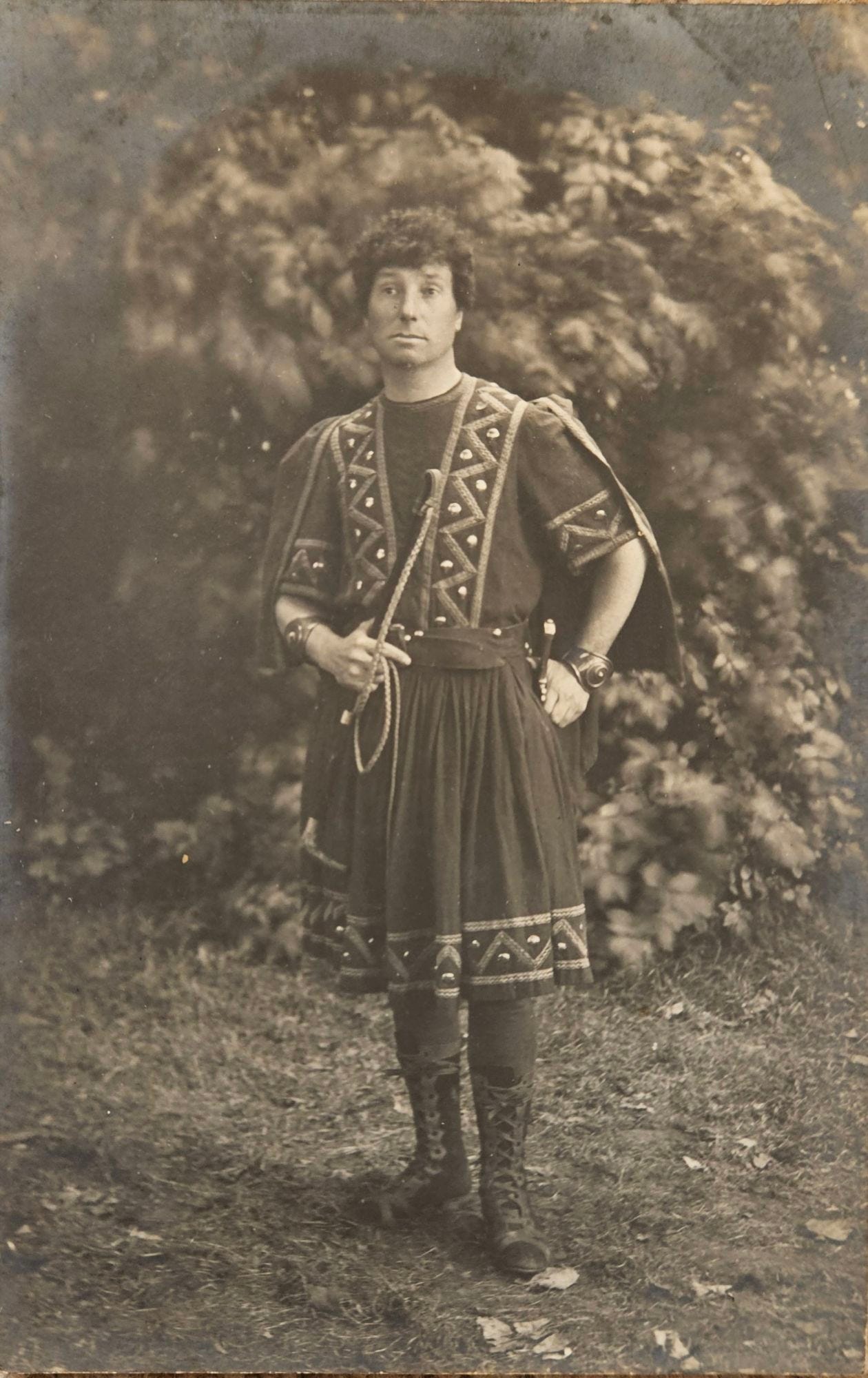
However, a photographic postcard that recently joined the Pressphotoman collection suggests that his horse-riding skills may have led to another role too.
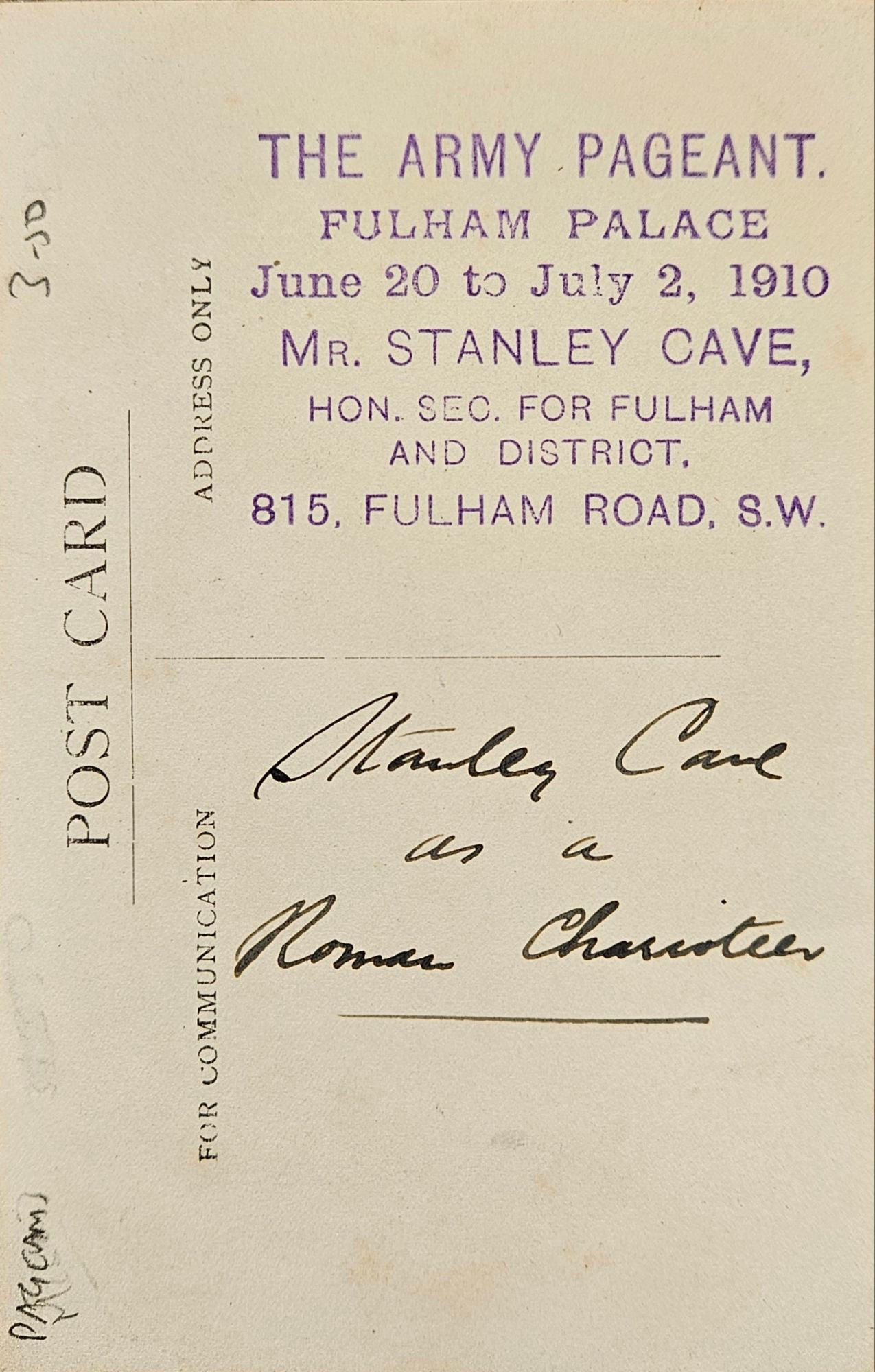
The card’s verso is marked ‘Stanley Cave as a Roman Charioteer’ in an unknown hand alongside a stamp recording his role in helping organise the event.
Aside from Mr. Cave’s splendid outfit, the photographer also captured his visibly distracted expression, which I initially put down to the pressures of helping organise such a huge undertaking.
However, a press report, again taken from the Fulham Chronicle, revealed how a few weeks earlier, Stanley Cave had suffered a family tragedy.
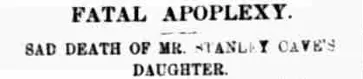
An inquest heard how his ten year-old daughter Ellen had died from a cerebral haemorrhage whilst she slept.
A week later, the paper reported on her funeral “amidst many manifestations of grief and sympathy.”
In the years that followed, members of the Cave family took an active part in many more pageants staged in Fulham raising money for local charities.
When Mr. Cave’s youngest daughter Mary married in 1931, the Fulham Chronicle described how she had taken the role of Anne Boleyn on several occasions playing opposite her father’s Henry VIII.

 Pressphotoman
Leave a comment