
The name Bassett-Lowke will be familiar to model and miniature railway enthusiasts in Britain and around the world.
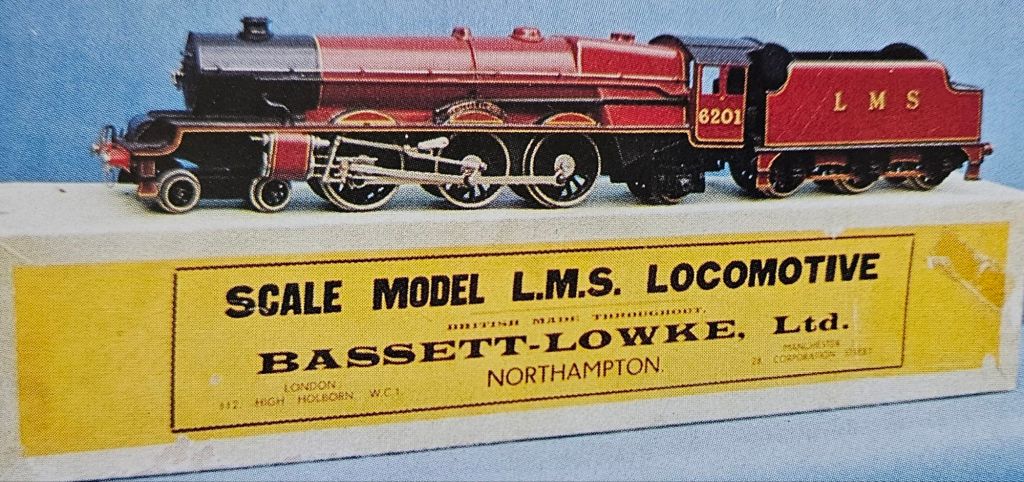
The company co-founded in the late-1890s by Wenman Joseph Bassett-Lowke (1877-1953) became a by-word for its high-quality products.
Today they’re revered by collectors and enthusiasts.
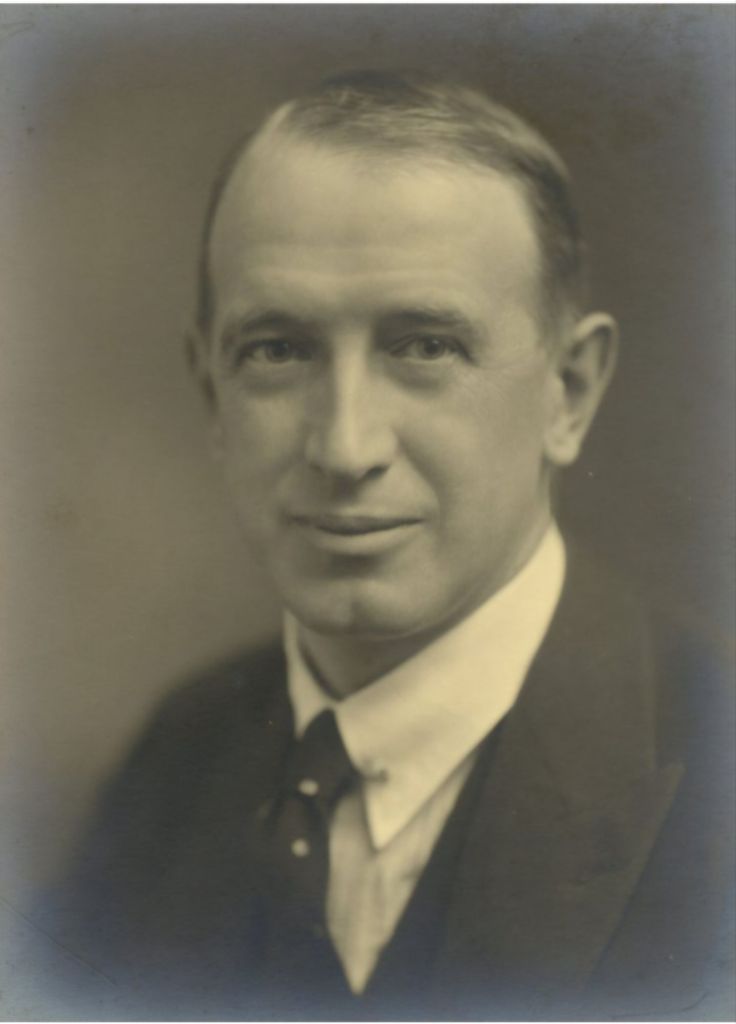
However, I knew nothing of any of this when I came across ‘WJ Bassett-Lowke, Northampton’ stamped on a series of stereocards during a recent eBay trawl.
Curious to learn more, my initial research revealed that ‘WJ’ was an accomplished photographer from his teens.
Delving further into his life story, a fascinating biography published in 1999 by his niece Janet included one sentence on page 35 that stood out.
“Photographs were even taken by WJ in stereograph (3D),” she wrote.
Thanks to a helpful American eBayer, who was selling a large collection of WJ Bassett-Lowke stereocards bought at auction in England, I was able to purchase a dozen dated between 1900 and 1904.
In a short Pressphotoman series over coming weeks, I’ll explore what these cards add to the established narrative about their creator.
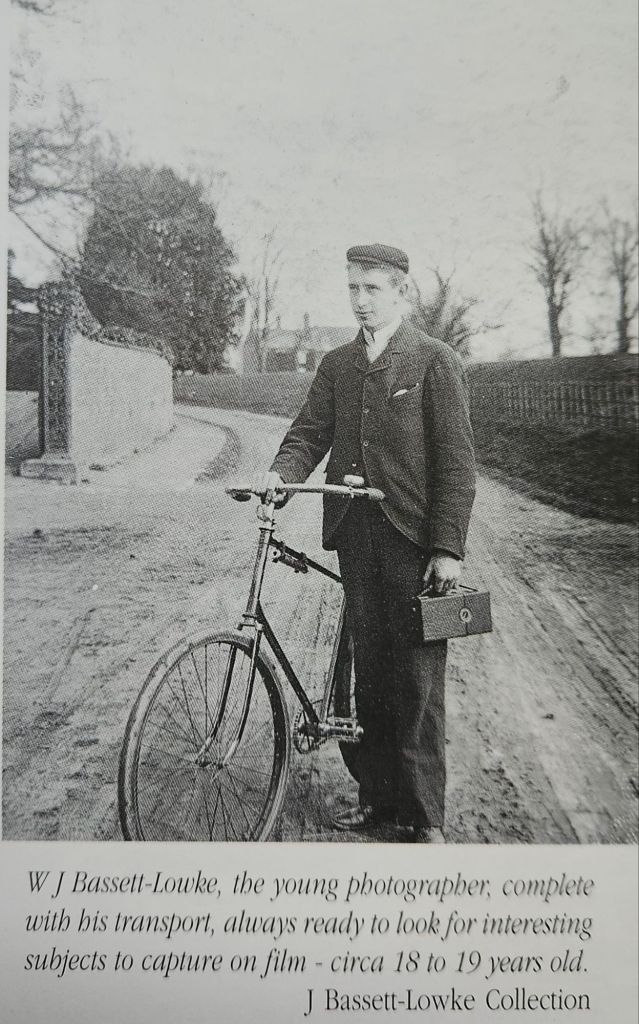
(Rail Romances, Chester, 1999).
By the time the photograph above was taken, ‘WJ’ was in thrall to photography.
His father ran a firm of engineers, boilermakers, and iron and brass founders in Northampton.
In one of its outbuildings, WJ had the run of a photographic dark room.
As well as an enthusiasm for model engineering and cycling, he shared a passion for photography with his father’s bookkeeper, HFR (Harry Foldar Robert) Franklin.
By 1899, the pair had set up a business making parts for small model engines that grew into the much-loved Bassett-Lowke company.
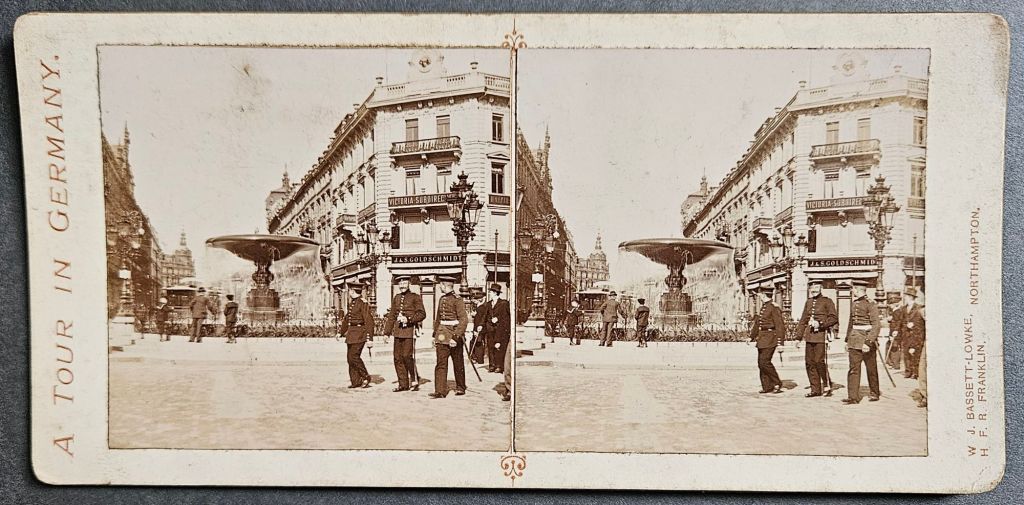
The following Spring, they undertook ‘A Tour in Germany’ that may have had a model engine purpose.
The earliest two stereocards I bought are dated ‘April 1900’ on the verso and feature both their names on the front of the cards.

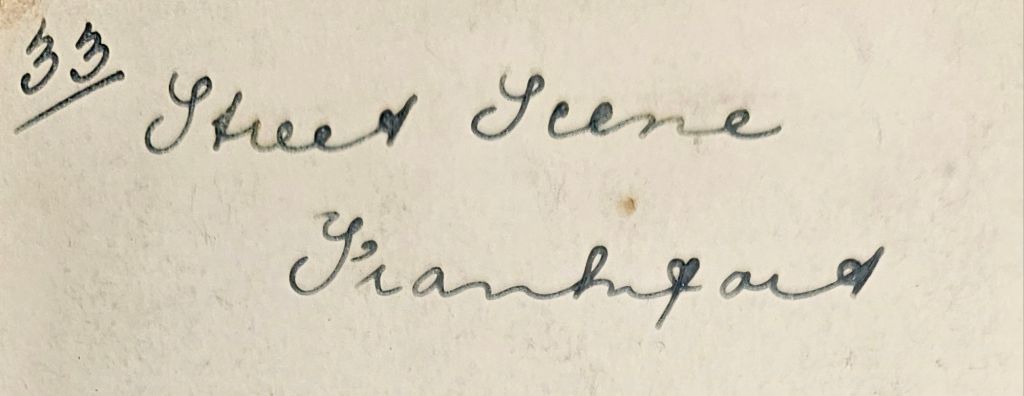
The first card, numbered ’33’ on the verso, suggesting it came from a series of views, features a street scene in Frankfurt.
The second numbered ’34’ portrays the famous Hauptmarkt in Nuremberg, which looks spectacular in 3D.
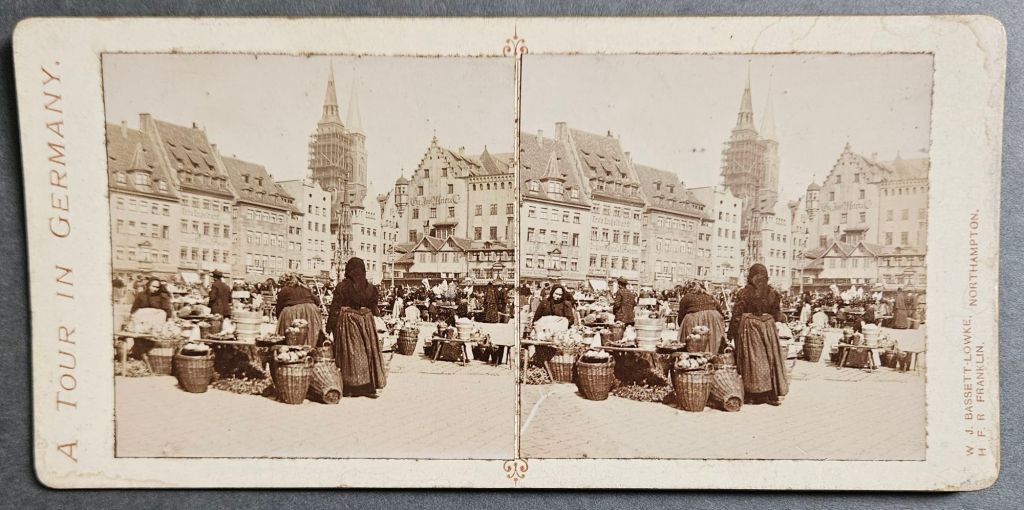
It is a scene recognisable today because of the twin towers of the medieval St. Sebaldus Church, here seen partly shrouded in scaffolding.
The church was extensively damaged during the Second World War and has since been restored, so WJ’s stereo has added historical value.
This Germany tour is not mentioned in Janet Bassett-Lowke’s biography of her uncle.
But she does highlight his attendance three months later at the 1900 Paris Exposition as “the most momentous decision in WJ’s life.”
It was while in Paris, she recounts, that he was impressed by the sheer quality of the mechanical toys and continental scale models displayed by German companies.
Nuremberg in particular was widely acknowledged as a centre of excellence for manufacturing model locomotives.
Could it be then that the tour of Germany including Nuremberg was a precursor to what happened in Paris when key business connections were made by WJ and Harry Franklin’s fledgling company?
In my next Pressphotoman post, I’ll explore a number of scenes from the 1900 Paris Exposition as captured by WJ’s 3D camera.
 Pressphotoman
Leave a comment