
The recently-released film Conclave about the election of a new Pope is being touted as an Oscar contender.
This is largely because of the central performance by Ralph Fiennes for his portrayal of a “deeply-troubled Cardinal … at the centre of a murky Vatican plot” (Peter Bradshaw, The Guardian).
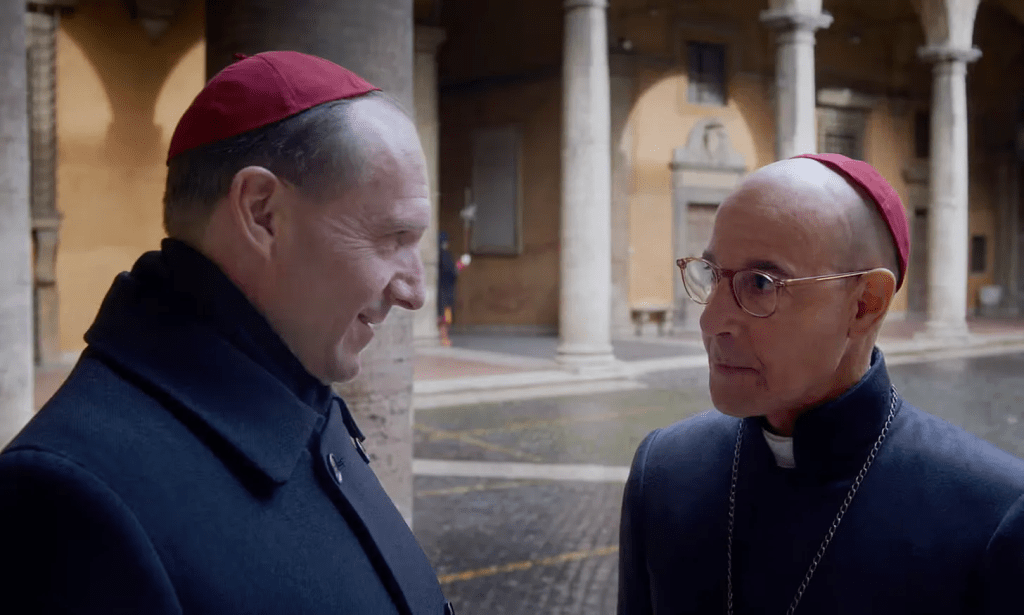
The film is the latest Papal subject to attract media attention and also that of this blog.
Last September’s Asia-Pacific tour by Pope Francis prompted a Pressphotoman post about a series of 3D stereoscopic portraits featuring one of his predecessors.
In an echo of the plot of Conclave, the stereos were published in 1904 following the election of Pope Pius X.
Given access to the Vatican, the leading stereoscopic company Underwood & Underwood produced a 36-card set titled A Pilgrimage to see the Holy Father through the Stereoscope.
The Underwood stereographer responsible was James Edward Ellam (1857-1920) whose career as a photojournalist is the subject of ongoing research by this blog.
A recent Pressphotoman acquisition adds another dimension to how these 3D images of Pius X were circulated in various formats and helped form the new Pope’s public image.
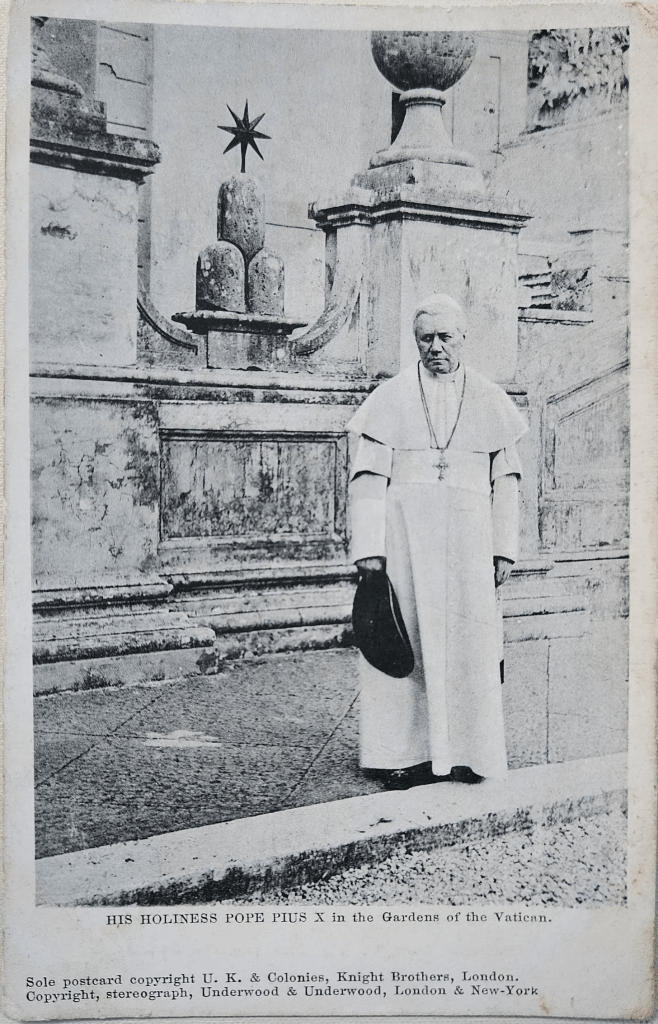
Titled “His Holiness Pope Pius X in the Gardens of the Vatican,” the credits on this picture postcard confirm that the image was taken from U&U’s original stereograph.
The ‘sole postcard copyright’ holder for the ‘U.K. & Colonies’ was identified as Knight Brothers of London.
They were certainly in the market for images to publish and sell to a worldwide audience.
The company was formed in 1904 by Watson and George Knight, who had previously worked for another London postcard publisher.
E. Wrench Ltd., launched by teenager John Evelyn Wrench, boomed spectacularly from 1900 as the picture postcard craze took hold.
But by 1906, the firm had crashed and burned amid financial difficulties.
Knight Brothers registered their trademark ‘knight’ in August 1905.
The number ‘1446’ on this postcard indicates that it may have been one of a series of Papal portraits secured from Underwood & Underwood.

Another point of note is that the card was ‘printed in Saxony’ which Wrench had first identified as home to a ‘veritable hotbed of good printers’ (Anthony Byatt, Picture Postcards and their Publishers, 1978).
Like Wrench before them though, Knight Brothers enjoyed short-lived success.
It became a limited company in 1906, but within a couple of years had ceased trading.


 Pressphotoman
Leave a comment