
Paul Frecker’s recently published book Cartomania: Photography & Celebrity in the Nineteenth Century (September Publishing) is a veritable feast for collectors of cartes de visite.
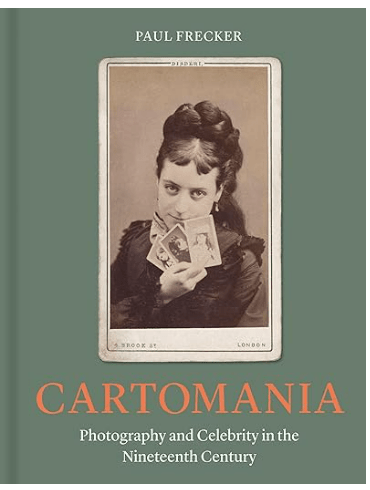
(September Publishing (2024), £40).
It’s the culmination of more than two decades working as a specialist photography dealer.
In particular, it showcases Paul’s collection of the palm-of-the-hand-sized cards that reached peak popularity during the 1860s.
More modest in size, my own collection started amid ongoing research into the photography firm of W. & D. Downey of South Shields, Newcastle on Tyne and later London.
The company’s story, achievements and several examples of their cartes feature in Paul’s book, which I’m thoroughly enjoying reading.
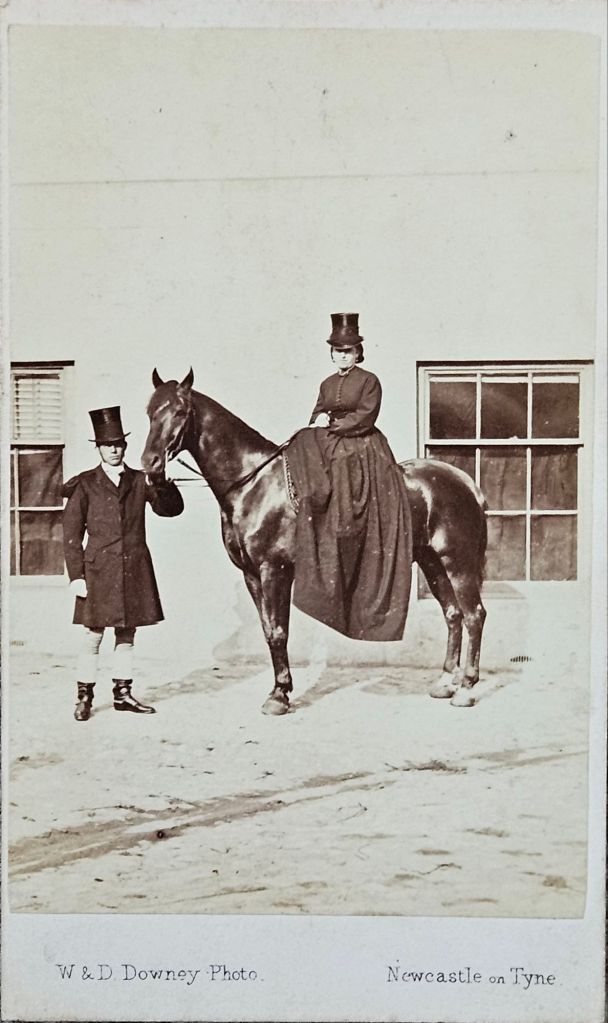
One early Downey carte that I obtained several months ago via a well-known auction site continues to intrigue me.
It features a woman in full riding habit and hat sat side-saddle on her horse with a smartly-dressed groom in attendance.
© Author’s collection.
This striking example of the carte format prompted questions in my mind as to who it featured and when and where the photograph was taken.
Looking for clues, what appear to be footprints in the snow in the foreground suggest a winter’s day.
Shadows are cast onto the building in the background.
The low sun has also brought to life the horse’s coat, indicating that its groom had worked extra hard to prepare his charge for the camera.
As to who the carte features and when and where the photograph was taken, further research produced a helpful press report.
In May 1861 under the headline “The Photographic Art,” the North & South Shields Gazette printed an article about Downey’s activities.


It described how “the Messrs Downey” had just added “a series of local portraits” to “their photographs of illustrious men and legislators.”
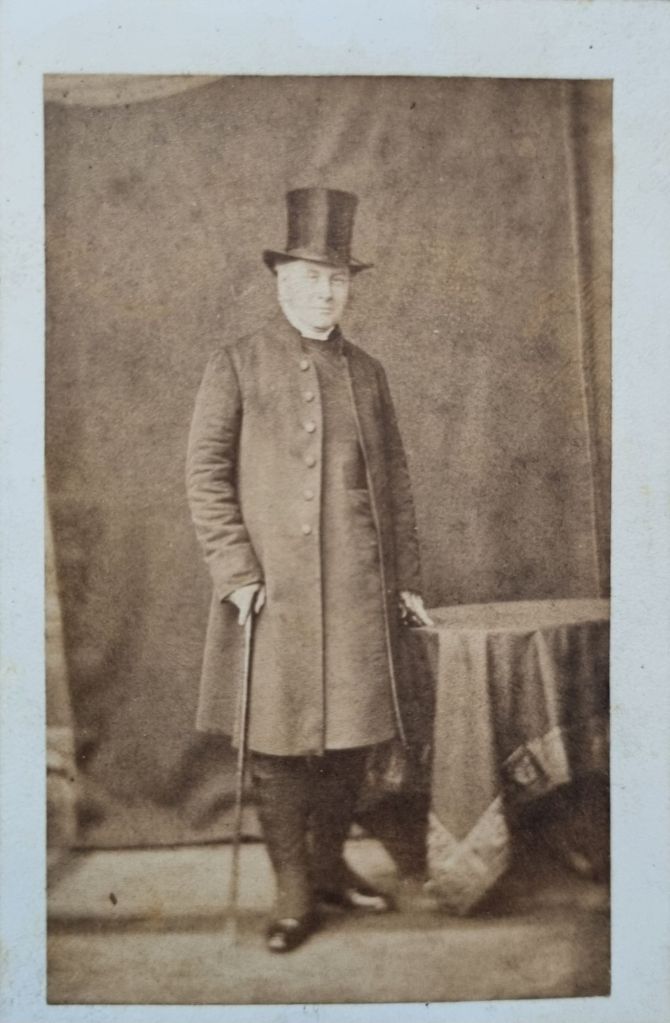
Among those “local portraits” were the Lord Bishop of Durham, Henry Montagu Villiers, and his family, who had “honoured them [Downey] with sittings at Auckland Castle.”
A previous Pressphotoman post (1st July 2024) revealed that the photoshoot for the carte below featuring the Lord Bishop of Durham took place in late-1860.
©️ Author’s collection.
Among other “local portraits’ credited to Downey were several featuring Sir Edward Blackett and his family “taken at Matfen Hall.”
The Blacketts were a long-established Northumberland family and Matfen Hall near Corbridge, built in the early 1830s, was their stately home.
Today it’s a luxury hotel, spa and golf estate.
But it was the newspaper article’s next sentence that offered a tantalising clue as to the identity of Downey’s woman on horseback.
It continued: “Let us add, as exemplified in the case of one of Sir Edward’s daughters and one of the honourable Misses Villiers [my italics] that the artists have exhibited much felicity in their management of a figure on horseback.”
This information helped narrow the field of likely candidates.
Looking at other sources, the 1861 Census records Sir Edward Blackett in residence at Matfen Hall with his daughters Louisa, Anna Maria and Georgiana Emma, who were all in their twenties.
As to the Villiers family, they were not at Auckland Castle when the census was taken, but at their London residence – 30 Cavendish Place, Marylebone not far from Oxford Street.
It listed the bishop together with his wife Amelia Maria Villiers and three of their daughters.
At the time, Gertrude, Mary and Evelyn Villiers were 17, 14 and 8 respectively though they had an elder sister Amy, who would have been 19.
Given this information, I was pleased to come across a further piece of evidence that points firmly in the direction of a member of the Villiers family being the Downey woman on horseback.
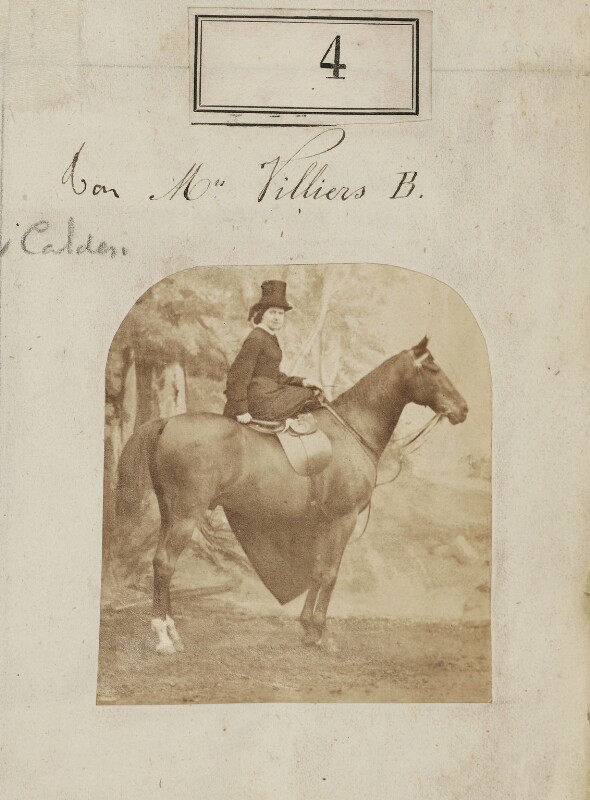
The collection of the National Portrait Gallery, London includes three horseback portraits featuring the ‘Hons. Mrs. Villiers.’
They are all by the celebrated portrait photographer Camille Silvy, who is a significant presence in Paul Frecker’s book Cartomania mentioned at the start of this post.
All three Silvy horseback portraits are dated 1860.
© National Portrait Gallery, London. NPG Ax50004.
Given the physical similarity to the woman on horseback in Downey’s carte, might the ‘Hon. Mrs. Villiers’ (above) be the mother of “one of the honourable Misses Villiers?’

© Author’s collection.
Or, looking more closely at the portrait, does the Downey carte actually feature the ‘Hons. Mrs. Villiers’ herself?
Your thoughts are welcome in the comment box below.
 Pressphotoman
Leave a comment