
Recently, I was wandering around an event billed as an ‘Antiques Fleamarket Fair.’
The catch-all title seemed to offer the possibility of discovering objects of interest to a photohistorian.
What I had not expected to find was a stereocard that is now the oldest object in my collection.
Amongst an array of items on one stall, I spotted the familiar vista of Fingal’s Cave on the Isle of Staffa off the west coast of Scotland.

© Author’s collection.
Free-viewing the card, two tiny figures at the mouth of the cave entrance were clearly visible, one pointing into the darkness beyond.
Turning the card over, the distinctive blue label and the quality of the images confirmed that my initial hunch was correct.
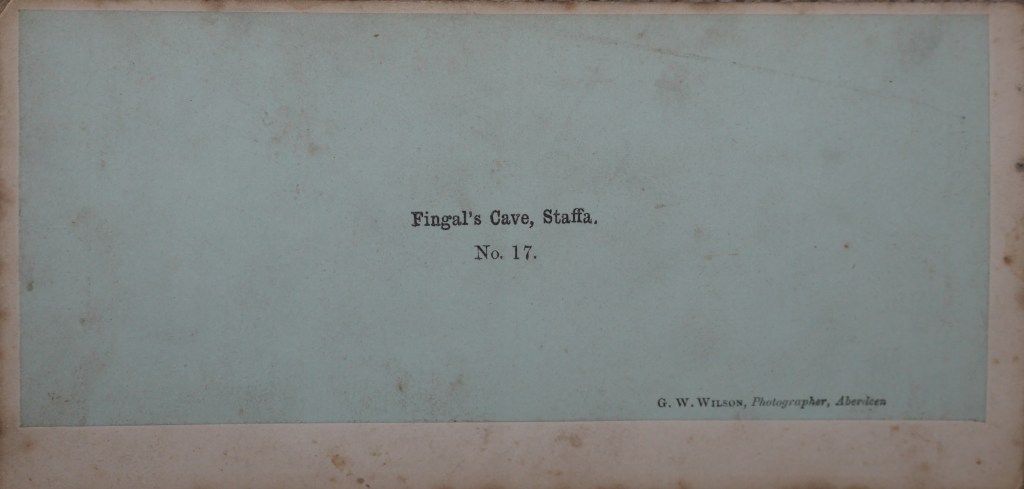
The card was the work of the celebrated stereographer George Washington Wilson of Aberdeen (1823-1893).
What I wasn’t able to confirm until I got home is that the card was as old as I thought it was.
My reference source was Roger Taylor’s George Washington Wilson: Artist and Photographer (1823-93) published in 2018 by the London Stereoscopic Company.
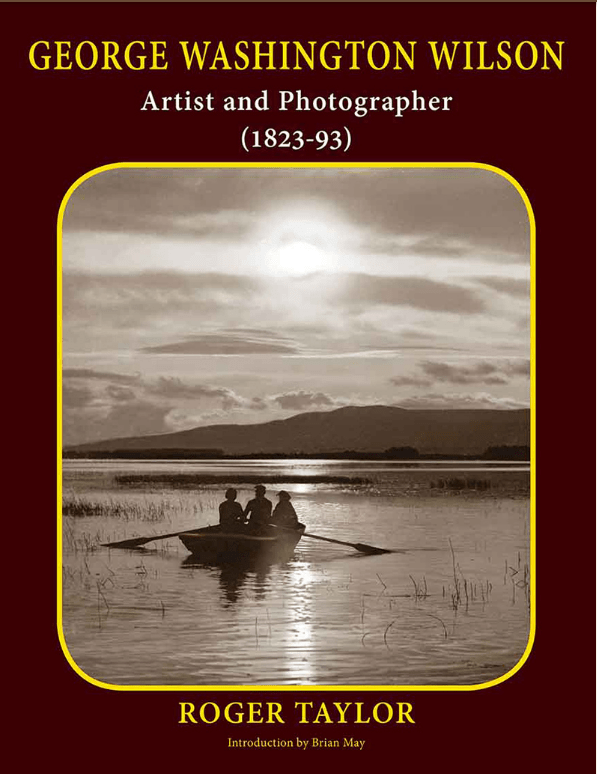
There on page 100, ‘Fingal’s Cave, Staffa’ was reproduced as plate 7.2 in a chapter about the stereographer’s output during the year 1859.
According to Taylor, it was among “topographical studies of Scottish studies intended exclusively for the tourist market.”
Wilson’s intention, he added, was to “carry a gleam of sunshine into many a home.”
The natural architecture of Fingal’s Cave had fascinated visitors since its discovery in the 1770s.
According to contemporary critics, Wilson’s stereo of the location apparently caught the grandeur and spirit of the place.
It prompted one reviewer to remark: “The celebrity of this picturesque cavern would alone insure a large demand for a good illustration of it.
“But even if it were altogether unknown, such a one as we have before us would, of itself, be enough to render it celebrated henceforth.”
A chronological listing of Wilson photographs reveals that though stereographed by him in 1859, ‘No. 17’ was not reviewed by the British Journal of Photography until September 1861.
That said, the card now in my collection has aged remarkably well and is a wonderful 3D image.
It also opens up the possibility that George Washington Wilson will join Underwood & Underwood and Excelsior Stereoscopic Tours of Burnley as 3D photography companies I collect.


 Pressphotoman
Leave a comment