
The success of W. & D. Downey of South Shields, Newcastle on Tyne and London was built upon its ability to recruit and train the right photographers.
As demonstrated by this mini-series profiling Downey luminaries, an association with the company, as royal warrant holders to Queen Victoria, proved useful when selling their own products.
Our final subject also used the verso of his cartes-de-visite to announce that he was ‘formerly with Messrs. W. & D. Downey, London.’
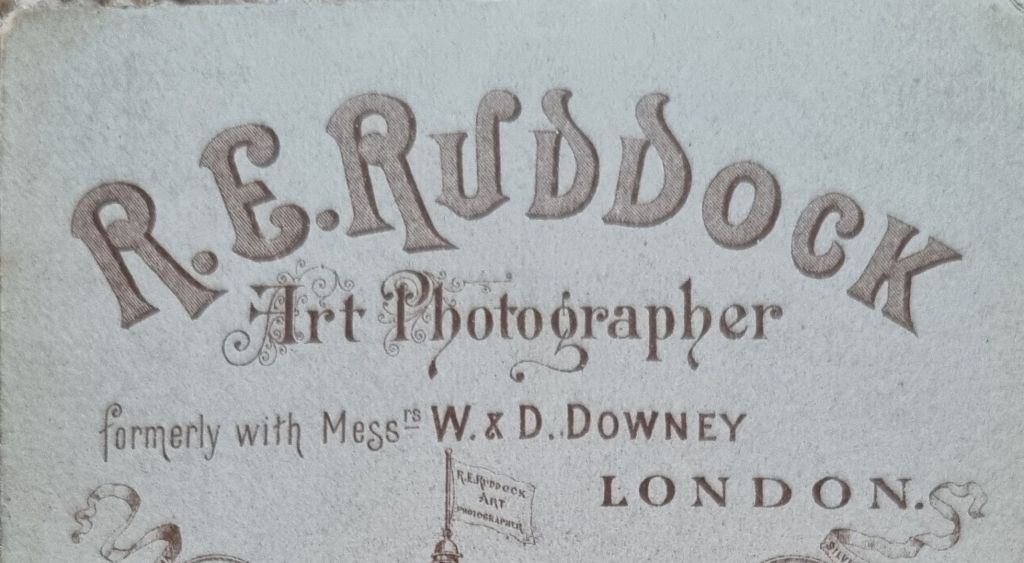
Given Downey’s origins in the North East of England, R. E. Ruddock’s credentials were impeccable.
Born in Bishopwearmouth, Sunderland in 1863, Richard Emerson Ruddock was part of a media family.
His father, also Richard, was a newspaper reporter and later executive with the Newcastle Chronicle for nearly half a century.
By the time he was 18, Ruddock junior was living in the Elswick district of Newcastle, working as an ‘artist and photographer.’
Given his father’s position, an opportunity to work for ‘W. & D. Downey, London’ may well have emerged through family contacts.
Though details of his assignments are not known, a period of employment at Downey’s studio in Ebury Street, Belgravia during the 1880s would have provided invaluable experience.
By the end of the decade, R.E. Ruddock had returned to the North East and formed a partnership with another Tyneside photographer, Matthew Auty (1850-1895).
‘Auty & Ruddock’ operated from the seaside resort of Tynemouth where the Ruddock family including wife Alice and a son, also named Richard, made their home.
However, in March 1892, the ‘Auty & Ruddock’ business partnership was dissolved and six months later, R.E. Ruddock launched his own portrait studio in nearby Newcastle.

The opening of the Grand Studio in Goldsmiths Hall ‘at the corner of Blackett Street and Pilgrim Street’ was supported by an advertising campaign in the local press.
This included a double-column advertisement in a number of newspapers including the Newcastle Daily Chronicle.
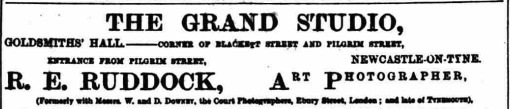
The ad went on to include a detailed description of the new studio and its facilities.
One press report described it as ‘an establishment which, for luxury and artistic refinement, excels anything of the kind either in the provinces or in London itself.’
The high-quality theme extended to the design of Ruddock’s products including silver-etched cartes-de-visite.
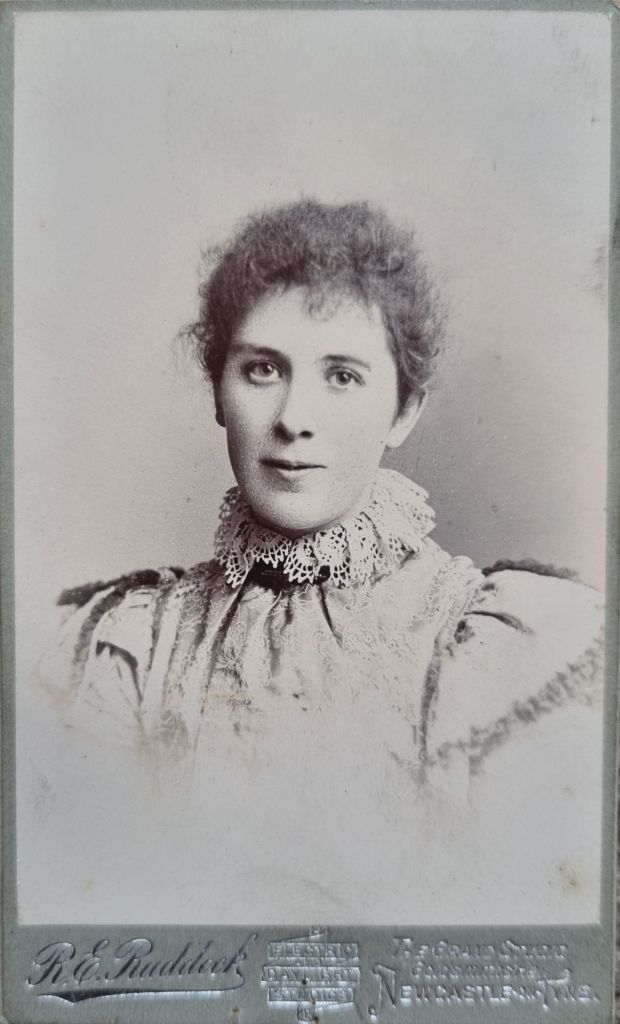
by R. E. Ruddock c. 1890s.
© Author’s collection.
At some point during the 1890s, ‘R.E. Ruddock’ became ‘Ruddock Ltd’ and extended its range to include portraits mounted within embossed cardboard frames.

© Author’s collection.
As the 20th century dawned, photography was embracing new formats.
The newly-popular picture postcard offered fresh commercial opportunities and ‘Ruddock Ltd’ enthusiastically embraced this development.
Alongside black-and-white ‘real photograph’ cards (RPPCs), the company published colourised scenes that married art and photography.

© Author’s collection.
By 1904, ‘Ruddock Ltd, Newcastle on Tyne’ claimed to be one of the largest publishers of view postcards in the North of England.
New series continued to be issued as described in this article published by the Newcastle Evening Chronicle in 1906.
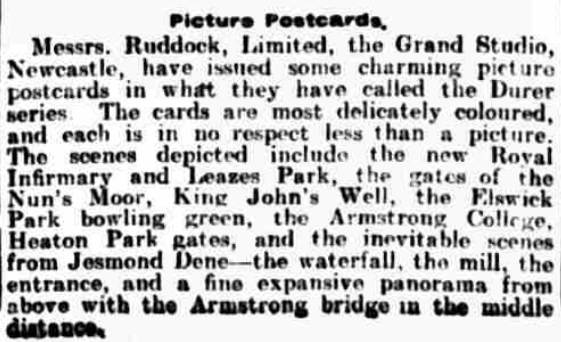
From British Newspaper Archive.
‘… and the inevitable scenes from Jesmond Dene’ may well have included this postcard.
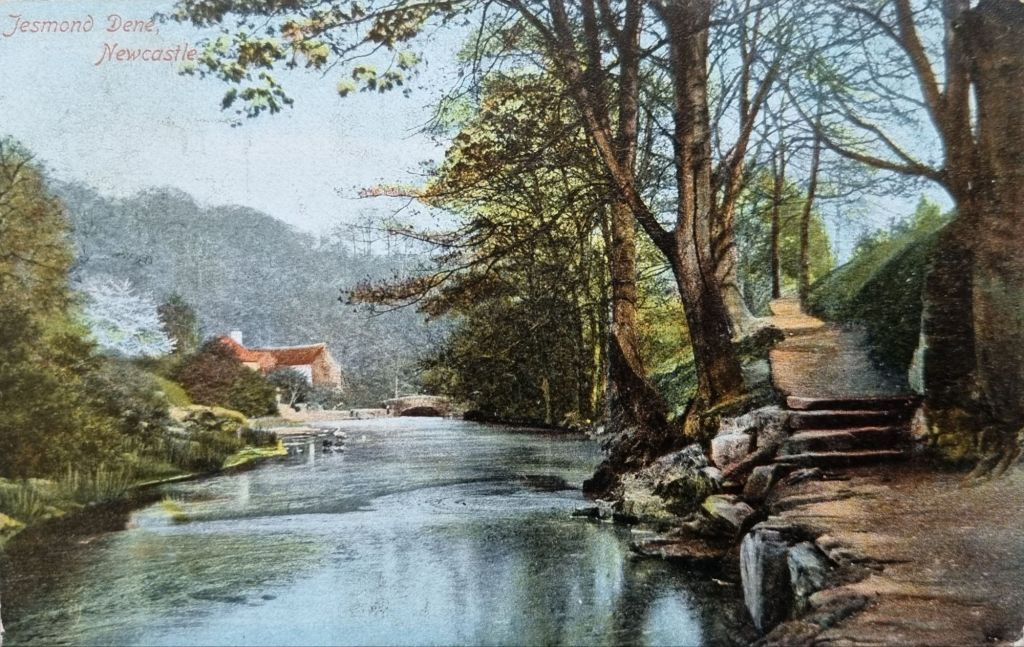
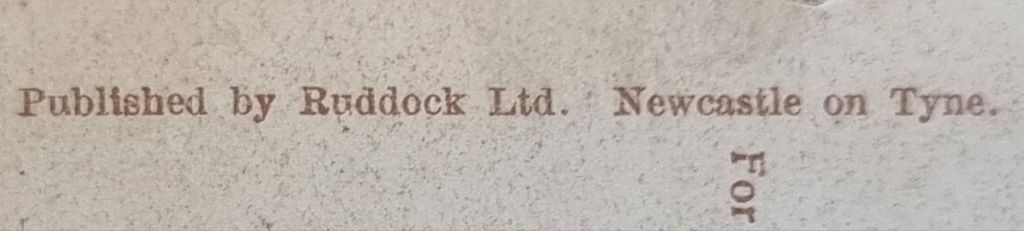
Despite the fact that photographic portraits credited to ‘Ruddock Ltd’ still appeared as illustrations in the Newcastle press, the business was in financial difficulties.
By November, its liquidation was announced and the ‘Grand Studio’ and its high-quality contents including a ‘stock of picture postcards’ were sold by auction, presumably to realise assets and pay off creditors.
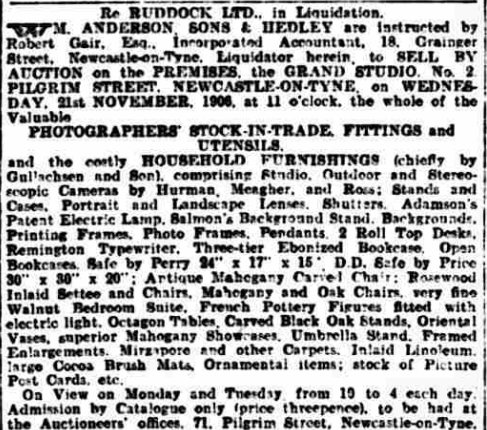
From the British Newspaper Archive.
Whatever the reputational damage caused by this business failure, R.E. Ruddock was not yet finished with photography. Far from it.
Within a short time, he took over the long-established studio of ‘Abel Lewis’ on Whiteladies Road in the Clifton district of Bristol.
Lewis, a long-serving member of the Royal Photographic Society, established his award-winning photography studio in the 1860s, first in the Isle of Man and then in Bristol.
Following the Ruddock take-over, photographs credited to ‘Ruddock Ltd, Clifton’ were soon appearing in local newspapers suggesting access to a wider photographic and press network.
However, the death in 1908 of Richard Ruddock senior prompted his son’s return to Newcastle where he was among the funeral’s chief mourners.
Mr. R.E. Ruddock’s Bristol studio continued to operate and in 1912, he opened a ‘New Photographic Studio’ further along Whiteladies Road.
The press article announcing this news also found space to highlight its proprietor’s connection ‘for many years’ to ‘W. & D. Downey, the well-known firm of court photographers.’
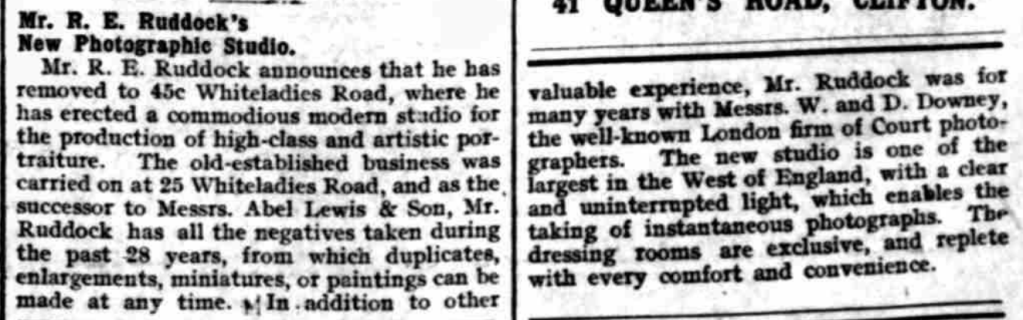
However, two years later, the same paper reported: ‘We understand that Mr. Frank Holmes has acquired the goodwill and business of Mr. R. E. Ruddock (late Abel Lewis).’
That August, as the First World War broke out, Ruddock emigrated to the United States where he was then joined by his wife Alice and other family members, settling in Seattle, Washington.
US citizenship followed in 1921 where he continued working as a photographer.
His death a decade later, aged 68 in Scranton, Pennsylvania, was marked by a short newspaper obituary accompanied by a poorly reproduced halftone photograph.
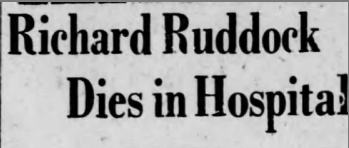
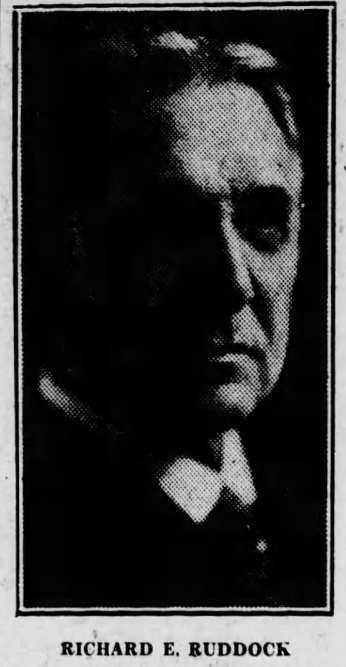
The paper reported that Ruddock, a widower, died of pneumonia, had ‘been employed at J.B. Schreiver’s [photographic] studio during the past several years’ and ‘was well-known in the city.’
Like his fellow Downey luminaries H.S. Mendelssohn and John Edwards, who featured earlier in this mini-series, a handful of Ruddock’s portraits feature in the collection of the National Portrait Gallery, London.
https://www.npg.org.uk/collections/search/person/mp93463/richard-emerson-ruddock?role=art
The value of having worked for W. & D. Downey whether on Tyneside or in London seems to have held all our subjects in good stead during their subsequent careers in photography.
If you can add any information to each of the four photographers profiled or if you know of examples of their work, please use the comments box at the bottom of this blogpost or any of the blogposts below.
 Pressphotoman
Leave a comment