
Research into the photographic firm W. & D. Downey of South Shields, Newcastle upon Tyne and London is regularly published on this blog.
A number of photographers who worked for the Downey brothers, William (1829-1915) and Daniel (1831-1881), later went on to enjoy successful careers of their own.
Over coming weeks, a Pressphotoman mini-series will share new research on a selection of Downey luminaries.
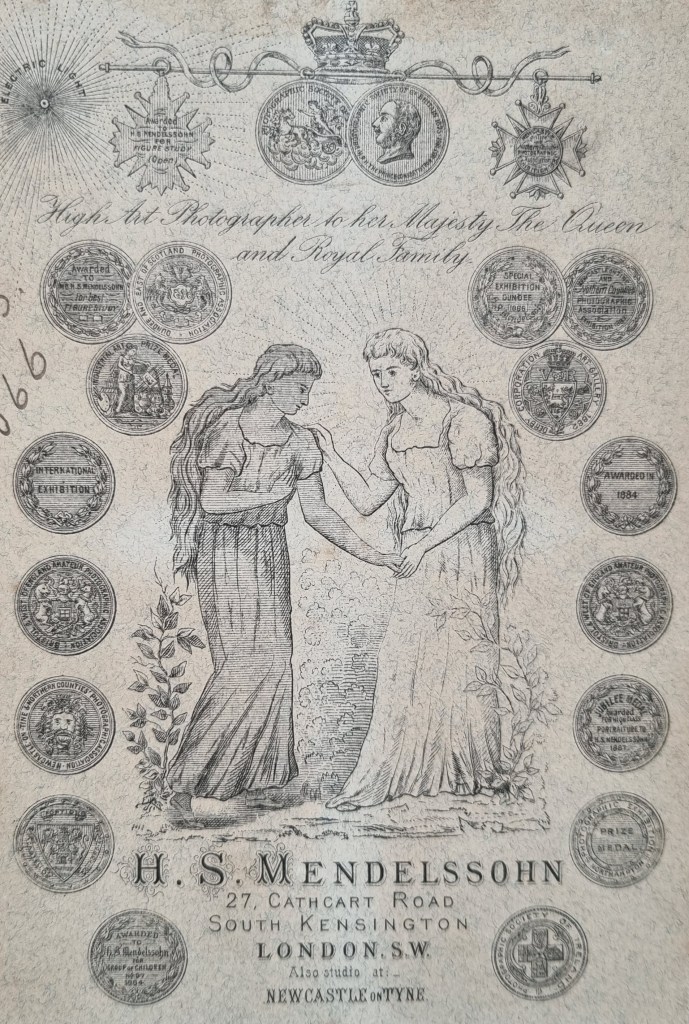
H.S. Mendelssohn, London & Newcastle on Tyne. c. 1880s.
© Author’s collection.
When the celebrated portrait photographer Hayman Seleg (H.S.) Mendelssohn died in 1908, aged 59, a brief obituary in the Royal Photographic Society Journal described how his career began.
Born in 1847 in Germany and raised in Poland, “… political reasons obliged him to leave that country, and he settled at Newcastle-on-Tyne where he commenced his photographic career.”
It went on: “After serving with Mr. D. Downey for some time, he went into business for himself.”
This passing reference to Daniel Downey points to an apprenticeship with the company’s Eldon Square studio in the late 1860s.
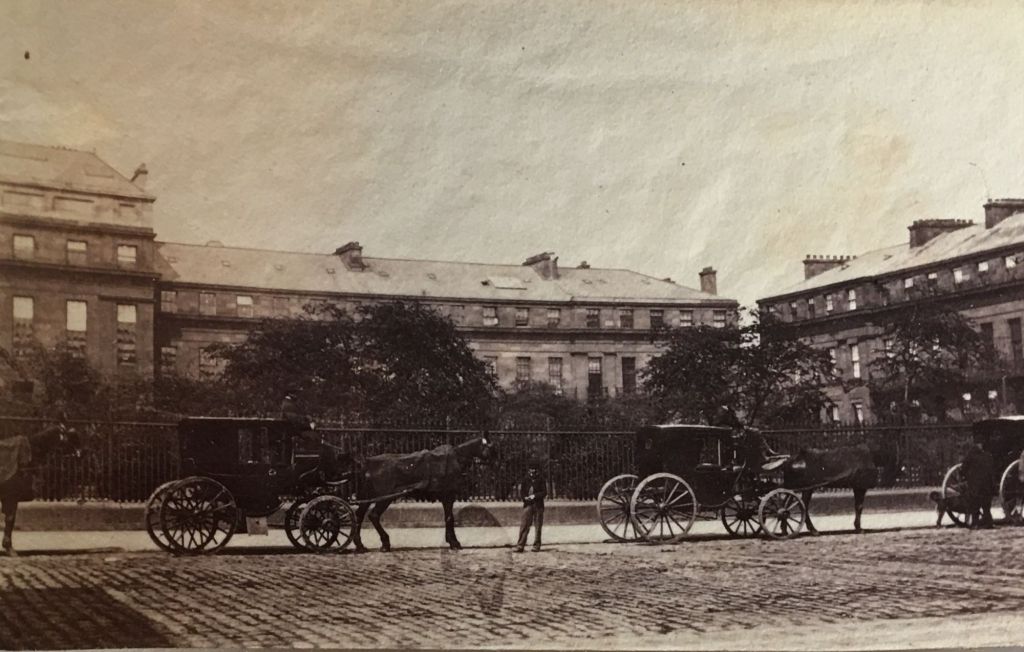
Married with two very young children, the transition to life in a different country must have been unimaginably hard.
The Mendelssohns were one of only 160 Jewish families living in Newcastle at that time.
By 1871, they were sharing a house with jeweller Simon Falk and his family in Blandford Street, a short walk from the city’s railway station.
Evidently, employment with W. & D. Downey proved life-changing.
In the 1871 census, Mr. Mendelssohn’s stated ‘trade or profession’ was ‘photographer.’
He then formed a business partnership with another of the Downey brothers, John (1823-1906), who was also a photographer.
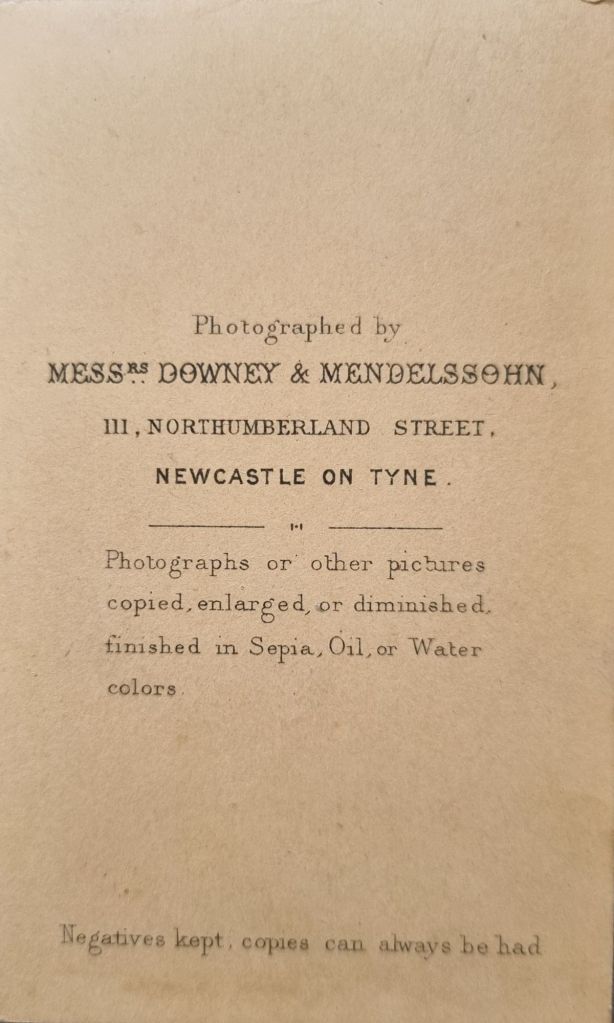
In late-January 1872, the firm of Downey & Mendelssohn opened for business in premises at 111 Northumberland Street.
© Author’s collection.
Interestingly, this was the address that W. & D. Downey used when it opened its first studio in Newcastle on Tyne a decade earlier.
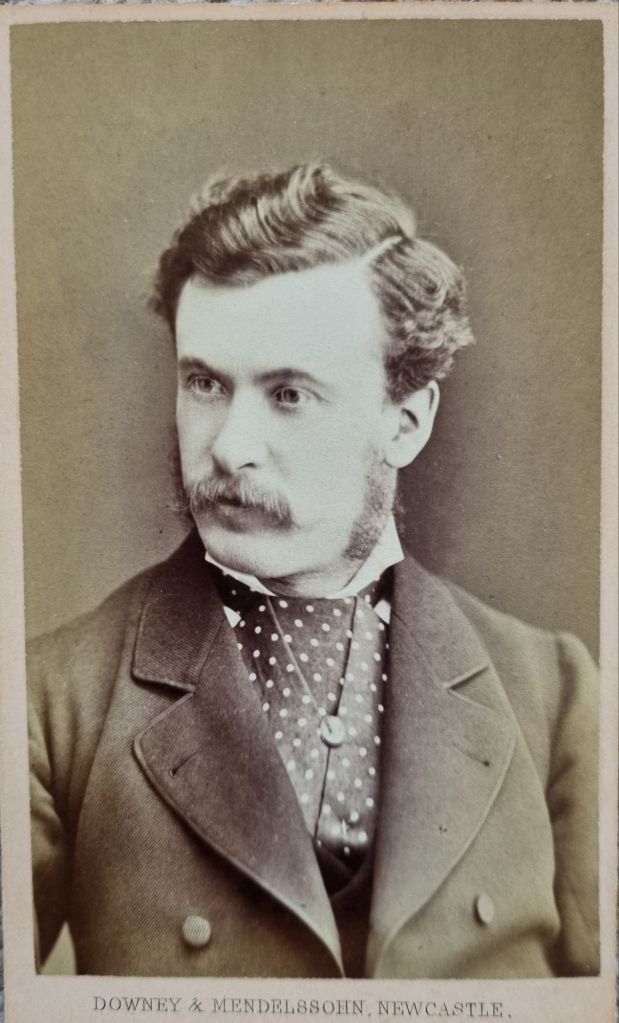
Advertisements placed by Downey & Mendelssohn in the Newcastle press offered a range of services.
These included ‘photographs taken of any animate or inanimate object’ and ‘Rembrandt portraits taken to perfection,’ however conventional portraits were their stock-in-trade.
© Author’s collection.
Soon, the firm’s carte-de-visite verso evolved to include the signature flourish that later characterised H.S. Mendelssohn’s own photography business.

© Author’s collection.
Another notable detail was the addition of the term ‘Photo Artists’ in line with an array of competitors in the city, adding ‘sepia, oil or water colors [sic]’ to their products.
Within 12 months, their studio moved a short distance from 111 Northumberland Street (left of map below) to 17 Oxford Street (bottom right).
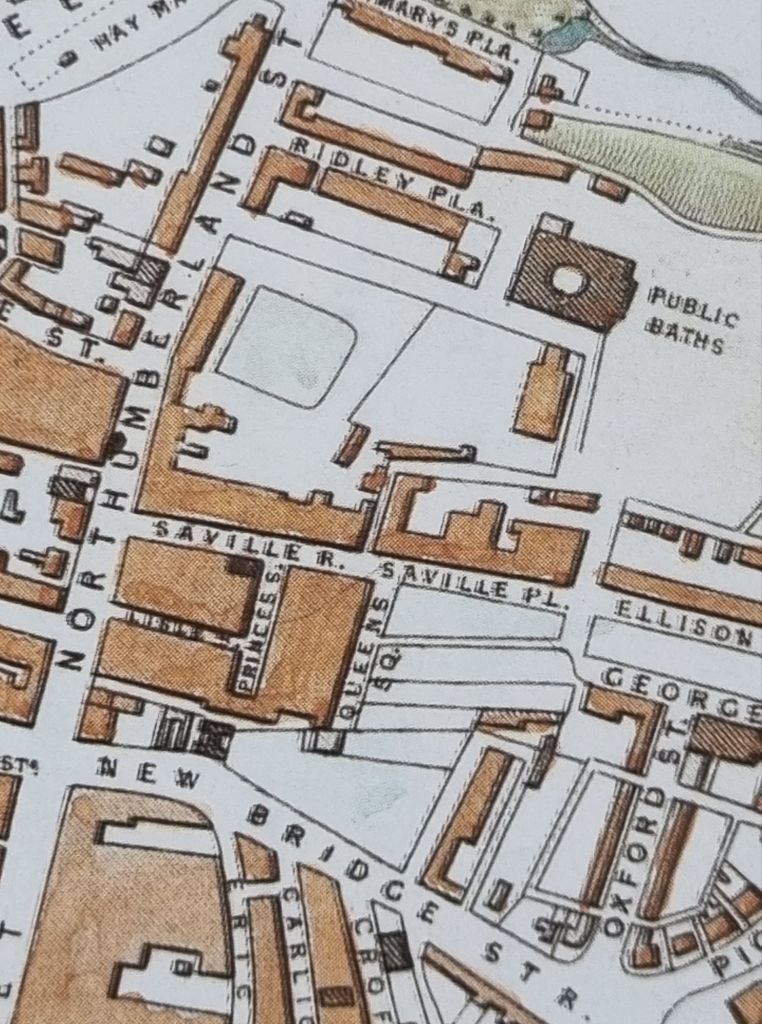
From John Tallis map of Newcastle on Tyne (1854).
The firm also adopted a distinctive orange-coloured card for presenting its products.

©️ Author’s collection.
In December 1873, Downey & Mendelssohn’s two-year long partnership came to an end, and ‘H. S. Mendelssohn, Photo Artists’ became sole proprietor of 17 Oxford Street.
By this point, he was an active participant in the photographic life of the city.
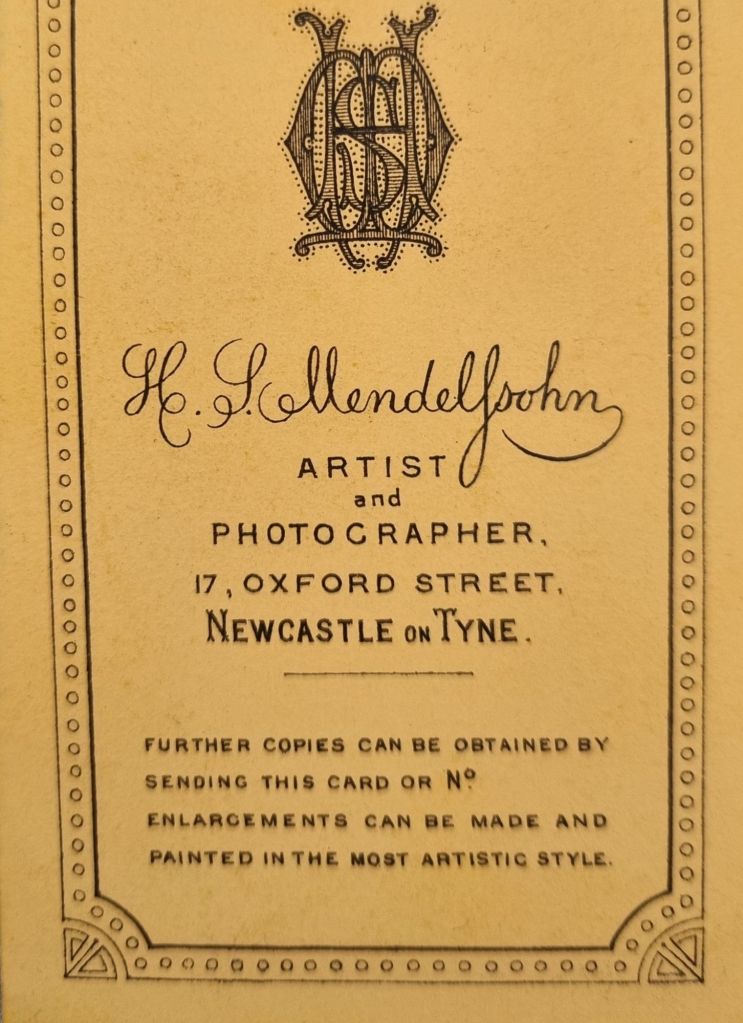
©️ Author’s collection.
This 1874 newspaper advertisement promoted an exhibition of his portraits using the carbon print process invented in Newcastle by (Sir) Joseph Swan.
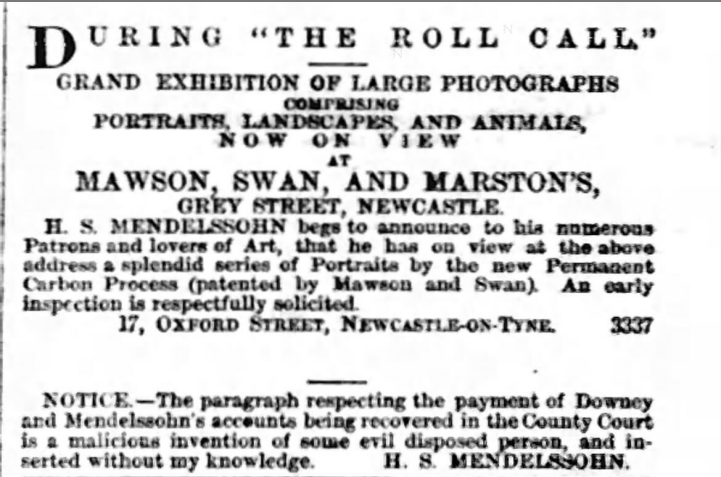
From British Newspaper Archive.
However, the adjoining ‘Notice’ hints at a form of intimidation that could be viewed as anti-semitic, which he was willing to confront publicly.
From this point, H.S. Mendelssohn’s career went from strength to strength.
He opened a further studio in nearby Sunderland in 1881 and the following year, his business expanded to London where his growing reputation attracted prestigious clients.
Queen Victoria’s diary entry for 20th December 1883, made at Osborne House on the Isle of Wight, recorded: “A new photographer, named Mendelssohn, has taken lovely photographs of [Victoria’s grandchildren] Daisy [Margaret of Connaught] and little Arthur [Duke of Connaught].”
Whether W. & D. Downey’s royal warrant to Her Majesty (1879) played a part, it proved to be the first of many royal commissions.
H.S. Mendelssohn’s career is celebrated in various collections including the National Portrait Gallery, London where he is credited with 70 portraits.
https://www.npg.org.uk/collections/search/person/mp58904/hayman-seleg-mendelssohn?role=art
This cabinet card featuring the actress Miss Ellen Terry taken in 1883 demonstrates his skills and how far he had travelled since arriving in Newcastle on Tyne as a refugee fleeing persecution.

In the next post in this mini-series, how Downey’s principal photographer in the 1860s and 1870s used that calling card to attract clients to his own successful portrait studio.

 Pressphotoman
Leave a comment