
Collectors on the hunt for a particular item or object will be familiar with the daily visit to online auction sites.
This involves entering a few well-chosen words into a search engine and hoping that a ‘new’ or ‘recently added’ result appears.
Even when this happens, the item description often suggests little to indicate that the seller is offering what you are looking for.
This was the case recently when a ‘Victorian Gentlemen’ appeared in a trawl for cartes-de-visites produced by W. & D. Downey during their early years in South Shields.
Initially, the card’s dirty and stained verso looked unpromising.
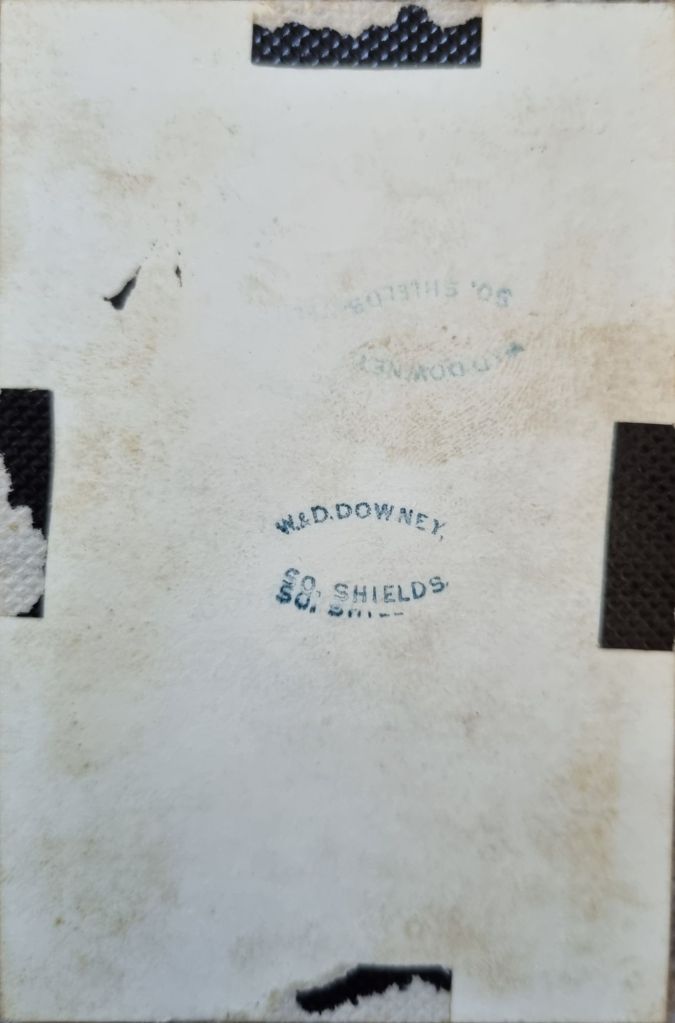
Though it featured the coveted company stamp, a previous owner had attached four pieces of what appeared to be adhesive tape.
However, turning the card over, its subject appeared to be in much better shape.
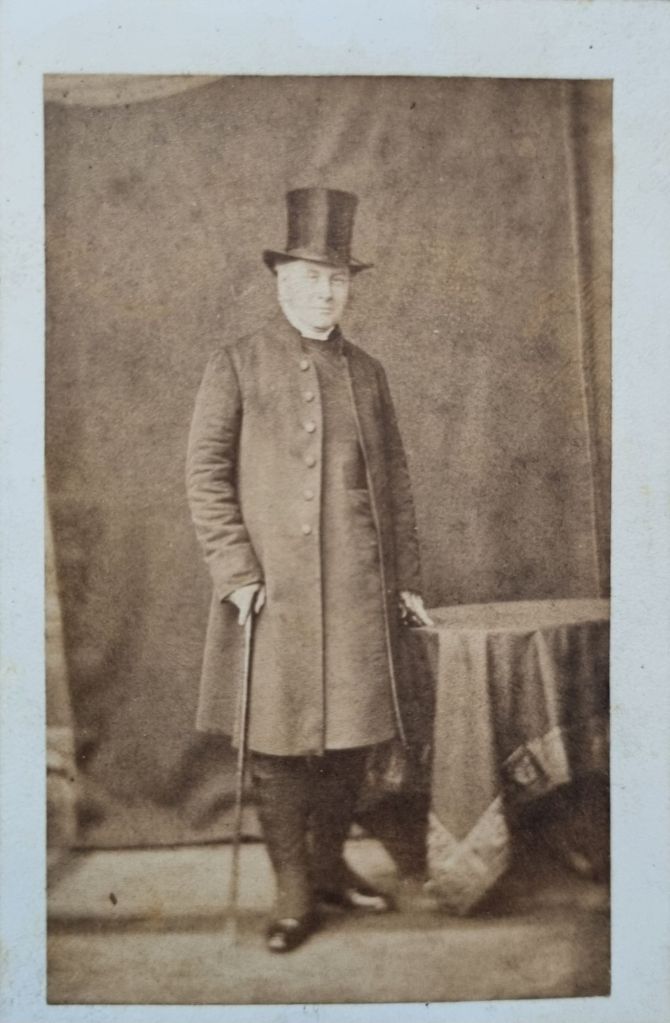
What was particularly striking was his outfit of coat and short cassock plus gaiters and knee breeches with silk top hat and cane.
Previous research into Downey’s list of clerical clients around 1860 identified an assortment of vicars and non-conformist ministers.
But this ‘Victorian Gentleman’ seemed to be of higher status.
It took a cross-check with the National Portrait Gallery, London to confirm who he was.
The answer – the Lord Bishop of Durham, the Right Reverend Dr. Henry Montagu Villiers.
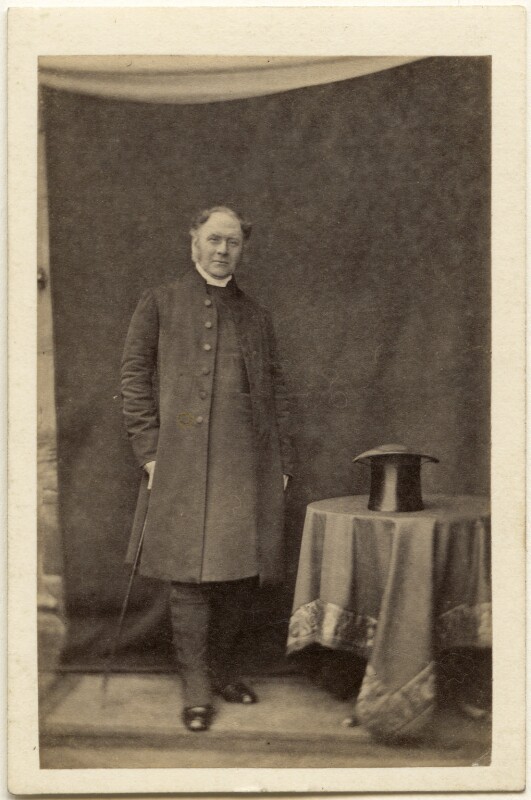
© National Portrait Gallery, London. NPG x139849.
The NPG’s portrait matched my ‘Victorian Gentleman’ in almost every detail except that his top hat was placed on a cloth-covered table nearby.
Removing the top hat allowed the light to fall on his face producing, to my eyes, a more detailed and pleasing portrait.
Which of the two portraits was taken first is hard to tell.
In the NPG version, the bishop is using his cane for support rather than leaning on the table, so perhaps this came later in the shoot when (minus his top hat) he felt (and looked) more relaxed.
Another interesting feature of these portraits is that they are slightly smaller than other Downey cartes-de-visites of the period.
Both measure 3 and 5/8 inches (rather than 4 inches) by 2 and 3/8 inches.
The accuracy of the NPG’s dating of ‘around 1860’ is supported by the Bishop of Durham’s installation in September of that year.
By December, a lengthy article about W. & D. Downey in the North & South Shields Gazette titled ‘Photography in South Shields’ described how “the portrait of the Lord Bishop of Durham has also been taken by Messrs. Downey.”
©️ Author’s collection.
Whether or not these portraits were made available to the public, they soon had an added commercial value.
In August 1861, the national press reported the death of Henry Montagu Villiers “whose health has long been in a precarious state … in his 48th year.”
A fortnight later, his funeral was held in Bishop Auckland when, according to the Brighton Gazette, “the shops of the town were closed, as were also the principal shops in the city of Durham.
“And the bells of the cathedral in Durham and of the churches of Newcastle, Shields, Sunderland and other towns, tolled solemnly during the course of the day.”

 Pressphotoman
Leave a comment