
In the mid-19th century, Eldon Square in the heart of Newcastle upon Tyne was home to both commercial and amateur photographers.
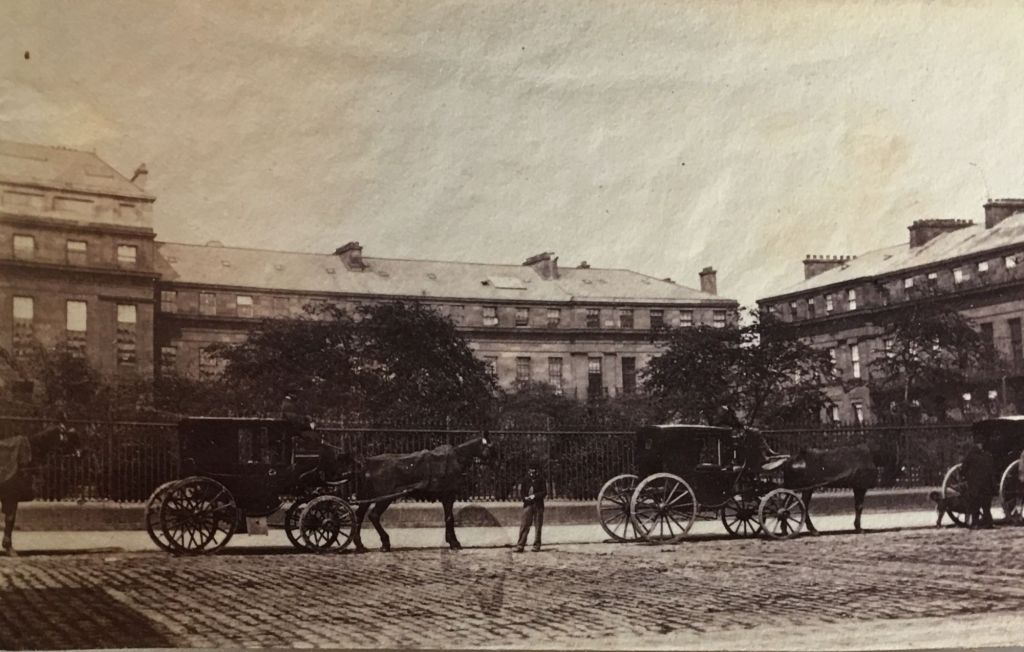
c. 1860s.
© Private collection, Zurich.
This photograph taken in the 1860s shows its terrace of grand houses designed by architects John Dobson and Thomas Oliver and built by Richard Grainger between 1825 and 1831 (Pevsner and Richmond).
Over the next few weeks, Pressphotoman will shine a spotlight on particular houses, exploring their contribution to photography’s growing popularity during the medium’s early decades.
To launch this mini-series, 9 Eldon Square will be an address familiar to regular readers of this blog as the long-time home of commercial photography firm W. & D. Downey.
For new readers, brothers William and Daniel Downey started in business in their native South Shields around 1856, opening a studio in Newcastle upon Tyne at 111 Northumberland Street in the autumn of 1861.

Within six months, the Downey’s had moved studios again and secured a prime location in Eldon Square, one of the city’s most fashionable addresses.
As the census reveals, its residents were typically medical practitioners, dental surgeons, lawyers and well-connected ladies and gentlemen of means with the necessary domestic staff to maintain such a lifestyle.
Research into how no. 9 became home to W. & D. Downey reveals a tragic tale played out in the columns of the local press.
On 7th June 1861, the Newcastle Courant reported an inquest into the death of Richard Downing Esq., a 63 year-old surgeon dentist.
London-born, he had lived with his ‘landed proprietor’ father in Eldon Square since it was built, first at no. 17, then at no. 9.
Under the headline ‘Distressing Suicide,’ the paper reported how Mr. Downing had been in a depressed state of mind during the previous fortnight.
After going upstairs to his bedroom after dinner, his younger sister Jane “heard something fall heavily in the deceased’s room.
“She entered the apartment, and then saw Mr. Downing laying on his back with a deep and large gash in his throat and in a state of insensibility.”
A servant was despatched to bring Dr. De May, “the family medical man,” who lived at no. 15, accompanied by Dr. Heath.
The newspaper account continued: “The deceased was unhappily beyond the reach of medical skill, and within five or six minutes after the arrival of the professional gentleman he expired.”
The nature of Downing’s depression was not disclosed, but he had ended a business partnership with his father and brother in March 1860, and the following month, 9 Eldon Square was put up for ‘sale by auction.’
A year later though, as recorded by the 1861 census, Richard Downing, his sister Jane and a house servant and maid servant were still in residence.
Following Downing’s death, efforts to put his affairs in order moved at speed.
Within a fortnight, an auction of his ‘household furniture and other effects’ took place at no. 9.
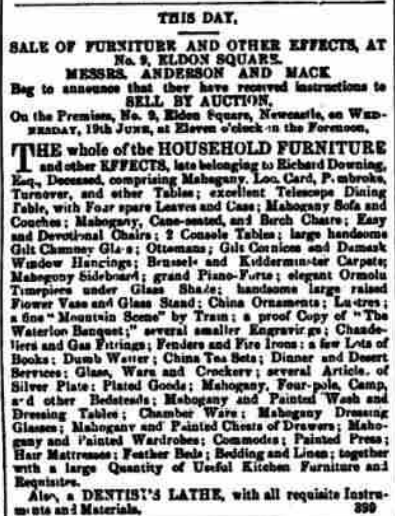
From British Newspaper Archive.
By August, the house was again on the property market, this time ‘to be let and entered upon immediately,’ suggesting no. 9 was empty and that Downing’s sister and domestic staff had moved out.

Described as a ‘desirable dwelling house’ complete with Coach House, the same ad appeared regularly in the local press for several months.
Attempts to find a suitable tenant may have been hampered in part by the property’s association with Mr. Downing’s death.
Eventually in March 1862, Downey’s used one of its regular ads in the Newcastle papers to announce that no. 9 had new occupants.

From a commercial point of view, the timing could not have been better.
Two months earlier, Downey’s had taken a series of photographs in the aftermath of the Hartley Pit Disaster, 15 miles away, which claimed the lives of more than 200 men and boys.
Using its entrepreneurial instincts, the company sent copies to Queen Victoria, enabling it to re-brand its products with a new logo advertising both its royal patronage and new Newcastle address.
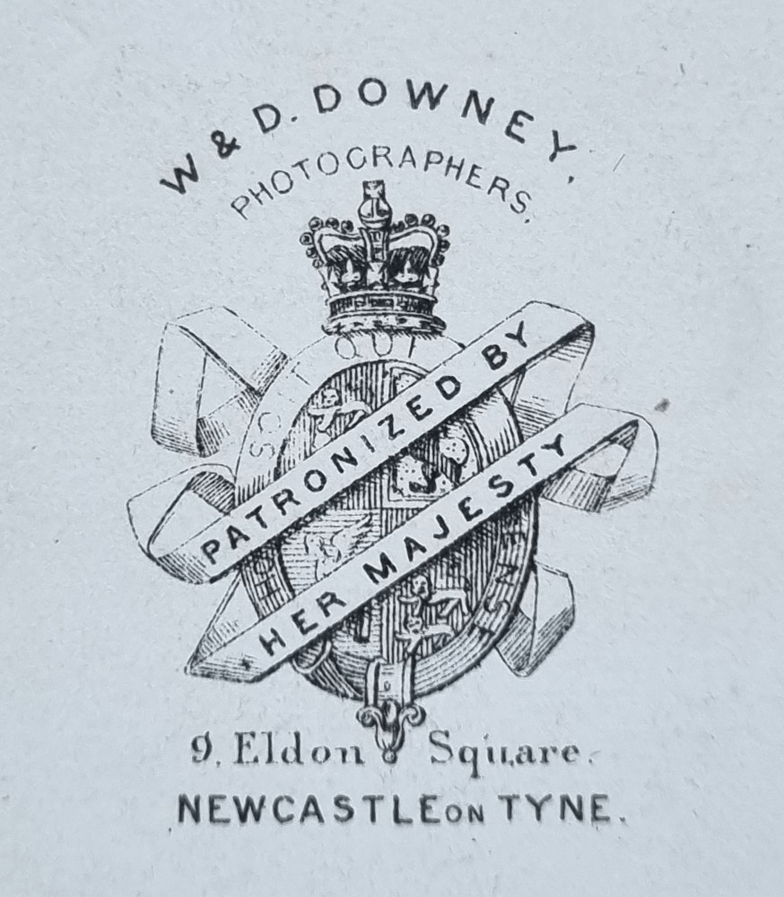
The move signalled the start of a highly successful chapter in the history of W. & D. Downey and 9 Eldon Square became a go-to destination for those in the region and beyond wanting a photographic portrait in the latest style.
In the next blogpost in this mini-series, a rival commercial photographer moves into Eldon Square, signalling a battle for customers that lasted into the 1870s.


 Pressphotoman
Leave a comment