
One of the joys of photo collecting is looking for clues that may help confirm the provenance of an image.
Last week’s blogpost about portraits of Mrs. Susan Davidson of Ridley Hall, Northumberland – one taken in Paris by Alexandre Ken and another by W. & D. Downey of South Shields – suggested further research questions.
Mrs. Davidson
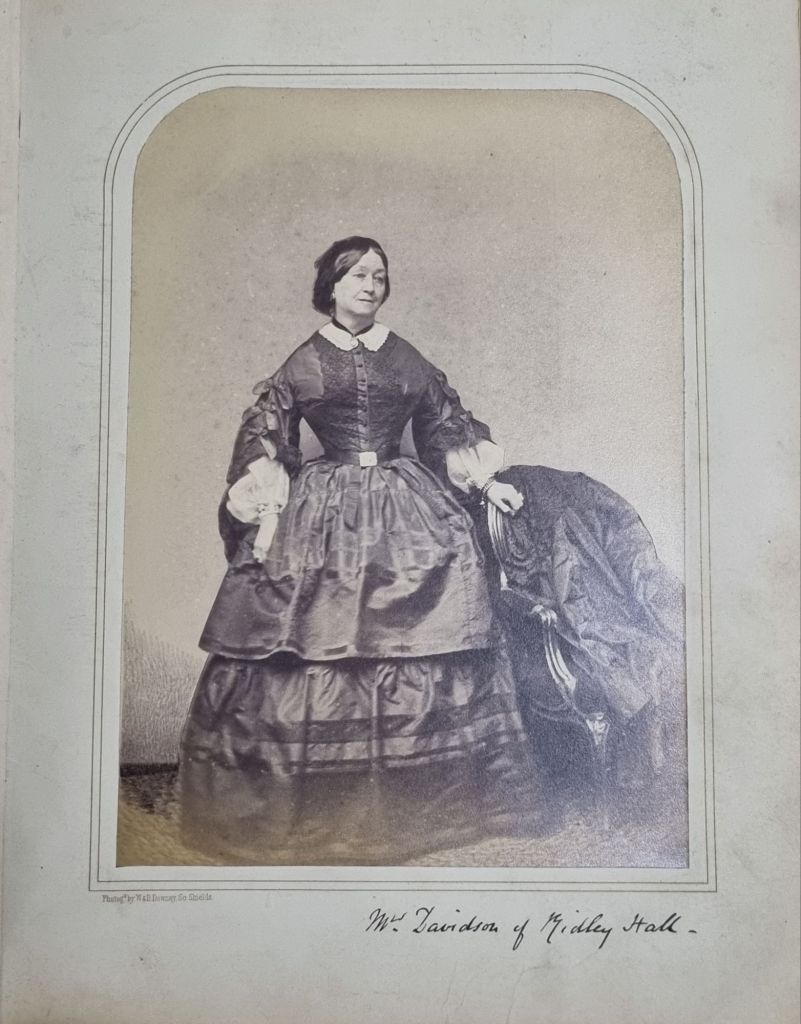
In the case of the Downey portrait, I wondered when and where was it taken?
© Tyne & Wear Archives and Museums. DX985/9.
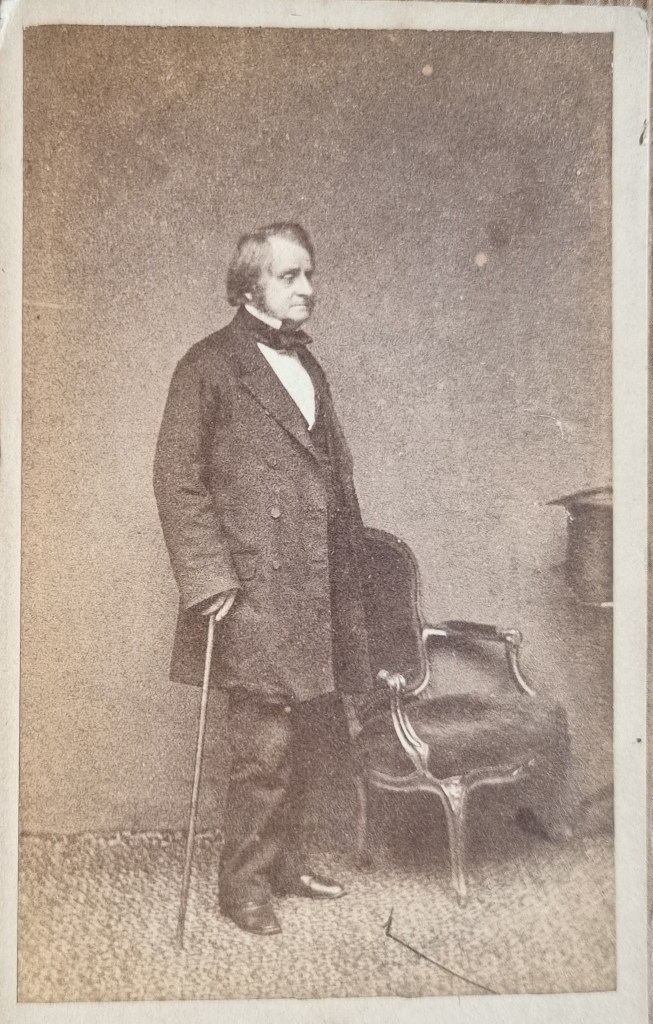
For clues, I turned to the oldest Downey carte-de-visite in my own collection.
It features John Arthur Roebuck (1802-1879), then MP for Sheffield, and is stamped “W. & D. Downey, South Shields” on the verso.
Albumen carte-de-visite. © Author’s collection.
What immediately caught my eye in both portraits was the distinctive armchair.
Such pieces of furniture were used to provide physical support to the standing “sitter” whilst the camera plate was being exposed and to avoid any blurring.
In addition, the floor covering in the immediate foreground of both photographs has a common pattern and design.
This evidence suggested that the same studio props were used by Downey for both portraits and (possibly) the same location too.
Armed with this information, I reviewed my collection of newspaper cuttings about Downey’s activities during its formative years.
According to the North & South Shields Gazette (6th September 1860), “Mr. J.A. Roebuck, Esq., MP” was amongst “the noblemen and gentlemen” photographed during Downey’s “first professional visit to London.”
To underline this, the National Portrait Gallery, London has another cdv of Mr. Roebuck attributed to Downey in its collection.

© National Portrait Gallery, London. NPG x12861.
Visibly from the same London sitting, the MP’s cane is leant against the backdrop whilst his top hat sits nearby on a small table.
As previously described, the same armchair and floor covering are on view.
The NPG dates its Roebuck cdv as “early 1860s” and its location as “unknown place (photographers’ studio).”
Where this “unknown place” was located is difficult to say, though it may have been a space borrowed for the occasion.
Afterwards, the Downey brothers, William and Downey, returned to the North-East of England and, by Christmas 1860, were displaying portraits from their London visit in the South Shields premises that were their base.
By the following Spring, their Roebuck portrait was among a fresh range of carte-de-visite being sold to the public, permission having been obtained from some of their London sitters.
In contrast, Mrs. Davidson’s portrait, though possessing many physical similarities in style and presentation, appears to have involved a more private arrangement.
As her later Parisien portrait by Alexandre Ken suggests, she was clearly attuned to the latest trends in portrait photography.
Evidence obtained for this blogpost suggests that she may have taken advantage of Downey’s presence in London in September 1860 to make her own statement about image and status.
 Pressphotoman
Leave a comment