
Over the weekend, a trip to the Glasshouse International Centre for Music (formerly Sage Gateshead) had a welcome photographic spin-off.
It offered an opportunity to look at Newcastle from across the River Tyne and see how much has changed since a stereographer captured the same scene in the 1860s.
Here’s that stereo from my collection. There is no identifying photographer or company credit on either front or verso.

This close-up image taken from the left-hand stereo half highlights a number of well-known landmarks on the city skyline.
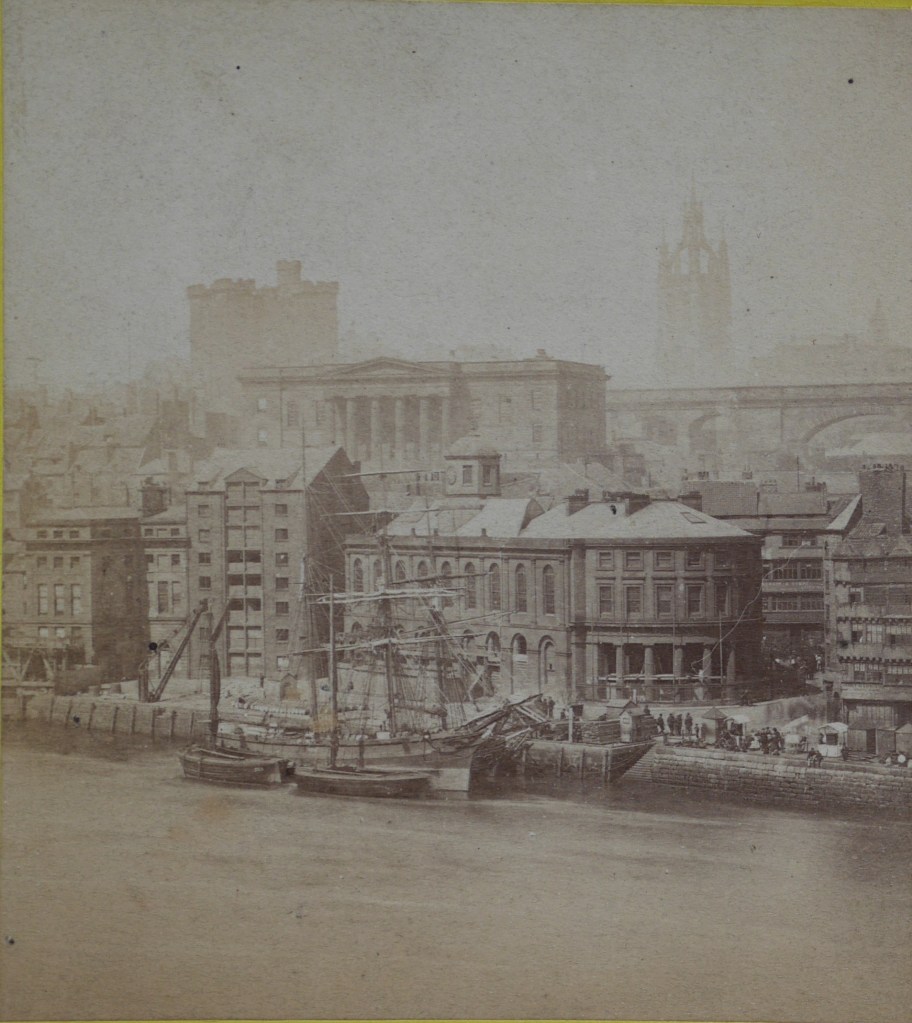
From left to right, they are the Castle Keep with its crenellated battlements, the Greek Doric order Moot Hall opened as a courthouse in 1812 and St. Nicholas’ Church with its distinctive lantern tower.
On the quayside, a masted sailing ship is tied up alongside various smaller craft.
A dock crane is visible to the left and groups of people are huddled together amid wooden huts and stalls to the right.
The stereo, though difficult to date precisely, is similar in style and presentation to that of the Stephenson Memorial (unveiled in 1862) featured in a recent Pressphotoman blogpost (5th February 2024).
By way of comparison, here is a location photograph taken over the weekend from roughly the same position using a Samsung Galaxy phone.
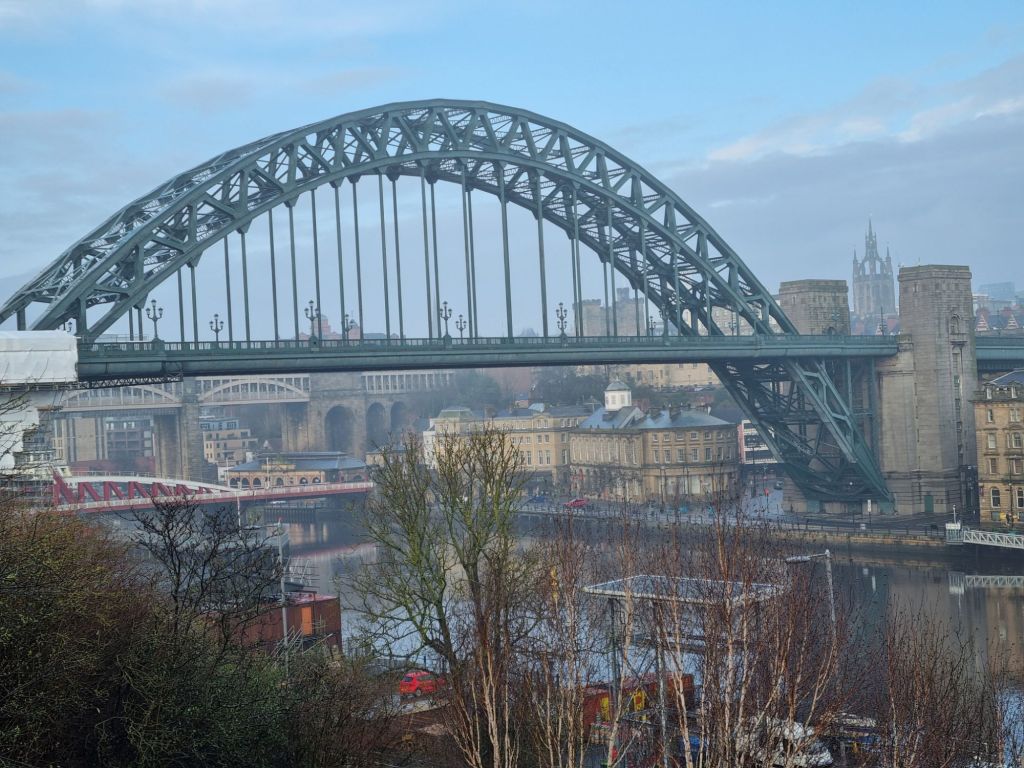
Author’s photo. 2nd March 2024.
Still visible between the towers of the Tyne Bridge (opened in 1928) is St. Nicholas Church (now Cathedral), whilst the Castle Keep can also be glimpsed between the road and the curve of the metal girders above.
The Moot Hall, now a grade 1 listed building, is obscured by the bridge structure.
Down on the quayside, the sailing ships may have gone, but the buildings with their curved architectural sweep and topped by a white roof rotunda remain intact from the 1860s.
Much of the quayside area was devastated by a huge fire in 1854, so it is interesting to see buildings that survived, captured photographically around 160 years apart.
 Pressphotoman
Leave a comment