
After a week in which the health of King Charles III has hit the headlines, an article in the latest issue of The PhotoHistorian (No. 197/Winter 2023) sheds light on earlier media relationships with the monarchy.
In an essay titled “Photographers to Her Majesty,” Roger Taylor provides a fascinating insight into the relationship between photographers and Queen Victoria.
He describes how a system of Royal Warrants granted to approved companies proved difficult to enforce and, as a result, was widely abused.
Warrants were issued on the principle that “the tradesman must have supplied, on a regular basis, goods or services ordered and paid for by a department of the Royal Household.”
However, many businesses, not only photographers, falsely claimed royal patronage and displayed the royal arms without permission.
In reality, only 51 photography firms were granted Royal Warrants in the years 1849 to 1900, some on more than one occasion.
As a result, those operating without a warrant with its privileged access to royal personages faced a number of challenges to create photographs featuring the Queen and members of her family.
These are well described in an 1899 article written by PR Salmon, FRPS (1872-1959), details of whose life and career feature elsewhere on this website.
At the time, he was working as a travelling stereoscopic photographer for the 3D company Lévy et ses Fils of Paris, and filing reports as a journalist to the British press and trade papers.
In “With Queen and Camera at Cimiez” (British Journal of Photography, 21st April 1899), Salmon (using the pen-name ‘Richard Penlake’) described his attempts to photograph Queen Victoria during her annual visit to the South of France.
The brief from his French employer was to “stay one week and get what was possible,” however this proved a less than straightforward assignment.
To begin with, security was tight with sentries posted in the grounds and inside the Hotel Regina where the Queen was based.
According to Salmon’s account, photographers were more in fear of “Monsieur Paoli and his large corps of plain clothes officials, which includes some of the sharpest men from the detective force of Paris.”
Their modus operandi included wearing disguises and giving off an air of noncholant disinterest until anyone with a camera started behaving suspiciously.
Using a 7.5″ x 5″ (stereoscopic) hand camera, Salmon was advised by the Queen’s Courier in “a nicely worded letter” that photography was strictly forbidden in the Royal apartments and in the grounds.
Despite this, thanks to a permit obtained from the hotel manager, he was able to photograph in its grounds, where he had observed guests and visitors moving about freely.
This meant, he states: “I was able to add considerably to my stock of pictures, and, moreover, could get an excellent ‘pitch’ when the Queen left the hotel for her afternoon drives.”
Whilst PR Salmon was relying on his wits and ingenuity to obtain a royal photo, research for this piece has revealed that another stereographer was present during that week in Cimiez.
The difference between the two men was that the other was a Royal Warrant holder.
Edinburgh-born AL (Alexander Lamont) Henderson (1838-1907) ran a successful portrait photography business in the second half of the 19th century.
As revealed by this carte-de-visite verso, ‘A.L. Henderson’ operated studios at two locations in London endorsed by his impeccable royal credentials.
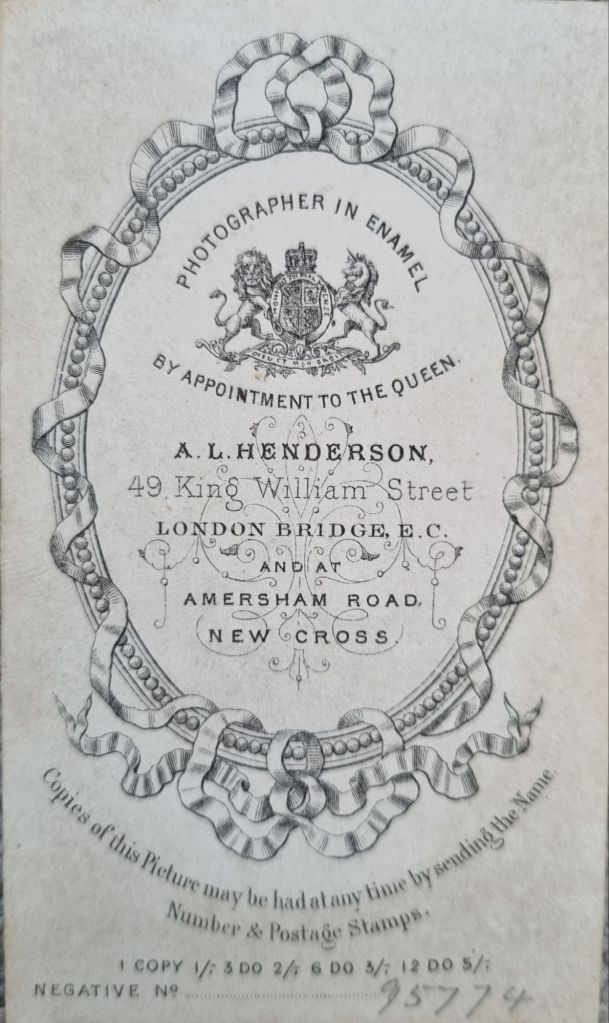
In 1884, he was awarded a Royal Warrant as “Photographer In Enamel By Appointment To The Queen.”
Enamelling, a technique that became Henderson’s forte, enabled the highest possible gloss finish to be coated on the surface of a photograph.
Examples of his enamel work including this image of Prince Albert feature in the Royal Collection.
As a Royal Warrant holder, Henderson was also able to take advantage of other opportunities that arose from his privileged position.
In 1897, 3D giants Underwood & Underwood published his stereo of “Her Majesty Queen Victoria at Breakfast …” issued to mark the Queen’s Diamond Jubilee.
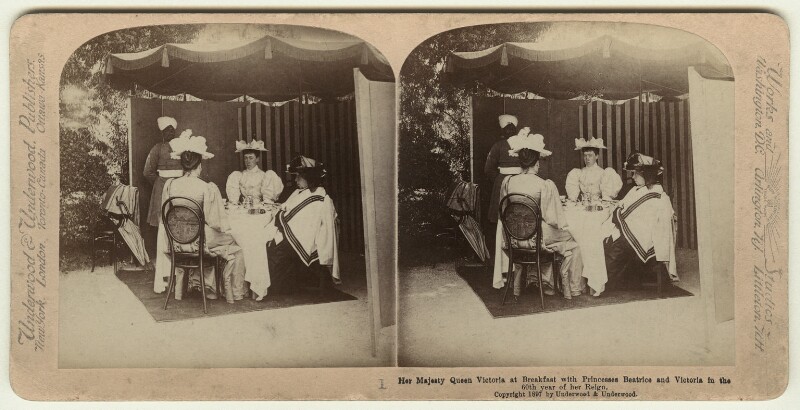
© National Portrait Gallery, London. NPG x45209.
The image had actually been taken two years earlier during the Queen’s annual South of France sojourn, but was re-branded “in the 60th year of her reign” to cash in on the Jubilee celebrations.
Like PR Salmon, AL Henderson was photographically active during Queen Victoria’s stay at Cimiez during April 1899.
This news photo was published in London by the Penny Illustrated Paper and credited to “AL Henderson, Photographer Royal.”

Though the photo did not feature the Queen herself, the accompanying report bore evidence of Henderson’s inside knowledge of the Royal Household.
It named the kilted attendants as Sandy Rankin and Willie Brown, who had been in the Queen’s service for 18 years and 5 years respectively, and Mr. Bullen, the groom, who had clocked up 17 years.
The donkey pulling the carriage was named as Zora, “an Egyptian, but born at Windsor,” whilst Turin, the small white dog (sat in the carriage) was a Pomeranian from Italy, and the collie, Rob Roy, (by the wall) was called Roy for short.
As Salmon was also working as a journalist and knew Henderson through their photographic activities, it maybe that the pair collaborated on the Penny Illustrated Paper report.
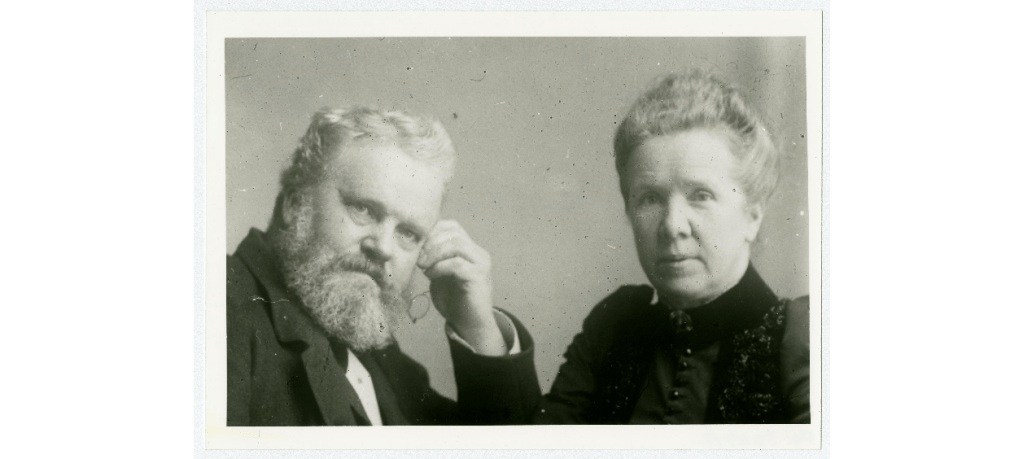
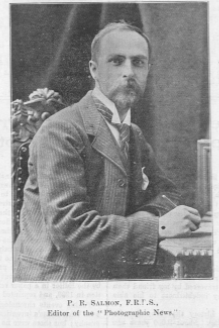
To conclude, photographs featuring photographers themselves tend to be the exception, so I was pleased to come across these images of AL Henderson and PR Salmon that were new to me.



 Pressphotoman
Leave a comment