
Newspaper adverts are a great fund of information about the early decades of photography, especially when other primary sources such as company records have vanished.
The ongoing digitisation of newspaper archives has brought previously unavailable collections into the public domain and made them more easily accessible.
For the researcher, searchable commercial websites such as the British Newspaper Archive, Find My Past, and Newspapers.com by My Ancestry are well worth regular visits in search of new discoveries.
As regular readers will be aware, the American stereoscopic photography company of Underwood & Underwood (U&U) continues to interest this researcher.
During the 1890s, its activities in Britain were chronicled by the photographic and trade press.
Until recently though, I had found little trace in the regional press of the network of agents so essential to the company’s successful business model.
This involved agents employing canvassers working door-to-door who took orders for stereoscopes and views, returning later to deliver the goods.
To begin with, U&U imported its products through the transatlantic port of Liverpool where it established an office in late 1890/early 1891.
After initially lodging in the city, co-founder Bert Underwood and his wife Susie set up home at 19 Oxford Street in the Mount Pleasant district of the city which acted as the U&U office.
It was at this address that their first child, Elmer Roy Underwood, was born on 8th May 1891.

It’s notable that Bert listed his profession as “photographic agent.”
Within a few months, the company’s import of stereoscopes and stereocards into Liverpool was in full swing.
This newspaper advert from the Liverpool Mercury reveals the initial scale of U&U’s operation.
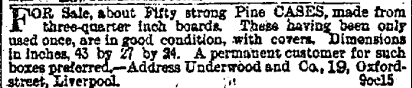
By 1894, it had reportedly shipped three million views and 16,000 stereoscopes through Liverpool into Britain.
At this point, Underwood sold cards produced by more established stereoscopic publishers, notably C. Bierstadt of Niagara Falls; the Littleton View Company of New Hampshire; and J.F. Jarvis of Washington, DC.
According to the Getty Museum, this Bierstadt view originally dates from 1869. In U&U’s version, “Liverpool” features in the list of Underwood offices on the right-hand side of the card.

© Author’s collection.
With supplies of its 3D wares at hand, the company began establishing a sales network of the type that had proved so successful in America during the previous decade.
To help achieve this objective, advertisements were placed in local newspapers such as this one from The Hinckley Times in Leicestershire published in January 1892.
It announced that “Mr. P. Payne” at the “Free Library” had been given “the sole right to sell” U&U’s stereoscopes and views in “Hinckley and District.”

According to trade directories, Peter Payne was the town’s librarian and its “Free Library and News Room,” maintained at an annual subscription of £40, boasted 1500 volumes.
Given the Underwood company’s later promotion of stereoscopy as an educational aid, it is interesting that a library was pinpointed as a suitable location for one of its representatives.
Within a few months, Hinckley had another sole agent offering U&U’s 3D products.
This newspaper advertisement from The Nuneaton Observer lists the prices of the company’s stereoscopes and stereocards (slides), and promotes its views “from all parts of the world” as “the finest in the world.”

According to Wright’s Directory for Leicestershire for 1892, Abraham Farndon operated from 7 Castle Street, Hinckley as a “coal merchant and bicycle, glass and china dealer.”
During this period, U&U were also making inroads into the rapidly expanding world of photographic societies.
Such groups thrived all over Britain as the medium reached new practitioners and audiences, in part through Kodak’s “you press the button, we do the rest” cameras.
The Eastbourne Chronicle (7th May 1892) reported how at a meeting of the Lewes Photographic Society, “some stereoscopic views by Messrs. Underwood & Underwood were shown and much admired by those present.”
The public’s renewed appetite for 3D seemed insatiable as this double-column advertisement placed in The Workington Star in January 1893 underlined.
“Have you, or do you want, a STEREOSCOPE!”, the ad proclaimed before describing a range of attractive offers for those purchasing U&U products in bulk.
Quantities of a gross (144 views) or half gross (72 views) came with a “PLUSH CABINET.”
This product echoed the revolving cabinet in which to store multiple sets of views that the company heavily promoted around 1900. Free stereocopes were also included.

In this advertisement, there was no mention of Underwood’s Liverpool office, but “Baltimore, Ottawa, Kansas and New York” were highlighted, adding an air of international glamour to proceedings.
John P. Mossop, the named “sole agent,” was listed in the 1891 Census for Workington as a 28 year-old grocer.
Another U&U “agent” based in York was less forthcoming about his personal details, but confidently offered customers “the cheapest and finest views in the world.”
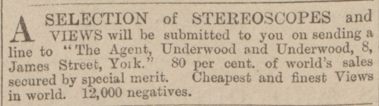
The handful of adverts featured in this piece offer a glimpse of U&U’s activities during the early 1890s when it began to expand its business from America into Europe and beyond.
What is more significant perhaps is that by the close of 1893, two of the featured traders, Messrs. Farndon and Mossop, had encountered financial problems that, according to press reports, led to them being declared bankrupt.
In America, 1893 also marked a financial panic that led to one of the most severe economic depressions in US history, which had worldwide ramifications.
This might also explain why in August of that year, Bert Underwood, his wife Susie and their by then three year-old son Roy left Liverpool and returned to the United States.
As U&U’s later history indicates, this unforeseen set of circumstances marked only a temporary blip in its inexorable rise to eventual pre-dominance in the 3D market.


 Pressphotoman
Leave a comment