
Since first writing up what I knew about the life and career of James Edward Ellam (Press Photo Pioneer – 28th April 2023), I’ve been fortunate enough to locate 30 examples of his 3D views.
That’s resulted in this blogpost-a-day series, which has appeared throughout September, attracting ‘likes’ and ‘follows’ and interest from other photohistorians.
Those who’ve followed my daily posts will have worked out that today, by including two of James’s stereos in “The Great Gale” (23rd September 2023), I’m a stereo short.
So I thought I would conclude the series with a few reflections on what more I’ve learned about James and how his amateur stereoscopy in Yorkshire fed into his later life as a Fleet Street photographer.

As comments like “wow,” “beautiful” and “amazing” in response to various posts have underlined, James was a fine stereoscopic photographer.
He was also well-travelled as the range of locations he stereographed in England, Scotland, Wales and continental Europe bear out.
The role of amateur societies in popularising photography in the latter part of the 19th century is currently the focus of a number of academic research projects.
In James’s case, summer excursions organised by the Stockton Photographic Society, of which he was Secretary, played a significant part in his development as a 3D practitioner.
As one newspaper report noted (Stockton Herald, 7th February 1891), “Stereoscopic work is one of the principal branches of the Society’s operations” and added that “the roll of the Society … now numbers nearly sixty.”
A visit I made in 2018 to Preston Park Museum, near Yarm, which has a collection of around 20 of James’s stereocards, enabled me to make an important link.
I was able to place one that I saw there, featuring a flood in Yarm dated October 1893, alongside one of my 30 with the same title from a different viewpoint.
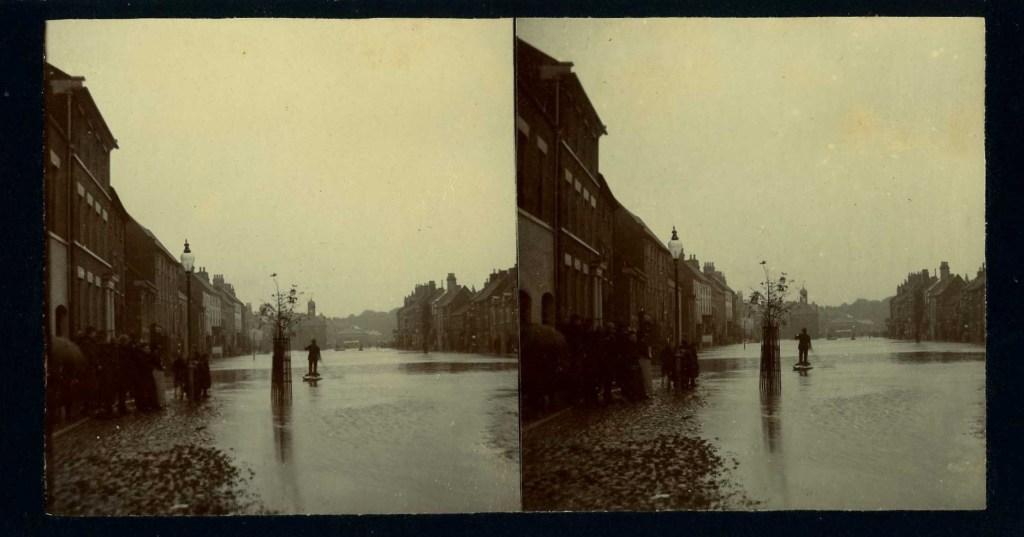

This illustrated how James shot sequences in 3D, a skill that would come in useful when he began supplying photographs to illustrated newspapers in Fleet Street.
It was also evident in the two stereos that I wrote about in “The Great Gale” featuring the effects of a storm in Scotland in October 1898 that created headline news.
Another formative influence was James’s job as a chemist’s assistant with Strickland & Holt in Yarm where he lived in the first half of the 1890s.
Back in 2018, Stephanie Richardson, whose family co-founded the business nearly 170 years ago, shared with me several examples of James’s stereo views.
As a result, I was able to recognise the “J.E. Ellam, Yarm” stamp which features on the verso on the first half-a-dozen or so cards I blogged about.
Stephanie also showed me a stereo illustrating an outdoor portrait studio used by Strickland & Holt customers in the 1890s.
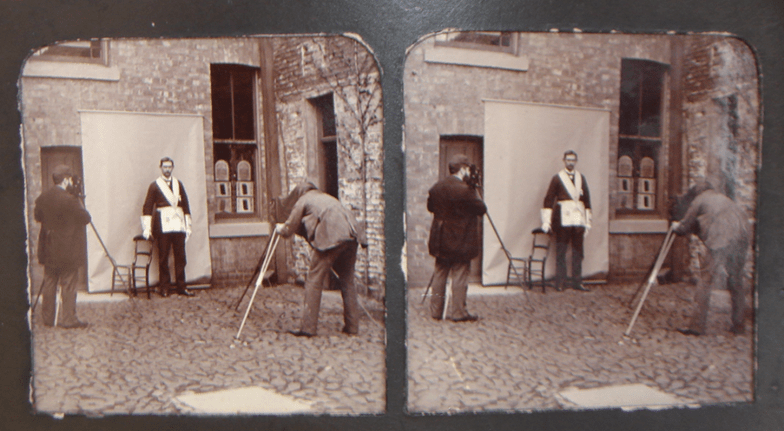
What I know realise is that the bearded man on the left (above) bears a resemblance to Henry Bradley (below), with whose family James lodged during his years in Yarm and later in Dunmow, Essex.
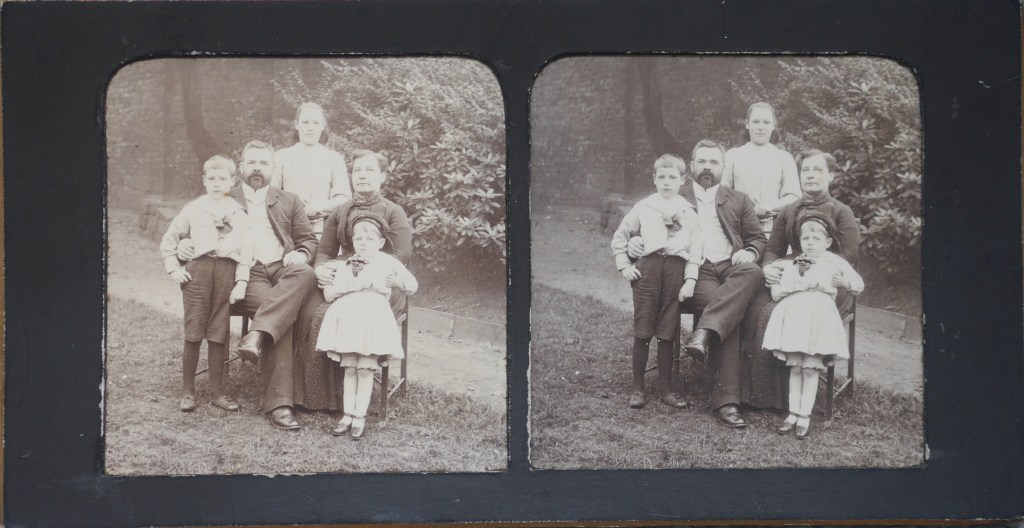
Henry was also active in the Stockton Photographic Society as a committee member and later as a vice-president.
The 3D portrait of the Bradley family that featured in the cache of 30 was another breakthrough moment in my research project.
Looking at census records, I was able to put names to faces in the stereo, notably Henry, who I had previously seen featured in a promotional postcard for his outfitters business, his wife Dorothy, and some of their children.
Viewing the stereo, I wondered if the youngest of the girls featured was their daughter Marguerita?
I knew that in the 1911 England Census, Henry recorded the “personal occupation” of Marguerita Annie Bradley, or “Mab” as she was known throughout her life, as a “Retoucher” working “at home.”
By that point in his professional life, James was working for London News Agency Photos at 46 Fleet Street.
Though he lived in London during the week, he returned to Dunmow at weekends and stayed with the Bradley family.
Could it be that in 1911, Miss “Mab” Bradley, then aged 22, was earning a living by retouching photographic negatives, including James’s, to improve their quality?
Further research into Mab’s photographic career has confirmed that she too was an accomplished photographer.
The 1921 Census records her living in Dunmow with her parents and sisters Clare and Feodora, but more importantly, her “personal occupation” is recorded as “photographer.”
For example, she is credited with photographs that feature in local history publications including Dunmow and Its Charters (1923) and A Short History of Great Dunmow Church (1926).

Both publications feature in the British Library and both post-date James’s death in an accident involving an omnibus in Fleet Street in 1920, so it appears that Mab’s photography continued to flourish.
One last thought occurs to me.
Perhaps the cache of 30 stereos that have formed the basis of this blogpost-a-day series once belonged to Miss Mab Bradley (1889-1979).
The donation of the 30 stereos to a charity in Essex before reaching a well-known auction website would indicate that this thought is worth further investigation.
 Pressphotoman
Leave a comment