
The subjects stereographed by James Edward Ellam (1857-1920) during the 1890s and featured in this series of daily blogposts have been wide-ranging.
As examples of his craft, many pre-date his professional working relationship with the 3D photography giants Underwood & Underwood.
But they well illustrate the commercial possibilities offered by stereography for consumption by late-19th and early-20th century audiences.
For example, a few years ago, I saw an Underwood & Underwood boxed set for sale titled “Birds Nests Through the Stereoscope” copyrighted and dated to 1899.
Today and tomorrow, birdlife as seen through James’s 3D camera seen at close quarters takes centre-stage.
First up is a study of “The Wheatear” as it is described on the verso of the card in pencil in James’s hand.

A small ground-dwelling robin-sized bird, it is billed as “one of the world’s great migrants” (RSPB Pocket Guide to British Birds by Simon Harrap 2012).
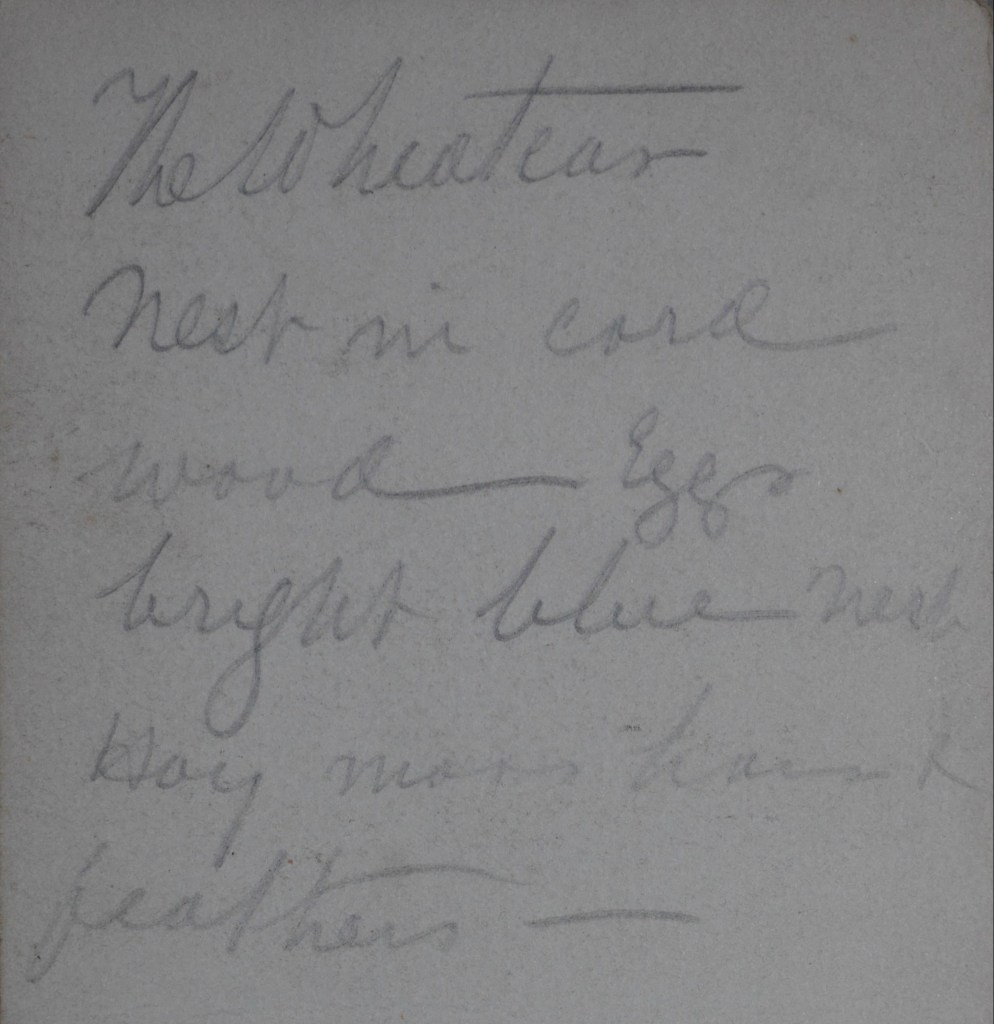
The description on the card verso also includes details about the location of the Wheatear’s nest (“? wood”), the colour of its eggs (“bright blue”) and the nest materials used (“hay mixed with feathers”).
Looking at examples of male and female Wheatears, the bird featured here most closely resembles the markings of a female.
Through the stereoscope, the scene comes to life in 3D and the viewer appears to be almost within touching distance of its subject.
However, to my eyes, the bird’s legs are hard to discern, making it appear suspended in mid-air as if stuffed or separately edited into the shot.
Whether James was a keen bird-watcher, or this stereo was a technical challenge that he set himself, the result is slightly unnerving.
Tomorrow: “A Blue Tit Robbing the Pears.”
 Pressphotoman
Leave a comment