
This blogpost-a-day series about a cache of stereos attributable to James Edward Ellam (1857-1920) has so far revealed a wide range of subjects from cathedrals and castles to floods and snow.
But today’s stereo marks a change and is an example of the sort of comic or sentimental 3D cards that were hugely popular with late-Victorian and Edwardian audiences.

Titled “Darby & Joan,” two children dressed in Scottish-themed tartan outfits appear as the hero and heroine of the mid-18th century ballad by Henry Woodfall.
The term “Darby & Joan” has come to signify a loving, virtuous married couple, so the use of young children to convey its theme adds a twist that was presumably intended to increase its commercial appeal.
Looking at the faded title written in ink, it strongly resembles James’s handwriting indicating, as with other stereos from posts this week, that he may have been the stereographer responsible.
As we learned yesterday, James lodged with fellow photography enthusiast Henry Bradley, his wife Dorothy and their five children in Yarm, Yorkshire and then when they moved to Dunmow, Essex in 1896 (“The Bradley Family” – 21st September 2023).
Given this domestic arrangement, it is possible that two of the younger Bradleys posed as models for this 3D portrait.
As evidence for this, it’s noticeable that a particular style of shoe with an ankle strapping is present in both the Bradley family portrait and “Darby & Joan.”
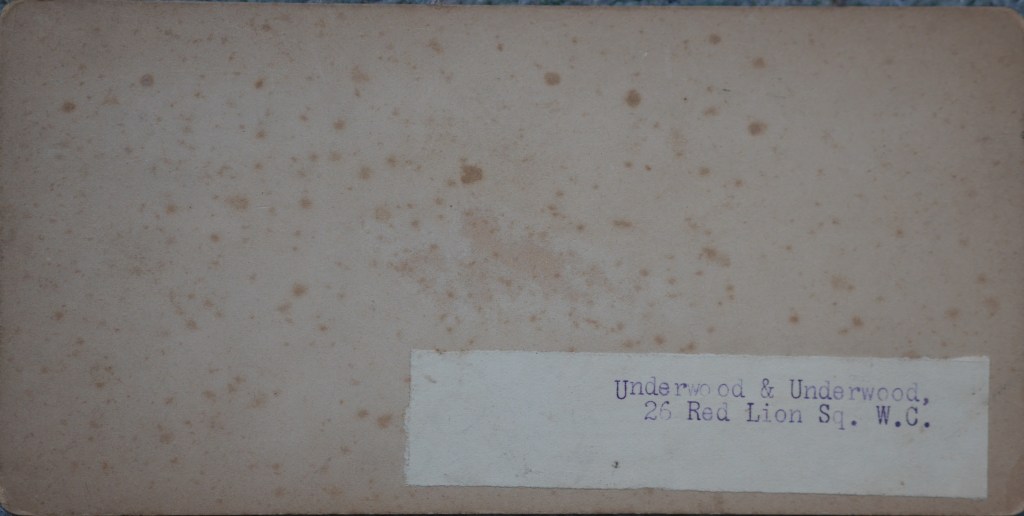
Further evidence of James’s embryonic relationship with the stereoscopic photography company Underwood & Underwood (U&U) is revealed by the verso.
It boasts a typed sticker featuring the Underwood company’s London address from the mid-1890s of 26 Red Lion Square.
Here, a little company history is helpful.
U&U began life in Ottawa, Kansas in the early 1880s, but as the company expanded beyond America, an office was opened in Liverpool in 1890 to handle its transatlantic trade.
By the mid-1890s, 26 Red Lion Square in London was the hub of its UK operation as the company developed new markets for its 3D products in Europe and beyond.
Whether James submitted “Darby & Joan” for publication by U&U, the card’s verso indicates a connection with the company at some point in its life.
James’s relationship with the Underwood company was certainly up and running by June 1897 when U&U published his views of the Thanksgiving Service for Queen Victoria’s Diamond Jubilee.
And with London’s Fleet Street demanding photos to illustrate its news stories, James was well placed to help service that demand.
Tomorrow: “The Great Gale.”
 Pressphotoman
Leave a comment