
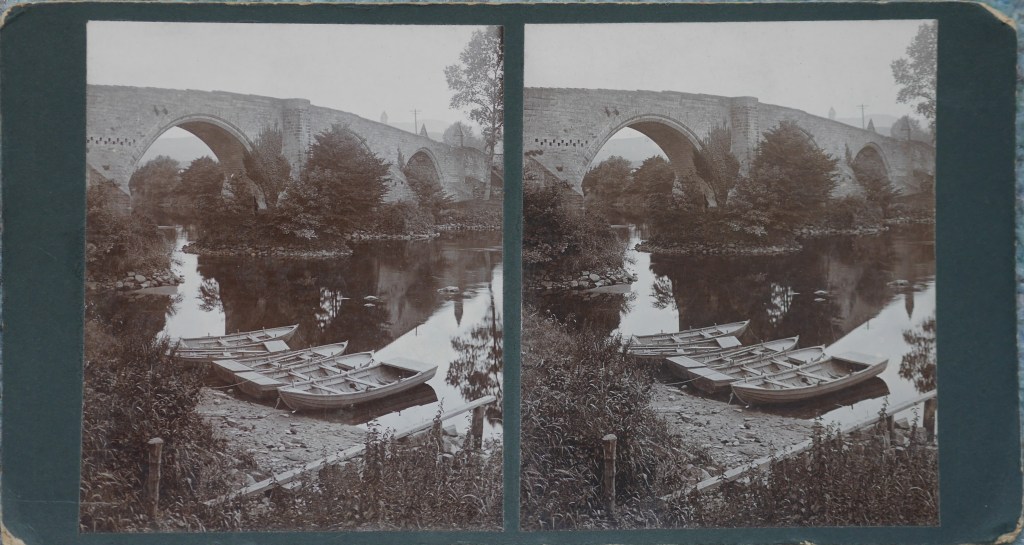
Our recent brief Scottish tour featuring stereos by James Edward Ellam (1857-1920) concludes with Stirling Old Bridge.
Made of stone, the 80-metre long structure with its four semi-circular arches was the main crossing point of the River Forth until the early 1800s.
Today it is in the care of Historic Environment Scotland.
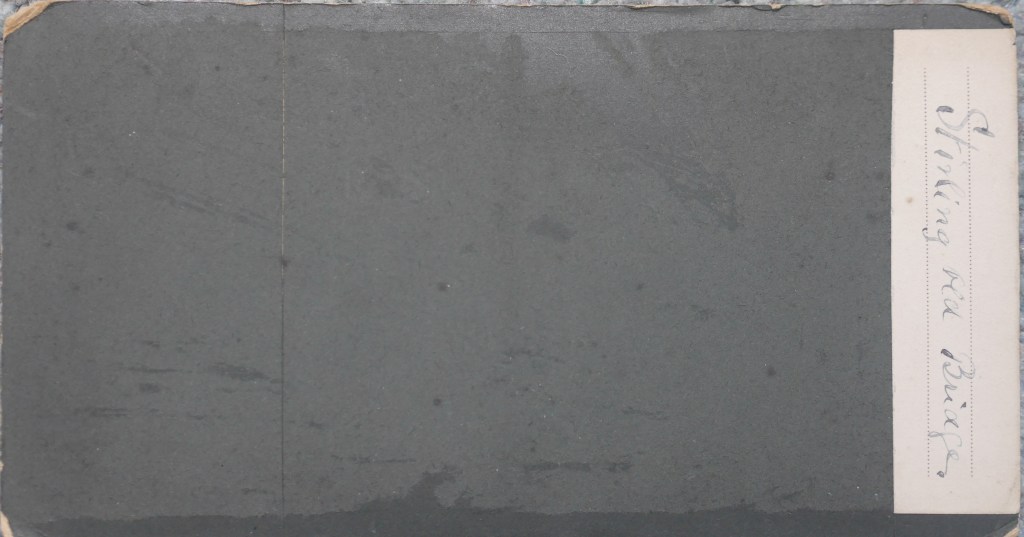
In the absence of a “J.E. Ellam” credit or any of the bordered stickers seen in previous stereos by him, we are left with a sample of his distinctive handwriting to verify its provenance.
As to the composition of the stereo, it is almost painterly with the use of reflections, adding to the sense of stillness created.
By placing the rowing boats in the immediate foreground along with the wooden fence post and row of nettles, the viewer’s eye is led slowly towards the bridge itself in a classic example of stereo composition.
The worn away edges of the card suggest it was a much-used and perhaps much-appreciated example of his 3D craft.
As we will see in tomorrow’s post, around this time, James Edward Ellam’s 3D photography came to the attention of the American stereoscopic photography company Underwood & Underwood, who opened an office in London in the mid-1890s.
Tomorrow: “Fountains Abbey.”
 Pressphotoman
Leave a comment